MCAT-TEST Exam Details
-
Exam Code
:MCAT-TEST -
Exam Name
:Medical College Admission Test: Verbal Reasoning, Biological Sciences, Physical Sciences, Writing Sample -
Certification
:Medical Tests Certifications -
Vendor
:Medical Tests -
Total Questions
:812 Q&As -
Last Updated
:Jul 16, 2026
Medical Tests MCAT-TEST Online Questions & Answers
-
Question 431:
Family violence, such as domestic violence, child abuse, and elder abuse, are serious and pervasive problems in the United States. On an annual basis, the National Crime Survey has found domestic violence results in 21000 hospitalizations, 99800 days of hospitalization, 28700 emergency department visits, and 39900 visits to physicians.
Currently there is little consensus about the definitions of intimate violence. Even the terms employed are varied; for example, domestic violence, conjugal violence, intimate abuse, and partner abuse. Similarly, there are a range of causal explanations, and these are contingent upon the theoretical perspective employed. There is also controversy whether the term "violence," "abuse," or "aggression" should be used. Finally, within the terms adopted, there is no consensus about the victim-perpetrator relationship. For example, do the terms refer to a married co-habiting couple? Two heterosexual individuals who do not reside together but are dating? All this has implications for research, practice, and policy.
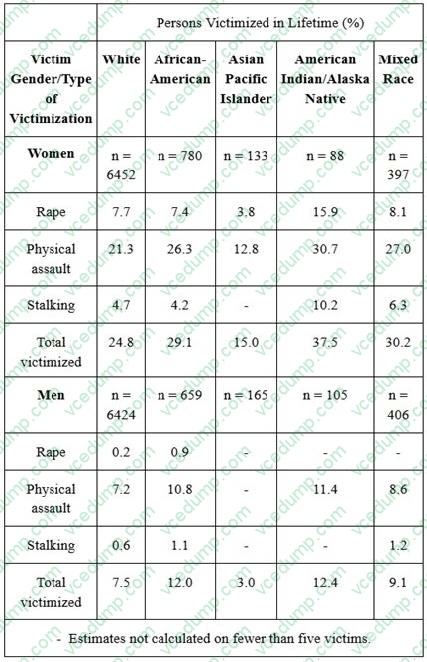
The National Violence Against Women Survey was one of the largest studies sponsored by the National Institute of Justice and the Centers for Disease Control and Prevention. It systematically analyzed crime against women in the United States. A total of 8000 men and 8000 women in the United States were interviewed on the phone using a closed-ended survey. Table 1 displays the breakdown of figures when examining life time victimization by racial groups.
Table 1 Percentage of people victimized by an intimate partner in lifetime, by victim gender, type of victimization, and victim race Source: Adapted from P Tjaden and N. Thoennes, "Consequences of Intimate Partner Violence: Findings from the National Violence Against Women Survey."
How would a scholar utilizing social control theory explain domestic violence?
A. Domestic violence is modeled and learned.
B. Domestic violence is triggered by the lack of regulations and cohesive networks in society.
C. Labelling as deviant the reactions of both the perpetuator and the victim of intimate violence reinforces such behaviors.
D. Domestic violence is caused by an interaction of factors from the micro, meso, and macro-levels causing a feedback loop that then results in a loss of systems control. -
Question 432:
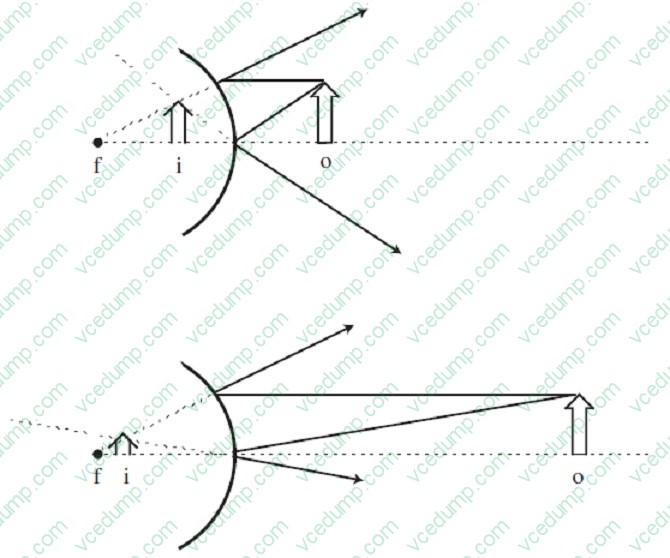
Aclown stands with her toes touching a fun house mirror with a convex bottom and a concave top. Which of the following best describes the distortion of the clown's image as she walks away from the mirror?
A. Her head will shrink; her feet will grow, then shrink.
B. Her head will shrink then grow; her feet will shrink, then grow.
C. Her head will grow; her feet will grow.
D. Her head will grow, then shrink; her feet will shrink. -
Question 433:
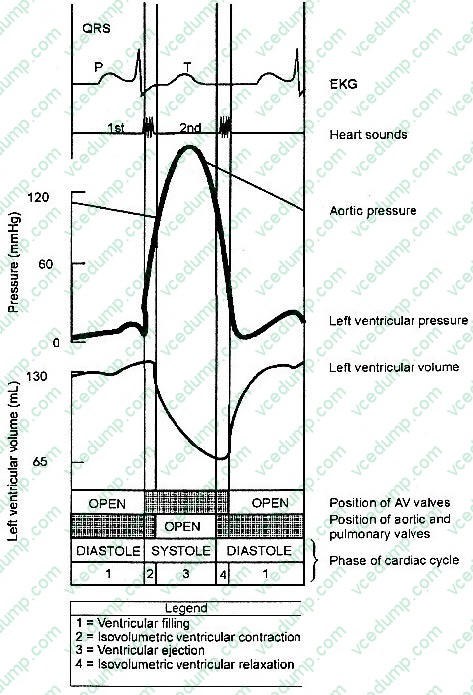
The process of depolarization triggers the cardiac cycle. The electronics of the cycle can be monitored by an electrocardiogram (EKG). The cycle is divided into two major phases, both named for events in the ventricle: the period of ventricular contraction and blood ejection, systole, followed by the period of ventricular relaxation and blood filling, diastole.
During the very first part of systole, the ventricles are contracting but all valves in the heart are closed thus no blood can be ejected. Once the rising pressure in the ventricles becomes great enough to open the aortic and pulmonary valves, the ventricular ejection or systole occurs. Blood is forced into the aorta and pulmonary trunk as the contracting ventricular muscle fibers shorten. The volume of blood ejected from a ventricle during systole is termed stroke volume.
During the very first part of diastole, the ventricles begin to relax, and the aortic and pulmonary valves close. No blood is entering or leaving the ventricles since once again all the valves are closed. Once ventricular pressure falls below atrial pressure, the atrioventricular (AV) valves open. Atrial contraction occurs towards the end of diastole, after most of the ventricular filling has taken place. The ventricle receives blood throughout most of diastole, not just when the atrium contracts.
Figure 1: Electronic and pressure changes in the heart and aorta during the cardiac cycle.
The wall of the left ventricle is at least three times as thick as that of the right ventricle. This feature aids circulation by assuring that:
A. blood entering the pulmonary artery is at a much higher pressure than blood entering the aorta.
B. blood entering the aorta is at a much higher pressure than blood entering the pulmonary artery.
C. the left ventricle has a higher blood capacity than the right ventricle at all times.
D. the right ventricle has a higher blood capacity than the left ventricle at all times. -
Question 434:
Compounds containing a hydroxyl group attached to a benzene ring are called phenols. Derivatives of phenols, such as naphthols and phenanthrols, have chemical properties similar to those of phenols, as do most of the many naturally-occurring substituted phenols. Like other alcohols, phenols have higher boiling points than hydrocarbons of similar molecular weight. Like carboxylic acids, phenols are more acidic than their alcohol counterparts. Phenols undergo a number of different reactions; both their hydroxyl groups and their benzene rings are highly reactive. A number of chemical tests can be used to distinguish phenols from alcohols and carboxylic acids.
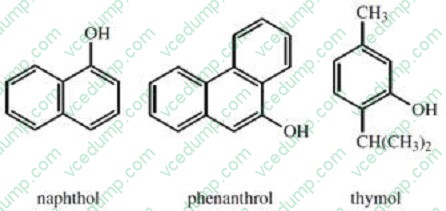
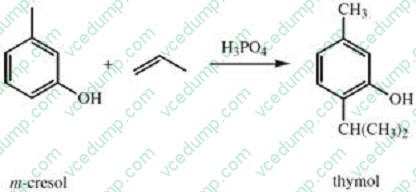
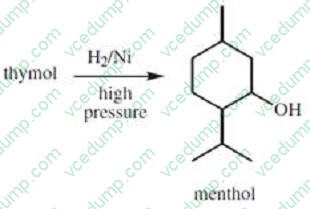
Thymol, a naturally occurring phenol, is an effective disinfectant that is obtained from thyme oil. Thymol can also be synthesized from m-cresol, as shown in Reaction A below. Thymol can then be converted to menthol, another naturally-occurring organic compound; this conversion is shown in Reaction B.
Reaction A
Reaction B
What simple chemical test could be used to distinguish between the following two compounds?
A. Option A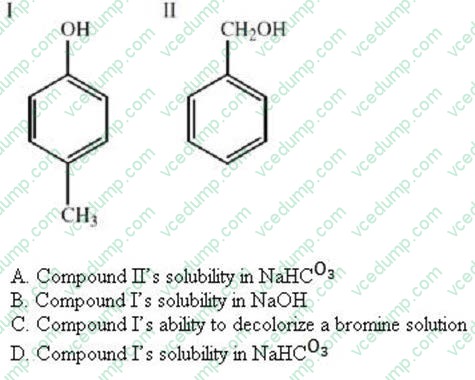
B. Option B
C. Option C
D. Option D -
Question 435:
A student was given a sample of an unknown liquid and asked to determine as much as possible about its structure. He was told that the compound contained only carbon, hydrogen, and oxygen, and had only one type of functional group. The student found its boiling point to be 206. Using mass spectroscopy, he determined its molecular weight to be 138 g/mol. Finally, he took the infrared spectrum of the compound, which is shown below.
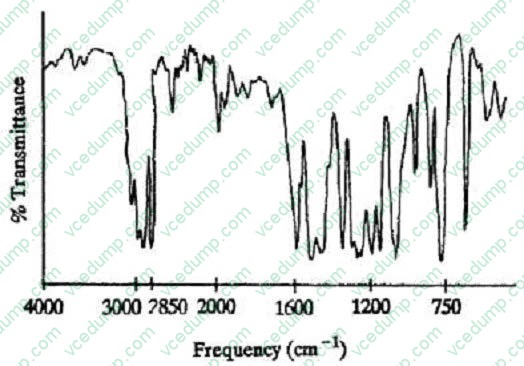
From this spectrum, the student quickly reached a conclusion about the functional group. He then turned his attention to the fingerprint region of the compound, which generally has a complicated pattern of peaks that are determined by the structure of the hydrocarbon portion of a molecule. The student decided that the large peak at 750 cm-1 must indicate that this was a disubstituted aromatic compound.
The student decides to carry out some simple tests on the compound in order to confirm his identification. Which of the following statements is NOT true?
A. He could distinguish between a phenol and a benzoic acid by seeing if the unknown can be extracted with a weak base.
B. He could distinguish between a benzyl aldehyde and a benzyl ketone by seeing if the unknown will react with cold KMn.
C. He could distinguish between a benzyl alcohol and a phenol by attempting to dissolve the unknown in an aqueous solution of HCl.
D. He could distinguish between a benzyl alcohol and a benzoic ester by attempting to dissolve the unknown in an aqueous solution of NaOH. -
Question 436:
Musical instruments generate vibrations in the air that are perceived as musical tones. In many kinds of drums, these vibrations are created by a standing waves in a vibrating membrane. In a timpani drum, membrane vibration is coupled to the vibration of an enclosed volume of air. There may also be a second membrane whose vibration is coupled to that of the first by the enclosed air space, as in a snare drum. An idealized circular membrane will vibrate at normal mode frequencies given by Equation 1 where T is the membrane tension, r is the membrane radius, is the mass per unit area of the membrane, and frel is the relative frequency shown under each mode in Figure 1. The pitch of drums can be tuned by adjusting the membrane tension.
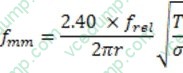
Equation 1
The modes are designated by two numbers, m and n. m indicates the number of diameter nodes, and n indicates the number of circular nodes. Several modes of vibration are shown in Figure 1.
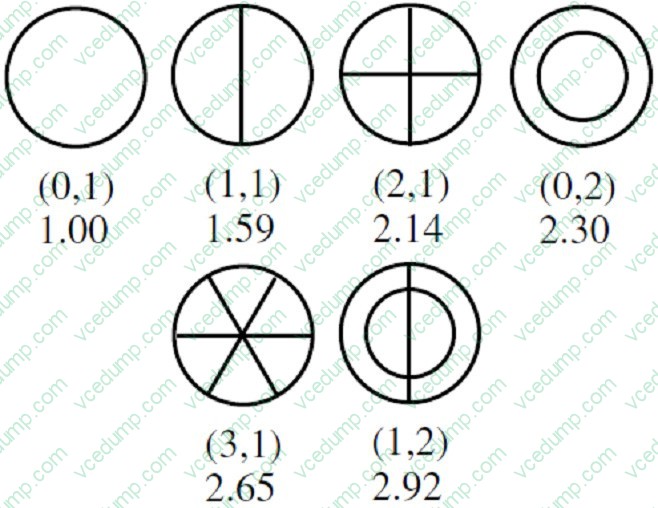
Figure 1
The sound waves generated by a drum are:
A. longitudinal waves because the displacement is perpendicular to the direction of propagation.
B. longitudinal waves because the displacement is parallel to the direction of propagation.
C. transverse waves because the displacement is perpendicular to the direction of propagation.
D. transverse waves because the displacement is parallel to the direction of propagation. -
Question 437:
An enzyme catalyst is kept in a solution buffered to the pH that maximizes activity for those enzymes found in the blood. The enzyme catalyzes a reaction that produces an acid whose pKa is 4.5. In this buffer solution, the acid product will be:
A. primarily deprotonated.
B. primarily protonated.
C. protonated and deprotonated in roughly equal amounts.
D. not formed. -
Question 438:
The process of depolarization triggers the cardiac cycle. The electronics of the cycle can be monitored by an electrocardiogram (EKG). The cycle is divided into two major phases, both named for events in the ventricle: the period of ventricular contraction and blood ejection, systole, followed by the period of ventricular relaxation and blood filling, diastole.
During the very first part of systole, the ventricles are contracting but all valves in the heart are closed thus no blood can be ejected. Once the rising pressure in the ventricles becomes great enough to open the aortic and pulmonary valves, the ventricular ejection or systole occurs. Blood is forced into the aorta and pulmonary trunk as the contracting ventricular muscle fibers shorten. The volume of blood ejected from a ventricle during systole is termed stroke volume.
During the very first part of diastole, the ventricles begin to relax, and the aortic and pulmonary valves close. No blood is entering or leaving the ventricles since once again all the valves are closed. Once ventricular pressure falls below atrial pressure, the atrioventricular (AV) valves open. Atrial contraction occurs towards the end of diastole, after most of the ventricular filling has taken place. The ventricle receives blood throughout most of diastole, not just when the atrium contracts.
Figure 1: Electronic and pressure changes in the heart and aorta during the cardiac cycle.
The graph below shows the effects on stroke volume of stimulating the sympathetic nerves to the heart.
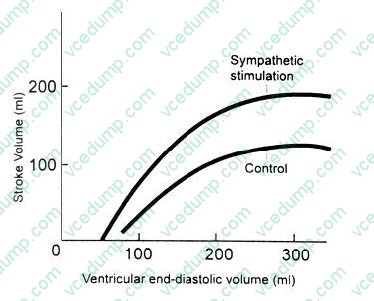
According to the graph, the net result of sympathetic stimulation on stroke volume is to:
A. approximately double stroke volume at any given end diastolic volume.
B. decrease stroke volume at any given end diastolic volume.
C. increase stroke volume at any given end diastolic volume.
D. leave stroke volume relatively unchanged. -
Question 439:
In 1972, Georges Ungar reported the discovery of a peptide that appeared to transfer learning. Ungar's claim was based on experiments in which rats placed in a chamber with specially designed dark and light regions were trained to avoid
the dark regions of the chamber. Following their training, the rats were killed and brain extracts were prepared. These brain extracts were injected into naive rats which were then observed to acquire the fear of darkness without training. Two
hypotheses were proposed to explain these remarkable results:
Hypothesis 1
Ungar concluded that the extracts contained some chemical that transmitted the learned fear of darkness to the naive rats. A fifteen amino-acid polypeptide was isolated from the brain extracts and sequenced. Ungar claimed that this peptide,
called scotophobin, was a chemical transmitter of learning. The peptide had the primary structure shown below:
C-ser-asp-asn-arg-gln-gln-gly-lys-ser-ala-arg-gln-glygly-tyr-N Scotophobin
Hypothesis 2
Other researchers, who tested scotophobin but could not reproduce Ungar's results, argued that scotophobin did not transfer the learned fear of darkness. Instead, they suggested that scotophobin, which is structurally similar to ACTH and
vasopressin, acted to increase stress in the rats. Since stress increases sympathetic nervous activity, rats injected with scotophobin would become hyperactive and tend to spend less time in the dark regions of the experimental chamber.
They argued that such stress responses in the rats could be misinterpreted as a fear of darkness. Ungar's claim was further weakened by chemical analysis in which both the scotophobin extracts which Ungar had injected into the naive rats
and a sample of synthesized scotophobin peptide were subjected to SDS polyacrylamide gel electrophoresis, as shown in Figure 1.
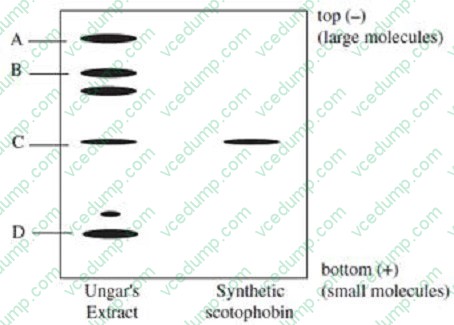
Figure 1
Researchers were interested in purifying a second protein (protein X) from Ungar's extract. The gene segment encoding protein X was believed to consist of thirty nucleotides. According to Figure 1, which band could represent protein X?
A. Band A
B. Band B
C. Band C
D. Band D -
Question 440:
A student was given a sample of an unknown liquid and asked to determine as much as possible about its structure. He was told that the compound contained only carbon, hydrogen, and oxygen, and had only one type of functional group. The student found its boiling point to be 206. Using mass spectroscopy, he determined its molecular weight to be 138 g/mol. Finally, he took the infrared spectrum of the compound, which is shown below.
From this spectrum, the student quickly reached a conclusion about the functional group. He then turned his attention to the fingerprint region of the compound, which generally has a complicated pattern of peaks that are determined by the structure of the hydrocarbon portion of a molecule. The student decided that the large peak at 750 cm-1 must indicate that this was a disubstituted aromatic compound.
The overlapping set of peaks near 3000 cm-1 includes one peak at 2850 cm-1. What type of functional group could this indicate?
A. Methyl
B. Phenol
C. Carboxyl
D. Aldehyde carbonyl
Related Exams:
Tips on How to Prepare for the Exams
Nowadays, the certification exams become more and more important and required by more and more enterprises when applying for a job. But how to prepare for the exam effectively? How to prepare for the exam in a short time with less efforts? How to get a ideal result and how to find the most reliable resources? Here on Vcedump.com, you will find all the answers. Vcedump.com provide not only Medical Tests exam questions, answers and explanations but also complete assistance on your exam preparation and certification application. If you are confused on your MCAT-TEST exam preparations and Medical Tests certification application, do not hesitate to visit our Vcedump.com to find your solutions here.