MCAT-TEST Exam Details
-
Exam Code
:MCAT-TEST -
Exam Name
:Medical College Admission Test: Verbal Reasoning, Biological Sciences, Physical Sciences, Writing Sample -
Certification
:Medical Tests Certifications -
Vendor
:Medical Tests -
Total Questions
:812 Q&As -
Last Updated
:Jul 16, 2026
Medical Tests MCAT-TEST Online Questions & Answers
-
Question 401:
Muzak, the intentionally unobtrusive music that most people associate with elevators and dentists' waiting rooms, represents the paradoxical success story of a product designed to be ignored. Although few people admit to enjoying its blandly melodic sounds, Muzak reaches over 100 million listeners in 14 countries and has played in the White House, the Apollo lunar spacecraft, and countless supermarkets, offices, and factories. This odd combination of criticism and widespread acceptance is not surprising, however, when one considers that Muzak is not created for the enjoyment of its listeners: rather, its purpose is to modify physiological and psychological aspects of an environment.
In the workplace, Muzak is credited with increasing both productivity and profitability. Research into the relationship between music and productivity can be traced to the earliest days of the Muzak Corporation. Developed by a military officer in 1922 as a way of transmitting music through electrical wires, Muzak blossomed in the 1930's following a study which reported that people work harder when they listen to certain kinds of music. Impressed by these findings, the BBC began to broadcast music in English munitions factories during World War II in an effort to combat fatigue. When workers assembling weapons increased their output by 6 percent, the U.S. War Production Board contracted the Muzak Corporation to provide uplifting music to American factories. Today, the corporation broadcasts its "Environmental Music" to countless businesses and institutions throughout the world. And while most people claim to dislike Muzak's discreet cadences, it seems to positively influence both productivity and job satisfaction.
Researchers speculate that listening to Muzak and other soft music improves morale and reduces stress by modifying our physiology. Physiological changes such as lowered heart rate and decreased blood pressure have been documented in hospital studies testing the effect of calming music on cardiac patients. In addition, certain kinds of music seem to effect one's sense of emotional, as well as physical, well being. It is just this sort of satisfaction which is thought to result in increased performance in the workplace. In a study of people performing repetitive clerical tasks, those who listened to music performed more accurately and quickly than those who worked in silence; those who listened to Muzak did better still. Moreover, while Muzak was conceived as a tool for productivity, it also seems to influence a business' profitability. In an experiment in which supermarket shoppers shopped to the mellow sounds of Muzak, sales were increased by as much as 12 percent. What makes Muzak unique is a formula by which familiar tunes are modified and programmed. Careful instrumentation adds to an overall sound that is neither monotonous nor rousing. But it is the precisely timed programming that separates Muzak from other "easy listening" formats. At the core of the programming is the concept of the "Stimulus Progression". Muzak programs are divided into quarter-hour groupings of songs, and are specifically planned for the time of day at which they will be heard. Each composition is assigned a mood rating between 1 and 6 called a stimulus value; a song with a rating of 2, for example, is slower and less invigorating than one with a value of 5. Approximately six compositions with ascending stimulus values play during any given quarter hour; each 15-minute segment ends in silence. Each segment of a 24-hour program is carefully planned. Segments that are considered more stimulating air at 11 a.m. and 3 p.m. (the times when workers typically tire), while more soothing segments play just after lunchtime and towards the end of the day, when workers are likely to be restless.
From the point of view of management, then, Muzak is a useful tool in the effort to maximize both productivity and profits. However, some people object to its presence, labeling it as a type of unregulated air pollution. Still others see it as an Orwellian nightmare, a manipulation of the subconscious. But Muzak's effectiveness seems to lie in the fact that most people never really listen to it. While it may be true that no one actually likes this carefully crafted aural atmosphere, many simply ignore it, allowing its forgettable sounds to soften the contours of the day.
It can be inferred from the passage that some critics of Muzak believe that Muzak:
A. is not significantly different from other "easy listening" programs.
B. subtly manipulates the subconscious mind.
C. is actually distracting to many workers.
D. caters to the whims of supermarket consumers. -
Question 402:
Electromagnetic radiation from space constantly bombards the earth. Most wavelengths are absorbed by the atmosphere; however, there are two "windows" of nonabsorption through which significant amounts of radiation reach the ground. The first transmits ultraviolet and visible light, as well as infrared light or heat; the second transmits radio waves. As a result, terrestrial organisms have evolved a number of pigments that interact with light in various ways: some capture light energy, some provide protection from light- induced damage, and some serve camouflage or signaling purposes.
Among these compounds are many conjugated polyenes, which play important roles as photoreceptors. For every chemical compound, there are certain wavelengths of light whose quanta possess exactly the correct amount of energy to raise electrons from their ground state to higher-energy orbitals. For most organic compounds, these wavelengths are in the UV range. However, conjugated double bond systems stabilize the electrons, so that they can be excited by lower-frequency photons with wavelengths in the visible spectrum. Such a pigment, known as a chromophore, will then transmit the "subtraction color," a color complementary to the one absorbed. For instance, carotene, a hydrocarbon compound with eleven conjugated double bonds, absorbs blue light and transmits orange. The wavelength that is absorbed generally increases with the number of conjugated bonds; rings and side-chains also affect wavelength.
Wavelength Color Subtraction Color 480 nm blue orange 580 nm yellow violet 680 nm red green
Among the many biological molecules that are affected by light is DNA, the genetic material of living organisms. DNA absorbs ultraviolet light, and may be damaged by UVC (< 280 nm) and UVB (280-315 nm). UVA (315-400 nm) and visible light can actually repair light-induced damage to DNA by a process called photorepair. For this reason, UVA, which also stimulates tanning, was once considered beneficial. However, there is now increasing evidence that UVA can damage skin.
Which of the following compounds would be most likely to produce color?
A. Option A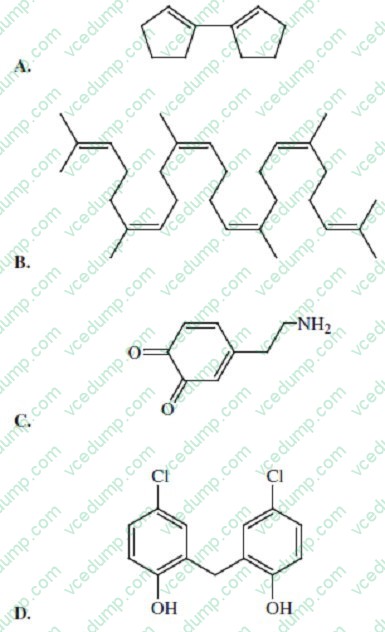
B. Option B
C. Option C
D. Option D -
Question 403:
If (sin[0] + cos[180]) = x - 2(sin[90]) and all angles are in degrees, what is x?
B. -1
C. -2
D. 1 -
Question 404:
Detergents are:
A. natural products.
B. synthetic products.
C. Both A and B.
D. None of above. -
Question 405:
X-rays are produced by a device which beams electrons with an energy between 103 and 106 eV at a metal plate. The electrons interact with the metal plate and are stopped by it. Much of the energy of the incoming electrons is released in the form of X-rays, which are high-energy photons of electromagnetic radiation. An example of such a device is shown below. Electrons are accelerated from the cathode towards the anode by an electric field.
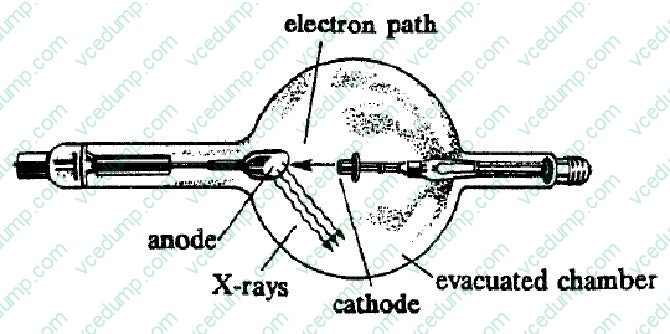
There are two mechanisms by which the X-rays are produced within the metal. The first mechanism is called bremsstrahlung, which is German for "breaking radiation." X-rays are emitted by the electrons as they are brought to rest by
interactions with the positive nuclei of the anode.
The second mechanism occurs when an incoming electron knocks an inner electron out of one of the metal atoms of the anode. This electron is replaced by an electron from a higher energy level of the atom, and a photon making up the
energy difference is emitted.
X-rays are absorbed by a material when they pass through it. The amount of X-rays absorbed increases with the density of the material. In addition, lower energy X-rays are more likely to be absorbed than higher energy X-rays. (Note: 1 eV =
1.6 x 10¹⁹ J; Planck's constant h = 4.1 x 10⁻¹⁵ eV•s; speed of light c = 3 x 10⁸ m/s.)
An electron is accelerated through a distance of 0.1 m by a potential difference of 10,000 volts. What is the electron's energy as it strikes the anode?
A. 100 eV
B. 1,000 eV
C. 10,000 eV
D. 1 J -
Question 406:
A hovercraft is a versatile vehicle capable of traveling over land, water, or any other essentially flat surface. The hovercraft consists of a body or hull onto which a rotor (lift fan) is mounted. The lift fan provides the vertical lift by propelling air into an area beneath the hovercraft called the skirt. The pocket of air in the skirt supports the moving hovercraft and reduces the friction between the vehicle and the ground to almost zero. As such, there is no contact between the hovercraft and the ground.
A second fan, which generates a horizontal thrust, propels the hovercraft forward. Rudders which direct the airflow from this second fan are used by the pilot to control the movement of the hovercraft. The horizontal movement of the

hovercraft is opposed by air resistance which generates aerodynamic drag.
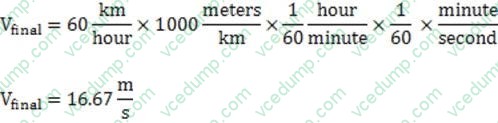
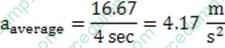
A 600 kg hovercraft traveling across a frozen lake accelerates from rest to a speed of 60 kilometers per hour in 4 seconds. What is the average force produced by the thrust fan?
A. 4.2 N
B. 145 N
C. 2500 N
D. 9000 N -
Question 407:
Historically, two different methods have been used to estimate the fluid pressure in capillary beds.
Method 1 A glass pipette is inserted into the capillary. The level of blood rising in the pipette is measured and used to calculate the pressure. Alternatively, an inert fluid of density can be placed in the pipette and its height h can be measured. The pressure in the capillary is given by gh, where g is the acceleration due to gravity.
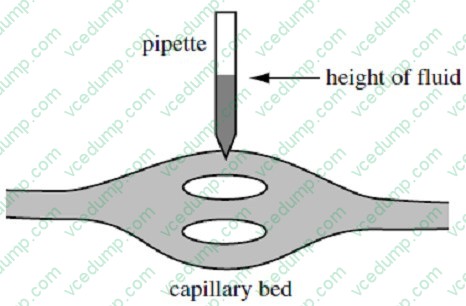
Figure 1 Method 2 The pressure can be measured indirectly in the following way. A section of gut tissue is removed from a specimen and placed on a beam balance. Blood is circulated through the tissue by a pump. The arterial pressure is then decreased. This leads to a decrease in the capillary hydrostatic pressure in the gut capillaries. The constant osmotic pressure of plasma proteins in the capillary causes absorption of fluid from the gut section which will decrease its weight. To prevent a change in the weight of the gut section, the venous pressure is increased. This tends to increase the capillary pressure, reducing the flow of fluid from the gut tissue into the capillaries. The capillary pressure is thus held constant (and the balance kept level) as the arterial pressure is decreased and the venous pressure increased. The arterial and venous pressures meet at the capillary pressure being measured.
( = MRT, where is the osmotic pressure, M the molarity of the solutes, R the universal gas constant, and T the temperature in Kelvin.)
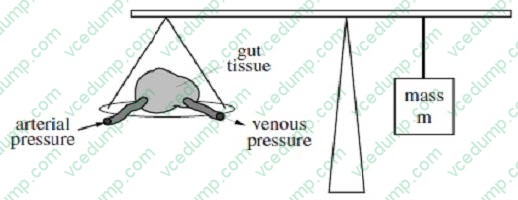
Figure 2
An arteriole is almost completely blocked by a blood clot as shown below. At which point will the velocity of blood flow be the greatest? (Assume ideal laminar flow throughout.)
A. A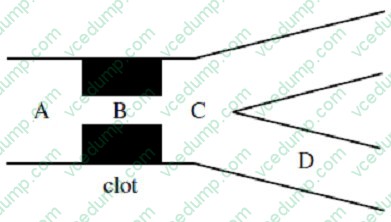
B. B
C. C
D. D -
Question 408:
A given volume of a diprotic acid is completely neutralized by twice that volume of a 0.3 N NaOH solution. What is the molarity of the acid?
A. 0.15 M
B. 0.30 M
C. 0.60 M
D. 1.20 M -
Question 409:
Hemoglobin (Hb) and myoglobin (Mb) are the O2-carrying proteins in vertebrates. Hb, which is contained within red blood cells, serves as the O2 carrier in blood and also plays a vital role in the transport of CO2 and H+. Vertebrate Hb consists of four polypeptides (subunits) each with a heme group. The four chains are held together by noncovalent attractions. The affinity of Hb for O2 varies between species and within species depending on such factors as blood pH, stage of development, and body size. For example, small mammals give up O2 more readily than large mammals because small mammals have a higher metabolic rate and require more O2 per gram of tissue.
The binding of O2 to Hb is also dependent on the cooperativity of the Hb subunits. That is, binding at one heme facilitates the binding of O2 at the other hemes within the Hb molecule by altering the conformation of the entire molecule. This conformational change makes subsequent binding of O2 more energetically favorable. Conversely, the unloading of O2 at one heme facilitates the unloading of O2 at the others by a similar mechanism.
Figure 1 depicts the O2-dissociation curves of Hb (Curves A, B, and C) and myoglobin (Curve D), where saturation, Y, is the fractional occupancy of the O2-binding sites. The fraction of O2 that is transferred from Hb as the blood passes through the tissue capillaries is called the utilization coefficient. A normal value is approximately 0.25.
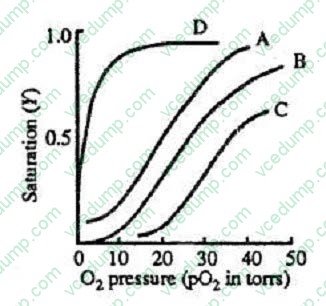
Figure 1
Myoglobin facilitates transport in muscle and serves as a reserve store of O2. Mb is a single polypeptide chain containing a heme group, with a molecular weight of 18 kd. As can be seen in Figure 1, Mb (Curve D) has a greater affinity for than Hb.
The utilization coefficient is continually being adjusted in response to physiological changes. Which of the following values most likely represents the utilization coefficient for human adult Hb during strenuous exercise?
A. 0.0
B. 0.125
C. 0.25
D. 0.75 -
Question 410:
Just as the ingestion of nutrients is mandatory for human life, so is the excretion of metabolic waste products. One of these nutrients, protein, is used for building muscle, nucleic acids, and countless compounds integral to homeostasis. However, the catabolism of the amino acids generated from protein digestion produces ammonia, which, if not further degraded, can become toxic. Similarly, if the same salts that provide energy and chemical balance to cells are in excess, fluid retention will occur, damaging the circulatory, cardiac, and pulmonary systems.
One of the most important homeostatic organs is the kidney, which closely regulates the excretion and reabsorption of many essential ions and molecules. One mechanism of renal function involves the secretion of antidiuretic hormone (ADH).
Diabetes insipidus (DI), is the condition that occurs when ADH is ineffective. As a result, the kidneys are unable to concentrate urine, leading to excessive water loss. There are two types of DI -- central and nephrogenic. Central DI occurs when there is a deficiency in the quantity or quality of ADH produced. Nephrogenic DI occurs when the kidney tubules are unresponsive to ADH. To differentiate between these two conditions, a patient's urine osmolarity is measured both prior to therapy and after a 24-hour restriction on fluid intake. Exogenous ADH is then administered and urine osmolarity is measured again. The table below gives the results of testing on four patients. Assume that a urine osmolarity of 285 mOsm/L of H2O is normal.
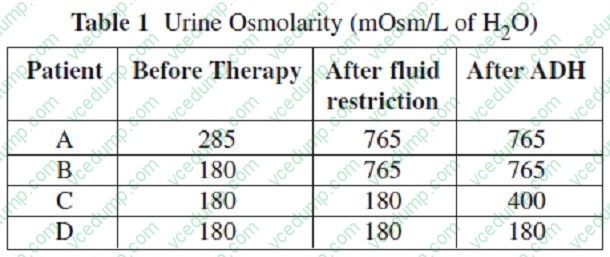
Based on the data in Table 1, which of the four patients most likely has nephrogenic diabetes insipidus?
A. Patient A
B. Patient B
C. Patient C
D. Patient D



Related Exams:
Tips on How to Prepare for the Exams
Nowadays, the certification exams become more and more important and required by more and more enterprises when applying for a job. But how to prepare for the exam effectively? How to prepare for the exam in a short time with less efforts? How to get a ideal result and how to find the most reliable resources? Here on Vcedump.com, you will find all the answers. Vcedump.com provide not only Medical Tests exam questions, answers and explanations but also complete assistance on your exam preparation and certification application. If you are confused on your MCAT-TEST exam preparations and Medical Tests certification application, do not hesitate to visit our Vcedump.com to find your solutions here.