MCAT-TEST Exam Details
-
Exam Code
:MCAT-TEST -
Exam Name
:Medical College Admission Test: Verbal Reasoning, Biological Sciences, Physical Sciences, Writing Sample -
Certification
:Medical Tests Certifications -
Vendor
:Medical Tests -
Total Questions
:812 Q&As -
Last Updated
:Jul 16, 2026
Medical Tests MCAT-TEST Online Questions & Answers
-
Question 361:
Uric acid is a major nitrogenous waste matter that is formed by:
A. Earthworm.
B. Grasshopper.
C. Planaria.
D. Man. -
Question 362:
...Squeaking sand produces sounds with very high frequencies -- between 500 and 2,500 hertz, lasting less than a quarter of a second. The peals are musically pure, often containing four or five harmonic overtones. Booming sand makes louder, low-frequency sounds of 50 to 300 hertz, which may last as long as 15 minutes in larger dunes (although typically they last for seconds or less). In addition, they are rather noisy, containing a multitude of nearby frequencies. Booms have never been observed to contain more than one harmonic of the fundamental tone. These dramatic differences once led to a consensus that although both types of sand produce acoustic emissions, the ways in which they do so must be substantially different.... In the late 1970s, however, Peter K. Haff, then at the California Institute of Technology, produced squeaks in booming sand, suggesting a closer connection between the two. Both kinds of sand must be displaced to make sounds. Walking on some sand, for example, forces the sand underfoot to move down and out, producing squeaks. In the case of booming sand, displacement occurs during avalanches. It is within the avalanche that sound begins and where the answers must be hiding. Before an avalanche can occur, winds must build a dune up to a certain angle, usually about 35 degrees for dry desert sand. Once an angle is achieved, the sand on the leeward side of the dune begins to slump. Intact layers of sand slip over the layers below, like a sheared deck of cards. At the same time, the individual grains in the upper layers tumble over the grains underneath, momentarily falling into the spaces between them and bouncing out again to continue their downward journey. Their concerted up-and-down motion is believed to be the secret source of sound. Fully developed avalanches, in which sliding plates of sand remain intact for most of their motion, have the greatest acoustic output. In some places, where large amounts of sand are involved, booming can be heard up to 10 kilometers away. Because it is caused by large volumes of shearing sand, the roaring is also loud. In fact, sounds made by booming sand can be nearly deafening, and the vibrations causing them can be so intense that standing in their midst is nearly impossible. A good place to start in exploring the vibrational properties of sand is with the grains themselves. The mean diameter of most sand grains, whether acoustically active or not, is about 300 microns. Usually the grains in a booming dune are very similar in size, especially near the leeward crest, where the sound most often originates; such uniformity allows for more efficient shearing. Otherwise, the smaller grains impede the smooth motion of the larger ones. Similar sizes do not alone allow sand to boom. On the contrary, the booming sands of Korizo and Gelf Kebib, also in Libya, feature an uncharacteristically broad range of particle sizes. Moreover, silent dune sand often contains grains somewhat similar to nearby booming sand. Grains of booming sand also tend to have uncommonly smooth surfaces, with protrusions on the scale of mere microns. Booming dunes are often found at the downwind end of large sand sources; having bounced and rolled across the desert for long distances, the sand grains in these dunes are usually highly polished. Over time a grain can also be polished by repeated shifts within a moving dune. And squeaking sand as well tends to be exceptionally smooth.... ...Another important factor is humidity, because moisture can modify the friction between grains or cause sand to clump together, thus precluding shearing. Sounds occur in those parts of the dune that dry the fastest. Precipitation may be rare in the desert, but dunes retain water with remarkable efficiency. Sand near the surface dries quickly, however, and sand around a dune's crest tends to dry the fastest.
According to information presented in the passage, which of the following is true of all booming dunes?
A. The dune needs to build up to a certain critical angle.
B. The dune is composed of sand grains of similar size.
C. The dune is composed of exceptionally rough sand grains.
D. The dune needs to be dried for a while by winds to have moisture removed. -
Question 363:
Which of the following phases are common to cells undergoing meiosis and mitosis?
I. G0 phase
II. G2 phase
III.
S phase
A. I only
B. I and II only
C. II and III only
D. I, II, and III
I. G0 phase II. G2 phase III. S phase -
Question 364:
Hemoglobin (Hb) and myoglobin (Mb) are the O2-carrying proteins in vertebrates. Hb, which is contained within red blood cells, serves as the O2 carrier in blood and also plays a vital role in the transport of CO2 and H+. Vertebrate Hb consists of four polypeptides (subunits) each with a heme group. The four chains are held together by noncovalent attractions. The affinity of Hb for O2 varies between species and within species depending on such factors as blood pH, stage of development, and body size. For example, small mammals give up O2 more readily than large mammals because small mammals have a higher metabolic rate and require more O2 per gram of tissue.
The binding of O2 to Hb is also dependent on the cooperativity of the Hb subunits. That is, binding at one heme facilitates the binding of O2 at the other hemes within the Hb molecule by altering the conformation of the entire molecule. This conformational change makes subsequent binding of O2 more energetically favorable. Conversely, the unloading of O2 at one heme facilitates the unloading of O2 at the others by a similar mechanism.
Figure 1 depicts the O2-dissociation curves of Hb (Curves A, B, and C) and myoglobin (Curve D), where saturation, Y, is the fractional occupancy of the O2-binding sites. The fraction of O2 that is transferred from Hb as the blood passes through the tissue capillaries is called the utilization coefficient. A normal value is approximately 0.25.

Figure 1
Myoglobin facilitates transport in muscle and serves as a reserve store of O2. Mb is a single polypeptide chain containing a heme group, with a molecular weight of 18 kd. As can be seen in Figure 1, Mb (Curve D) has a greater affinity for than Hb.
The sigmoidal shape of the O2-dissociation curve of Hb is due to:
A. the effects of oxidation and reduction on the heme groups within the Hb molecule.
B. the concentration of carbon dioxide in the blood.
C. the fact that Hb has a lower affinity for than Mb.
D. the cooperativity in binding among the subunits of the Hb molecule. -
Question 365:
The time has come to acknowledge the ascendancy of the humanistic psychology movement. The so- called "Third Stream" emerged at mid-century, asserting itself against the opposition of a pair of mighty, long-established currents, psychoanalysis and behaviorism. The hostility between these two older schools, as well as divisiveness within each of them, probably helped enable humanistic psychology to survive its early years. But the movement flourished because of its wealth of insights into the nature of this most inexact science.
Of the three major movements in the course of 20th century psychology, psychoanalysis is the oldest and most introspective. Conceived by Sigmund Freud as a means of treating mental and emotional disorders, psychoanalysis is based on the theory that people experience unresolved emotional conflicts in infancy and early childhood. Years later, although these experiences have largely disappeared from conscious awareness, they may continue to impair a person's ability to function in daily life. The patient experiences improvement when the psychoanalyst eventually unlocks these long-repressed memories of conflict and brings them to the patient's conscious awareness.
In the heyday of behaviorism, which occurred between the two world wars, the psychoanalytic movement was heavily criticized for being too concerned with inner subjective experience. Behavioral psychologists, dismissing ideas and feelings as unscientific, tried to deal only with observable and quantifiable facts. They perceived the human being merely as an organism which generated responses to stimuli produced by its body and the environment around it. Patients' neuroses no longer needed analysis; they could instead by modified by behavioral conditioning. Not even babies were safe: B.F. Skinner devised a container in which infants could be raised under "ideal" conditions -- if a sound-proof box can be considered the ideal environment for child-rearing.
By mid-century, a number of psychologists had grown dissatisfied with both the deterministic Freudian perspective and the mechanistic approach of behaviorism. They questioned the idea that human personality becomes permanently fixed in the first few years of life. They wondered if the purpose of psychology was really to reduce people to laboratory specimens. Was it not instead possible that human beings are greater than the sum of their parts? That psychology should speak to their search for fulfillment and meaning in life?
It is questions like these that members of the Third Stream have sought to address. While the movement cannot be simplified down to a single theoretical position, it does spring from certain fundamental propositions. Humanistic psychologists believe that conscious experience, rather than outward behavior, is the proper subject of psychology. We recognize that each human being is unique, capable of change and personal growth. We see maturity as a process dependent on the establishment of a set of values and the development of self. And we believe that the more aspects of self which are satisfactorily developed, the more positive the individual's self-image.
Abraham Maslow, a pioneer of the Third Stream, articulated a hierarchy of basic human needs, starting with food, water and air, progressing upward through shelter and security, social acceptance and belonging, to love, esteem and self-expression. Progress toward the higher stages cannot occur until all of the more basic needs have been satisfied. Individuals atop the pyramid, having developed their potential to the highest possible extent, are said to be "self-actualized".
If this humanist theoretical perspective is aimed at empowering the individual, so too are the movement's efforts in the practical realm of clinical psychology. Believing that traditional psychotherapists tend to lead patients toward predetermined resolutions of their problems, Carl Rogers pressed for objective evaluations of both the process and outcome of psychotherapeutic treatment. Not content to function simply as a reformer, Rogers also pioneered the development of "client-centered" or nondirective therapy, which emphasizes the autonomy of the client (i.e., patient). In client-centered therapy, clients choose the subjects for discussion, and are encouraged to create their own solutions to their problems.
According to the passage, the ultimate goal of Carl Rogers's client-centered therapy is:
A. simplification of the Third Stream's theoretical perspective.
B. self-directed personal growth for the client.
C. rejection of Maslow's scheme of self-actualization.
D. increased autonomy of psychotherapists. -
Question 366:
In the early nineteenth century a large number of communal experiments, both secular and religious, sprang up in the northeastern United States. Perhaps the most famous secular commune was Brook Farm, founded by transcendentalists George Ripley and William H. Channing to promote the pursuit of leisure and culture through the proper application of time and labor. Its members (among the more notable were Nathaniel Hawthorne and Margaret Fuller) pursued field labor by day, art and philosophy by night. For a time the system worked so well that two afternoons a week were set aside for leisure and Brook Farm began outcompeting local farmers at the produce market. But by nature the Farm's members were thinkers, not workers; despite their success they remained mainly interested in the theoretical and philosophical implications of the experiment. Thus, when a devastating fire brought the community considerable financial burdens in its fifth year, the members felt little compunction about closing shop and returning to their comfortable Boston homes.
One of the most notable religious utopias was the Oneida community. Its founder, John Humphrey Noyes, believed that Christ's second coming had already occurred and that everyone alive was favored by Divine grace, which Noyes saw as an imperative to live a better life. Perhaps surprisingly, the Oneidans embraced industry and commerce, achieving success in fruit packing, trap making, and silk thread winding. They owned everything communally, and this principle extended to each other. The Oneidans saw monogamy as a selfish act and asserted that the men and women of the community were united in one "complex" marriage; sex between any two consenting members was perfectly acceptable. The Oneidans maintained order solely through "criticism"--anyone acting out of line was made to stand before the other members and hear his or her faults recounted. Oneida remained viable for some thirty years, until the leadership devolved on Noyes' son, an agnostic. The old religious fervor died out, and the dream degenerated into a joint stock company. Doubtless the most successful communalists were the Shakers, so called for the early propensity to tremble ecstatically during religious worship. Their guiding light, Mother Ann, espoused four key principles: Virgin Purity, Christian Communism, Confession, and Separation from the World. Though the Shakers were less adamant on the last point--maintaining social relations and some commerce with heir neighbors--they insisted on the other three, and renounced both personal property and sex. Men and women lived in a single large "Unitary Dwelling" and were considered complete equals, but they occupied separate wings and could speak together only if a third person were present. Despite their religious strictness, Shakers were known as simple, sincere, intelligent people, healthy and long-lived, producers of lovely books and hymns, and of furniture still prized for its quality and durability. In their eyday, six thousand Shakers lived in fifty-eight separate "families" throughout the Northeast. Later their celibacy, combined with their strict discipline, led to a decline in numbers, but even today a small number of elderly Shakers in two communities in Maine and New Hampshire continue to keep the faith.
According to the passage, the Oneidans believed that:
A. men and women were equal in the eyes of God.
B. monogamy was wrong in principle.
C. rules and standards of behavior were unnecessary.
D. they were destined to witness Christ's second coming. -
Question 367:
The mechanism for the acid-catalyzed esterification of a carboxylic acid, carried out with R'OH, is shown below. The tagged alcohol R'18OH is used to study the reaction mechanism. The resulting ester is separated from the reaction mixture; the water from the reaction mixture is then distilled off completely and collected as a separate fraction.

Esterification may also occur between parts of the same molecule. Which of the following compounds would most easily undergo internal esterification to form a cyclic ester?
A. Option A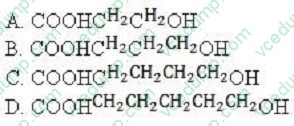
B. Option B
C. option C
D. Option D -
Question 368:
Studies of photosynthesis began in the late eighteenth century. One scientist found that green plants produce a substance (later shown to be oxygen) that supports the flame of a candle in a closed container. Several years later it was discovered that a plant must be exposed to light in order to replenish this flame- sustaining "substance." Soon another discovery showed that the oxygen is formed at the expense of another gas, carbon dioxide.
In 1804, de Saussure conducted experiments revealing that equal volumes of carbon dioxide and oxygen are exchanged between a plant and the air surrounding it. De Saussure determined that the weight gained by a plant grown in a pot equals the sum of the weights of carbon derived from absorbed carbon dioxide and water absorbed through plant roots. Using this information, de Saussure was able to postulate that in photosynthesis carbon dioxide and water combine using energy in the form of light to produce carbohydrates, water, and free oxygen. Much later, in 1845, scientists' increased understanding of concepts of chemical energy led them to perceive that, through photosynthesis, light energy is transformed and stored as chemical energy.
In the twentieth century, studies comparing photosynthesis in green plants and in certain sulfur bacteria yielded important information about the photosynthetic process. Because water is both a reactant and a product in the central reaction, it had long been assumed that the oxygen released by photosynthesis comes from splitting the carbon dioxide molecule. In the 1930s, however, this popular view was decisively altered by the studies of C. B. Van Niel. Van Niel studied sulfur bacteria, which use hydrogen sulfide for photosynthesis in the same way that green plants use water, and produce sulfur instead of oxygen. Van Niel saw that the use of carbon dioxide to form carbohydrates was similar in the two types of organisms. He reasoned that the oxygen produced by green plants must derive from water -- rather than carbon dioxide, as previously assumed -- in the same way that the sulfur produced by the bacteria derives from hydrogen sulfide. Van Niel's finding was important because the earlier belief had been that oxygen was split off from carbon dioxide, and that carbon then combined with water to form carbohydrates. The new postulate was that, with green plants, hydrogen is removed from water and then combines with carbon dioxide to form the carbohydrates needed by the organism.
Later, Van Niel's assertions were strongly backed by scientists who used water marked with a radioactive isotope of oxygen in order to follow photosynthetic reactions. When the photosynthetically-produced free oxygen was analyzed, the isotope was found to be present.
Which of the following can be inferred about the scientists discussed in the passage?
A. They relied on abstract reasoning in the absence of physical data.
B. They never came to understand the role of light in photosynthesis.
C. Each contributed to our understanding of the production of oxygen by plants.
D. They tended to undervalue previous scientific findings. -
Question 369:

Given the following H?values, calculate the H?of formation of (s).

A. Option A
B. Option B
C. Option C
D. Option D -
Question 370:
Which stimulus is the main factor that influences circadian rhythms?
A. pain
B. temperature
C. pressure
D. light




Related Exams:
Tips on How to Prepare for the Exams
Nowadays, the certification exams become more and more important and required by more and more enterprises when applying for a job. But how to prepare for the exam effectively? How to prepare for the exam in a short time with less efforts? How to get a ideal result and how to find the most reliable resources? Here on Vcedump.com, you will find all the answers. Vcedump.com provide not only Medical Tests exam questions, answers and explanations but also complete assistance on your exam preparation and certification application. If you are confused on your MCAT-TEST exam preparations and Medical Tests certification application, do not hesitate to visit our Vcedump.com to find your solutions here.