MCAT-TEST Exam Details
-
Exam Code
:MCAT-TEST -
Exam Name
:Medical College Admission Test: Verbal Reasoning, Biological Sciences, Physical Sciences, Writing Sample -
Certification
:Medical Tests Certifications -
Vendor
:Medical Tests -
Total Questions
:812 Q&As -
Last Updated
:Jul 16, 2026
Medical Tests MCAT-TEST Online Questions & Answers
-
Question 351:
As a result of substance abuse throughout adolescence, a young adult suffers from a number of psychological symptoms reflecting diminished executive functioning. Which of the following are likely true of this patient?
I. Pathological changes to the prefrontal cortex.
II. Increased susceptibility to auditory hallucinations.
III.
Reduced behavioral impulse control.
A. I only
B. III only
C. I and III only
D. II and III only
I. Pathological changes to the prefrontal cortex. II. Increased susceptibility to auditory hallucinations. III. Reduced behavioral impulse control. -
Question 352:
The polymerase chain reaction (PCR) is a powerful biological tool that allows the rapid amplification of any fragment of DNA without purification. In PCR, DNA primers are made to flank the specific DNA sequence to be amplified. These primers are then extended to the end of the DNA molecule with the use of a heat- resistant DNA polymerase. The newly synthesized DNA strand is then used as the template to undergo another round of replication.
The 1st step in PCR is the melting of the target DNA into 2 single strands by heating the reaction mixture to approximately 94 oC, and then rapidly cooling the mixture to allow annealing of the DNA primers to their specific locations. Once the primer has annealed, the temperature is elevated to 72 oC to allow optimal activity of the DNA polymerase. The polymerase will continue to add nucleotides until the entire complimentary strand of the template is completed at which point the cycle is repeated (Figure 1)

Figure 1
One of the uses of PCR is sex determination, which requires amplification of intron 1 of the amelogenin gene. This gene found on the X-Y homologous chromosomes has a 184 base pair deletion on the Y homologue. Therefore, by amplifying intron 1 females can be distinguished from males by the fact that males will have 2 different sizes of the amplified DNA while females will only have 1 unique fragment size.
Why is a heat resistant DNA polymerase required for successive replication in the polymerase chain reaction, rather than simply a human DNA polymerase?
A. The high temperatures required to melt the DNA double strand may denature a normal human cellular DNA polymerase.
B. The high temperatures required to melt the DNA would cause human DNA polymerase to remain bound to the DNA strand.
C. Heat resistant DNA polymerase increases the rate of the polymerase chain reaction at high temperatures whereas human DNA polymerase lowers the rate.
D. Heat resistant DNA polymerase recognizes RNA primers whereas human DNA polymerase does not. -
Question 353:
The Russia which emerged from the terrible civil war after the 1917 Revolution was far from the Bolsheviks' original ideal of a non-exploitative society governed by workers and peasants. By 1921, the regime was weakened by widespread famine, persistent peasant revolts, a collapse of industrial production stemming from the civil war, and the consequent dispersal of the industrial working class -- the Bolsheviks' original base of support. To buy time for recovery, the government in 1921 introduced the New Economic Policy, which allowed private trade in farm products (previously banned) and relied on a fixed grain tax instead of forced requisitions to provide food for the cities. The value of the ruble was stabilized. Trade unions were again allowed to seek higher wages and benefits, and even to strike. However, the Bolsheviks maintained a strict monopoly of power by refusing to legalize other parties. After the death of the Revolution's undisputed leader, Lenin, in January 1924, disputes over the long-range direction of policy led to an open struggle among the main Bolshevik leaders. Since open debate was still possible within the Bolshevik Party in this period, several groups with differing programs emerged in the course of this struggle. The program supported by Nikolai Bukharin -- a major ideological leader of the Bolsheviks with no power base of his own -- called for developing agriculture through good relations with wealthy peasants, or "kulaks." Bukharin favored gradual industrial development, or "advancing towards Socialism at a snail's pace." In foreign affairs, Bukharin's policy was to ally with non-Socialist regimes and movements that were favorable to Russia. A faction led by Leon Trotsky, head of the Red Army and the most respected revolutionary leader after Lenin, called for rapid industrialization and greater central planning of the economy, financed by a heavy tax on the kulaks. Trotsky rejected the idea that a prosperous, human Socialist society could be built in Russia alone (Stalin's slogan of "Socialism in One Country"), and therefore called for continued efforts to promote working-class revolutions abroad. As time went on, he became bitterly critical of the new privileged elite emerging within both the Bolshevik Party and the Russian state. Joseph Stalin, General Secretary of the Bolshevik Party, was initially considered a "center," conciliating figure, not clearly part of a faction. Stalin's eventual supremacy was ensured by three successive struggles within the party, and only during the last did his own program become clear. First, in 1924?5, Stalin isolated Trotsky, allying for this purpose with Grigori Zinoviev and Lev Kamenev, Bolshevik leaders better known than Stalin himself, whom Trotsky mistakenly considered his main rivals. Stalin maneuvered Trotsky out of leadership of the Red Army, his main potential power base. Next, Stalin turned on Zinoviev and Kamenev, using his powers as head of the Party organization to remove them from party leadership in Leningrad and Moscow, their respective power bases. Trotsky, Zinoviev, and Kamenev then belatedly formed the "Joint Opposition" (1926?7). With Bukharin's help, Stalin easily outmaneuvered the Opposition: Bukharin polemicized against Trotsky, while Stalin prevented the newspapers from printing Trotsky's replies, organized gangs of toughs to beat up his followers, and transferred his supporters to administrative posts in remote regions. At the end of 1927, Stalin expelled Trotsky from the Bolshevik Party and exiled him. (Later, in 1940, he had him murdered.) Zinoviev and Kamenev, meanwhile, recanted their views in order to remain within the Party. The final act now began. A move by kulaks to gain higher prices by holding grain off the market touched off a campaign against them by Stalin. Bukharin protested, but with the tradition of Party democracy now all but dead, Stalin had little trouble silencing Bukharin. Meanwhile, he began a campaign to force all peasants -- not just kulaks -- onto state-controlled "collective farms," and initiated a crash industrialization program during which he deprived the trade unions of all rights and cut real wages by 50%. Out of the factional struggle in which he emerged by 1933 as sole dictator of Russia, Stalin's political program of building up heavy industry on the backs of both worker and peasant emerged with full clarity.
An important feature of Bukharin's program was:
A. a tax on the peasants.
B. avoiding confrontations with the trade unions.
C. forming alliances with friendly foreign regimes.
D. maintaining open debate within the Party. -
Question 354:
The resistance of a resistor is defined as the ratio of the voltage drop across it to the current passing through it. The resistance of a resistor can be measured using the circuit illustrated in Figure 1.
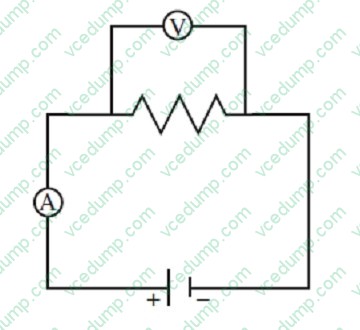
Figure 1
In the above circuit, a variable voltage source with negligible internal resistance is connected to a resistor. The voltage across the resistor is measured by a voltmeter and the current through the resistor is measured by an ammeter.

Additional resistors may be added to the circuit. The total resistance can be calculated as follows: If and are two resistances of two resistors, then the total resistance is given by = + when the resistors are connected in

series, and by 1/ = 1/ + 1/ when the resistors are connected in parallel.

Circuits similar to the one above are used in the common household appliance known as the toaster. The rate by which energy in the form of heat is dissipated by the resistor equals , where I is the current that passes through the resistor and R is the resistance of the resistor. Energy is dissipated in a resistor because moving electrons collide with atoms in the resistor, causing the atoms to vibrate.
In which direction do the electrons travel, and in which direction does the current flow, in the circuit in Figure 1?
A. The electrons travel clockwise, and the current flows counterclockwise.
B. The electrons travel clockwise, and the current flows clockwise.
C. The electrons travel counterclockwise, and the current flows clockwise.
D. The electrons travel counterclockwise, and the current flows counterclockwise. -
Question 355:
In 1965, Boris Deryagin reported the discovery of an unusual substance formed during the condensation of water vapor in quartz capillaries. The material, called poly-water, appeared to be a polymer of water monomers and differed from normal water in a number of ways. It had a freezing point of ?0?C and solidified into a glass-like solid with substantially less volumetric expansion than that of ordinary water upon freezing. It had a density 40% greater than water and a refractive index of 1.48.
An intricate apparatus was used to produce the poly-water. Ordinary distilled water was placed in a chamber held at 160?C with pressure below atmospheric pressure. This chamber was connected to a second chamber by a tube held at 500?C in order to prevent the passage of liquid water. The second chamber was held at 0?C and contained a drawn quartz capillary in which the water vapor condensed, forming poly-water.
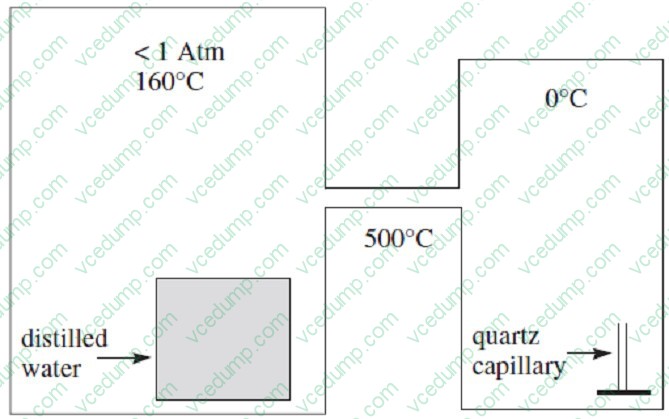
Hypothesis 1
Deryagin proposed that polywater was a polymer of water monomers arranged in a network of hexagonal units. The polymerization was catalyzed by the silicate surface of the quartz capillary.
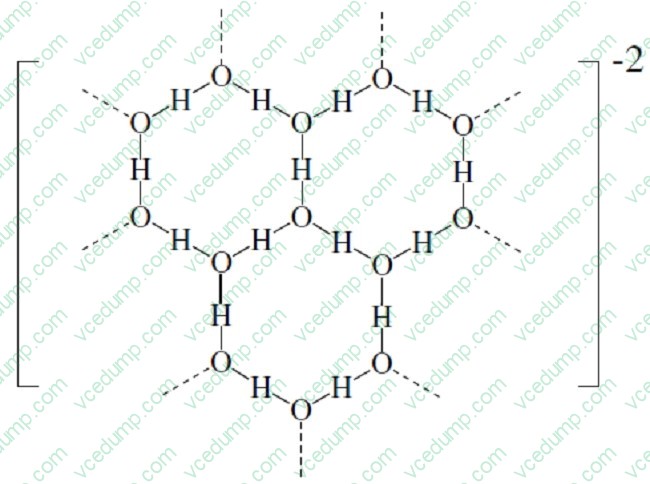
Proposed Structure of Polywater Hypothesis 2
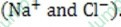
Another researcher was skeptical. Analysis indicated that polywater was merely a solution of water and dissolved particles including silicon, carbon dioxide, and substantial concentrations of ions These contaminants dissolved from the quartz capillary and from materials used in the apparatus.

(constants for normal water : density = 1 g/c , index of refraction = 1.33 , freezing point depression constant = 1.86°C )

Hypothesis 1 proposes that polywater is a repeating structure of monomers. What is the formal charge on hydrogen in this structure?
A. -1
B. +1
C. -2
D. +2 -
Question 356:
Morphine alkaloids derived from the opium poppy have long been used as analgesics. Codeine, the methyl ether of morphine, is a naturally occurring alkaloid with medicinal properties very similar to those of morphine. Thousands of derivatives of morphine have been synthesized and tested for their biological effects. For example, the diacylated derivative of morphine, heroin, is a highly addictive drug. Much effort has gone into understanding how morphine and its derivatives function.
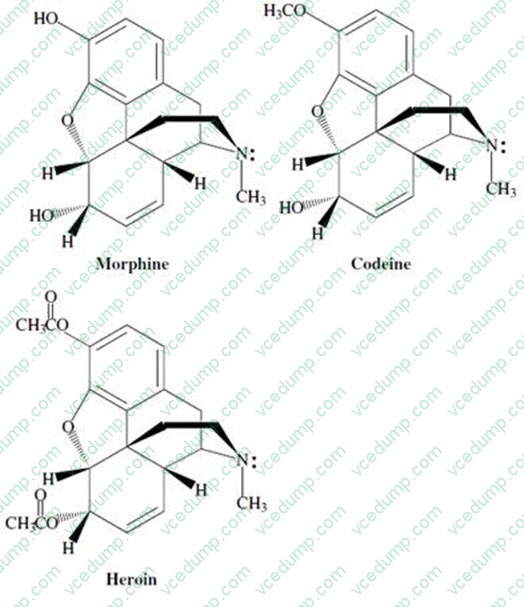
Studies have shown that certain common structural features of alkaloids are required for the compound to exhibit biological activity. These structural requirements are summarized by the so called "morphine rule":
Demerol and methadone, shown in Figure 2, are two synthetic alkaloids designed to satisfy the "morphine rule." Synthetic alkaloids such as these have been found to mimic certain physiological properties of morphine and its derivatives, and
have found pharmacological application due to other, more desirable biological effects. Methadone has been used widely in the United States and Great Britain as a treatment for heroin addiction; it reduces the physical symptoms
accompanying withdrawal without producing many of the other effects of heroin.
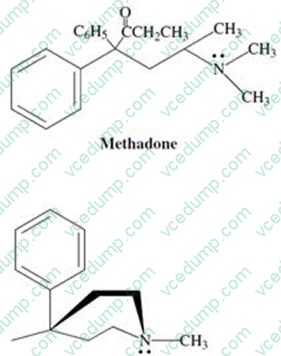
Meperidine (demerol) Figure 2
Which of the following compounds would be most likely to have morphine-like biological effects?
A. Option A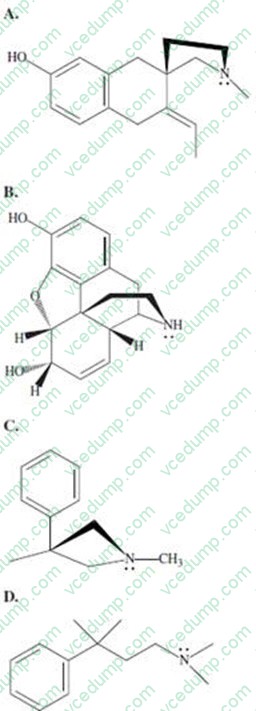
B. Option B
C. Option C
D. Option D -
Question 357:
The polymerase chain reaction (PCR) is a powerful biological tool that allows the rapid amplification of any fragment of DNA without purification. In PCR, DNA primers are made to flank the specific DNA sequence to be amplified. These primers are then extended to the end of the DNA molecule with the use of a heat- resistant DNA polymerase. The newly synthesized DNA strand is then used as the template to undergo another round of replication.
The 1st step in PCR is the melting of the target DNA into 2 single strands by heating the reaction mixture to approximately 94 oC, and then rapidly cooling the mixture to allow annealing of the DNA primers to their specific locations. Once the primer has annealed, the temperature is elevated to 72 oC to allow optimal activity of the DNA polymerase. The polymerase will continue to add nucleotides until the entire complimentary strand of the template is completed at which point the cycle is repeated (Figure 1)
Figure 1
One of the uses of PCR is sex determination, which requires amplification of intron 1 of the amelogenin gene. This gene found on the X-Y homologous chromosomes has a 184 base pair deletion on the Y homologue. Therefore, by amplifying
intron 1 females can be distinguished from males by the fact that males will have 2 different sizes of the amplified DNA while females will only have 1 unique fragment size.
Both copies of intron 1 of the amelogenin gene on the 2 sex chromosomes can be referred to as:
A. homologous chromosomes.
B. recessive traits.
C. alleles.
D. spliced RNA. -
Question 358:
In the course of gathering data in an experiment, a researcher develops the following correlation matrix: Table 1 Correlation Matrix
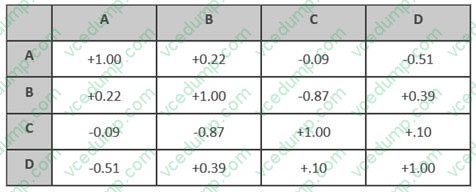
Which of the following pairs of variables are most strongly correlated?
A. A, C
B. A, D
C. B, D
D. C, D -
Question 359:

In the circuit below, = = 10 ohms. Removing will have which of the following effects on the current through ?
A. Decrease to 1/2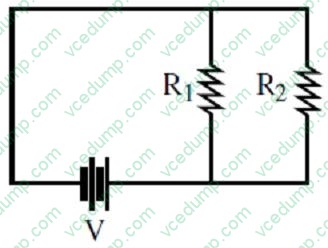
B. No change
C. Double
D. Increase by factor of 10 -
Question 360:
A student conducts a chemical analysis of the components of a popular soft drink. The beverage label shows that the drink contains carbonated water, phosphoric acid, caffeine, and caramel color, but does not indicate the concentrations of these chemicals.
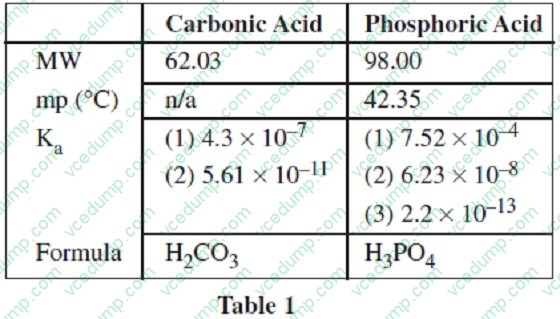
Dissolved carbon dioxide will react reversibly with water to form carbonic acid. In an attempt to analyze the beverage composition, the student conducts the following experiments on a one liter sample of the beverage.
Experiment 1
The sample is placed in a sealed beaker cooled to 10?C and a vacuum is created in the space above the beverage. The gas pumped from this space is passed through a solution of BaCl2, producing a white precipitate. The process
continues until no more precipitate forms. The precipitate is dried and found to have a mass of 9.5 grams.
Experiment 2
The remaining solution left in the sealed beaker is then titrated with 0.01 M NaOH to give the titration curve shown in Figure 1.
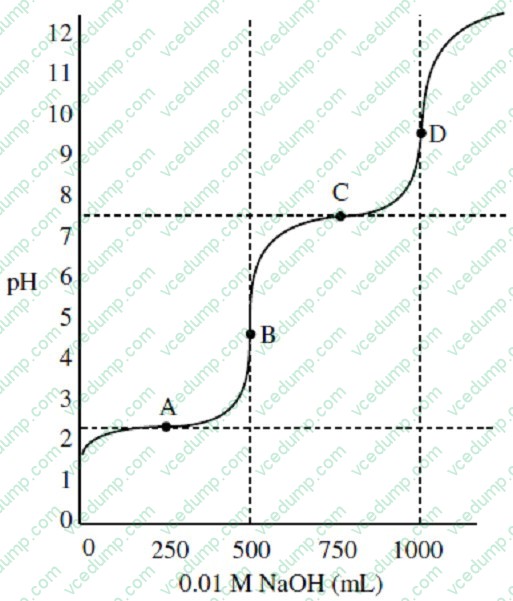
Figure 1
Which region of the graph in Figure 1 provides the best buffering around neutral pH?
A. A
B. B
C. C
D. D
Related Exams:
Tips on How to Prepare for the Exams
Nowadays, the certification exams become more and more important and required by more and more enterprises when applying for a job. But how to prepare for the exam effectively? How to prepare for the exam in a short time with less efforts? How to get a ideal result and how to find the most reliable resources? Here on Vcedump.com, you will find all the answers. Vcedump.com provide not only Medical Tests exam questions, answers and explanations but also complete assistance on your exam preparation and certification application. If you are confused on your MCAT-TEST exam preparations and Medical Tests certification application, do not hesitate to visit our Vcedump.com to find your solutions here.