MCAT-TEST Exam Details
-
Exam Code
:MCAT-TEST -
Exam Name
:Medical College Admission Test: Verbal Reasoning, Biological Sciences, Physical Sciences, Writing Sample -
Certification
:Medical Tests Certifications -
Vendor
:Medical Tests -
Total Questions
:812 Q&As -
Last Updated
:Jul 16, 2026
Medical Tests MCAT-TEST Online Questions & Answers
-
Question 371:
(1) Fluorescent proteins are found in bioluminescent sea creatures, such as jellyfish. (2) In 1969, the green fluorescent protein was discovered and, since then, prolific research has resulted in the discovery and development of many new fluorescent proteins. (3) Fluorescent proteins can be expressed in cells, making them easily visible under a microscope. (4) In fact, the use of fluorescent proteins revolutionized bio- imaging because the inherently natural nature meant that they could be incorporated into living cells with no deadly toxic effects. (5) Numerous other scientific and medical applications also exploit the unique properties of fluorescent proteins, which is why they were the subject of the 2008 Nobel Prize for Chemistry. (6) However, the science behind fluorescent proteins is still not fully understood and there are many more avenues for exploration.
What does the conclusion of the passage suggest?
A. Fluorescent proteins were the subject of a Nobel Prize.
B. Scientists know nothing about how fluorescent proteins work.
C. Further research could be conducted on fluorescent proteins.
D. There is no point in researching fluorescent proteins nowadays. -
Question 372:
Saul Hoffman's scientific journal paper published in 2015 in Societies explores the relationship between two topics that at the surface are very distant from each other. As he goes on to state, "It is relatively easy, at least for an economist, to see why economists would be attracted to issues like teen pregnancy and teen childbearing, despite their apparent distance from the core topics of economics. First, economics ? especially microeconomics ?is fundamentally the study of choices that individuals make, traditionally and most often in formal markets with monetary prices, but now more and more frequently outside that sphere. Viewed from that perspective, choices involving sexual and fertility behavior among teens are an incredibly challenging, but inviting, target. Is it possible to identify the role of economic incentives, including government policy, on these behaviors? Is it sensible to apply traditional models of rational choice decision-making to teens?
Second, the traditional concern about teen fertility was predicated on the notion that it was an economically catastrophic act. In a famous and oft-quoted 1968 article, Arthur Campbell wrote that 'The girl who has an illegitimate child at the age of 16 suddenly has 90 percent of her life's script written for her,' including reduced opportunities for schooling, the labor market, and marriage. But it doesn't take too much reflection to appreciate that more may be going on in leading to these poor outcomes than just a teen birth. Disentangling the causal effect of teen childbearing on subsequent socio-economic outcomes from its correlational effect is another deliciously inviting and challenging target, this time well-suited for the applied economist or econometrician.
Just to make all this yet more inviting, the two research strands are closely related. Suppose it could be demonstrated that for some teens the socio-economic impact of a teen birth was negligible. For example, maybe future prospects for some teens were equally poor with or without a birth or perhaps government programs provided substantial benefits, so that the net impact on socio-economic well-being was consequently small or even positive. Then, it might well be 'rational' in an economic sense to have a teen birth in the first place, thereby linking the research on the causal impact of a teen birth with the research on the choice determinants of a teen birth. So what came to be known as the teen birth `causes' literature and the teen birth `consequences' literature were clearly interrelated.
And then, to add yet another layer of challenge, the teen fertility rate in the U.S. has fallen at a rate that is totally unprecedented. Teen fertility was once widespread, with most of it occurring within early and sometimes not entirely voluntary marriage. In 1960, the teen fertility rate was approximately 90 births per 1000, which implied that more than 40% of women ever had a teen birth. When I published my first article on teen births 25 years ago, the teen fertility rate was 60 births per 1000, down one-third from 1960, but it had increased six years in a row in what turned out to be a deviation from the downward trend. Since then the rate has declined every single year, except for a short but puzzling uptick between 2005 and 2007. In 2014, the teen fertility rate was 24.2 births per 1000, the lowest teen fertility rate ever recorded in the U.S., though still shockingly high by European standards. Thus, the rate fell by more than 50% during my professional association with the topic and by 70% since 1960. Of course, at the same time teen marital births largely disappeared, falling from 85% of teen births to 12%.
This adds yet another focus for economic research. Why did the rate fall? Did it have anything to do with changes in the costs of teen childbearing or changes in policy? Is it a good thing or not?
In this article I try to make sense out of these various research strands by providing a personal narrative through the economics literature on teen childbearing, with a special emphasis on the three issues discussed above. My goal is to make the literature, including some reasonably technical content, accessible and valuable to a non-economist."
Hoffman, S. (2015). Teen Childbearing and Economics: A Short History of a 25-Year Research Love Affair. Societies, 5(3), 646-663. doi:10.3390/soc5030646
According to passage information, a scholar interested in microeconomics might study all of the following EXCEPT:
A. which environmental factors make a city dweller more likely to litter.
B. the reasons behind college students' choices to spend their time studying vs. socializing.
C. how divorce influences real estate prices and choices.
D. how recent college graduates prioritize cost versus convenient location in choosing an apartment. -
Question 373:
When glucose is heated with Fehling's solution, the colour of the precipitate obtained is:
A. black.
B. yellow.
C. red.
D. white. -
Question 374:
Four major blood types exist in the human ABO blood system: types A, B, AB, and O; and there are three alleles that code for them. The A and B alleles are codominant, and the O allele is recessive. Blood types are derived from the presence of specific polysaccharide antigens that lie on the outer surface of the red blood cell membrane. The A allele codes for the production of the A antigen; the B allele codes for the production of the B antigen; the O allele does not code for any antigen. While there are many other antigens found on red blood cell membranes, the second most important antigen is the Rh antigen. Rh is an autosomally dominant trait coded for by 2 alleles. If this antigen is present, an individual is Rh+; if it is absent, an individual is Rh-. For example, a person with type AB blood with the Rh antigen is said to be AB+.
These antigens become most important when an individual comes into contact with foreign blood. Because of the presence of naturally occurring substances that closely mimic the A and B antigens, individuals who do not have these antigens on their red blood cells will form antibodies against them. This is inconsequential until situations such as blood transfusion, organ transplant, or pregnancy occur.
Erythroblastosis fetalis is a condition in which the red blood cells of an Rh+ fetus are attached by antibodies produced by its Rh- mother. Unlike ABO incompatibility, in which there are naturally occurring antibodies to foreign antigens, the Rh system requires prior sensitization to the Rh antigen before antibodies are produced. This sensitization usually occurs during the delivery of an Rh+ baby. So while the first baby will not be harmed, any further Rh+ fetuses are at risk. The Coombs tests provide a method for determining whether a mother has mounted an immune response again her baby's blood. The tests are based on whether or not agglutination occurs when Coombs reagent is added to a sample. Coombs reagent contains antibodies against the anti-Rh antibodies produced by the mother. The indirect Coombs test takes the mother's serum, which contains her antibodies but no red blood cells, and mixes it with Rh+ red blood cells. Coombs reagent is then added. If agglutination occurs, the test is positive, and the mother must be producing anti-Rh antibodies. The direct Coombs test mixes the baby's red blood cells with Coombs reagent. If agglutination occurs, the test is positive, and the baby's red blood cells must have been attacked by its mother's anti-Rh antibodies.
A new virus has been discovered that evades detection by the immune system of only those individuals with type A or type AB blood. Which of the following best accounts for this observation?
A. The viral antigens resemble the A antigen.
B. The viral antigens resemble the B antigen.
C. The viral antigens are
D. The viral antigens are too small to elicit an immune response. -
Question 375:
Which of the following molecules would produce the NMR spectrum shown below?
A. Option A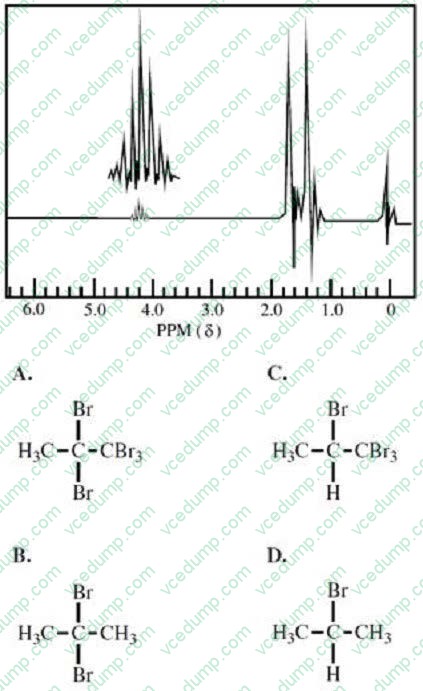
B. Option B
C. Option C
D. Option D -
Question 376:
In 1972, Georges Ungar reported the discovery of a peptide that appeared to transfer learning. Ungar's claim was based on experiments in which rats placed in a chamber with specially designed dark and light regions were trained to avoid
the dark regions of the chamber. Following their training, the rats were killed and brain extracts were prepared. These brain extracts were injected into naive rats which were then observed to acquire the fear of darkness without training. Two
hypotheses were proposed to explain these remarkable results:
Hypothesis 1
Ungar concluded that the extracts contained some chemical that transmitted the learned fear of darkness to the naive rats. A fifteen amino-acid polypeptide was isolated from the brain extracts and sequenced. Ungar claimed that this peptide,
called scotophobin, was a chemical transmitter of learning. The peptide had the primary structure shown below:
C-ser-asp-asn-arg-gln-gln-gly-lys-ser-ala-arg-gln-glygly-tyr-N scotophobin
Hypothesis 2
Other researchers, who tested scotophobin but could not reproduce Ungar's results, argued that scotophobin did not transfer the learned fear of darkness. Instead, they suggested that scotophobin, which is structurally similar to ACTH and
vasopressin, acted to increase stress in the rats. Since stress increases sympathetic nervous activity, rats injected with scotophobin would become hyperactive and tend to spend less time in the dark regions of the experimental chamber.
They argued that such stress responses in the rats could be misinterpreted as a fear of darkness. Ungar's claim was further weakened by chemical analysis in which both the scotophobin extracts which Ungar had injected into the naive rats
and a sample of synthesized scotophobin peptide were subjected to SDS polyacrylamide gel electrophoresis, as shown in Figure 1.
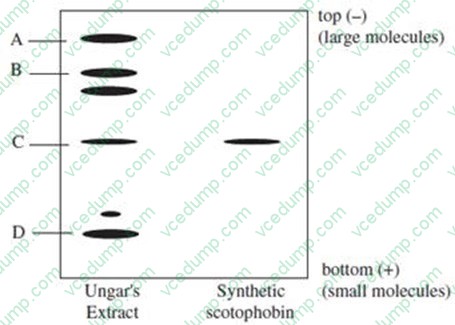
Figure 1
Hydrolytic enzymes cleave polypeptides at specific amino acid residues. Which of the following hydrolytic enzymes could be used to cleave scotophobin into three fragments?
A. Trypsin only
B. Trypsin or clositripain only
C. Clositripain or chymotrypsin only
D. Clositripain or pepsin only -
Question 377:
(1) Fluorescent proteins are found in bioluminescent sea creatures, such as jellyfish. (2) In 1969, the green fluorescent protein was discovered and, since then, prolific research has resulted in the discovery and development of many new fluorescent proteins. (3) Fluorescent proteins can be expressed in cells, making them easily visible under a microscope. (4) In fact, the use of fluorescent proteins revolutionized bio- imaging because the inherently natural nature meant that they could be incorporated into living cells with no deadly toxic effects. (5) Numerous other scientific and medical applications also exploit the unique properties of fluorescent proteins, which is why they were the subject of the 2008 Nobel Prize for Chemistry. (6) However, the science behind fluorescent proteins is still not fully understood, and there are many more avenues for exploration.
What is implied by the fourth sentence of the passage?
A. The discovery of fluorescent proteins was not important in the field of bio-imaging.
B. Fluorescent proteins kill living cells.
C. Bio-imaging in living cells has always been possible.
D. Bio-imaging in living cells was not possible before the discovery of fluorescent proteins. -
Question 378:
A rate of change of angular momentum of a body is equivalent to:
A. impulsive force.
B. the applied torque.
C. applied force.
D. moment of inertia. -
Question 379:
According to attachment theory, which of the following children is most likely to attach to a male psychologist, previously unknown to the child, in the course of a psychological study?
A. A two-month old female infant raised in a safe, stable environment
B. A five-month old male infant raised in a safe, stable environment
C. An eight-month old male infant raised by a single caregiver who frequently neglect the child
D. A thirteen-month old female infant raised by two caregivers who occasionally neglect the child -
Question 380:
When Gwendolyn Brooks published her first collection of poetry A Street In Bronzeville in 1945 most reviewers recognized Brooks' versatility and craft as a poet. Yet, while noting her stylistic successes few of her contemporaries discussed the critical question of Brooks' relationship to the Harlem Renaissance. How had she addressed herself, as a poet, to the literary movement's assertion of the folk and African culture, and its promotion of the arts as the agent to define racial integrity? The New Negro poets of the Harlem Renaissance expressed a deep pride in being Black; they found reasons for this pride in ethnic identity and heritage; and they shared a common faith in the fine arts as a means of defining and reinforcing racial pride. But in the literal expression of this impulse, the poets were either romantics, or realists and, quite often within the same poem, both. The realistic impulse, as defined best in the poems of McKay's Harlem Shadows (1922), was a sober reflection upon Blacks as second class citizens, segregated from the mainstream of American socio-economic life, and largely unable to realize the wealth and opportunity that America promised. The romantic impulse, on the other hand, as defined in the poems of Sterling Brown's Southern Road (1932), often found these unrealized dreams in the collective strength and will of the folk masses. In comparing the poems in A Street in Bronzeville with various poems from the Renaissance, it becomes apparent that Brooks brings many unique contributions to bear on this tradition. The first clue that A Street In Bronzeville was, at its time of publication, unlike any other book of poems by a Black American is its insistent emphasis on demystifying romantic love between Black men and women. During the Renaissance, ethnic or racial pride was often focused with romantic idealization upon the Black woman. A casual streetwalker in Hughes' poem, "When Sue Wears Red," for example, is magically transformed into an Egyptian Queen. In A Street In Bronzeville, this romantic impulse runs headlong into the biting ironies of racial discrimination. There are poems in which Hughes, McKay and Brown recognize the realistic underside of urban life for Black women. But for Brooks, unlike the Renaissance poets, the victimization of poor Black women becomes not simply a minor chord but a predominant theme. ...Brooks' relationship with the Harlem Renaissance poets, as A Street in Bronzeville ably demonstrates, was hardly imitative. As one of the important links with the Black poetic tradition of the 1920s and 1930s, she enlarged the element of realism that was an important part of the Renaissance world-view. Although her poetry is often conditioned by the optimism that was also a legacy of the period, Brooks rejects outright their romantic prescriptions for the lives of Black women. And in this regard, she serves as a vital link with the Black Arts Movement of the 1960s that, while it witnessed the flowering of Black women as poets and social activists as well as the rise of Black feminist aesthetics in the 1970s, brought about a curious revival of romanticism in the Renaissance mode.
Which of the following would best complete the last paragraph of the passage?
A. For many readers, however, Brooks will best be remembered for her virtuosity in poetic technique.
B. In many ways, Brooks' poetry owes more to the influence of the Black Arts movement than to the poets of the Harlem Renaissance.
C. For while poets of the Black Arts movement would often idealize their culture, their work was tempered by realism.
D. But while her importance for later movements is established, Brooks' relationship to the Harlem Renaissance remains open to question.

Related Exams:
Tips on How to Prepare for the Exams
Nowadays, the certification exams become more and more important and required by more and more enterprises when applying for a job. But how to prepare for the exam effectively? How to prepare for the exam in a short time with less efforts? How to get a ideal result and how to find the most reliable resources? Here on Vcedump.com, you will find all the answers. Vcedump.com provide not only Medical Tests exam questions, answers and explanations but also complete assistance on your exam preparation and certification application. If you are confused on your MCAT-TEST exam preparations and Medical Tests certification application, do not hesitate to visit our Vcedump.com to find your solutions here.