MCAT-TEST Exam Details
-
Exam Code
:MCAT-TEST -
Exam Name
:Medical College Admission Test: Verbal Reasoning, Biological Sciences, Physical Sciences, Writing Sample -
Certification
:Medical Tests Certifications -
Vendor
:Medical Tests -
Total Questions
:812 Q&As -
Last Updated
:Jul 16, 2026
Medical Tests MCAT-TEST Online Questions & Answers
-
Question 301:
Aerobic respiration is the major process used by oxygen- requiring organisms to generate energy. During respiration, glucose is metabolized to generate chemical energy in the form of ATP: The biochemical machinery necessary for cellular respiration is found in the mitochondria, small organelles scattered throughout the cytoplasm of most eukaryotic cells. The number of mitochondria per cell varies by tissue type and cell function.

Mitochondria are unusual in that they have their own genetic systems that are entirely separate from the cell's genetic material. However, mitochondrial replication is still dependent upon the cell's nuclear DNA to encode essential proteins required for replication. Despite this fact, mitochondria seem to replicate randomly, out of phase with both the cell cycle and other mitochondria.
The nature of the mitochondrial genome and protein synthesizing machinery has led many researchers to postulate that mitochondria may have arisen as the result of the ingestion of a bacterium by a primitive cell millions of years ago. It is postulated that the two may have entered into a symbiotic relationship and eventually became dependent on each another; the cell sustained the bacterium, while the bacterium provided energy for the cell. Gradually, the two evolved into the present-day eukaryotic cell, with the mitochondrion retaining some of its own DNA. This is known as the endosymbiotic hypothesis. Because mitochondrial DNA is inherited in a non-Mendelian fashion (mitochondria are inherited from the maternal parent, who supplies most of the cytoplasm to the fertilized egg), it has been used to look at evolutionary relationships among different organisms.
Which of the following mitochondrial genome characteristics differs most from the characteristics of the nuclear genome?
A. Mitochondrial DNA is a double-helix.
B. Some mitochondrial genes code for tRNA.
C. Specific mutations to mitochondrial DNA can be lethal to the organism.
D. Almost every base in mitochondrial DNA codes for a product. -
Question 302:
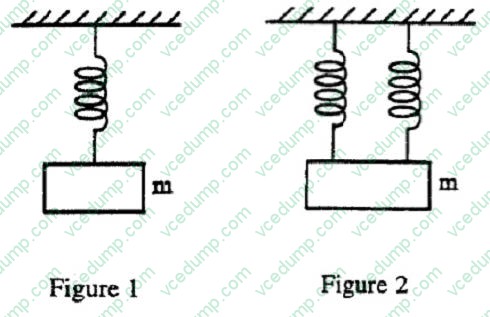
The simple harmonic motion of a mass suspended from vertical springs is investigated in two experiments. The springs used in both experiments have a spring constant k and a natural length L0. The material used to make the springs has a Young's modulus of 2 x 10¹¹ Pa.
In the first experiment a mass m is suspended from a spring. The mass stretches the spring to a new length L, called the equilibrium length.
In the second experiment the mass m is suspended from two identical springs as shown in Figure 2 below. When the mass m is in equilibrium, each spring is stretched from its natural length by the same amount xe.
In both experiments the masses of the springs are negligible, and the elastic limits of the springs are never exceeded.
In the first experiment, what is the mass of the object hanging from the spring?
A. kL/g
B. kL0/g
C. k(L-L0)/g
D. k/g -
Question 303:
Just as the ingestion of nutrients is mandatory for human life, so is the excretion of metabolic waste products. One of these nutrients, protein, is used for building muscle, nucleic acids, and countless compounds integral to homeostasis. However, the catabolism of the amino acids generated from protein digestion produces ammonia, which, if not further degraded, can become toxic. Similarly, if the same salts that provide energy and chemical balance to cells are in excess, fluid retention will occur, damaging the circulatory, cardiac, and pulmonary systems.
One of the most important homeostatic organs is the kidney, which closely regulates the excretion and reabsorption of many essential ions and molecules. One mechanism of renal function involves the secretion of antidiuretic hormone (ADH).
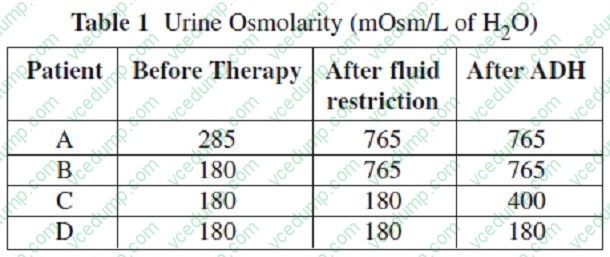
Diabetes insipidus (DI), is the condition that occurs when ADH is ineffective. As a result, the kidneys are unable to concentrate urine, leading to excessive water loss. There are two types of DI -- central and nephrogenic. Central DI occurs when there is a deficiency in the quantity or quality of ADH produced. Nephrogenic DI occurs when the kidney tubules are unresponsive to ADH. To differentiate between these two conditions, a patient's urine osmolarity is measured both prior to therapy and after a 24-hour restriction on fluid intake. Exogenous ADH is then administered and urine osmolarity is measured again. The table below gives the results of testing on four patients. Assume that a urine osmolarity of 285 mOsm/L of H2O is normal.
Which of the following would you most likely expect to find in a patient with diabetes insipidus?
A. Decreased plasma osmolarity
B. Increased urine osmolarity
C. Increased urine glucose
D. Increased urine output -
Question 304:
Although nihilism is commonly defined as a form of extremist political thought, the term has a broader meaning. Nihilism is in fact a complex intellectual stance with venerable roots in the history of ideas, which forms the theoretical basis for many positive assertions of modern thought. Its essence is the systematic negation of all perceptual orders and assumptions. A complete view must account for the influence of two historical crosscurrents: philosophical skepticism about the ultimacy of any truth, and the mystical quest for that same pure truth. These are united by their categorical rejection of the "known". The outstanding representative of the former current, David Hume (1711?776), maintained that external reality is unknowable, since sense impressions are actually part of the contents of the mind. Their presumed correspondence to external "things" cannot be verified, since it can be checked only by other sense impressions. Hume further asserts that all abstract conceptions turn out, on examination, to be generalizations from sense impressions. He concludes that even such an apparently objective phenomenon as a cause-and-effect relationship between events may be no more than a subjective fabrication of the observer. Stanley Rosen notes: "Hume terminates in skepticism because he finds nothing within the subject but individual impressions and ideas". For mystics of every faith, the "experience of nothingness" is the goal of spiritual practice. Buddhist meditation techniques involve the systematic negation of all spiritual and intellectual constructs to make way for the apprehension of pure truth. St. John of the Cross similarly rejected every physical and mental symbolization of God as illusory. St. John's spiritual legacy is, as Michael Novak puts it, "the constant return to inner solitude, an unbroken awareness of the emptiness at the heart of consciousness. It is a harsh refusal to allow idols to be placed in the sanctuary. It requires also a scorching gaze upon all the bureaucracies, institutions, manipulators, and hucksters who employ technology and its supposed realities to bewitch and bedazzle the psyche". Novak's interpretation points to the way these philosophical and mystical traditions prepared the ground for the political nihilism of the nineteenth and twentieth centuries. The rejection of existing social institutions and their claims to authority is in the most basic sense made possible by Humean skepticism. The political nihilism of the Russian intelligentsia combined this radical skepticism with a near mystical faith in the power of a new beginning. Hence, their desire to destroy becomes a revolutionary affirmation; in the words of Stanley Rosen, "Nihilism is an attempt to overcome or repudiate the past on behalf of an unknown and unknowable, yet hoped-for, future." This fusion of skepticism and mystical re-creation can be traced in contemporary thought, for example as an element in the counterculture of the 1960s.
In the passage, quotations from writers about nihilism are used in order to:
I. summarize specific points made in the course of the passage.
II. contrast points of view on the subject under discussion.
III.
make transitions between points in the discussion.
A. I only
B. I and II only
C. I and III only
D. II and III only
I. summarize specific points made in the course of the passage. II. contrast points of view on the subject under discussion. III. make transitions between points in the discussion. -
Question 305:
Many nutrients required by plants exist in soil as basic cations:

A soil's cation-exchange capacity is a measure of its ability to adsorb these basic cations as well as exchangeable hydrogen and aluminum ions. The cation-exchange capacity of soil is derived from two sources: small clay particles called micelles consisting of alternating layers of alumina and silica crystals, and organic colloids.

Replacement of + and + by other cations of lower valence creates a net negative charge within the inner layers of the micelles. This is called the soil's permanent charge. For example, replacement of an atom of aluminum by calcium within a section where the net charge was previously zero, as shown below, produces a net charge of ?, to which other cations can become adsorbed.

Figure 1
A pH-dependent charge develops when hydrogen dissociates from hydroxyl moieties on the outer surfaces of the clay micelles. This leaves negatively-charged oxygen atoms to which basic cations may adsorb. Likewise, a large pH-
dependent charge develops when hydrogen dissociates from carboxylic acids and phenols in organic matter.
In most clays, permanent charges brought about by substitution account for anywhere from half to nearly all of the total cation-exchange capacity. Soils very high in organic matter contain primarily pH-dependent charges. In a research study,
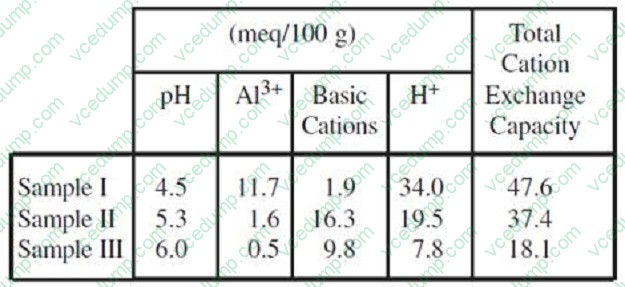
three samples of soil were leached with a 1 N solution of neutral KCl, and the displaced A13+ and basic cations measured. The sample was then leached again with a buffered solution of BaCl2 and triethanolamine at pH 8.2, and the
displaced H+ measured. Table 1 gives results for three soils tested by this method.
Table 1
Due to the buffering effect of the soil's cation exchange capacity, just measuring the soil solution's pH will not indicate how much base is needed to change the soil pH. In another experiment, measured amounts of acid and base were added to 10-gram samples of well-mixed soil that had been collected from various locations in a field. The volumes of the samples were equalized by adding water. The results were recorded in Figure 2.
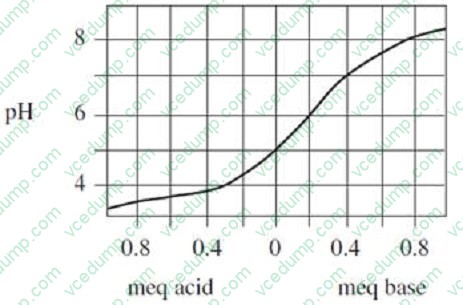
Figure 2.
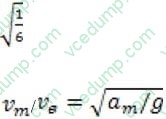
A body is dropped from a height of 30 m on Earth and hits the ground with a velocity. The body is then taken to the Moon, which has a gravitational acceleration 1/6 that of Earth. It is again dropped from a height of 30 m, hitting the Moon with a velocity of vm. What is the ratio of vm/ve?
A. 1/6
B. sqrt (1/6)
C. 6
D. 36 -
Question 306:
Which of the following functional groups are NOT found on the side chains of any of the naturally occurring amino acids?
A. Hydroxyl
B. Methyl
C. Carboxylic acid
D. Aldehyde -
Question 307:
A certain molecule acts by cytochrome oxidase A3, the final enzyme in the electron transport chain. Administration of a large dose of this substance to a human would likely:
A. lead to death due to an inability of the cell to pass electrons to oxygen, thus stopping aerobic respiration and asphyxiating the cells.
B. lead to death due to an inadequate supply of ADP to accept a phosphate group at the ATP synthase enzyme.
C. have no effect as cells would switch which macronutrient they metabolize to circumvent the blocked biochemical pathway.
D. increase the cell's ATP production as negative feedback would cause the cell to up-regulate anaerobic pathways. -
Question 308:
Synthetic dyes constitute a commercially significant area of organic chemistry. The color producing properties of these compounds are the result of highly delocalized electron systems giving rise to electronic transitions whose absorptions occur in the visible region. Most commercially useful dyes can be classified as one of three types -- anthraquinones, azo dyes, or triarylmethyl salts. Examples of each type are illustrated in Figure 1.
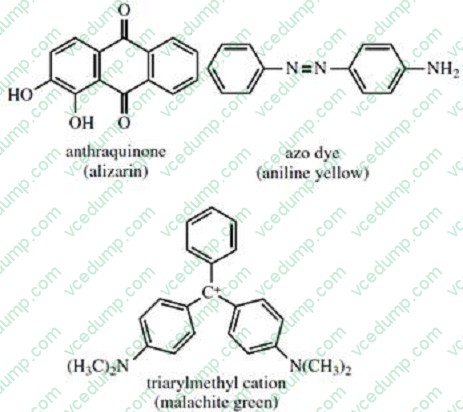
Figure 1
In order for a dye to be useful in the fabric industry, it must have sufficient affinity for the polymeric fibers of which the material is composed; the dye must not only impart a color to the fabric, but must also do so in a relatively permanent manner (color fastness). Proper design of synthetic polymers requires the placement of acidic or basic side chains along the polymer backbone such that binding sites are available for dying. Similarly, dyes must be produced not only with the appropriate color-producing structure, but also with an affinity for the fabric in question. The structural units of several common synthetic fibers are shown in Figure 2.
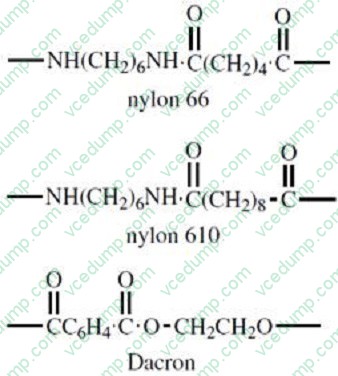
Figure 2
Dacron belongs to which of the following general classifications?
A. Polyamide
B. Polyester
C. Polyurethane
D. Polypeptide -
Question 309:
Four major blood types exist in the human ABO blood system: types A, B, AB, and O; and there are three alleles that code for them. The A and B alleles are codominant, and the O allele is recessive. Blood types are derived from the presence of specific polysaccharide antigens that lie on the outer surface of the red blood cell membrane. The A allele codes for the production of the A antigen; the B allele codes for the production of the B antigen; the O allele does not code for any antigen. While there are many other antigens found on red blood cell membranes, the second most important antigen is the Rh antigen. Rh is an autosomally dominant trait coded for by 2 alleles. If this antigen is present, an individual is Rh+; if it is absent, an individual is Rh-. For example, a person with type AB blood with the Rh antigen is said to be AB+. These antigens become most important when an individual comes into contact with foreign blood. Because of the presence of naturally occurring substances that closely mimic the A and B antigens, individuals who do not have these antigens on their red blood cells will form antibodies against them. This is inconsequential until situations such as blood transfusion, organ transplant, or pregnancy occur.
Erythroblastosis fetalis is a condition in which the red blood cells of an Rh+ fetus are attached by antibodies produced by its Rh- mother. Unlike ABO incompatibility, in which there are naturally occurring antibodies to foreign antigens, the Rh system requires prior sensitization to the Rh antigen before antibodies are produced. This sensitization usually occurs during the delivery of an Rh+ baby. So while the first baby will not be harmed, any further Rh+ fetuses are at risk.
The Coombs tests provide a method for determining whether a mother has mounted an immune response again her baby's blood. The tests are based on whether or not agglutination occurs when Coombs reagent is added to a sample. Coombs reagent contains antibodies against the anti-Rh antibodies produced by the mother. The indirect Coombs test takes the mother's serum, which contains her antibodies but no red blood cells, and mixes it with Rh+ red blood cells. Coombs reagent is then added. If agglutination occurs, the test is positive, and the mother must be producing anti-Rh antibodies. The direct Coombs test mixes the baby's red blood cells with Coombs reagent. If agglutination occurs, the test is positive, and the baby's red blood cells must have been attacked by its mother's anti-Rh antibodies.
A woman who has never been pregnant has type B- blood. Which of the following antibodies would you expect to find in her serum?
A. Anti-B antibody
B. Anti-A antibody
C. Anti-Rh antibody
D. Both anti-A and anti-Rh antibodies -
Question 310:
The value of the water dissociation constant Kw varies with temperature. Its value is normally given as 1.00 x 10⁻¹⁴ mol2 dm-6 at room temperature but 1.00 x 10⁻¹³ mol2 dm-6 at 60 °C. What is the pH of pure water at 60 °C?
A. Equal to 7.0 thus the water is neutral.
B. Less than 7.0 thus the water is acidic.
C. Less than 7.0 but the water is basic.
D. Less than 7.0 but the water is neutral.
Related Exams:
Tips on How to Prepare for the Exams
Nowadays, the certification exams become more and more important and required by more and more enterprises when applying for a job. But how to prepare for the exam effectively? How to prepare for the exam in a short time with less efforts? How to get a ideal result and how to find the most reliable resources? Here on Vcedump.com, you will find all the answers. Vcedump.com provide not only Medical Tests exam questions, answers and explanations but also complete assistance on your exam preparation and certification application. If you are confused on your MCAT-TEST exam preparations and Medical Tests certification application, do not hesitate to visit our Vcedump.com to find your solutions here.