MCAT-TEST Exam Details
-
Exam Code
:MCAT-TEST -
Exam Name
:Medical College Admission Test: Verbal Reasoning, Biological Sciences, Physical Sciences, Writing Sample -
Certification
:Medical Tests Certifications -
Vendor
:Medical Tests -
Total Questions
:812 Q&As -
Last Updated
:Jul 16, 2026
Medical Tests MCAT-TEST Online Questions & Answers
-
Question 321:
Four major blood types exist in the human ABO blood system: types A, B, AB, and O; and there are three alleles that code for them. The A and B alleles are codominant, and the O allele is recessive. Blood types are derived from the presence of specific polysaccharide antigens that lie on the outer surface of the red blood cell membrane. The A allele codes for the production of the A antigen; the B allele codes for the production of the B antigen; the O allele does not code for any antigen. While there are many other antigens found on red blood cell membranes, the second most important antigen is the Rh antigen. Rh is an autosomally dominant trait coded for by 2 alleles. If this antigen is present, an individual is Rh+; if it is absent, an individual is Rh-. For example, a person with type AB blood with the Rh antigen is said to be AB+.
These antigens become most important when an individual comes into contact with foreign blood. Because of the presence of naturally occurring substances that closely mimic the A and B antigens, individuals who do not have these antigens on their red blood cells will form antibodies against them. This is inconsequential until situations such as blood transfusion, organ transplant, or pregnancy occur.
Erythroblastosis fetalis is a condition in which the red blood cells of an Rh+ fetus are attached by antibodies produced by its Rh- mother. Unlike ABO incompatibility, in which there are naturally occurring antibodies to foreign antigens, the Rh system requires prior sensitization to the Rh antigen before antibodies are produced. This sensitization usually occurs during the delivery of an Rh+ baby. So while the first baby will not be harmed, any further Rh+ fetuses are at risk.
The Coombs tests provide a method for determining whether a mother has mounted an immune response again her baby's blood. The tests are based on whether or not agglutination occurs when Coombs reagent is added to a sample. Coombs reagent contains antibodies against the anti-Rh antibodies produced by the mother. The indirect Coombs test takes the mother's serum, which contains her antibodies but no red blood cells, and mixes it with Rh+ red blood cells. Coombs reagent is then added. If agglutination occurs, the test is positive, and the mother must be producing anti-Rh antibodies. The direct Coombs test mixes the baby's red blood cells with Coombs reagent. If agglutination occurs, the test is positive, and the baby's red blood cells must have been attacked by its mother's anti-Rh antibodies.
A couple decide to have a child. If the father's genotype is AO and the mother has type B blood of unknown genotype, which of the following are possible blood types for their child?
I. A
II. B
III. A, B
IV.
O
A. I and II only
B. I, II, and III only
C. I, II, and IV only
D. I, II, III, and IV
I. A II. B III. A, B IV. O -
Question 322:
Our sense of smell is arguably the most powerful of our five senses, but it also the most elusive. It plays a vital yet mysterious role in our lives. Olfaction is rooted in the same part of the brain that regulates such essential functions as body metabolism, reaction to stress, and appetite. But smell relates to more than physiological function: its sensations are intimately tied to memory, emotion, and sexual desire. Smell seems to lie somewhere beyond the realm of conscious thought, where, intertwined with emotion and experience, it shapes both our conscious and unconscious lives.
The peculiar intimacy of this sense may be related to certain anatomical features. Smell reaches the brain more directly than do sensations of touch, sight, or sound. When we inhale a particular odor, air containing volatile odiferous molecules is warmed and humidified as it flows over specialized bones in the nose called turbinates. As odor molecules land on the olfactory nerves, these nerves fire a message to the brain. Thus olfactory neurons render a direct path between the stimulus provided by the outside environment and the brain, allowing us to rapidly perceive odors ranging from alluring fragrances to noisome fumes.
Certain scents, such as jasmine, are almost universally appealing, while others, like hydrogen sulfide (which emits a stench reminiscent of rotten eggs), are usually considered repellent, but most odors evoke different reactions from person to person, sometimes triggering strong emotional states or resurrecting seemingly forgotten memories. Scientists surmise that the reason why we have highly personal associations with smells is related to the proximity of the olfactory and emotional centers of our brain. Although the precise connection between emotion and olfaction remains a mystery, it is clear that emotion, memory, and smell are all rooted in a part of the brain called the limbic lobe.
Even though we are not always conscious of the presence of odors, and are often unable to either articulate or remember their unique characteristics, our brains always register their existence. In fact, such a large amount of human brain tissue is devoted to smell that scientists surmise the role of this sense must be profound. Moreover, neurobiological research suggests that smell must have an important function because olfactory neurons can regenerate themselves, unlike most other nerve cells. The importance of this sense is further supported by the fact that animals experimentally denied the olfactory sense do not develop full and normal brain function.
The significance of olfaction is much clearer in animals than in human beings. Animal behavior is strongly influenced by pheromones, which are odors that induce psychological or behavioral changes and often provide a means of communicating within a species. These chemical messages, often a complex blend of compounds, are of vital importance to the insect world. Honeybees, for example, organize their societies through odor: the queen bee exudes an odor that both inhibits worker bees from laying eggs and draws drones to her when she is ready to mate. Mammals are also guided by their sense of smell. Through odors emitted by urine and scent glands, many animals maintain their territories, identify one another, signal alarm, and attract mates.
Although our olfactory acuity can't rival that of other animal species, human beings are also guided by smell. Before the advent of sophisticated laboratory techniques, physicians depended on their noses to help diagnose illness. A century ago, it was common medical knowledge that certain bacterial infections carry the musty odor of wine, that typhoid smells like baking bread, and that yellow fever smells like meat. While medical science has moved away from such subjective diagnostic methods, in everyday life we continue to rely on our sense of small, knowingly or not, to guide us.
The author answers all of the following questions EXCEPT:
A. why smells can evoke distant memories.
B. why odors elicit different reactions from person to person.
C. why a substantial part of the brain is devoted to smell.
D. which functions are rooted in the limbic lobe. -
Question 323:
TMS (tetramethylsilane) is commonly added to nuclear magnetic resonance (NMR) samples. It has a chemical shift which is upfield of most organic signals, and it gives a strong, sharp singlet peak and can be easily removed. Why is TMS added to NMR samples?
A. to reduce noise in the spectrum
B. to calibrate the NMR spectrum
C. to react with the sample
D. to provide a lock signal -
Question 324:
The lead-acid battery, also called a lead storage battery, is the battery of choice for starting automobiles. It contains 6 cells connected in series, each composed of a lead oxide cathode "sandwiched" between 2 lead anodes. Insulating separators are placed between the electrodes to prevent internal short-circuits. Aqueous sulfuric acid is the electrolyte.
When the battery is being discharged, the following reaction takes place:

Reaction 1
The electrode reactions, both written as reductions, are shown in Table 1.
Table 1
Half-reaction
E?V)
PbO2(s) + SO42-(aq) + 4H+(aq) + 2ePbSO4(s) + 2H2O
PbSO4(s) + 2e-Pb(s) + SO42-(aq)
?.36
As a car operates, the battery is recharged by electricity produced by the car's alternator, an AC generator whose ultimate power source is the car's internal combustion engine. In spite of this, batteries eventually lose their power. The battery
is said to be "dead" when Reaction 1 has proceeded completely to the right.
Which of the following occurs as the battery is being recharged?
A. Option A
B. Option B
C. Option C
D. Option D -
Question 325:
The resistance of a resistor is defined as the ratio of the voltage drop across it to the current passing through it. The resistance of a resistor can be measured using the circuit illustrated in Figure 1.
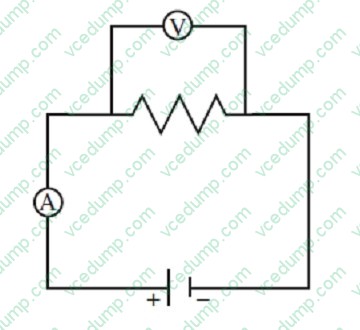
Figure 1
In the above circuit, a variable voltage source with negligible internal resistance is connected to a resistor. The voltage across the resistor is measured by a voltmeter and the current through the resistor is measured by an ammeter.

Additional resistors may be added to the circuit. The total resistance can be calculated as follows: If and are two resistances of two resistors, then the total resistance is given by = + when the resistors are connected in

series, and by 1/ = 1/ + 1/ when the resistors are connected in parallel.

Circuits similar to the one above are used in the common household appliance known as the toaster. The rate by which energy in the form of heat is dissipated by the resistor equals , where I is the current that passes through the resistor and R is the resistance of the resistor. Energy is dissipated in a resistor because moving electrons collide with atoms in the resistor, causing the atoms to vibrate.

What is the energy delivered to a piece of toast in one second when it is inside a toaster in which a 4 a current passes through a 10-k resistor?
A. 0.04 J
B. 0.16 J
C. 2.5 J
D. 40 J -
Question 326:
Hemoglobin (Hb) and myoglobin (Mb) are the O2-carrying proteins in vertebrates. Hb, which is contained within red blood cells, serves as the O2 carrier in blood and also plays a vital role in the transport of CO2 and H+. Vertebrate Hb consists of four polypeptides (subunits) each with a heme group. The four chains are held together by noncovalent attractions. The affinity of Hb for O2 varies between species and within species depending on such factors as blood pH, stage of development, and body size. For example, small mammals give up O2 more readily than large mammals because small mammals have a higher metabolic rate and require more O2 per gram of tissue.
The binding of O2 to Hb is also dependent on the cooperativity of the Hb subunits. That is, binding at one heme facilitates the binding of O2 at the other hemes within the Hb molecule by altering the conformation of the entire molecule. This conformational change makes subsequent binding of O2 more energetically favorable. Conversely, the unloading of O2 at one heme facilitates the unloading of O2 at the others by a similar mechanism.
Figure 1 depicts the O2-dissociation curves of Hb (Curves A, B, and C) and myoglobin (Curve D), where saturation, Y, is the fractional occupancy of the O2-binding sites. The fraction of O2 that is transferred from Hb as the blood passes through the tissue capillaries is called the utilization coefficient. A normal value is approximately 0.25.
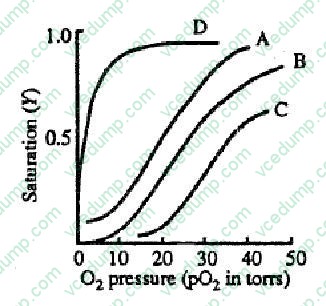
Figure 1
Myoglobin facilitates transport in muscle and serves as a reserve store of O2. Mb is a single polypeptide chain containing a heme group, with a molecular weight of 18 kd. As can be seen in Figure 1, Mb (Curve D) has a greater affinity for
than Hb.
In sperm whales, the Mb content of muscle is about 0.004 moles/kg of muscle. If a sperm whale has 1000 kg of muscle, approximately how much O2 is bound to Mb, assuming that the Mb is saturated with O2?
A. 4 moles
B. 8 moles
C. 12 moles
D. 16 moles -
Question 327:
In response to period of extreme psychological trauma, a patient begins experiencing a feeling of detachment. He says, "I felt like it wasn't real while it was happening. I was just watching myself do it without any control. I mean, you know, I knew it was happening but I didn't feel like it was." The patient is describing:
A. dissociative identity disorder.
B. an anxiety disorder.
C. depersonalization disorder.
D. a schizophrenic episode. -
Question 328:
The nuclei of certain unstable isotopes will spontaneously decay, producing a more stable nucleus and releasing a particle or quantity of energy. Alpha decay releases a helium nucleus, beta decay emits an electron, while gamma decay is the emission of a high energy photon. Each type of radioactive decay is characterized, in part, by the half-life of the radioactive material--the time required for half of the nuclei in a sample to undergo decay. Examples of such decays are shown in Figure 1.
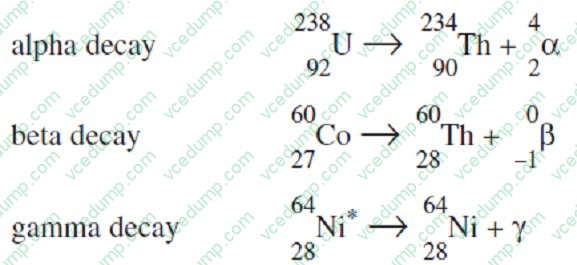
Figure 1
A Geiger counter can be used to detect the decay of radioactive materials. A simple Geiger counter consists of a hollow metal cylinder with a wire along its axis. The cylinder is filled with low pressure argon gas and a high voltage difference is
applied between the wire and the cylinder. When alpha, beta, or gamma radiation passes through the cylinder, it interacts with the gas particles and leads to the formation of ions which cause a discharge between the wire and the cylinder.
The consequent current may be used to drive a speaker, producing the characteristic clicking sound of the Geiger counter each time a pulse of current occurs. The Geiger counter circuitry is shown in Figure 2.
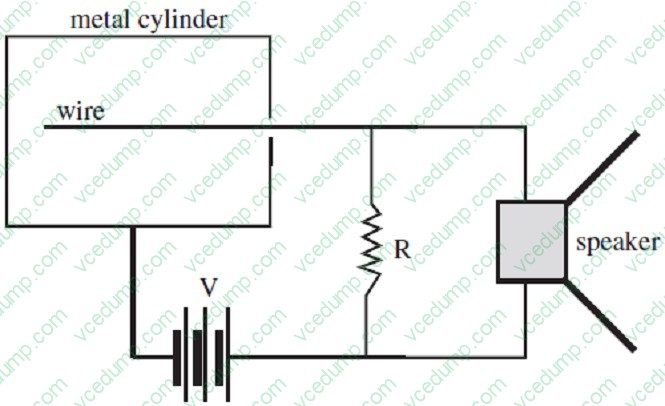
Figure 2
A Geiger counter is best suited for which of the following applications:
A. comparing the relative magnitudes of radioactivities of two nuclear waste depositories.
B. spatially locating a radioactive isotope injected into a patient.
C. calculating the total energy of a radioactive particle.
D. determining the identity of various types of radioactivity. -
Question 329:
Bebop lives! cries the newest generation of jazz players. During the 1980s, musicians like Wynton Marsalis revived public interest in bebop, the speedy, angular music that first bubbled up out of Harlem in the early 1940s, changing the face of jazz. That Marsalis and others thought of themselves as celebrating and preserving a noble tradition is, in one sense, inevitable. After the excesses of experimental or "free" jazz in the 1960s and the electronic jazz-rock "fusion" of the 70s, it is hardly surprising that people should hearken back to a time when jazz was "purer," perhaps even at the apex of its development. But the recent enthusiasm for bebop is also ironic in light of the music's initial public reception. In its infancy, during the first two decades of the 20th century, jazz was played by small groups of musicians improvising variations on blues tunes and popular songs. Most of the musicians were unable to read music, and their improvisations were fairly rudimentary. Nevertheless, jazz attained international recognition in the 1920s. Two of the people most responsible for its rise in popularity were Louis Armstrong, the first great jazz soloist, and Fletcher Henderson, leader of the first great jazz band. Armstrong, with his buoyant personality and virtuosic technical skills, greatly expanded the creative range and importance of the soloist in jazz. Henderson, a pianist with extensive training in music theory, foresaw the orchestral possibilities of jazz played by a larger band. He wrote out arrangements of songs for his band members that preserved the spirit of jazz, while at the same time giving soloists a more structured musical background upon which to shape their solo improvisations. In the 1930s, jazz moved further into the mainstream with the advent of the Swing Era. Big bands in the Henderson mold, led by musicians like Benny Goodman, Count Basie and Duke Ellington, achieved unprecedented popularity with jazz-oriented "swing" music that was eminently danceable.
Against this musical backdrop, bebop arrived on the scene. Like other modernist movements in art and literature, bebop music represented a departure from tradition in both form and content, and was met with initial hostility. Bebop tempos were unusually fast, with the soloist often playing at double time to the backing musicians. The rhythms were tricky and complex, the melodies intricate and frequently dissonant, involving chord changes and notes not previously heard in jazz. Before bebop, jazz players had improvised on popular songs such as those produced by Tin-Pan Alley, but bebop tunes were often originals with which jazz audiences were unfamiliar.
Played mainly by small combos rather than big bands, bebop was not danceable; it demanded intellectual concentration. Soon, jazz began to lose its hold on the popular audience, which found the new music disconcerting. Compounding public alienation was the fact that bebop seemed to have arrived on the scene in a completely mature state of development, without that early phase of experimentation that typifies so many movements in the course of Western music. This was as much the result of an accident of history as anything else. The early development of bebop occurred during a three-year ban on recording in this country made necessary by the petrol and vinyl shortages of World War II. By the time the ban was lifted, and the first bebop records were made, the new music seemed to have sprung fully-formed like Athena from the forehead of Zeus. And though a small core of enthusiasts would continue to worship bebop pioneers like Charlie Parker and Dizzy Gillespie, many bebop musicians were never able to gain acceptance with any audience and went on to lead lives of obscurity and deprivation.
The author suggests that bebop seemed to represent a radical departure from earlier jazz in that it:
A. grew to maturity before reaching a wide audience.
B. attracted primarily a youthful audience.
C. dispensed with written arrangements of songs.
D. expressed the alienation of the musicians who played it. -
Question 330:
According to the reaction coordinate diagram shown below, which of the following forward reactions would proceed most rapidly at high temperatures?
A. A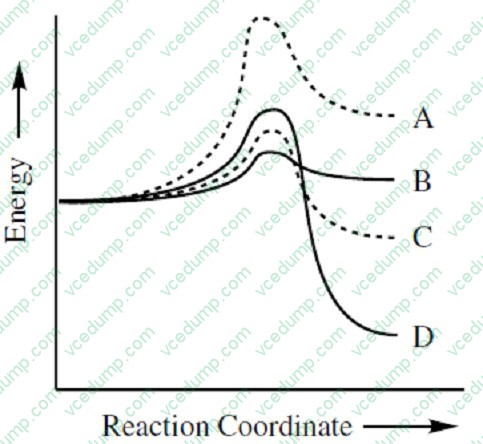
B. B
C. C
D. D
Related Exams:
Tips on How to Prepare for the Exams
Nowadays, the certification exams become more and more important and required by more and more enterprises when applying for a job. But how to prepare for the exam effectively? How to prepare for the exam in a short time with less efforts? How to get a ideal result and how to find the most reliable resources? Here on Vcedump.com, you will find all the answers. Vcedump.com provide not only Medical Tests exam questions, answers and explanations but also complete assistance on your exam preparation and certification application. If you are confused on your MCAT-TEST exam preparations and Medical Tests certification application, do not hesitate to visit our Vcedump.com to find your solutions here.