MCAT-TEST Exam Details
-
Exam Code
:MCAT-TEST -
Exam Name
:Medical College Admission Test: Verbal Reasoning, Biological Sciences, Physical Sciences, Writing Sample -
Certification
:Medical Tests Certifications -
Vendor
:Medical Tests -
Total Questions
:812 Q&As -
Last Updated
:Jul 16, 2026
Medical Tests MCAT-TEST Online Questions & Answers
-
Question 281:
The pages of the look are visible to us because they:
A. absorb light.
B. emit light.
C. reflect light.
D. refract light. -
Question 282:
When light in the ultraviolet region of the spectrum is shone on a type of material known as a phosphor, it fluoresces and emits light in the visible region of the spectrum. Lamps that utilize this property, known as fluorescent lamps, are very efficient light sources. The arrangement of a typical fluorescent lamp is shown below. The lamp is a glass tube whose inside walls are covered with a phosphor. The tube has an appreciable length-to-diameter ratio so as to reduce the power losses at each end, and it is filled with argon gas mixed with mercury vapor. Inside each end of the tube are tungsten electrodes covered with an emission material.
Electrons are liberated at the cathode and accelerated by an applied electric field. These free electrons encounter the gas mixture, ionizing some mercury atoms and exciting others. Since it requires more energy to ionize the atoms than to excite the electrons, more excitation than ionization occurs. When the excited electrons revert to their ground state, they radiate ultraviolet photons with a wavelength of 253.7 nm. These photons impinge on the phosphor coating of the tube and excite electrons in the phosphor to higher energy states. The excited electrons in the phosphor return to their ground state in two or more steps, producing radiation in the visible region of the spectrum. Not every fluorescent lamp emits the same color of radiation; the color is dependent on the relative percentages of different heavy metal compounds in the phosphor.
The fluorescent lamp shown operates at 100 volts and draws 400 milliamps of current during normal operation. Of the total power that the lamp consumes, only 25% is converted to light, while the remaining 75% is dissipated as heat. This energy keeps the lamp at its optimum working temperature of 40°C. In the lamp shown, the phosphor coating is calcium metasilicate, which emits orange to yellow light.
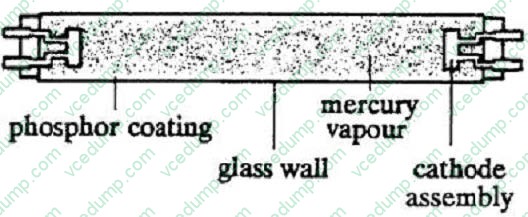
The lamp also emits a small proportion of ultraviolet light in addition to the light emitted in the visible spectrum. This ultraviolet light is incident on a metal that has a work function, which is the minimum energy necessary to free an electron, of
2.00 eV. What will be the kinetic energy of an electron that is ejected from the metal if the frequency of the incident light is 1.2?015 Hz? (Note: h = 4.14?0-15 eV穝.)?
A. 9.936 eV
B. 6.948 eV
C. 4.968 eV
D. 2.968 eV -
Question 283:
Rancidity involves:
A. oxidation and reduction.
B. oxidation and hydrolysis.
C. hydrolysis and reduction.
D. reduction only. -
Question 284:
The rich analyses of Fernand Braudel and his fellow Annales historians have made significant contributions to historical theory and research. In a departure from traditional historical approaches, the Annales historians, assume (as do Marxists) that history cannot be limited to a simple recounting of conscious human actions, but must be understood in the context of forces and material conditions that underlie human behavior. Braudel was the first Annales historian to gain widespread support of the idea that history should synthesize data from various social sciences, especially economics, in order to provide a broader view of human societies over time (although Febvre and Bloch, founders of the Annales school, had originated this approach).
Braudel conceived of history as the dynamic interaction of three temporalities. The first of these, the evenementielle, involved short-lived dramatic "events," such as battles, revolutions and the actions of great men, which had preoccupied traditional historians like Carlyle. Conjonctures was Braudel's term for larger cyclical processes that might last up to half a century. The longue duree, a historical wave of great length, was for Braudel the most fascinating of the three temporalities. Here he focused on those aspects of everyday life that might remain relatively unchanged for centuries. What people ate, what they wore, their means and routes of travel -- for Braudel these things create "structures" which define the limits of potential social change for hundreds of years at a time. Braudel's concept of the longue duree extended the perspective of historical space as well as time. Until the Annales school, historians had taken the juridical political unit the nation-state, duchy, or whatever as their starting point. Yet, when such enormous timespans are considered, geographical features may well have more significance for human populations than national borders. In his doctoral thesis, a seminal work on the Mediterranean during the reign of Philip II, Braudel treated the geohistory of the entire region as a "structure" that had exerted myriad influences on human lifeways since the first settlements on the shores of the Mediterranean Sea. And so the reader is given such arcane information as the list of products that came to Spanish shores from North Africa, the seasonal routes followed by Mediterranean sheep and their shepherds, and the cities where the best ship timber could be bought. Braudel has been faulted for the imprecision of his approach. With his Rabelaisian delight in concrete detail, Braudel vastly extended the realm of relevant phenomena; but this very achievement made it difficult to delimit the boundaries of observation, a task necessary to beginning any social investigation. Further, Braudel and other Annales historians minimize the differences among the social sciences. Nevertheless, the many similarly-designed studies aimed at both professional and popular audiences indicate that Braudel asked significant questions which traditional historians had overlooked.
Which of the following statements would be most likely to follow the last sentence of the passage?
A. Few such studies, however, have been written by trained economists.
B. It is time, perhaps, for a revival of the Carlylean emphasis on personalities.
C. Many historians believe that Braudel's conception of three distinct "temporalities" is an oversimplification.
D. Such diverse works as Gascon's study of Lyon and Barbara Tuchman's A Distant Mirror testify to his relevance. -
Question 285:
In 1965, Boris Deryagin reported the discovery of an unusual substance formed during the condensation of water vapor in quartz capillaries. The material, called poly-water, appeared to be a polymer of water monomers and differed from normal water in a number of ways. It had a freezing point of ?0?C and solidified into a glass-like solid with substantially less volumetric expansion than that of ordinary water upon freezing. It had a density 40% greater than water and a refractive index of 1.48.
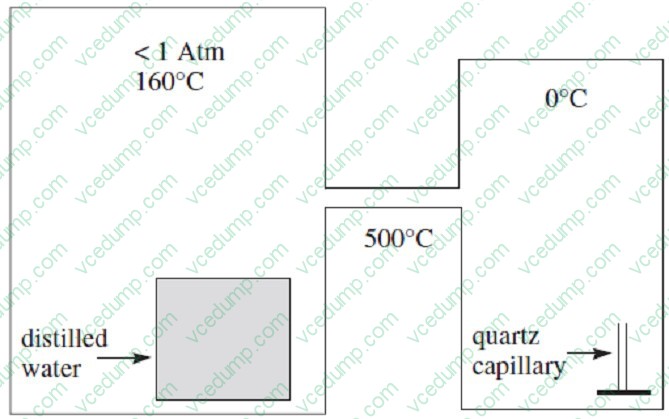
An intricate apparatus was used to produce the poly-water. Ordinary distilled water was placed in a chamber held at 160?C with pressure below atmospheric pressure. This chamber was connected to a second chamber by a tube held at 500?C in order to prevent the passage of liquid water. The second chamber was held at 0?C and contained a drawn quartz capillary in which the water vapor condensed, forming poly-water.
Hypothesis 1
Deryagin proposed that polywater was a polymer of water monomers arranged in a network of hexagonal units. The polymerization was catalyzed by the silicate surface of the quartz capillary.
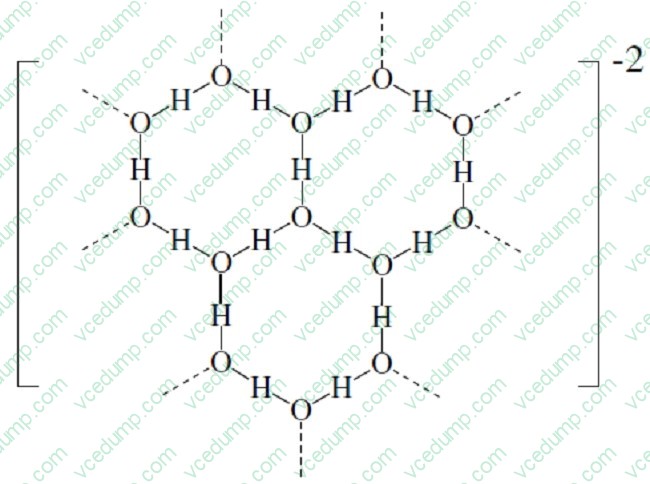
Proposed Structure of Polywater Hypothesis 2
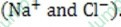
Another researcher was skeptical. Analysis indicated that polywater was merely a solution of water and dissolved particles including silicon, carbon dioxide, and substantial concentrations of ions These contaminants dissolved from the quartz capillary and from materials used in the apparatus.

(constants for normal water : density = 1 g/c , index of refraction = 1.33 , freezing point depression constant = 1.86°C )
Assume that Hypothesis 2 is correct. Compared to normal water, polywater would have a:
A. lower vapor pressure and higher boiling point.
B. lower vapor pressure and lower boiling point.
C. higher vapor pressure and lower boiling point.
D. similar vapor pressure and boiling point. -
Question 286:
When food is scarce, tool use among non-human primates does not increase. This counterintuitive finding leads researchers to suggest that the driving force behind tool use is ecological opportunity ?and that the environment shapes development of culture. Whether you're a human being or an orangutan, tools can be a big help in getting what you need to survive. However, a review of current research into the use of tools by non-human primates suggests that ecological opportunity, rather than necessity, is the main driver behind primates such as chimpanzees picking up a stone to crack open nuts. An opinion piece by Dr Kathelijne Koops of the University of Cambridge and others, published today (12 November 2014) in Biology Letters, challenges the assumption that necessity is the mother of invention. She and her colleagues argue that research into tool use by primates should look at the opportunities for tool use provided by the local environment.
Science Daily and University of Cambridge, Tools and primates: Opportunity, not necessity, is the mother of invention, 2014.
This two-paragraph passage is the introduction to the article cited below the passage. From just this introduction, it can be assumed that the author will most likely use the following technique to support the premise of the article:
A. The author will use data from a variety of studies to support the title statement.
B. The author will construct an argument against Koops' opinion piece in the remainder of the article.
C. The author will use a list of cause-and-effect relationships to support the title statement.
D. The author will use specific information from Koops' opinion piece to support the title statement. -
Question 287:
Due to ever-increasing paranoia about the transmission of hepatitis and AIDS via blood transfusions and the frequent difficulty of procuring matching blood donors for patients, researchers have been working at a feverish pace to produce disease-free and easy-to-use blood substitutes. The difficulty most synthetic blood researches have had is in formulating a substance that combines qualities of sterility, high capacity for carrying oxygen to body tissues, and versatility within the human body. Three major substitute technologies have been developed to date; each has certain advantages and shortcomings.
"Red blood," the first of the blood substitute technologies, is derived from hemoglobin which has been recycled from old, dead, or worn-out red blood cells and modified so that it can carry oxygen outside the red blood cell. Hemoglobin, a complex protein, is the blood's natural oxygen carrier and is attractive to scientists for use in synthetic blood because of its oxygen-carrying capacity. However, hemoglobin can sometimes constitute a two-fold threat to humans when it is extracted from the red blood cell and introduced to the body in its naked form. First, hemoglobin molecules are rarely sterile and often remain contaminated by viruses to which they were exposed in the cell. Second, naked hemoglobin is extremely dangerous to the kidneys, causing blood flow at these organs to shut down and leading, ultimately, to renal failure. Additional problems arise from the fact that hemoglobin is adapted to operate optimally within the intricate environment of the red blood cell. Stripped of the protection of the cell, the hemoglobin molecule tends to suffer breakdown within several hours. Although modification has produced more durable hemoglobin molecules which do not cause renal failure, undesired side effects continue to plague patients and hinder the development of hemoglobin-based blood substitutes.
Another synthetic blood alternative, "white blood," is dependent on laboratory synthesized chemicals called perfluorocarbons (PFCs). Unlike blood, PFCs are clear oil like liquids, yet they are capable of absorbing quantities of oxygen up to 50% of their volume, enough of an oxygen carrying potential for oxygen-dependent organisms to survive submerged in the liquid for hours by "breathing" it. Although PFCs imitate real blood by effectively absorbing oxygen, scientists are primarily interested in them as constituents of blood substitutes because they are inherently safer to use than hemoglobin-based substitutes. PFCs do not interact with any chemicals in the body and can be manufactured in near-perfect sterility. The primary pitfall of PFCs is in their tendency to form globules in plasma that can block circulation. Dissolving PFCs in solution can mitigate globulation; however, this procedure also seriously curtails the PFCs' oxygen capacity.
The final and perhaps most ambitious attempt to form a blood substitute involves the synthesis of a modified version of human hemoglobin by genetically-altered bacteria. Fortunately, this synthetic hemoglobin seems to closely mimic the qualities of sterility, and durability outside the cellular environment, and the oxygen-carrying efficiency of blood. Furthermore, researchers have found that if modified hemoglobin genes are added to bacterial DNA, the bacteria will produce the desired product in copious quantities. This procedure is extremely challenging, however, because it requires the isolation of the human gene for the production of hemoglobin, and the modification of the gene to express a molecule that works without support from a living cell.
While all the above technologies have serious drawbacks and difficulties, work to perfect an ideal blood substitute continues. Scientists hope that in the near future safe synthetic blood transfusions may ease blood shortages and resolve the unavailability of various blood types.
The author mentions all of the following as weaknesses of synthetic bloods EXCEPT:
A. naked hemoglobin can cause renal failure in humans.
B. "red blood" can transmit viruses to a recipient.
C. genetic engineering can be extremely difficult.
D. "white blood" has a low oxygen-carrying potential. -
Question 288:
Alleles are created when a single gene undergoes several distinct mutations. These alleles may have different dominance relationships with one another; for example, there are three alleles coding for the human blood groups, the IA, IB, and i alleles. Both the IA and IB alleles are dominant to the i allele, but IA and IB are codominant to each other.
A multiple-allele system has recently been discovered in the determination of hair coloring in a species of wild rat. The rats are found to have one of three colors: brown, red, or white. Let B = the gene for brown hair; b = the gene for red hair; and w = the gene for white hair. The results from nine experimental crosses are shown below. The males and females in Crosses 1, 2, and 3 are all homozygous for hair color.
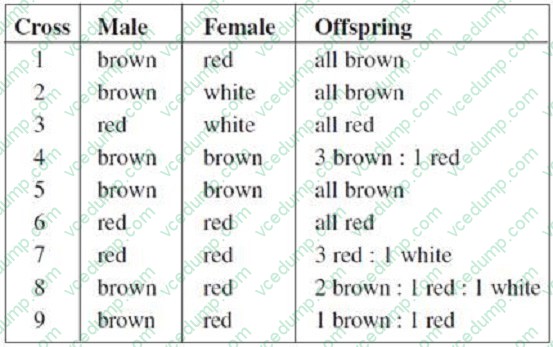
If a large number of brown offspring from Cross 8 are mated with each other, what is the expected percentage of white offspring?
A. 6.25%
B. 8.33%
C. 12.5%
D. 25% -
Question 289:
It is critical for the human body blood to maintain its pH at approximately 7.4. Decreased or increased blood pH are called acidosis and alkalosis respectively; both are serious metabolic problems that can cause death. The table below lists the major buffers found in the blood and/or kidneys. Table 1 Buffer pKa of a typical conjugate acid:*
+ Histidine side chains

Organic phosphates N-terminal amino groups

6.1
6.3
6.8
7.0
8.0
9.2

*For buffers in many of these categories, there is a range of actual values.
The relationship between blood pH and the of any buffer can be described by the Henderson-Hasselbalch equation:
pH = + log([conjugate base]/[conjugate acid]) Equation 1

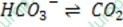
Bicarbonate, the most important buffer in the plasma, enters the blood in the form of carbon dioxide, a byproduct of metabolism, and leaves in two forms: exhaled and excreted bicarbonate. Blood pH can be adjusted rapidly by changes
in the rate of exhalation. The reaction given below, which is catalyzed by carbonic anhydrase in the erythrocytes, describes how bicarbonate and interact in the blood.
+ + Reaction 1
What would be the order of conjugate acid strength in the following buffers?
A. Option A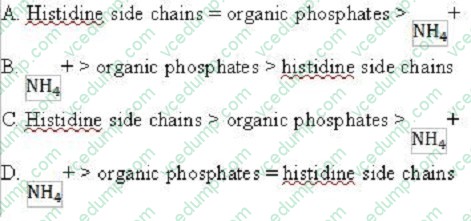
B. Option B
C. Option C
D. Option D -
Question 290:
Agonistic behavior, or aggression, is exhibited by most of the more than three million species of animals on this planet. Animal behaviorists still disagree on a comprehensive definition of the term, but aggressive behavior can be loosely described as any action that harms an adversary or compels it to retreat. Aggression may serve many purposes, such as food gathering, establishing territory, and enforcing social hierarchy. In a general Darwinian sense, however, the purpose of aggressive behavior is to increase the individual animal's -- and thus, the species' -- chance of survival. Aggressive behavior may be directed at animals of other species, or it may be conspecific -- that is, directed at members of an animal's own species. One of the most common examples of conspecific aggression occurs in the establishment and maintenance of social hierarchies. In a hierarchy, social dominance is usually established according to physical superiority; the classic example is that of a pecking order among domestic fowl. The dominance hierarchy may be viewed as a means of social control that reduces the incidence of attack within a group. Once established, the hierarchy is rarely threatened by disputes because the inferior animal immediately submits when confronted by a superior. Two basic types of aggressive behavior are common to most species: attack and defensive threat. Each type involves a particular pattern of physiological and behavioral responses, which tends not to vary regardless of the stimulus that provokes it. For example, the pattern of attack behavior in cats involves a series of movements, such as stalking, biting, seizing with the forepaws and scratching with the hind legs, that changes very little regardless of the stimulus -- that is, regardless of who or what the cat is attacking. The cat's defensive threat response offers another set of closely linked physiological and behavioral patterns. The cardiovascular system begins to pump blood at a faster rate, in preparation for sudden physical activity. The eyes narrow and the ears flatten against the side of the cat's head for protection, and other vulnerable areas of the body such as the stomach and throat are similarly contracted. Growling or hissing noises and erect fur also signal defensive threat. As with the attack response, this pattern of responses is generated with little variation regardless of the nature of the stimulus. Are these aggressive patterns of attack and defensive threat innate, genetically programmed, or are they learned? The answer seems to be a combination of both. A mouse is helpless at birth, but by its 12th day of life can assume a defensive threat position by backing up on its hind legs. By the time it is one month old, the mouse begins to exhibit the attack response. Nonetheless, copious evidence suggests that animals learn and practice aggressive behavior; one need look no further than the sight of a kitten playing with a ball of string. All the elements of attack -- stalking, pouncing, biting and shaking -- are part of the game which prepares the kitten for more serious situations later in life.
Which of the following topics related to agonistic behavior is NOT explicitly addressed in the passage?
A. The physiological changes that accompany attack behavior in cats
B. The evolutionary purpose of aggression
C. Conspecific aggression that occurs in dominance hierarchies
D. The relationship between play and aggression
Related Exams:
Tips on How to Prepare for the Exams
Nowadays, the certification exams become more and more important and required by more and more enterprises when applying for a job. But how to prepare for the exam effectively? How to prepare for the exam in a short time with less efforts? How to get a ideal result and how to find the most reliable resources? Here on Vcedump.com, you will find all the answers. Vcedump.com provide not only Medical Tests exam questions, answers and explanations but also complete assistance on your exam preparation and certification application. If you are confused on your MCAT-TEST exam preparations and Medical Tests certification application, do not hesitate to visit our Vcedump.com to find your solutions here.