MCAT-TEST Exam Details
-
Exam Code
:MCAT-TEST -
Exam Name
:Medical College Admission Test: Verbal Reasoning, Biological Sciences, Physical Sciences, Writing Sample -
Certification
:Medical Tests Certifications -
Vendor
:Medical Tests -
Total Questions
:812 Q&As -
Last Updated
:Jul 16, 2026
Medical Tests MCAT-TEST Online Questions & Answers
-
Question 271:
Four major blood types exist in the human ABO blood system: types A, B, AB, and O; and there are three alleles that code for them. The A and B alleles are codominant, and the O allele is recessive. Blood types are derived from the presence of specific polysaccharide antigens that lie on the outer surface of the red blood cell membrane. The A allele codes for the production of the A antigen; the B allele codes for the production of the B antigen; the O allele does not code for any antigen. While there are many other antigens found on red blood cell membranes, the second most important antigen is the Rh antigen. Rh is an autosomally dominant trait coded for by 2 alleles. If this antigen is present, an individual is Rh+; if it is absent, an individual is Rh-. For example, a person with type AB blood with the Rh antigen is said to be AB+.
These antigens become most important when an individual comes into contact with foreign blood. Because of the presence of naturally occurring substances that closely mimic the A and B antigens, individuals who do not have these antigens on their red blood cells will form antibodies against them. This is inconsequential until situations such as blood transfusion, organ transplant, or pregnancy occur.
Erythroblastosis fetalis is a condition in which the red blood cells of an Rh+ fetus are attached by antibodies produced by its Rh- mother. Unlike ABO incompatibility, in which there are naturally occurring antibodies to foreign antigens, the Rh system requires prior sensitization to the Rh antigen before antibodies are produced. This sensitization usually occurs during the delivery of an Rh+ baby. So while the first baby will not be harmed, any further Rh+ fetuses are at risk.
The Coombs tests provide a method for determining whether a mother has mounted an immune response again her baby's blood. The tests are based on whether or not agglutination occurs when Coombs reagent is added to a sample. Coombs reagent contains antibodies against the anti-Rh antibodies produced by the mother. The indirect Coombs test takes the mother's serum, which contains her antibodies but no red blood cells, and mixes it with Rh+ red blood cells. Coombs reagent is then added. If agglutination occurs, the test is positive, and the mother must be producing anti-Rh antibodies. The direct Coombs test mixes the baby's red blood cells with Coombs reagent. If agglutination occurs, the test is positive, and the baby's red blood cells must have been attacked by its mother's anti-Rh antibodies.
How might one most practically assess the risk of erythroblastosis fetalis in a pregnant woman?
A. Test all women for the presence of anti-Rh antibodies.
B. Test all fetuses for the presence of the Rh antigen within the first trimester of pregnancy.
C. Test only Rh?mothers for the presence of anti- Rh antibodies.
D. Test all mothers of Rh+ children for the presence of anti-Rh antibodies. -
Question 272:
Stem cells in bone marrow can develop into:
A. white blood cells.
B. platelets.
C. red blood cells.
D. All of these. -
Question 273:
Which gas is formed when ammonium chloride is heated with aqueous sodium hydroxide?
A. Ammonia
B. Chlorine
C. Hydrogen
D. Nitrogen -
Question 274:
Morphine alkaloids derived from the opium poppy have long been used as analgesics. Codeine, the methyl ether of morphine, is a naturally occurring alkaloid with medicinal properties very similar to those of morphine. Thousands of derivatives of morphine have been synthesized and tested for their biological effects. For example, the diacylated derivative of morphine, heroin, is a highly addictive drug. Much effort has gone into understanding how morphine and its derivatives function.
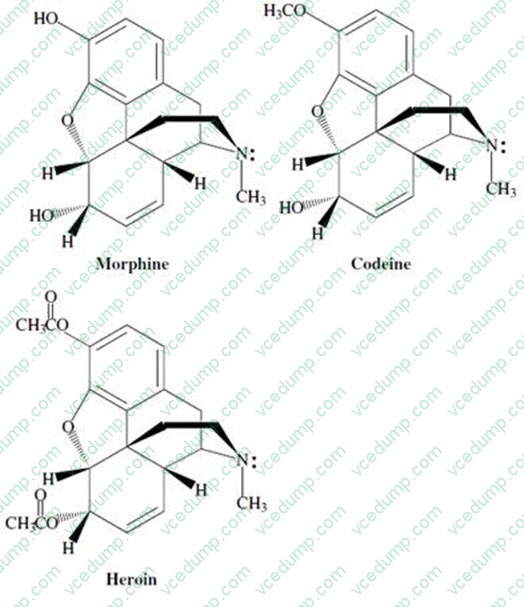
Studies have shown that certain common structural features of alkaloids are required for the compound to exhibit biological activity. These structural requirements are summarized by the so called "morphine rule":
Demerol and methadone, shown in Figure 2, are two synthetic alkaloids designed to satisfy the "morphine rule." Synthetic alkaloids such as these have been found to mimic certain physiological properties of morphine and its derivatives, and
have found pharmacological application due to other, more desirable biological effects. Methadone has been used widely in the United States and Great Britain as a treatment for heroin addiction; it reduces the physical symptoms
accompanying withdrawal without producing many of the other effects of heroin.
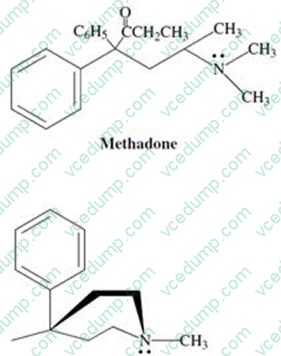
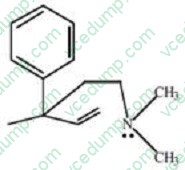
Meperidine (demerol) Figure 2
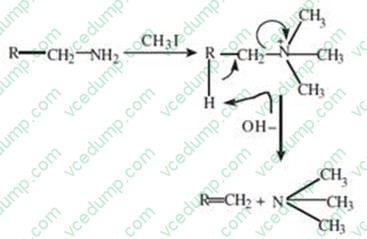
Hofmann elimination involves methylation of the amine nitrogen followed by elimination (E2). Which of the following represents a possible product of one sequence of Hofmann elimination on Meperidine (demerol)?
A. Option A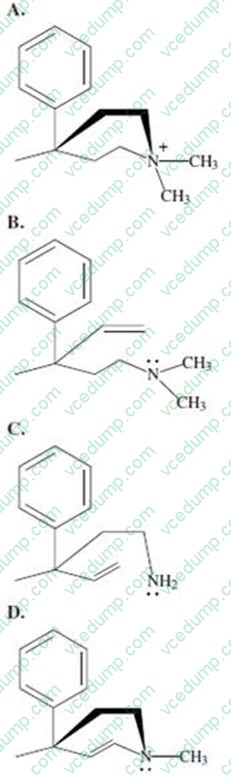
B. Option B
C. Option C
D. Option D -
Question 275:
Oversecretion of gastric HCl can be treated by severing the vagus nerve in a procedure called a vagotomy which reduces parasympathetic activity. Which of the following effects is LEAST likely to be caused by a vagotomy?
A. Decreased heart rate
B. Decreased gastric motility
C. Decreased HCl production
D. Increased blood pressure -
Question 276:
The force restraining an object's motion on an inclined plane:
A. is directed into the plane.
B. may be friction.
C. is directed to sideways.
D. is always friction. -
Question 277:
If the distance between two bodies each 1 Kg is 1 meter, then the force of attraction between these two bodies is:
A. 9 x 10⁹ N
B. 3 x 10-11 N
C. 6.67 x 10⁻¹¹ N
D. 8.8 x 10⁻¹² N -
Question 278:
Synthetic dyes constitute a commercially significant area of organic chemistry. The color producing properties of these compounds are the result of highly delocalized electron systems giving rise to electronic transitions whose absorptions occur in the visible region. Most commercially useful dyes can be classified as one of three types -- anthraquinones, azo dyes, or triarylmethyl salts. Examples of each type are illustrated in Figure 1.
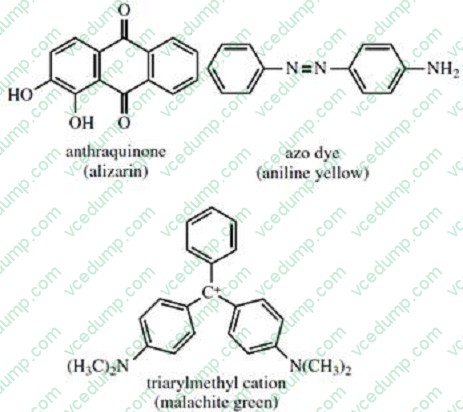
Figure 1
In order for a dye to be useful in the fabric industry, it must have sufficient affinity for the polymeric fibers of which the material is composed; the dye must not only impart a color to the fabric, but must also do so in a relatively permanent manner (color fastness). Proper design of synthetic polymers requires the placement of acidic or basic side chains along the polymer backbone such that binding sites are available for dying. Similarly, dyes must be produced not only with the appropriate color-producing structure, but also with an affinity for the fabric in question. The structural units of several common synthetic fibers are shown in Figure 2.
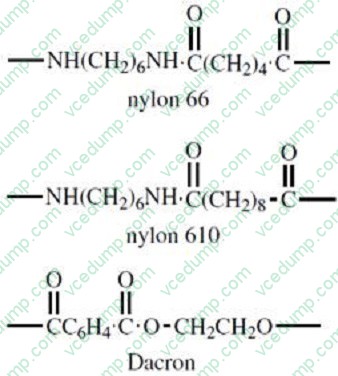
Figure 2
Certain natural protein fibers such as silk or wool can be treated with aqueous base, then with solutions containing cationic dyes such as malachite green to produce color fast yarns. The most likely explanation for the affinity of malachite green for silk or wool via this process is that:
A. many of the R groups on the amino acids of which these fibers are composed contain COOH groups.
B. very few of the R groups on the amino acids of which these fibers are composed contain OH groups.
C. the aqueous base hydrolyzes some of the peptide linkages in these fibers.
D. the aqueous base neutralizes the cationic dye. -
Question 279:
Compounds containing a hydroxyl group attached to a benzene ring are called phenols. Derivatives of phenols, such as naphthols and phenanthrols, have chemical properties similar to those of phenols, as do most of the many naturally-occurring substituted phenols. Like other alcohols, phenols have higher boiling points than hydrocarbons of similar molecular weight. Like carboxylic acids, phenols are more acidic than their alcohol counterparts. Phenols undergo a number of different reactions; both their hydroxyl groups and their benzene rings are highly reactive. A number of chemical tests can be used to distinguish phenols from alcohols and carboxylic acids.
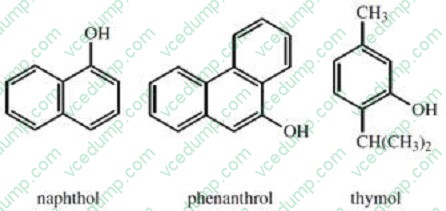
Thymol, a naturally occurring phenol, is an effective disinfectant that is obtained from thyme oil. Thymol can also be synthesized from m-cresol, as shown in Reaction A below. Thymol can then be converted to menthol, another naturally-occurring organic compound; this conversion is shown in Reaction B.
Reaction A
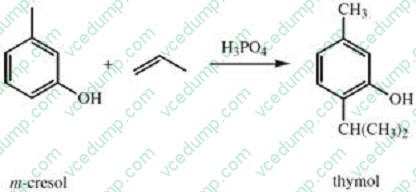
Reaction B
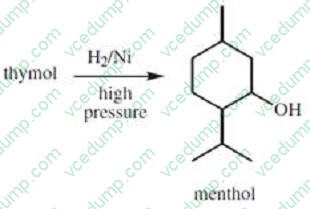
Compound ?(C10H14O) dissolves in aqueous sodium hydroxide but is insoluble in aqueous sodium bicarbonate. The proton NMR spectrum of compound X is as follows:
1.3 (9H) singlet
4.8 (1H) singlet
7.1 (4H) Multiplet
Which of the following is the structure of Compound??
A. Option A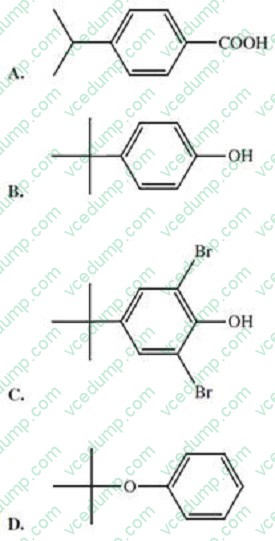
B. Option B
C. Option C
D. Option D -
Question 280:
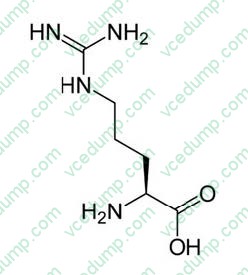
Arginine is one of the 20 most common natural amino acids. Most healthy people do not need to supplement with arginine because the body usually produces sufficient quantities. The pathway for arginine synthesis was studied using cells from a red bread mold. This natural form of arginine is illustrated below.
The red bread mold Neurospora crassa grows well on a cultural plate with "minimal" medium which is a fluid containing only a few simple sugars, inorganic salts, and vitamin. Neurospora that grows normally in nature (wild type) has enzymes that convert these simple substances into the amino acids necessary for growth. Mutating any one of the genes that makes an enzyme can produce a Neurospora strain that cannot grow on minimal medium. The mutant would only grow if the enzyme product were to be added as a supplement. On the other hand, if a "complete" medium is provided, containing all required amino acids, then Neurospora would grow, with or without mutation.
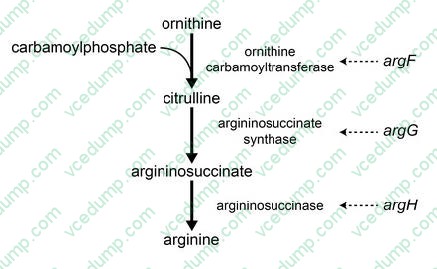
Figure 1 A synthesis pathway for the amino acid arginine. Each gene in italics in the diagram produces one enzyme necessary for the synthesis of this essential amino acid required for growth.

Table 1 Growth response of mutant strains in "minimal" media with supplements (ornithine, citrulline, argininosuccinate, and arginine) as indicated. Strain growth is indicated by (+) and no strain growth is indicated by (-). Which of the following is NOT an accurate description of naturally-occurring arginine?
A. Acidic amino acid
B. L-Configuration
C. -Amino acid
D. S-Configuration
Related Exams:
Tips on How to Prepare for the Exams
Nowadays, the certification exams become more and more important and required by more and more enterprises when applying for a job. But how to prepare for the exam effectively? How to prepare for the exam in a short time with less efforts? How to get a ideal result and how to find the most reliable resources? Here on Vcedump.com, you will find all the answers. Vcedump.com provide not only Medical Tests exam questions, answers and explanations but also complete assistance on your exam preparation and certification application. If you are confused on your MCAT-TEST exam preparations and Medical Tests certification application, do not hesitate to visit our Vcedump.com to find your solutions here.