MCAT-TEST Exam Details
-
Exam Code
:MCAT-TEST -
Exam Name
:Medical College Admission Test: Verbal Reasoning, Biological Sciences, Physical Sciences, Writing Sample -
Certification
:Medical Tests Certifications -
Vendor
:Medical Tests -
Total Questions
:812 Q&As -
Last Updated
:Jul 16, 2026
Medical Tests MCAT-TEST Online Questions & Answers
-
Question 241:
Saul Hoffman's scientific journal paper published in 2015 in Societies explores the relationship between two topics that at the surface are very distant from each other. As he goes on to state, "It is relatively easy, at least for an economist, to see why economists would be attracted to issues like teen pregnancy and teen childbearing, despite their apparent distance from the core topics of economics. First, economics ?especially microeconomics ?is fundamentally the study of choices that individuals make, traditionally and most often in formal markets with monetary prices, but now more and more frequently outside that sphere. Viewed from that perspective, choices involving sexual and fertility behavior among teens are an incredibly challenging, but inviting, target. Is it possible to identify the role of economic incentives, including government policy, on these behaviors? Is it sensible to apply traditional models of rational choice decision-making to teens?
Second, the traditional concern about teen fertility was predicated on the notion that it was an economically catastrophic act. In a famous and oft-quoted 1968 article, Arthur Campbell wrote that 'The girl who has an illegitimate child at the age of 16 suddenly has 90 percent of her life's script written for her,' including reduced opportunities for schooling, the labor market, and marriage. But it doesn't take too much reflection to appreciate that more may be going on in leading to these poor outcomes than just a teen birth. Disentangling the causal effect of teen childbearing on subsequent socio-economic outcomes from its correlational effect is another deliciously inviting and challenging target, this time well-suited for the applied economist or econometrician.
Just to make all this yet more inviting, the two research strands are closely related. Suppose it could be demonstrated that for some teens the socio-economic impact of a teen birth was negligible. For example, maybe future prospects for some teens were equally poor with or without a birth or perhaps government programs provided substantial benefits, so that the net impact on socio-economic well-being was consequently small or even positive. Then, it might well be 'rational' in an economic sense to have a teen birth in the first place, thereby linking the research on the causal impact of a teen birth with the research on the choice determinants of a teen birth. So what came to be known as the teen birth `causes' literature and the teen birth `consequences' literature were clearly interrelated.
And then, to add yet another layer of challenge, the teen fertility rate in the U.S. has fallen at a rate that is totally unprecedented. Teen fertility was once widespread, with most of it occurring within early and sometimes not entirely voluntary marriage. In 1960, the teen fertility rate was approximately 90 births per 1000, which implied that more than 40% of women ever had a teen birth. When I published my first article on teen births 25 years ago, the teen fertility rate was 60 births per 1000, down one-third from 1960, but it had increased six years in a row in what turned out to be a deviation from the downward trend. Since then the rate has declined every single year, except for a short but puzzling uptick between 2005 and 2007. In 2014, the teen fertility rate was 24.2 births per 1000, the lowest teen fertility rate ever recorded in the U.S., though still shockingly high by European standards. Thus, the rate fell by more than 50% during my professional association with the topic and by 70% since 1960. Of course, at the same time teen marital births largely disappeared, falling from 85% of teen births to 12%.
This adds yet another focus for economic research. Why did the rate fall? Did it have anything to do with changes in the costs of teen childbearing or changes in policy? Is it a good thing or not?
In this article I try to make sense out of these various research strands by providing a personal narrative through the economics literature on teen childbearing, with a special emphasis on the three issues discussed above. My goal is to make the literature, including some reasonably technical content, accessible and valuable to a non-economist."
Hoffman, S. (2015). Teen Childbearing and Economics: A Short History of a 25-Year Research Love Affair. Societies, 5(3), 646-663. doi:10.3390/soc5030646
What does the author mean by the claim in paragraph 3 that "what came to be known as the teen birth 'causes' literature and the teen birth 'consequences' literature were clearly interrelated"?
A. The question of why teens give birth is closely related to the question of how having a child affects their future prospects.
B. The topic of teen birth has been overlooked, and so research on causes and consequences has been conducted by members of the same small research community.
C. Causes and consequences literature have suffered from the same mistake of assuming teen birth is more catastrophic than it actually is.
D. Researchers have created a false dichotomy between causes and effects, when actually researchers on these two topics are asking the same questions. -
Question 242:
All of the following are true about the DNA molecule, except:
A. It is made of nucleotides.
B. Its structure is identical to the RNA molecule.
C. It is a double helix.
D. It is contained in human chromosomes. -
Question 243:
A continuous spectrum of light, sometimes called blackbody radiation, is emitted from a region of the Sun called the photosphere. Although the continuous spectrum contains light of all wavelengths, the intensity of the emitted light is much greater at some wavelengths than at others. The relationship between the most intense wavelength of blackbody radiation and the temperature of the emitting body is given by Wien's law, λ = 2.9 x 10⁶/T, where λ is the wavelength in nanometers and T is the temperature in kelvins.
As the blackbody radiation from the Sun passes through the cooler gases in the Sun's atmosphere, some of the photons are absorbed by the atoms in these gases. A photon will be absorbed if it has just enough energy to excite an electron from a lower energy state to a higher one. The absorbed photon will have an energy equal to the energy difference between these two states. The energy of a photon is given by E = hf = hc/λ where h = 6.63 x 10⁻³⁴ J•s, Planck's constant, and c = 3 x 10⁸ m/s, the speed of light in a vacuum.
The Sun is composed primarily of hydrogen. Electron transitions in the hydrogen atom from energy state n = 2 to higher energy states are listed below along with the energy of the absorbed photon:
Final Energy State Energy (x 10-19 J) n = 3
3.02
n = 4
4.08
n = 5
4.57 n = 6
4.84 n = ∞
5.44
Based on the data in the table, what is the approximate wavelength of a photon emitted in the electron transition from energy state n = 4 to energy state n = 3?
A. 5 nm
B. 30 nm
C. 100 nm
D. 2,000 nm -
Question 244:
Hemoglobin (Hb) and myoglobin (Mb) are the O2-carrying proteins in vertebrates. Hb, which is contained within red blood cells, serves as the O2 carrier in blood and also plays a vital role in the transport of CO2 and H+. Vertebrate Hb consists of four polypeptides (subunits) each with a heme group. The four chains are held together by noncovalent attractions. The affinity of Hb for O2 varies between species and within species depending on such factors as blood pH, stage of development, and body size. For example, small mammals give up O2 more readily than large mammals because small mammals have a higher metabolic rate and require more O2 per gram of tissue.
The binding of O2 to Hb is also dependent on the cooperativity of the Hb subunits. That is, binding at one heme facilitates the binding of O2 at the other hemes within the Hb molecule by altering the conformation of the entire molecule. This conformational change makes subsequent binding of O2 more energetically favorable. Conversely, the unloading of O2 at one heme facilitates the unloading of O2 at the others by a similar mechanism.
Figure 1 depicts the O2-dissociation curves of Hb (Curves A, B, and C) and myoglobin (Curve D), where saturation, Y, is the fractional occupancy of the O2-binding sites. The fraction of O2 that is transferred from Hb as the blood passes through the tissue capillaries is called the utilization coefficient. A normal value is approximately 0.25.
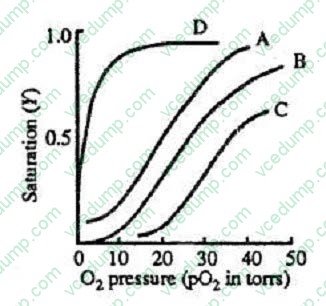
Figure 1
Myoglobin facilitates transport in muscle and serves as a reserve store of O2. Mb is a single polypeptide chain containing a heme group, with a molecular weight of 18 kd. As can be seen in Figure 1, Mb (Curve D) has a greater affinity for than Hb.
If Curve B represents the O2-dissociation curve for human adult Hb, which of the following best explains why Curve A most closely resembles the curve for fetal Hb?
A. Fetal tissue has a higher metabolic rate than adult tissue.
B. Fetal tissue has a lower metabolic rate than adult tissue.
C. Fetal Hb has a higher affinity for than adult Hb.
D. Fetal Hb has a lower affinity for than adult Hb. -
Question 245:
Hypoxia refers to a physiological condition in which the body lacks sufficient oxygen for normal cellular functioning. Prolonged hypoxia generally leads to an inhibition of mental capacity and a reduction in the work capacity of muscle. Severe cases of hypoxia can lead to coma or even death. Depending on the cause, hypoxia can be classified into four general types:
Hypoxic hypoxia is a type of hypoxia that occurs when the partial pressure of oxygen in the blood is too low. For example, climbers at high altitude, where the air contains less oxygen, might experience hypoxic hypoxia because the partial pressure of oxygen in the air inhaled is very low, leading to insufficient partial pressure of oxygen in the blood.
Anemic hypoxia describes a diminished ability of the blood to transport oxygen. Several factors can influence the oxygen-carrying capacity of the blood. Primary causes of anemic hypoxia include a lower than normal number of functional erythrocytes or an insufficient quantity of hemoglobin, the oxygen- carrying molecules of the blood. Abnormal hemoglobin can also decrease the blood's capacity to carry oxygen and lead to anemic hypoxia.
Ischemic hypoxia is caused by a decreased delivery of blood to the tissues. Localized circulatory deficiencies, such as blood clots, and global circulatory deficiencies, such as heart failure, decrease the delivery of blood to the tissues, and can therefore cause ischemic hypoxia.
Histotoxic hypoxia results from the inability of cells to utilize the oxygen available in the blood. Causes of histotoxic hypoxia include the poisoning of cellular enzymes involved in aerobic respiration, as well as the decreased metabolic capacity of the oxidative enzymes due to vitamin deficiency. Cyanide poisoning causes histotoxic hypoxia by blocking the action of cytochrome oxidase in the electron transport chain so that tissues cannot use oxygen even though it is available.
A patent foramen ovale occurs when an infant's foramen ovale does not close completely at birth. Based on the information presented in the passage, this can lead to:
A. hypoxic hypoxia because much of the blood does not reach the lungs to be oxygenated leading to a low
B. anemic hypoxia because the blood does not carry enough oxygen.
C. ischemic hypoxia because the flow of blood is shunted away from the lungs.
D. none of the above. -
Question 246:
Studies of photosynthesis began in the late eighteenth century. One scientist found that green plants produce a substance (later shown to be oxygen) that supports the flame of a candle in a closed container. Several years later it was discovered that a plant must be exposed to light in order to replenish this flame- sustaining "substance". Soon another discovery showed that the oxygen is formed at the expense of another gas, carbon dioxide.
In 1804, de Saussure conducted experiments revealing that equal volumes of carbon dioxide and oxygen are exchanged between a plant and the air surrounding it. De Saussure determined that the weight gained by a plant grown in a pot equals the sum of the weights of carbon derived from absorbed carbon dioxide and water absorbed through plant roots. Using this information, de Saussure was able to postulate that in photosynthesis carbon dioxide and water combine using energy in the form of light to produce carbohydrates, water, and free oxygen. Much later, in 1845, scientists' increased understanding of concepts of chemical energy led them to perceive that, through photosynthesis, light energy is transformed and stored as chemical energy.
In the twentieth century, studies comparing photosynthesis in green plants and in certain sulfur bacteria yielded important information about the photosynthetic process. Because water is both a reactant and a product in the central reaction, it had long been assumed that the oxygen released by photosynthesis comes from splitting the carbon dioxide molecule. In the 1930s, however, this popular view was decisively altered by the studies of C. B. Van Niel. Van Niel studied sulfur bacteria, which use hydrogen sulfide for photosynthesis in the same way that green plants use water, and produce sulfur instead of oxygen. Van Niel saw that the use of carbon dioxide to form carbohydrates was similar in the two types of organisms. He reasoned that the oxygen produced by green plants must derive from water -- rather than carbon dioxide, as previously assumed -- in the same way that the sulfur produced by the bacteria derives from hydrogen sulfide. Van Niel's finding was important because the earlier belief had been that oxygen was split off from carbon dioxide, and that carbon then combined with water to form carbohydrates. The new postulate was that, with green plants, hydrogen is removed from water and then combines with carbon dioxide to form the carbohydrates needed by the organism.
Later, Van Niel's assertions were strongly backed by scientists who used water marked with a radioactive isotope of oxygen in order to follow photosynthetic reactions. When the photosynthetically-produced free oxygen was analyzed, the isotope was found to be present.
According to the passage, C. B. Van Niel's experiments:
A. provided the first model of photosynthesis.
B. showed that the carbon dioxide molecule is split during photosynthesis.
C. proved that some organisms combine hydrogen sulfide with carbon dioxide in photosynthesis.
D. provided evidence that weakened the accepted model of photosynthesis. -
Question 247:
...Until last year many people -- but not most economists -- thought that the economic data told a simple tale. On one side, productivity -- the average output of an average worker -- was rising. And although the rate of productivity increase was very slow during the 1970's and early 1980's, the official numbers said that it had accelerated significantly in the 1990's. By 1994 an average worker was producing about 20 percent more than his or her counterpart in 1978. On the other hand, other statistics said that real, inflation- adjusted wages had not been rising at anything like the same rate. In fact, some of the most commonly cited numbers showed real wages actually falling over the last 25 years. Those who did their homework knew that the gloomiest numbers overstated the case....Still, even the most optimistic measure, the total hourly compensation of the average worker, rose only 3 percent between 1978 and 1994.... ...But now the experts are telling us that the whole thing may have been a figment of our statistical imaginations.... a blue-ribbon panel of economists headed by Michael Boskin of Stanford declared that the Consumer Price Index [C.P.I.] had been systematically overstating inflation, probably by more than 1 percent per year for the last two decades, mainly failing to take account of changes in the patterns of consumption and improvements in product quality.... ...The Boskin report, in particular, is not an official document -- it will be quite a while before the Government actually issues a revised C.P.I., and the eventual revision may be smaller than Boskin and his colleagues propose. Still, the general outline of the resolution is pretty clear. When all the revisions are taken into account, productivity growth will probably look somewhat higher than it did before, because some of the revisions being proposed to the way we measure consumer prices will also affect the way we calculate growth. But the rate of growth of real wages will look much higher -- and so it will now be roughly in line with productivity, which will therefore reconcile numbers on productivity and wages with data that show a roughly unchanged distribution of income between capital and labor. In other words, the whole story about workers not sharing in productivity gains will turn out to have been based on a statistical illusion. It is important not to go overboard on this point. There are real problems in America, and our previous concerns were by no means pure hypochondria. For one thing, it remains true that the rate of economic progress over the past 25 years has been much slower than it was in the previous 25. Even if Boskin's numbers are right, the income of the median family -- which officially has experienced virtually no gain since 1973 -- has risen by only about 35 percent over the past 25 years, compared with 100 percent over the previous 25. Furthermore, it is quite likely that if we "Boskinized" the old data -- that is, if we tried to adjust the C.P.I. for the 50's and 60's to take account of changing consumption patterns and rising product quality -- we would find that official numbers understated the rate of progress just as much if not more than they did in recent decades.... ...Moreover, while workers as a group have shared fully in national productivity gains, they have not done so equally. The overwhelming evidence of a huge increase in income inequality in America has nothing to do with price indexes and is therefore unaffected by recent statistical revelations. It is still true that families in the bottom fifth, who had 5.4 percent of total income in 1970, had only 4.2 percent in 1994; and that over the same period the share of the top 5 percent went from 15.6 to 20.1. And it is still true that corporate C.E.O.'s, who used to make about 35 times as much as their employees, now make 120 times as much or more.... ...While these are real and serious problems, however, one thing is now clear: the truth about what is happening in America is more subtle than the simplistic morality play about greedy capitalists and oppressed workers that so many would- be sophisticates accepted only a few months ago. There was little excuse for buying into that simplistic view then; there is no excuse now.... What is the effect of revising the C.P.I. on the calculation of labor's percentage share of national income?
A. A greater disparity will be apparent between the highest and lowest incomes.
B. The percentage share will appear the same.
C. The percentage share will appear smaller.
D. The percentage share will appear larger. -
Question 248:
A certain chemical is found to inhibit the synthesis of all steroids. The synthesis of which of the following hormones would NOT be affected when a dose of this chemical is administered to a laboratory rat?
A. Cortisol
B. Aldosterone
C. Epinephrine
D. Testosterone -
Question 249:
The resistance of a resistor is defined as the ratio of the voltage drop across it to the current passing through it. The resistance of a resistor can be measured using the circuit illustrated in Figure 1.
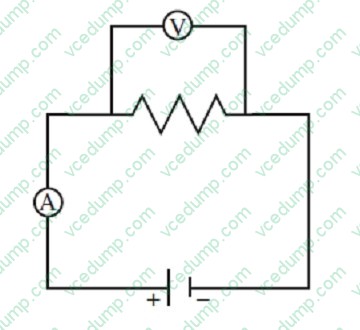
Figure 1
In the above circuit, a variable voltage source with negligible internal resistance is connected to a resistor. The voltage across the resistor is measured by a voltmeter and the current through the resistor is measured by an ammeter.

Additional resistors may be added to the circuit. The total resistance can be calculated as follows: If and are two resistances of two resistors, then the total resistance is given by = + when the resistors are connected in

series, and by 1/ = 1/ + 1/ when the resistors are connected in parallel.

Circuits similar to the one above are used in the common household appliance known as the toaster. The rate by which energy in the form of heat is dissipated by the resistor equals , where I is the current that passes through the resistor and R is the resistance of the resistor. Energy is dissipated in a resistor because moving electrons collide with atoms in the resistor, causing the atoms to vibrate.
As current passes through a resistor, the temperature of the resistor will increase. Which of the following accounts for the temperature increases?
A. The average kinetic energy of the atoms in the resistor increases as a result of the collisions with the electrons in the current.
B. The average potential energy of the atoms in the resistor increases as a result of the collisions with the electrons in the current.
C. The average kinetic energy of the electrons in the current increases as a result of the collisions with the atoms in the resistor.
D. The average potential energy of the electrons in the current increases as a result of the collisions with the atoms in the resistor. -
Question 250:
A biochemist grows two cultures of yeast -- one aerobically and the other anaerobically -- and measures the amount of ATP produced by each culture. He finds that the aerobically-grown yeast produce about 18 times as much ATP as the anaerobically-grown yeast. These observations are consistent with the fact that in the aerobically grown yeast:
A. oxygen is converted into ATP.
B. oxygen is necessary to convert glucose into pyruvate.
C. oxygen is the final electron acceptor of the respiratory chain.
D. oxygen is necessary for the reduction of pyruvate into lactate.
Related Exams:
Tips on How to Prepare for the Exams
Nowadays, the certification exams become more and more important and required by more and more enterprises when applying for a job. But how to prepare for the exam effectively? How to prepare for the exam in a short time with less efforts? How to get a ideal result and how to find the most reliable resources? Here on Vcedump.com, you will find all the answers. Vcedump.com provide not only Medical Tests exam questions, answers and explanations but also complete assistance on your exam preparation and certification application. If you are confused on your MCAT-TEST exam preparations and Medical Tests certification application, do not hesitate to visit our Vcedump.com to find your solutions here.