MCAT-TEST Exam Details
-
Exam Code
:MCAT-TEST -
Exam Name
:Medical College Admission Test: Verbal Reasoning, Biological Sciences, Physical Sciences, Writing Sample -
Certification
:Medical Tests Certifications -
Vendor
:Medical Tests -
Total Questions
:812 Q&As -
Last Updated
:Jul 16, 2026
Medical Tests MCAT-TEST Online Questions & Answers
-
Question 231:
A compound contains 75% carbon and 25% hydrogen by mass. What is the molecular formula of the compound?
A. CH4
B. CH3
C. C2H4
D. C2H6 -
Question 232:
One of the basic principles of ecology is that population size is to some extent a function of available food resources. Recent field experiments demonstrate that the interrelationship may be far more complex than hitherto imagined. Specifically, the browsing of certain rodents appears to trigger biochemical reactions in the plants they feed on that help regulate the size of the rodent populations. Two such examples of phytochemical regulation (regulation involving plant chemistry) have been reported so far. Patricia Berger and her colleagues at the University of Utah have demonstrated that instrumentality of 6- methoxybenzoxazolinone (6-MBOA) in triggering reproductive behavior in the mountain vole (Microtus montanus), a small rodent resembling the field mouse. 6-MBOA forms in young mountain grasses in response to browsing by predators such as voles. The experimenters fed rolled oats coated with 6-MBOA to non-breeding winter populations of Microtus. After three weeks, the sample populations revealed a high incidence of pregnancy among the females and pronounced swelling of the testicles among the males. Control populations receiving no 6- MBOA revealed no such signs. Since the timing of reproductive effort is crucial to the short-lived vole in an environment in which the onset of vegetative growth can vary by as much as two months, the phytochemical triggering of copulatory behavior in Microtus represents a significant biological adaptation. A distinct example is reported by John Bryant of the University of Alaska. In this case, plants seem to have adopted a form of phytochemical self-defense against the depredations of the snowshoe hare (Lepus americanus) of Canada and Alaska. Every ten years or so, for reasons that are not entirely understood, the Lepus population swells dramatically. The result is intense overbrowsing of early and mid-successional deciduous trees and shrubs. Bryant has shown that, as if in response, four common boreal forest trees favored by Lepus produce adventitious shoots high in terpene and phenolic resins which effectively discourage hare browsing. He treated mature, non-resinous willow twigs with resinous extracts from the adventitious shoots of other plants and placed treated and untreated bundles at hare feeding stations, weighing them at the end of each day. Bryant found that bundles containing only half the resin concentration of natural twigs were left untouched. The avoidance of these unpalatable resins, he concludes, may play a significant role in the subsequent decline in the Lepus population to its normal level. These results suggest obvious areas for further research. For example, observational data should be reviewed to see whether the periodic population explosions among the prolific lemming (like the vole and the snowshoe hare, a small rodent in a marginal northern environment) occur during years in which there is an early onset of vegetative growth; if so, a triggering mechanism similar to that found in the vole may be involved.
The experiments performed by Berger and Bryant both study:
I. the effect of diet on reproduction in rodents
II. the relationship between food source and population size.
III.
phytochemical phenomena in northern environments.
A. II only
B. III only
C. I and II only
D. II and III only
I. the effect of diet on reproduction in rodents II. the relationship between food source and population size. III. phytochemical phenomena in northern environments. -
Question 233:
The mind, just like the body, has its needs. The needs of the body are the foundations of society; those of the mind are its amenities. While government and laws provide for the safety and well-being of men when they gather together, the sciences and the arts, which are less despotic but perhaps more powerful, spread garlands of flowers over the iron chains that bind them, stifle in them the sense for that original liberty for which they seem to have been born, cause them to love their own enslavement, and turn them into so-called "civilized people." Necessity raised thrones; the sciences and the arts have strengthened them. O earthly powers: cherish talents and protect those who cultivate them. O civilized people, cultivate them: you happy slaves owe to them that delicate and refined taste of which you are so proud, that gentleness of character and urbanity of manner which make relations among you so amiable and easy -- in other words, that semblance of all the virtues, none of which you actually possess... ...How pleasant it would be to live among us, if our external appearance were always a reflection of what is in our hearts, if decency were virtue, if our maxims served as our rules, and if true philosophy were inseparable from the title of philosopher! But so many qualities are seldom found together, and virtue hardly ever walks in such great pomp. Richness of adornment may be the mark of a man of taste, but a healthy, robust man is known by other signs: it is beneath the rustic clothes of a farmer, and not the gilt of a courtier, that strength and vigor of the body will be found. Ornamentation is just as foreign to virtue, which is the strength and vigor of the soul. The good man is an athlete who prefers to compete in the nude: he disdains all those vile ornaments which would hinder the use of his strength, ornaments which were for the most part invented only to hide some deformity. Before art had molded our manners and taught our passions to speak an affected language, our customs were rustic but natural, and differences in conduct revealed clearly differences in character. Human nature, basically, was no better, but men found security in being able to see through each other easily, and this advantage, which we no longer appreciate, spared them many vices. Now that more subtle refinements and more delicate taste have reduced the art of pleasing to set rules, a base and deceptive uniformity prevails in our behavior, and all minds seem to have been cast in the same mold. Incessantly politeness and propriety make demands on us, and incessantly we follow usage but never our own inclinations. We no longer dare to appear as we are, and under this perpetual constraint, the men who form this herd called society, when placed in the same circumstances, will all act similarly unless stronger motives direct them to do otherwise. Therefore we will never know well those with whom we deal, for to know our friends we will have to wait for some crises to arise -- which is to say that we will have to wait until it is too late, as it is for these very crises that it is essential to know one's friends well. What vice would not accompany this uncertainty? No more sincere friendships, no more genuine esteem, no more well-based confidence. Suspicion, offenses, fears, coldness, reserve, hatred and betrayal will constantly hide under the same false veil of politeness, under that much touted urbanity which we owe to the enlightenment of our times. The name of the Master of the Universe will no longer be profaned by swearing, but insulted by blasphemies that will not offend our scrupulous ears. Men will not boast of their own merits, but belittle those of others. An enemy will not be crudely insulted, but adroitly slandered. National hatreds will die, but so will patriotism. A dangerous skepticism will take the place of the scorning of ignorance. Some excesses will be forbidden, some vices dishonored, but others will be dignified with the name of virtues, and one must either have them or feign them. Let those who want to praise the sobriety of the sages of our time do so; as for me, I see in it only a refinement of intemperance that is as unworthy of my praise as their hypocritical simplicity.
Based on the opinions professed in the passage, the author would most likely believe that "well-based confidence" (line 59) would most likely arise from:
A. the uncertainty of not knowing another's true feelings.
B. knowledge of the true content of another's character.
C. the parity between appearance and true virtue.
D. knowledge of the absence of truth in the "veil" of politeness. -
Question 234:
Which of the following products may be formed in the reaction below?
A. Option A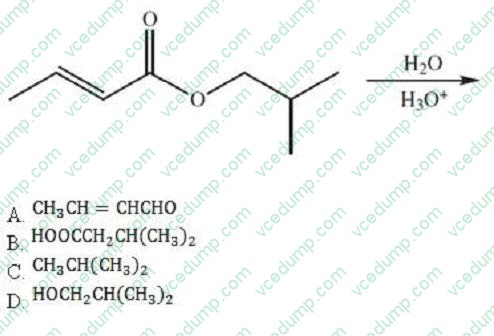
B. Option B
C. Option C
D. option D -
Question 235:
The Russian wheat aphid, Diuraphis noxia, is a small green insect discovered in southern Russia around the turn of the century. Agricultural researchers are not quite sure, but they believe the Russian aphid adapted itself to wheat about ten thousand years ago, when the crop was first domesticated by man. What is not in doubt is the insect's destructiveness. Spread by both wind and human transport, the Russian aphid has destroyed wheat fields throughout Asia, Africa, and Latin America. Until a few years ago, the United States had been free of this pest. But in the spring of 1986, a swarm of Russian aphids crossed the Mexican border and settled a few hundred miles north, in central Texas. From there, it quickly spread to other Western states, destroying wheat fields all along its path. In fact, the level of destruction has been so great over the past five years that entomologists are calling the Russian aphid the greatest threat to American agriculture since the Hessian fly, Phytophaga destructor, was inadvertently brought to the colonies on ships by German mercenary troops during the Revolutionary War. A combination of several factors have made it particularly difficult to deal with the threat posed by this aphid. First, Russian aphids reproduce asexually at a phenomenal rate. This process, known as parthenogenesis, often results in as many as twenty generations of insects in a single year. Although most generations remain in a limited geographic area because they have no wings, a few generations are born with wings, allowing the insect to spread to new areas. Second, because wheat is a crop with a very low profit margin, most American farmers do not spray it with pesticides; it simply is not economical to do so. And since the Russian aphid has only recently entered the United States, it has no natural enemies among North American insects or animals. As a result, there have been no man-made or natural obstacles to the spread of the Russian aphid in the United States.
Agricultural researchers seeking to control the Russian aphid have looked to its place of origin for answers. In the Soviet Union, the Russian aphid has been kept in check by predators which have evolved alongside it over many thousands of years. One species of wasp seems to be particularly efficient at destroying the aphid. The pregnant females of the species search the Russian aphid's home, the interior of a wheat stalk, sting the aphid into paralysis, and then inject an egg into its body. When the egg hatches the wasp larva feeds off of the aphid, killing it in the process.
The introduction of predators like the wasp, coupled with the breeding of new strains of insect-resistant wheat, may substantially curb the destructiveness of the Russian aphid in the future. For the time being, however, American farmers are left to their own devices when it comes to protecting their wheat crops
Which of the following statements would be most in agreement with the statements in the passage?
A. It is no longer economical to grow crops with low profit margins.
B. Humans are powerless against the forces of nature.
C. Regional ecosystems are often severely damaged when new organisms are introduced.
D. It is more difficult to stop the spread of an insect that reproduces asexually than one that reproduces sexually. -
Question 236:
Researchers are currently trying to develop materials which could be used to replace damaged or destroyed human muscle tissue. One of the more promising avenues of research involves the use of substances that contract with the
application of a small electric current.
Two physicists published an article relating to their work with Substance Q42, a material which contracts with the application of very small electric currents.
The atomic structure of the substance, they report, is designed so that the magnetic fields from each atom maintain a certain distance between adjacent atoms. With the application of an electrical current, the atoms' magnetic fields are
dampened slightly, causing them to draw closer together. The extent to which it contracts is dependent upon the strength of the current passing through it, but will at any rate never exceed a 20% reduction in length.
Moreover, the physicists report, Substance Q42 essentially operated like a spring, but one which can compress itself. The force generated by a spring, Fs, is given by the following equation:
Fs = -kx,
where k is the spring of constant in N/m, and x is the distance of compression (or expansion, but that is irrelevant for this example, since Substance Q42 only compresses).
With this in mind, it is possible to calculate the feasibility of using Substance Q42 as a replacement for human muscle tissue. Assume a section of test Substance Q42 is hooked to a scalable electrical source. The section is 10 cm long at its
fully extended state, and 8 cm long when fully compressed due to an electrical current.
If an artificial arm muscle must be capable of doing 8 J work in 0.5 seconds time in order to efficiently substitute for human tissue, what average power must the section of Substance Q42 be capable of?
A. 16 Watts
B. 22 Watts
C. 32 Watts
D. 36 Watts -
Question 237:
At a recent meeting of the American Public Transit Association, the Environmental Protection Agency unveiled stringent new standards for pollution control. The transit authorities were particularly concerned about the implementation of a proposed "Clean Air Act." They believed the provisions of the Clean Air Act could severely affect basic services to their local communities. Many transit agencies were concerned that it would be difficult to comply with the pollution and emissions control standards while continuing to operate within realistic budgets. The aim of the Clean Air Act is to assure that by the year 2000, there will be a reduction of at least 10 million tons of sulfur dioxide from 1980 levels. The bill also calls for a reduction in pollutants that contribute to the depletion of ozone. Strict regulations of toxic air emissions would have to be established and enforced. Additionally, the Clean Air Act would establish specific acid-rain reduction quotas and enforce severe penalties for transgressors of any of the new clean air regulations. There is little doubt that mass-transit suppliers will be considerably affected by this new legislation, just as the chemical and petroleum industries have already been affected by similar legislation. Transit authorities are challenged to strike a difficult balance between complying with the government's new standards and developing an official concern for the environment, while continuing to fulfill the transportation needs of the general population. Among the areas addressed by the Clean Air Act, the topic of mobile resources is of particular interest to mass transit authorities. Provisions contained in the Act under this title are aimed at encouraging the development and practical use of alternative fuel sources, like solar energy and methane fuel. The goal of this section of the Act is to eradicate toxic fuel emissions in order to provide cleaner air and a more favorable environment. The Act even goes so far as to declare that in cities like New York, Los Angeles and Houston -- where air quality is particularly noxious and toxins exceed the limits of federal regulations -- forms of mass transit should run on so-called "clean-burning fuels" by the year 2000. Such fuels include reformulated gasoline, propane, electricity, natural gas, ethanol, methanol, or any similar type of low-emission fuel. In addition, the Act proposes that, by 1994, all new urban buses in cities with populations exceeding one million must operate solely on clean-burning fuels. The topics of alternative fuels and alternative fuel vehicles represent, by far, the most controversial issue in the Clean Air Act. President Bush has called alternative fuels "bold and innovative" means to control pollution, but according to many transportation experts, the Act's proposals on alternative fuel usage are unrealistic. The transit authorities recognize that concern for the environment and health hazards like pollution are global issues. However, most transit officials concur that inventing and developing new ways to fuel mass transit will take at least 50 years to realize. They point out that the Act does not mention the political and social ramifications of usurping the role of the petroleum industries. The Act does not mention if or how the thousands of people employed by the oil industry will get retrained to produce and implement the use of "clean" fuel. No one disputes the fact that people need some form of transportation to get from place to place. Preserving the environment should be a priority, yet we need to remember that even if toxic emissions are completely eliminated sometime in the future, the challenge of moving mass numbers of people where they want to go will still exist and must remain a priority. Transit authorities contend that unless the Clean Air Act also acknowledges this, and develops a way to encourage mass transit over personal transportation, the problems of pollution might not be significantly altered. They suggest that there are many areas in this country that have little or no mass transit and that, if the Clean Air Act's goal is to reduce pollution, perhaps the most practical and realistic means to achieve that goal is to encourage the development and maintenance of mass transit systems. Transit authorities feel that the Act errs in NOT:
A. sufficiently discussing the problems of lead emissions in the atmosphere.
B. adequately acknowledging the environmental benefits of mass transportation.
C. offering financial incentives to induce private automobile owners to use mass transit instead.
D. adequately emphasizing the role and responsibility of private industry in the current global warming crisis. -
Question 238:
When softball players take batting practice, they often use a machine called an "automatic pitcher," which is essentially a cannon that uses air pressure to launch a projectile. In a prototype automatic pitcher, a softball is loaded into the barrel of the cannon and rests against a flat disk. That disk is locked into place, and a high air pressure is built up behind it. When the disk is released, the softball is pushed along the barrel of the cannon and ejected at a speed of V0. Figure 1 shows the batter and automatic pitcher. The angle of the barrel to the horizontal is . The unit vectors I and j point in the horizontal and vertical directions respectively.
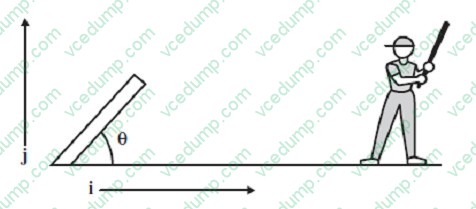
Figure 1
The height above the ground y of the softball as a function of time t is shown in Figure 2, where t = 0 at Point A, t = tB at Point B, and t = tC at Point C. The softball is ejected from the barrel of the cannon at Point A; it reaches its maximum height at Point B; and the batter hits the softball at Point C. (Note: Assume that the effects of air resistance are negligible unless otherwise stated.)
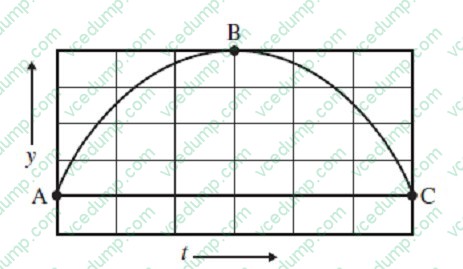
Figure 2
What physical quantity is NOT the same at Point C as at Point A?
A. The velocity of the softball
B. The speed of the softball
C. The gravitational potential energy of the softball
D. The horizontal component of the velocity of the softball -
Question 239:
The social phenomenon of groupthink is characterized by all of the following EXCEPT:
A. A significant over-rating of the decision-making abilities of members of the ingroup.
B. A decrease in the creativity of individual group members in contributing to solutions the ingroup wants to achieve.
C. High loyalty and group cohesiveness causing members to feel safe raising controversial issues and proposing alternative solutions.
D. An effort to minimize conflict and ensure consensus. -
Question 240:
A gibbon (lesser ape) of mass m and arm length l reaches to a branch level with its shoulder and starts to swing with its arm fully extended. At the bottom of the swing, its velocity is: A. Option A
B. Option B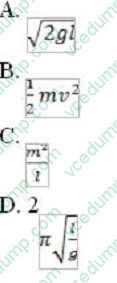
C. Option C
D. Option D

Related Exams:
Tips on How to Prepare for the Exams
Nowadays, the certification exams become more and more important and required by more and more enterprises when applying for a job. But how to prepare for the exam effectively? How to prepare for the exam in a short time with less efforts? How to get a ideal result and how to find the most reliable resources? Here on Vcedump.com, you will find all the answers. Vcedump.com provide not only Medical Tests exam questions, answers and explanations but also complete assistance on your exam preparation and certification application. If you are confused on your MCAT-TEST exam preparations and Medical Tests certification application, do not hesitate to visit our Vcedump.com to find your solutions here.