MCAT-TEST Exam Details
-
Exam Code
:MCAT-TEST -
Exam Name
:Medical College Admission Test: Verbal Reasoning, Biological Sciences, Physical Sciences, Writing Sample -
Certification
:Medical Tests Certifications -
Vendor
:Medical Tests -
Total Questions
:812 Q&As -
Last Updated
:Jul 16, 2026
Medical Tests MCAT-TEST Online Questions & Answers
-
Question 161:
Every atomic orbital contains plus and minus regions, defined by the value of the quantum mechanical function for electron density. When orbitals from different atoms overlap to form bonds, an equal number of new molecular orbitals results. These are of two types: or bonding orbitals, formed by overlap between orbital regions with the same sign, and antibonding * or * orbitals, formed by overlap between regions with opposite signs. Bonding orbitals have lower energy than their component atomic orbitals, and antibonding orbitals have higher energy. The electron pairs reside in the lower-energy bonding orbitals; the higher-energy, less stable orbitals remain empty when the molecule is in its ground state. A benzene ring has six unhybridized pz (one from each carbon atom), which together from six molecular orbitals, each one delocalized over the entire ring. Of the possible orbital structures for benzene, the one with the lowest energy has the plus region of all six p orbital functions on one side of the ring. The six electrons occupying the orbitals fill the three most stable molecular orbitals, leaving the other three empty. Molecular orbitals are filled from the lowest to the highest energy level. The number of bonds between atoms is determined by the number of filled bonding orbitals minus the number of filled antibonding orbitals; each antibonding orbital

cancels out a filled bonding orbital. For a diatomic molecule, orbitals in the n = 2 energy level are filled as follows: , , 2 , and (equal in energy), and * (equal in energy), *2 . (The designation of

the three p orbitals as , , and are interchangeable.) Absorption of a photon can raise an electron to a higher-energy molecular orbital. The excited electron does not immediately change its spin, which is opposite to that of the electron with which it was previously paired. This singlet state is relatively unstable: the molecule may interact with another molecule, or fluoresce and return to its ground state. Alternatively, there may be a change in spin direction somewhere in the system; the molecule then enters the so-called triplet state, which generally has lower energy. The molecule now cannot return quickly to its ground state, since the excited electron no longer has a partner of opposite spin with which to pair. It also cannot return to the singlet state, because the singlet has greater energy. Consequently, the triplet state, which has two unpaired electrons in separate orbitals, is long-lived by atomic standards, with a lifetime that may be ten seconds or more. During this period, the molecule is highly reactive.
Which of the following four depictions of molecular orbitals represents the highest energy state for a 6- carbon polyene molecule? (The signs given are the signs for the mathematical functions defining the p orbitals on one side of the molecule.)
A. – – – – – –
B. + + + – – –
C. + + – – + +
D. + – + – + – -
Question 162:
When softball players take batting practice, they often use a machine called an "automatic pitcher," which is essentially a cannon that uses air pressure to launch a projectile. In a prototype automatic pitcher, a softball is loaded into the barrel of the cannon and rests against a flat disk. That disk is locked into place, and a high air pressure is built up behind it. When the disk is released, the softball is pushed along the barrel of the cannon and ejected at a speed of V0. Figure 1 shows the batter and automatic pitcher. The angle of the barrel to the horizontal is . The unit vectors I and j point in the horizontal and vertical directions respectively.
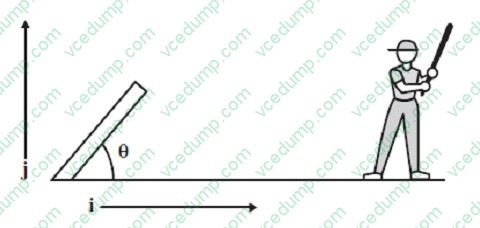
Figure 1
The height above the ground y of the softball as a function of time t is shown in Figure 2, where t = 0 at Point A, t = tB at Point B, and t = tC at Point C. The softball is ejected from the barrel of the cannon at Point A; it reaches its maximum height at Point B; and the batter hits the softball at Point C. (Note: Assume that the effects of air resistance are negligible unless otherwise stated.)
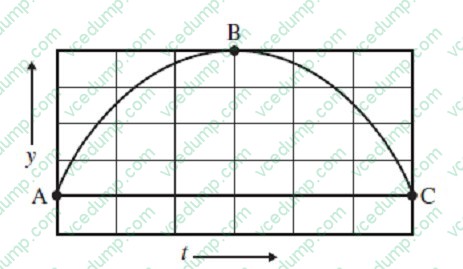
Figure 2
How does the work done by the automatic pitcher change as the angle of the barrel to the horizontal increases?
A. The work done increases, because the softball's maximum height increases.
B. The work done decreases, because the softball lands closer to the cannon.
C. The work done does not change, because the air pressure behind the disk is unchanged.
D. The work done does not change, because gravity is a conservative force. -
Question 163:
A student conducts a chemical analysis of the components of a popular soft drink. The beverage label shows that the drink contains carbonated water, phosphoric acid, caffeine, and caramel color, but does not indicate the concentrations of these chemicals.
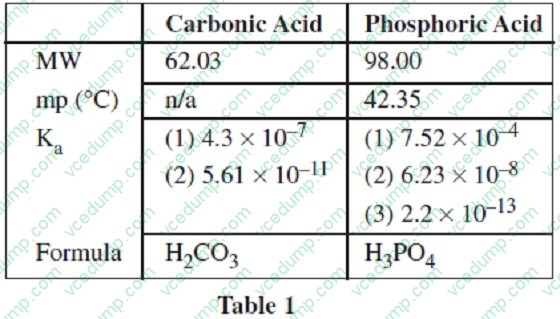
Dissolved carbon dioxide will react reversibly with water to form carbonic acid. In an attempt to analyze the beverage composition, the student conducts the following experiments on a one liter sample of the beverage.
Experiment 1
The sample is placed in a sealed beaker cooled to 10?C and a vacuum is created in the space above the beverage. The gas pumped from this space is passed through a solution of BaCl2, producing a white precipitate. The process
continues until no more precipitate forms. The precipitate is dried and found to have a mass of 9.5 grams.
Experiment 2
The remaining solution left in the sealed beaker is then titrated with 0.01 M NaOH to give the titration curve shown in Figure 1.
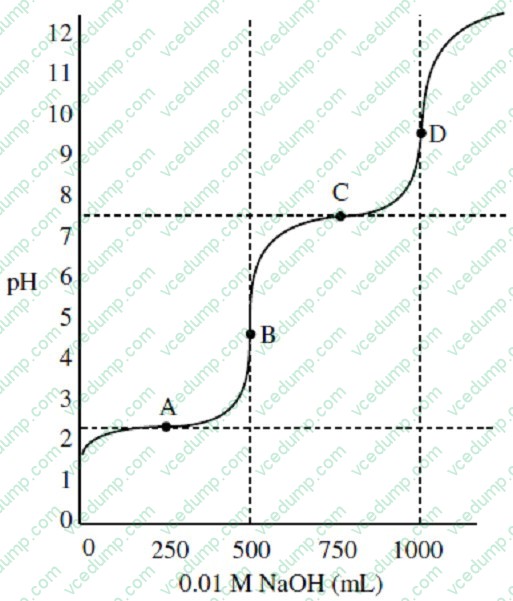
Figure 1
What is the approximate concentration of phosphoric acid in a 0.5 L sample of the beverage?
A. 0.005 M
B. 0.025 M
C. 0.5 M
D. 2.5 M -
Question 164:
One of the most common methods that scientists use to determine the age of fossils is known as carbon dating. 14C is an unstable isotope of carbon that undergoes beta decay with a half-life of approximately 5,730 years. Beta decay occurs when a neutron in the nucleus decays to form a proton and an electron which is ejected from the nucleus. 14C is generated in the upper atmosphere when 14N, the most common isotope of nitrogen, is bombarded by neutrons. This mechanism yields a global production rate of 7.5 kg per year of 14C, which combines with oxygen in the atmosphere to produce carbon dioxide. Both the production and the decay of 14C occur simultaneously. This process continues for many half-lives of 14C, until the total amount of 14C approaches a constant. A fixed fraction of the carbon ingested by all living organisms will be 14C. Therefore, as long as an organism is alive, the ratio of 14C to 12C that it contains is constant. After the organism dies, no new 14C is ingested, and the amount of 14C contained in the organism will decrease by beta decay. The amount of 14C that must have been present in the organism when it died can be calculated from the amount of 12C present in a fossil. By comparing the amount of 14C in the fossil to the calculated amount of 14C that was present in the organism when it died, the age of the fossil can be determined.
If the global production rate of 14C were to increase to 10 kg per year:
A. the number of 14C atoms decaying per minute would increase.
B. the number of 14C atoms decaying per minute would decrease.
C. the weight of 14C on the Earth would increase indefinitely.
D. the amount of 14C ingested by living organisms would not change. -
Question 165:
The percentage of arthropods in total animal kingdom is:
A. 85%
B. 45%
C. 75%
D. 60% -
Question 166:
In 1972, Georges Ungar reported the discovery of a peptide that appeared to transfer learning. Ungar's claim was based on experiments in which rats placed in a chamber with specially designed dark and light regions were trained to avoid
the dark regions of the chamber. Following their training, the rats were killed and brain extracts were prepared. These brain extracts were injected into naive rats which were then observed to acquire the fear of darkness without training. Two
hypotheses were proposed to explain these remarkable results:
Hypothesis 1
Ungar concluded that the extracts contained some chemical that transmitted the learned fear of darkness to the naive rats. A fifteen amino-acid polypeptide was isolated from the brain extracts and sequenced. Ungar claimed that this peptide,
called scotophobin, was a chemical transmitter of learning. The peptide had the primary structure shown below:
C-ser-asp-asn-arg-gln-gln-gly-lys-ser-ala-arg-gln-glygly-tyr-N scotophobin
Hypothesis 2
Other researchers, who tested scotophobin but could not reproduce Ungar's results, argued that scotophobin did not transfer the learned fear of darkness. Instead, they suggested that scotophobin, which is structurally similar to ACTH and
vasopressin, acted to increase stress in the rats. Since stress increases sympathetic nervous activity, rats injected with scotophobin would become hyperactive and tend to spend less time in the dark regions of the experimental chamber.
They argued that such stress responses in the rats could be misinterpreted as a fear of darkness. Ungar's claim was further weakened by chemical analysis in which both the scotophobin extracts which Ungar had injected into the naive rats
and a sample of synthesized scotophobin peptide were subjected to SDS polyacrylamide gel electrophoresis, as shown in Figure 1.
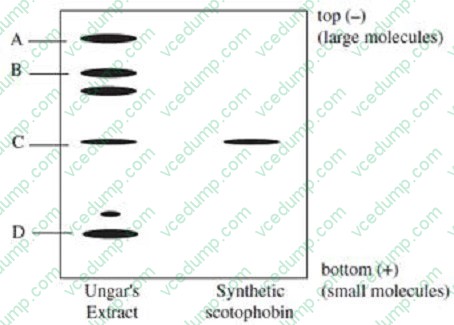
Figure 1
In a follow-up experiment, researchers administered scotophobin to rats in order to examine its physiological effects. Which of the following observations of physiological effects in the rat would provide the best support for Hypothesis 2?
A. Increase in urine volume
B. The rat pupils dilate causing the rat to prefer darkness and avoid light
C. Increase in heart rate
D. Dilation of arterioles regulating blood flow to the digestive tract -
Question 167:
For the last two decades many earth scientists have supported the notion that the Mediterranean was once a huge, dry desert, lying 3,000 meters below sea level. This "death valley" was thought to have existed at the end of Miocene time, about 6 to 5.5 million years ago.... ...From a geological point of view, the Mediterranean is a tectonically mobile land-enclosed depression -- small (about 3,000,000 square kilometers) in comparison to the major world oceans...Immediately obvious on all charts is the highly variable topography and relief of both the seafloor and adjacent borderland. The coastline is highly irregular and continental shelves, though generally narrow, are well developed off the major river deltas (Nile, Rhone, Po, and Ebro). Moreover, the deep-sea basins and trenches have distinctive relief, with basin plains ranging in depth from less than 1,000 meters to more than 4,000...Observation that rocks dredged offshore are similar to those on land raised a fundamental concept -- the key to understanding Mediterranean history lies in the adjacent emerged land masses, and vice- versa.... ...Early paleographic reconstructions showed that the once-open communication with the Atlantic deteriorated during the upper Miocene. Water-mass exchange continued for a while in the Rif Strait, but then ceased completely prior to the beginning of the Pliocene.... ...High relief near what is now the Strait of Gibraltar served as a barrier to the exchange of waters with the Atlantic. Exposed to a hot and dry climate, water evaporated and the then-dry basin elicited comparison with a gigantic Death Valley... Microfossil studies suggested that the depth of the Mediterranean basin at these times had been "deep." Estimates suggested a dry seafloor as far as 2,000 meters below ocean level... As a response to suddenly lowered sea level, rivers feeding the Mediterranean and canyons on the now-dry seafloor began a geologically dramatic phase of erosion. Deep, Grand Canyon-like gorges of the Nile and Rhone rivers, presently buried on land, were apparently cut during a great drawdown of water -- when the Mediterranean floor lay exposed 1,000 meters or more below its present level...The sudden flooding through a gigantic waterfall at Gibraltar drowned the exposed basin floor. These falls would have been 1,000 times bigger than Niagara Falls...This flooding event is recorded by the Miocene Pliocene boundary, a time when open marine faunal assemblages were suddenly reintroduced from the Atlantic.... ...Geological theories usually fall at a glacial pace into a sea of controversy, and this one is no exception. Today -- charging that proof for the theory is lacking -- many scientists believe that the Med always contained saltwater, with only the depth of the seafloor and the water being in question... Some of the tenets on which the theory was formulated are, if not defective, very seriously in question. To interpret their findings, a respectable number of geologists studying the surrounding emerged borderland as well as subsea sections indicate that alternative, more comprehensive concepts must be envisioned.... ...It is not realistic to envision the Mediterranean seafloor of about 5 million years ago as a desert at 3,000 meters below present ocean level. Several years ago...the Mediterranean [was compared] to a complex picture- puzzle that comprises numerous intricate pieces, many of which are already in place. A general image is emerging, although gaps in some areas of the picture remain fuzzy and indistinct.
It can be inferred from the passage that geological theories tend to:
A. exist in the world of science with little controversy.
B. develop over short periods of time after multiple research efforts.
C. be disproved with the next trend in scientific thought.
D. evolve to incorporate the growing body of knowledge derived from geological research. -
Question 168:
Hypoxia refers to a physiological condition in which the body lacks sufficient oxygen for normal cellular functioning. Prolonged hypoxia generally leads to an inhibition of mental capacity and a reduction in the work capacity of muscle. Severe cases of hypoxia can lead to coma or even death. Depending on the cause, hypoxia can be classified into four general types:
Hypoxic hypoxia is a type of hypoxia that occurs when the partial pressure of oxygen in the blood is too low. For example, climbers at high altitude, where the air contains less oxygen, might experience hypoxic hypoxia because the partial pressure of oxygen in the air inhaled is very low, leading to insufficient partial pressure of oxygen in the blood.
Anemic hypoxia describes a diminished ability of the blood to transport oxygen. Several factors can influence the oxygen-carrying capacity of the blood. Primary causes of anemic hypoxia include a lower than normal number of functional erythrocytes or an insufficient quantity of hemoglobin, the oxygen- carrying molecules of the blood. Abnormal hemoglobin can also decrease the blood's capacity to carry oxygen and lead to anemic hypoxia.
Ischemic hypoxia is caused by a decreased delivery of blood to the tissues. Localized circulatory deficiencies, such as blood clots, and global circulatory deficiencies, such as heart failure, decrease the delivery of blood to the tissues, and can therefore cause ischemic hypoxia.
Histotoxic hypoxia results from the inability of cells to utilize the oxygen available in the blood. Causes of histotoxic hypoxia include the poisoning of cellular enzymes involved in aerobic respiration, as well as the decreased metabolic capacity of the oxidative enzymes due to vitamin deficiency. Cyanide poisoning causes histotoxic hypoxia by blocking the action of cytochrome oxidase in the electron transport chain so that tissues cannot use oxygen even though it is available.
Exposure to high levels of radiation has been demonstrated to cause anemia. The most likely explanation is that radiation damages the:
A. blood vessels.
B. spleen.
C. thymus.
D. bone marrow. -
Question 169:
Arsenic is widely distributed in sulfide ores of many metals and is obtained as a byproduct of copper smelting. The element, as well as many compounds of arsenic -- for example arsine, AsH3 -- are extremely poisonous. Arsenic compounds, as might be expected, have found use in herbicides and pesticides, but have also been successful in some pharmacological agents. The first useful antisyphilitic agent, Salvarsan, or 3,3'-diamino-4,4'-dihydroxyarsenobenzene dihydrochloride, is an arsenic compound. The element sublimes at 600°C, forming tetrahedral molecules, As4. Arsenic is a metalloid, possessing properties characteristic of both metals and non-metals. Arsenic is a gray-colored, metalliclooking solid, but arsenic vapor is yellow in color, has a garlic-like odor, and is very poisonous. If the arsenic vapor is cooled rapidly, an unstable, yellow crystalline allotrope consisting of As4 molecules is produced. The Marsh test, based on the instability of arsine, is a very sensitive test for the presence of arsenic. This test is commonly employed in the detection of arsenic poisoning--either before or after death. The apparatus for the Marsh test is shown in Figure 1.
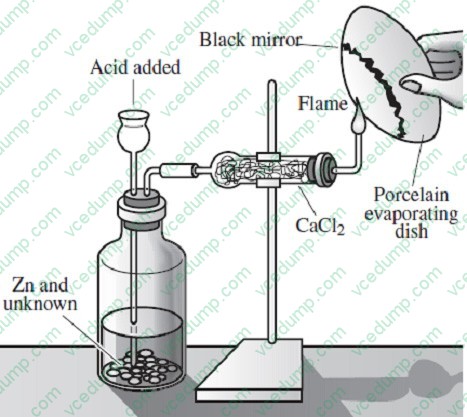
Figure 1 Typically, a sample, usually hair, is taken from a person suspected of being the victim of arsenic poisoning. This sample is then treated in such a way so as to produce arsenic oxide, As4O6. The oxide is then placed into the apparatus shown in Figure 1 and reacted according to Reaction 1. As4O6 + 12Zn(s) + 24H+(aq) AsH3(g) + 12Zn2 +(aq) + 6H2O Reaction 1
When the evolved arsine is ignited it decomposes into its elements. The arsenic vapor is rapidly cooled when it encounters the porcelain evaporating dish and deposits a black mirror of arsenic on the bottom, indicating the presence of arsenic in the original sample.
What is the most likely purpose of the calcium chloride in Figure 1?
A. To remove water from the evolved arsine gas
B. To remove HCl from the evolved arsine gas
C. To react with the zinc ion, making the reaction go to completion
D. To react with the evolved arsine gas -
Question 170:
The process by which individuals decide and choose to seek assistance for health or mental health problems is called help-seeking. Table 1 displays the percentage of American Indian/Alaska Native and non-Hispanic White adults who received mental health or counseling treatment in 2008
Help-seeking is a complex process and individuals will choose to obtain treatment for a variety of reasons. One of the strongest individual-related help-seeking predictors amounts to perceiving the need to do so. Other individual-related factors are the educational and the socioeconomic status. There may also be systematic factors that prevent people from doing so, such as general mistrust of health, mental health, and social service institutions, particularly among racial and ethnic minorities. It has been speculated that some of the mistrust stems from research studies, sponsored by medical establishments, where racial and ethnic minorities express concerns of being recruited for the purpose of serving as guinea pigs. Focus groups with African Americans and Chinese immigrants confirmed this anxiety and fear.
Thus, cultural factors also play a role in the help-seeking process. Western cultural norms about medicine are premised on norms of individualism. However, individuals from other cultures and racial and ethnic minority groups tend to be both more collectivistic and fatalist. Disease, both medical and mental, is believed to occur because of fate. It is not something where one should spend much time and effort fighting; the needs of the family and even of the extended family are to come first.
Table 1 Access to health care: Percentage of adults who received mental health treatment or counseling in the past year, 2008
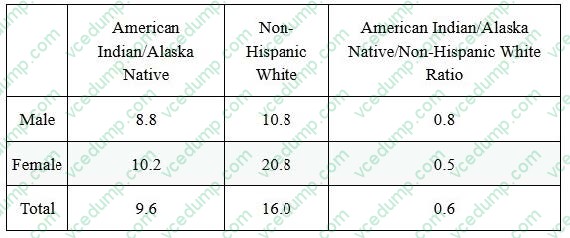
Source: Adapted from U.S. Department of Health and Human Services,"Mental Health and American Indians/ Alaska Natives"
What variables will a researcher interested in investigating the relationship between the "Big Five" personality traits and help-seeking behaviors include in the study?
A. Traditional, egalitarian, patriarchal, matriarchal, and androgynous
B. Overgeneralizations, polarized thinking, personalization, catastrophizing, and blaming
C. Neuroticism, extraversion, openness, agreeableness, and conscientiousness
D. Persona, shadow, anima, animus, and self
Related Exams:
Tips on How to Prepare for the Exams
Nowadays, the certification exams become more and more important and required by more and more enterprises when applying for a job. But how to prepare for the exam effectively? How to prepare for the exam in a short time with less efforts? How to get a ideal result and how to find the most reliable resources? Here on Vcedump.com, you will find all the answers. Vcedump.com provide not only Medical Tests exam questions, answers and explanations but also complete assistance on your exam preparation and certification application. If you are confused on your MCAT-TEST exam preparations and Medical Tests certification application, do not hesitate to visit our Vcedump.com to find your solutions here.