MCAT-TEST Exam Details
-
Exam Code
:MCAT-TEST -
Exam Name
:Medical College Admission Test: Verbal Reasoning, Biological Sciences, Physical Sciences, Writing Sample -
Certification
:Medical Tests Certifications -
Vendor
:Medical Tests -
Total Questions
:812 Q&As -
Last Updated
:Jul 16, 2026
Medical Tests MCAT-TEST Online Questions & Answers
-
Question 171:
When light in the ultraviolet region of the spectrum is shone on a type of material known as a phosphor, it fluoresces and emits light in the visible region of the spectrum. Lamps that utilize this property, known as fluorescent lamps, are very efficient light sources. The arrangement of a typical fluorescent lamp is shown below. The lamp is a glass tube whose inside walls are covered with a phosphor. The tube has an appreciable length-to-diameter ratio so as to reduce the power losses at each end, and it is filled with argon gas mixed with mercury vapor. Inside each end of the tube are tungsten electrodes covered with an emission material.
Electrons are liberated at the cathode and accelerated by an applied electric field. These free electrons encounter the gas mixture, ionizing some mercury atoms and exciting others. Since it requires more energy to ionize the atoms than to excite the electrons, more excitation than ionization occurs. When the excited electrons revert to their ground state, they radiate ultraviolet photons with a wavelength of 253.7 nm. These photons impinge on the phosphor coating of the tube and excite electrons in the phosphor to higher energy states. The excited electrons in the phosphor return to their ground state in two or more steps, producing radiation in the visible region of the spectrum. Not every fluorescent lamp emits the same color of radiation; the color is dependent on the relative percentages of different heavy metal compounds in the phosphor.
The fluorescent lamp shown operates at 100 volts and draws 400 milliamps of current during normal operation. Of the total power that the lamp consumes, only 25% is converted to light, while the remaining 75% is dissipated as heat. This energy keeps the lamp at its optimum working temperature of 40°C. In the lamp shown, the phosphor coating is calcium metasilicate, which emits orange to yellow light.
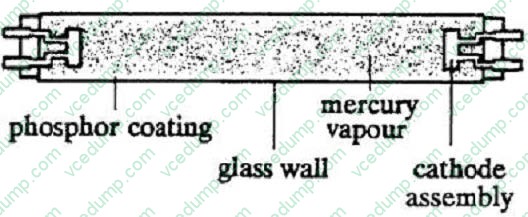
As the excited electrons in the coating drop back to their ground states in more than one step, they will emit light of:
A. higher frequency than the light absorbed.
B. longer wavelength than the light absorbed.
C. the same wavelength as the light absorbed.
D. greater energy than the light absorbed. -
Question 172:
Due to ever-increasing paranoia about the transmission of hepatitis and AIDS via blood transfusions and the frequent difficulty of procuring matching blood donors for patients, researchers have been working at a feverish pace to produce disease-free and easy-to-use blood substitutes. The difficulty most synthetic blood researches have had is in formulating a substance that combines qualities of sterility, high capacity for carrying oxygen to body tissues, and versatility within the human body. Three major substitute technologies have been developed to date; each has certain advantages and shortcomings.
"Red blood," the first of the blood substitute technologies, is derived from hemoglobin which has been recycled from old, dead, or worn-out red blood cells and modified so that it can carry oxygen outside the red blood cell. Hemoglobin, a complex protein, is the blood's natural oxygen carrier and is attractive to scientists for use in synthetic blood because of its oxygen-carrying capacity. However, hemoglobin can sometimes constitute a two-fold threat to humans when it is extracted from the red blood cell and introduced to the body in its naked form. First, hemoglobin molecules are rarely sterile and often remain contaminated by viruses to which they were exposed in the cell. Second, naked hemoglobin is extremely dangerous to the kidneys, causing blood flow at these organs to shut down and leading, ultimately, to renal failure. Additional problems arise from the fact that hemoglobin is adapted to operate optimally within the intricate environment of the red blood cell. Stripped of the protection of the cell, the hemoglobin molecule tends to suffer breakdown within several hours. Although modification has produced more durable hemoglobin molecules which do not cause renal failure, undesired side effects continue to plague patients and hinder the development of hemoglobin-based blood substitutes.
Another synthetic blood alternative, "white blood", is dependent on laboratory synthesized chemicals called perfluorocarbons (PFCs). Unlike blood, PFCs are clear oil like liquids, yet they are capable of absorbing quantities of oxygen up to 50% of their volume, enough of an oxygen carrying potential for oxygen-dependent organisms to survive submerged in the liquid for hours by "breathing" it. Although PFCs imitate real blood by effectively absorbing oxygen, scientists are primarily interested in them as constituents of blood substitutes because they are inherently safer to use than hemoglobin-based substitutes. PFCs do not interact with any chemicals in the body and can be manufactured in near-perfect sterility. The primary pitfall of PFCs is in their tendency to form globules in plasma that can block circulation. Dissolving PFCs in solution can mitigate globulation; however, this procedure also seriously curtails the PFCs' oxygen capacity.
The final and perhaps most ambitious attempt to form a blood substitute involves the synthesis of a modified version of human hemoglobin by genetically-altered bacteria. Fortunately, this synthetic hemoglobin seems to closely mimic the qualities of sterility, and durability outside the cellular environment, and the oxygen-carrying efficiency of blood. Furthermore, researchers have found that if modified hemoglobin genes are added to bacterial DNA, the bacteria will produce the desired product in copious quantities. This procedure is extremely challenging, however, because it requires the isolation of the human gene for the production of hemoglobin, and the modification of the gene to express a molecule that works without support from a living cell.
While all the above technologies have serious drawbacks and difficulties, work to perfect an ideal blood substitute continues. Scientists hope that in the near future safe synthetic blood transfusions may ease blood shortages and resolve the unavailability of various blood types.
According to the passage, how much oxygen can be absorbed by a 300 cc sample of PFC?
A. 50 cc
B. 100 cc
C. 150 cc D. 300 cc -
Question 173:
What happens if a reaction is at equilibrium state and some more reactants are added in container?
A. The equilibrium will not be affected.
B. The reverse reaction rate will increase.
C. The forward reaction rate will increase.
D. The forward reaction rate will decrease. -
Question 174:
A hedonic teenager of wayward morals, in one night, sequentially i) has consensual sexual intercourse with his sister, ii) leaves no tip at the bar, iii) has non-censual sexual relations with an unknown woman, and iv) vomits on the steps to the door of a local church.
The teenager has violated society's norms sequentially (to the greatest degree) on the order of:
A. mores, mores, the law, mores
B. taboo, folkways, the law, and taboo
C. the law, folkways, folkways, and folkways D. taboo, folkways, the law, and mores -
Question 175:
Walking down a street late at night, an adult male pedestrian notices a young female on the ground, not moving. The female is on the opposite side of the street. Crossing the street, the pedestrian notices that the young woman appears both much wealthier than he is and is of a different ethnicity. Seeing nobody else present, the pedestrian renders aid.
According to the bystander effect, which of the following would change how the pedestrian reacts?
A. The person requiring aid appearing to be of a lower socioeconomic class rather than a higher one
B. The presence of another group of people one block up the street
C. The person requiring aid appearing to be the same ethnicity rather than a different one
D. The presence of one other person who is already approaching the girl -
Question 176:
As Alice Echols went on to claim, "Nothing seems to conjure up the 1970s quite so effectively as disco. Even at the time, critics remarked upon disco's neat encapsulation of that decade's zeitgeist. `It must be clear by now to everyone with an ear or an eye that this era,' wrote journalist Andrew Kopkind in 1979, `is already the Disco Years, whether it will be called by that name or not.' A former sixties radical, Kopkind was by turns fascinated, bemused, and appalled by the disco epoch, and he likely imagined that in years to come fellow cultural critics would share his interest. But the seventies have not loomed large in our national imagination, except perhaps as comic relief. For many Americans, these were the forgettable years.
That forgettability owes a lot to the 1960s, the outsized decade that dwarfs all others in recent memory. The sixties will always be remembered for their audacity, whether found in the courage of civil rights protesters who put their bodies on the line or in those doomed but beautiful rock stars who tried breaking through to the other side. By contrast, the seventies seem the decade when nothing, or nothing good, happened ?an era memorable for the country's hapless presidents, declining prestige, bad fashions, ludicrous music, and such over-the-top narcissism that Tom Wolfe dubbed it the `Me Decade.' Before the decade was out, this narrative of decline had become routine. `After the poetry of the Beatles comes the monotonous bass-pedal bombardment of Donna Summer,' huffed one New York Times writer in 1979. It is a measure of the era's persistent bad press that a recent book challenging this view carries the pleading title Something Happened.
As for the sixties, it doesn't matter how much silliness went down, we still invest those times with seismic significance. Take Joe Cocker's performance at Woodstock. His spasmodic thrashing about and his vocals, slurred to the point of incomprehensibility, are something of a joke today. Cringe-inducing though it may be, however, Cocker's performance is never made to stand in for the whole of the sixties. The sixties remain enveloped in the gauzy sentimentalism of what might have been. Yet the iconic image of John Travolta as dance-floor king Tony Manero in white polyester suit, arm thrust to the disco heavens, has come to symbolize the narcissistic imbecility and inconsequentiality of the disco years.
Were it not for the Rubaiyat, I, too, might well regard the seventies as a lamentable and regrettable period in American history. The Rubaiyat was, yes, a disco. It was located in the heart of sixtiesland: Ann Arbor, Michigan, the home of the University of Michigan and legendary incubator of radical activism. At the height of the seventies, the town's annual Hash Bash ?a smoke-in to reform marijuana laws ?was still going strong and so were its two food co-ops-one reform, the other orthodox when it came to selling white foods (that is, rice, sugar, and flour of the white variety). Ann Arbor also had bookstores galore, including the original, wonderful Borders Bookstore, and any number of hippie-ish restaurants and bars such as the Fleetwood Diner, the Del Rio, and the Blind Pig. Musically, it prided itself on its vintage music (it hosted one of the earliest blues festivals), but at heart it was a rock town besotted with Iggy Pop and the Stooges and Sonic's Rendezvous, a band fronted by Patti Smith's future husband, Fred Smith. Its leading music store, Schoolkids' Records, stocked disco, but never played it. All of this is to say that disco-averse Ann Arbor came close to providing something of a safe haven from glitterball culture.
The Rubaiyat was no red-velvet-rope disco where fashionista doormen determined who was sufficiently fabulous to gain entry. This would never have worked in a town where down jackets and army surplus were hardly an unusual sight. The club did have some pretensions to classiness, but the mismatched, sagging booths and bordello red defeated occasional efforts at upmarket sophistication. What the Rubaiyat did have were better-than-average speakers, a heterogeneous cliente, and a weekend cover of three dollars."
Echols, A. (2011). Hot stuff: Disco and the Remaking of American Culture. New York: W. W. Norton.
Which of the following arguments would MOST STRONGLY support the author's claims?
A. Disco music is interesting sociologically but not musically due to the repetitive nature of its sound.
B. Disco music expressed the viewpoints of minority groups, and ultimately contributed to their acceptance in the mainstream.
C. Disco did not really disappear at the end of the 1970s; similar styles of dance music proliferated under different names.
D. A dramatic technical break occurred in American music in the early 70s between riff-based rock and beat-based dance music. -
Question 177:
X-rays are produced by a device which beams electrons with an energy between 103 and 106 eV at a metal plate. The electrons interact with the metal plate and are stopped by it. Much of the energy of the incoming electrons is released in the form of X-rays, which are high energy photons of electromagnetic radiation. An example of such a device is shown below. Electrons are accelerated from the cathode towards the anode by an electric field.
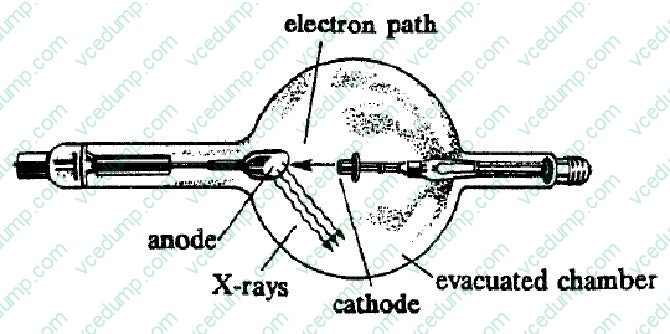
There are two mechanisms by which the X-rays are produced within the metal. The first mechanism is called bremsstrahlung, which is German for "breaking radiation." X-rays are emitted by the electrons as they are brought to rest by
interactions with the positive nuclei of the anode.
The second mechanism occurs when an incoming electron knocks an inner electron out of one of the metal atoms of the anode. This electron is replaced by an electron from a higher energy level of the atom, and a photon making up the
energy difference is emitted.
X-rays are absorbed by a material when they pass through it. The amount of X-rays absorbed increases with the density of the material. In addition, lower energy X-rays are more likely to be absorbed than higher energy X-rays. (Note: 1 eV =
1.6 x 10¹⁹ J; Planck's constant h = 4.1 x 10⁻¹⁵ eV•s; speed of light c = 3 x 10⁸ m/s.)
How does the wavelength of an X-ray produced from a K-alpha transition in molybdenum compare to that produced from a lower energy K-alpha transition in copper?
A. It is shorter.
B. It is the same.
C. It is longer.
D. It depends on the energy of the incoming electron. -
Question 178:
Which of the following molecules will stop being produced first when oxygen is no longer supplied to the cell?
A. Oxaloacetate
B. Pyruvate
C. Water
D. Adenosine triphosphate -
Question 179:
The lead-acid battery, also called a lead storage battery, is the battery of choice for starting automobiles. It contains 6 cells connected in series, each composed of a lead oxide cathode "sandwiched" between 2 lead anodes. Insulating separators are placed between the electrodes to prevent internal short-circuits. Aqueous sulfuric acid is the electrolyte.
When the battery is being discharged, the following reaction takes place:

Reaction 1
The electrode reactions, both written as reductions, are shown in Table 1.
Table 1
Half-reaction
E?V)
PbO2(s) + SO42-(aq) + 4H+(aq) + 2ePbSO4(s) + 2H2O
PbSO4(s) + 2e-Pb(s) + SO42-(aq)
1.69
?.36
As a car operates, the battery is recharged by electricity produced by the car's alternator, an AC generator whose ultimate power source is the car's internal combustion engine. In spite of this, batteries eventually lose their power. The battery
is said to be "dead" when Reaction 1 has proceeded completely to the right.
The graph below shows the change in potential versus time of a 12-V lead storage battery during discharge.
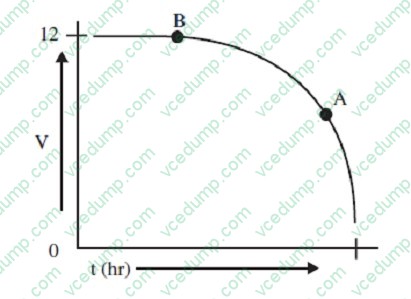
Which of the following is true?
A. The electrolyte density at point A is greater than it is at point B.
B. The electrolyte density at point A is less than it is at point B.
C. The electrolyte density at point A is the same as it is at point B.
D. The electrolyte density at points A and B cannot be compared without more information. -
Question 180:
Compounds containing a hydroxyl group attached to a benzene ring are called phenols. Derivatives of phenols, such as naphthols and phenanthrols, have chemical properties similar to those of phenols, as do most of the many naturally-occurring substituted phenols. Like other alcohols, phenols have higher boiling points than hydrocarbons of similar molecular weight. Like carboxylic acids, phenols are more acidic than their alcohol counterparts. Phenols undergo a number of different reactions; both their hydroxyl groups and their benzene rings are highly reactive. A number of chemical tests can be used to distinguish phenols from alcohols and carboxylic acids.
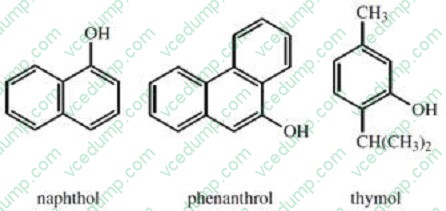
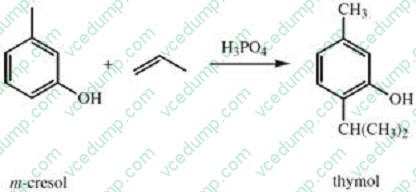
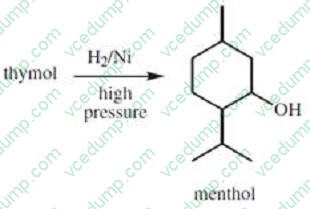
Thymol, a naturally occurring phenol, is an effective disinfectant that is obtained from thyme oil. Thymol can also be synthesized from m-cresol, as shown in Reaction A below. Thymol can then be converted to menthol, another naturally-occurring organic compound; this conversion is shown in Reaction B.
Reaction A
Reaction B
Which of the following shows the order of decreasing acidity among the four compounds below?
A. I, III, IV, II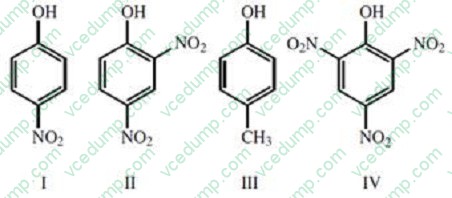
B. IV, I, II, III
C. IV, III, II, I
D. IV, II, I, III
Related Exams:
Tips on How to Prepare for the Exams
Nowadays, the certification exams become more and more important and required by more and more enterprises when applying for a job. But how to prepare for the exam effectively? How to prepare for the exam in a short time with less efforts? How to get a ideal result and how to find the most reliable resources? Here on Vcedump.com, you will find all the answers. Vcedump.com provide not only Medical Tests exam questions, answers and explanations but also complete assistance on your exam preparation and certification application. If you are confused on your MCAT-TEST exam preparations and Medical Tests certification application, do not hesitate to visit our Vcedump.com to find your solutions here.