MCAT-TEST Exam Details
-
Exam Code
:MCAT-TEST -
Exam Name
:Medical College Admission Test: Verbal Reasoning, Biological Sciences, Physical Sciences, Writing Sample -
Certification
:Medical Tests Certifications -
Vendor
:Medical Tests -
Total Questions
:812 Q&As -
Last Updated
:Jul 16, 2026
Medical Tests MCAT-TEST Online Questions & Answers
-
Question 181:
Historically, two different methods have been used to estimate the fluid pressure in capillary beds.
Method 1 A glass pipette is inserted into the capillary. The level of blood rising in the pipette is measured and used to calculate the pressure. Alternatively, an inert fluid of density can be placed in the pipette and its height h can be measured. The pressure in the capillary is given by gh, where g is the acceleration due to gravity.
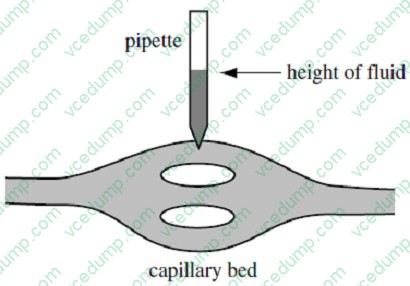
Figure 1 Method 2
The pressure can be measured indirectly in the following way. A section of gut tissue is removed from a specimen and placed on a beam balance. Blood is circulated through the tissue by a pump. The arterial pressure is then decreased. This leads to a decrease in the capillary hydrostatic pressure in the gut capillaries. The constant osmotic pressure of plasma proteins in the capillary causes absorption of fluid from the gut section which will decrease its weight. To prevent a change in the weight of the gut section, the venous pressure is increased. This tends to increase the capillary pressure, reducing the flow of fluid from the gut tissue into the capillaries. The capillary pressure is thus held constant (and the balance kept level) as the arterial pressure is decreased and the venous pressure increased. The arterial and venous pressures meet at the capillary pressure being measured.
( = MRT, where is the osmotic pressure, M the molarity of the solutes, R the universal gas constant, and T the temperature in Kelvin.)
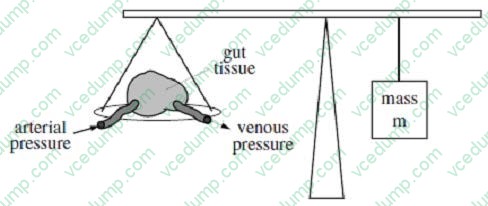
Figure 2
Assume that the beam balance of Method 2 is initially level. If the arterial pressure is decreased to a lower level while everything else is held constant, which graph best represents the change in the mass of the gut following the decrease in arterial pressure?
A. A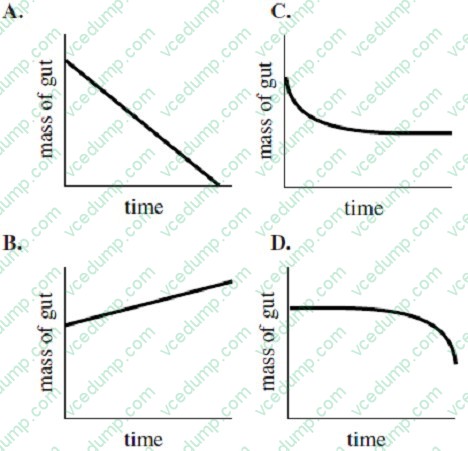
B. B
C. C
D. D -
Question 182:
The atomic size of an atom is:
A. greater than the positive ion.
B. smaller than the positive ion.
C. greater than the negative ion.
D. equal to covalent radius. -
Question 183:
The Russian wheat aphid, Diuraphis noxia, is a small green insect discovered in southern Russia around the turn of the century. Agricultural researchers are not quite sure, but they believe the Russian aphid adapted itself to wheat about ten thousand years ago, when the crop was first domesticated by man. What is not in doubt is the insect's destructiveness. Spread by both wind and human transport, the Russian aphid has destroyed wheat fields throughout Asia, Africa, and Latin America. Until a few years ago, the United States had been free of this pest. But in the spring of 1986, a swarm of Russian aphids crossed the Mexican border and settled a few hundred miles north, in central Texas. From there, it quickly spread to other Western states, destroying wheat fields all along its path. In fact, the level of destruction has been so great over the past five years that entomologists are calling the Russian aphid the greatest threat to American agriculture since the Hessian fly, Phytophaga destructor, was inadvertently brought to the colonies on ships by German mercenary troops during the Revolutionary War. A combination of several factors have made it particularly difficult to deal with the threat posed by this aphid. First, Russian aphids reproduce asexually at a phenomenal rate. This process, known as parthenogenesis, often results in as many as twenty generations of insects in a single year. Although most generations remain in a limited geographic area because they have no wings, a few generations are born with wings, allowing the insect to spread to new areas. Second, because wheat is a crop with a very low profit margin, most American farmers do not spray it with pesticides; it simply is not economical to do so. And since the Russian aphid has only recently entered the United States, it has no natural enemies among North American insects or animals. As a result, there have been no man-made or natural obstacles to the spread of the Russian aphid in the United States.
Agricultural researchers seeking to control the Russian aphid have looked to its place of origin for answers. In the Soviet Union, the Russian aphid has been kept in check by predators which have evolved alongside it over many thousands of years. One species of wasp seems to be particularly efficient at destroying the aphid. The pregnant females of the species search the Russian aphid's home, the interior of a wheat stalk, sting the aphid into paralysis, and then inject an egg into its body. When the egg hatches the wasp larva feeds off of the aphid, killing it in the process.
The introduction of predators like the wasp, coupled with the breeding of new strains of insect-resistant wheat, may substantially curb the destructiveness of the Russian aphid in the future. For the time being, however, American farmers are left to their own devices when it comes to protecting their wheat crops
The author most likely believes American farmers will:
A. develop new types of aphid-resistant wheat.
B. develop their own effective methods for dealing with the Russian aphid.
C. stop producing wheat until the Russian aphid is brought under control.
D. continue to lose a portion of their wheat crops for the foreseeable future. -
Question 184:
Fireworks have been used for centuries in celebrations around the world. One of the primary components of these devices, black powder, was developed by the Chinese over a thousand years ago and is still used today as a propellant and explosive. Black powder is composed of potassium nitrate (KNO3), charcoal (primarily C) and sulfur (S8) in a 75:15:10 ratio by weight. It is very stable if kept dry but can easily be ignited by a spark or burning fuse to undergo the following reaction:

Reaction 1 The basic firework is shown in Figure 1. Fireworks rely on a particular kind of combustion in which oxygen is supplied by oxidizing agents included in the pyrotechnic mixture. When ignited, the solid propellant begins to liquefy and vaporize allowing the fuel and oxidizing agents to interact more intimately leading to rapid expansion of gases. Delay fuses time the ignition of the other compartments to occur when the shell is high above ground.
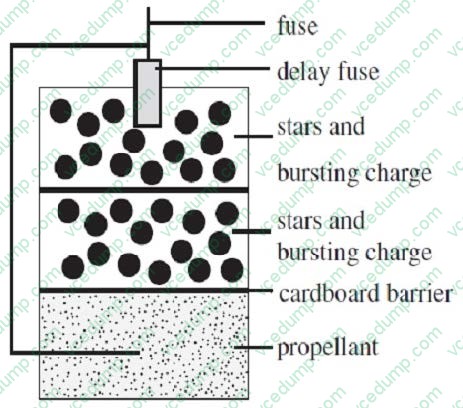
Figure 1
The light generating units of the firework are called stars and are dispersed and ignited by the bursting charge in each compartment. The intense colors of modern fireworks are generated by molecular emitters. For example, barium chloride emits green light (510?30 nm) and strontium chloride emits vibrant red light (605?50 nm). Many of the molecular emitters are unstable at room temperature and so cannot be placed directly into the firework. Instead, they are synthesized in the flame of the pyrotechnic reaction and exist for a short time before decomposing. The flame temperature must be carefully adjusted so that these emitters do not decompose too rapidly.

Which of the following bonds has the greatest ionic character?
A. Ba–Cl
B. Sr–Cl
C. N–N
D. O=CO -
Question 185:
The Russia which emerged from the terrible civil war after the 1917 Revolution was far from the Bolsheviks' original ideal of a non-exploitative society governed by workers and peasants. By 1921, the regime was weakened by widespread famine, persistent peasant revolts, a collapse of industrial production stemming from the civil war, and the consequent dispersal of the industrial working class -- the Bolsheviks' original base of support. To buy time for recovery, the government in 1921 introduced the New Economic Policy, which allowed private trade in farm products (previously banned) and relied on a fixed grain tax instead of forced requisitions to provide food for the cities. The value of the ruble was stabilized. Trade unions were again allowed to seek higher wages and benefits, and even to strike. However, the Bolsheviks maintained a strict monopoly of power by refusing to legalize other parties. After the death of the Revolution's undisputed leader, Lenin, in January 1924, disputes over the long-range direction of policy led to an open struggle among the main Bolshevik leaders. Since open debate was still possible within the Bolshevik Party in this period, several groups with differing programs emerged in the course of this struggle. The program supported by Nikolai Bukharin -- a major ideological leader of the Bolsheviks with no power base of his own -- called for developing agriculture through good relations with wealthy peasants, or "kulaks." Bukharin favored gradual industrial development, or "advancing towards Socialism at a snail's pace." In foreign affairs, Bukharin's policy was to ally with non-Socialist regimes and movements that were favorable to Russia. A faction led by Leon Trotsky, head of the Red Army and the most respected revolutionary leader after Lenin, called for rapid industrialization and greater central planning of the economy, financed by a heavy tax on the kulaks. Trotsky rejected the idea that a prosperous, human Socialist society could be built in Russia alone (Stalin's slogan of "Socialism in One Country"), and therefore called for continued efforts to promote working-class revolutions abroad. As time went on, he became bitterly critical of the new privileged elite emerging within both the Bolshevik Party and the Russian state. Joseph Stalin, General Secretary of the Bolshevik Party, was initially considered a "center," conciliating figure, not clearly part of a faction. Stalin's eventual supremacy was ensured by three successive struggles within the party, and only during the last did his own program become clear. First, in 1924?5, Stalin isolated Trotsky, allying for this purpose with Grigori Zinoviev and Lev Kamenev, Bolshevik leaders better known than Stalin himself, whom Trotsky mistakenly considered his main rivals. Stalin maneuvered Trotsky out of leadership of the Red Army, his main potential power base. Next, Stalin turned on Zinoviev and Kamenev, using his powers as head of the Party organization to remove them from party leadership in Leningrad and Moscow, their respective power bases. Trotsky, Zinoviev, and Kamenev then belatedly formed the "Joint Opposition" (1926?7). With Bukharin's help, Stalin easily outmaneuvered the Opposition: Bukharin polemicized against Trotsky, while Stalin prevented the newspapers from printing Trotsky's replies, organized gangs of toughs to beat up his followers, and transferred his supporters to administrative posts in remote regions. At the end of 1927, Stalin expelled Trotsky from the Bolshevik Party and exiled him. (Later, in 1940, he had him murdered.) Zinoviev and Kamenev, meanwhile, recanted their views in order to remain within the Party. The final act now began. A move by kulaks to gain higher prices by holding grain off the market touched off a campaign against them by Stalin. Bukharin protested, but with the tradition of Party democracy now all but dead, Stalin had little trouble silencing Bukharin. Meanwhile, he began a campaign to force all peasants -- not just kulaks -- onto state-controlled "collective farms," and initiated a crash industrialization program during which he deprived the trade unions of all rights and cut real wages by 50%. Out of the factional struggle in which he emerged by 1933 as sole dictator of Russia, Stalin's political program of building up heavy industry on the backs of both worker and peasant emerged with full clarity.
The passage supports the idea that struggles within the Bolshevik Party were primarily:
A. reflections of struggles among important groups in the general population.
B. the result of differences over economic policy.
C. the result of misdirected loyalty on the part of the Red Army.
D. caused by Russian social elites outside the Party. -
Question 186:
The under-secretion of parathormone causes:
A. decrease in blood phosphorus level.
B. decrease in blood calcium level.
C. increase in blood phosphorus level.
D. increase in blood calcium level. -
Question 187:
An automatic external defibrillator (AED) is simply a series of capacitors used to store a very large charge, which is then discharged through the patient's chest in a short time. If the capacitor in an AED is fully charged and the AED is no longer connected to the power source, what will happen to the energy stored in the AED if the dielectric (k = 1.5) is removed?
A. increase by a factor of 1.5
B. increase by a factor of 2.25
C. decrease by a factor of 1.5
D. decrease by a factor of v1.5 -
Question 188:
Milk produced initially by the mammary glands contains special lymph-like fluid that is called:
A. amniotic fluid.
B. colostrum.
C. pleural fluid.
D. serum. -
Question 189:
If a wire carrying a current flowing into the screen is placed in a magnetic field pointing left, in which direction will the Lorentz force act on the charge carriers?
A. to the left
B. to the right
C. upward
D. out of the screen -
Question 190:
Compounds containing a hydroxyl group attached to a benzene ring are called phenols. Derivatives of phenols, such as naphthols and phenanthrols, have chemical properties similar to those of phenols, as do most of the many naturally-occurring substituted phenols. Like other alcohols, phenols have higher boiling points than hydrocarbons of similar molecular weight. Like carboxylic acids, phenols are more acidic than their alcohol counterparts. Phenols undergo a number of different reactions; both their hydroxyl groups and their benzene rings are highly reactive. A number of chemical tests can be used to distinguish phenols from alcohols and carboxylic acids.
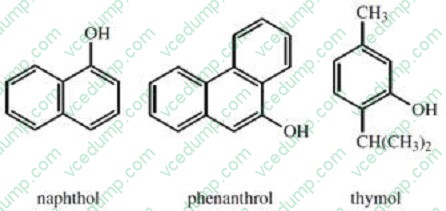
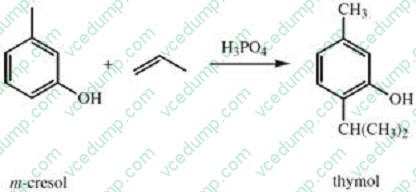
Thymol, a naturally occurring phenol, is an effective disinfectant that is obtained from thyme oil. Thymol can also be synthesized from m-cresol, as shown in Reaction A below. Thymol can then be converted to menthol, another naturally-occurring organic compound; this conversion is shown in Reaction B.
Reaction A
Reaction B
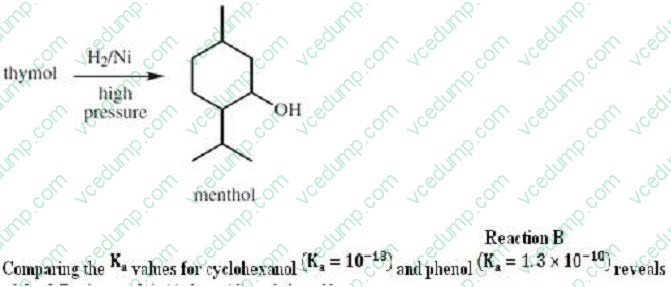
that phenol is more acidic than cyclohexanol. Which of the following explain(s) the acidity of phenol?
I. The exceptionally strong hydrogen bonding possible with phenol facilitates the loss of a proton, making it more acidic than cyclohexanol.
II. Phenol's conjugate base, phenoxide, is stabilized by resonance to a greater extent than phenol itself.
III.
The negative charge of the oxygen atom on the phenoxide ion is delocalized over the benzene ring.
A. I only
B. II only
C. II and III only
D. I, II, and III
I. The exceptionally strong hydrogen bonding possible with phenol facilitates the loss of a proton, making it more acidic than cyclohexanol. II. Phenol's conjugate base, phenoxide, is stabilized by resonance to a greater extent than phenol itself. III. The negative charge of the oxygen atom on the phenoxide ion is delocalized over the benzene ring.
Related Exams:
Tips on How to Prepare for the Exams
Nowadays, the certification exams become more and more important and required by more and more enterprises when applying for a job. But how to prepare for the exam effectively? How to prepare for the exam in a short time with less efforts? How to get a ideal result and how to find the most reliable resources? Here on Vcedump.com, you will find all the answers. Vcedump.com provide not only Medical Tests exam questions, answers and explanations but also complete assistance on your exam preparation and certification application. If you are confused on your MCAT-TEST exam preparations and Medical Tests certification application, do not hesitate to visit our Vcedump.com to find your solutions here.