MCAT-TEST Exam Details
-
Exam Code
:MCAT-TEST -
Exam Name
:Medical College Admission Test: Verbal Reasoning, Biological Sciences, Physical Sciences, Writing Sample -
Certification
:Medical Tests Certifications -
Vendor
:Medical Tests -
Total Questions
:812 Q&As -
Last Updated
:Jul 16, 2026
Medical Tests MCAT-TEST Online Questions & Answers
-
Question 151:
Sugars are carbohydrates, that is, molecules usually with the empirical formula C(H2O), and structural formulas made up of polyhydroxy aldehydes or ketones. Because of their polyfunctional nature, sugars can undergo a wide variety of
transformations upon treatment with acids, bases, or heat, and upon reaction with other simple reagents and enzymes. While many sugars occur in nature and are thus readily available, the synthesis and modification of simple sugars is a
necessary step in studies of enzymatic processes.
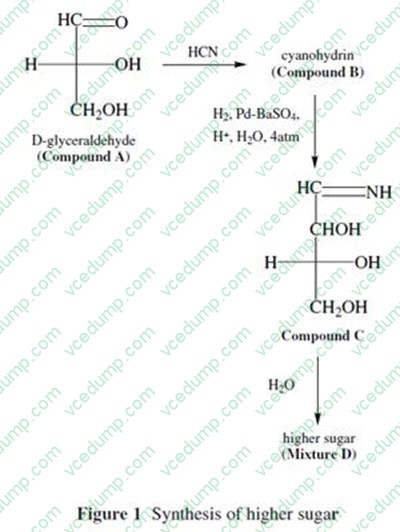
Higher sugars can be synthesized from the simple carbohydrate D-glyceraldehyde with the following procedure:
D-glyceraldehyde (Compound A) is reacted with HCN to produce a cyanohydrin (Compound B). Compound B is then treated with hydrogen gas and a modified palladium catalyst (similar to the Lindlar reagent) to give Compound C.
Compound C is hydrolyzed to give the higher sugars in Mixture D. This reaction is summarized in Figure 1. Mixture D contains two compounds, which can be separated by crystallization. Two doublets near 9.5 (, ppm) are observed in the 1H
NMR spectrum of mixture D, with each doublet corresponding to one of the two products present in the mixture. IR spectroscopy shows broad absorptions for both products around 3300 cm?.
The hydroxyl groups of carbohydrates can also participate in reactions. For example, D-glyceraldehyde can react with chloromethane under basic conditions to yield a completely methylated product. This SN2 reaction is shown in Figure 2.
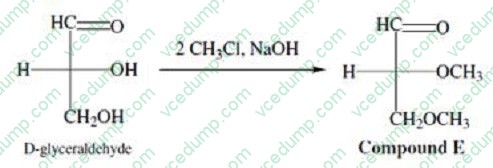
Figure 2 Methylation of D-glyceraldehyde
What are the missing compounds, respectively, in the following reaction?
A. Option A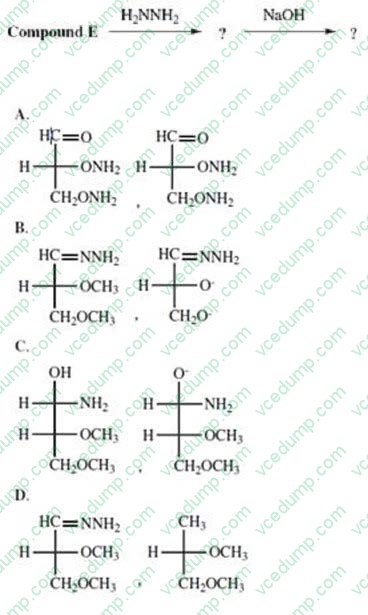
B. Option B
C. Option C
D. Option D -
Question 152:
Studies of photosynthesis began in the late eighteenth century. One scientist found that green plants produce a substance (later shown to be oxygen) that supports the flame of a candle in a closed container. Several years later it was discovered that a plant must be exposed to light in order to replenish this flame- sustaining "substance." Soon another discovery showed that the oxygen is formed at the expense of another gas, carbon dioxide.
In 1804, de Saussure conducted experiments revealing that equal volumes of carbon dioxide and oxygen are exchanged between a plant and the air surrounding it. De Saussure determined that the weight gained by a plant grown in a pot equals the sum of the weights of carbon derived from absorbed carbon dioxide and water absorbed through plant roots. Using this information, de Saussure was able to postulate that in photosynthesis carbon dioxide and water combine using energy in the form of light to produce carbohydrates, water, and free oxygen. Much later, in 1845, scientists' increased understanding of concepts of chemical energy led them to perceive that, through photosynthesis, light energy is transformed and stored as chemical energy.
In the twentieth century, studies comparing photosynthesis in green plants and in certain sulfur bacteria yielded important information about the photosynthetic process. Because water is both a reactant and a product in the central reaction, it had long been assumed that the oxygen released by photosynthesis comes from splitting the carbon dioxide molecule. In the 1930s, however, this popular view was decisively altered by the studies of C. B. Van Niel. Van Niel studied sulfur bacteria, which use hydrogen sulfide for photosynthesis in the same way that green plants use water, and produce sulfur instead of oxygen. Van Niel saw that the use of carbon dioxide to form carbohydrates was similar in the two types of organisms. He reasoned that the oxygen produced by green plants must derive from water -- rather than carbon dioxide, as previously assumed -- in the same way that the sulfur produced by the bacteria derives from hydrogen sulfide. Van Niel's finding was important because the earlier belief had been that oxygen was split off from carbon dioxide, and that carbon then combined with water to form carbohydrates. The new postulate was that, with green plants, hydrogen is removed from water and then combines with carbon dioxide to form the carbohydrates needed by the organism.
Later, Van Niel's assertions were strongly backed by scientists who used water marked with a radioactive isotope of oxygen in order to follow photosynthetic reactions. When the photosynthetically-produced free oxygen was analyzed, the isotope was found to be present.
According to the passage, the study of organisms that require hydrogen sulfide for photosynthesis:
A. proved that oxygen is not produced in photosynthesis.
B. contradicted the notion that oxygen is needed to support a candle's flame.
C. disproved assumptions about the role of light energy in photosynthesis.
D. clarified the role of water in photosynthesis among green plants. -
Question 153:
The mechanism for the acid-catalyzed esterification of a carboxylic acid, carried out with R'OH, is shown below. The tagged alcohol R'18OH is used to study the reaction mechanism. The resulting ester is separated from the reaction mixture; the water from the reaction mixture is then distilled off completely and collected as a separate fraction.

Assuming that only the forward reaction occurs, which of the following statements is correct?
A. The ester will contain labeled oxygen, while the water fraction will not.
B. The water fraction will contain labeled oxygen, while the ester will not.
C. Both the water fraction and the ester will contain labeled oxygen.
D. The location of the labeled oxygen cannot be determined. -
Question 154:
Which of the following is the reason that water boils at a much higher temperature than does hydrogen sulfide?
A. The intramolecular O–H bonds are stronger than the intramolecular S–H bonds.
B. The enthalpy of vaporization of water is less than that of hydrogen sulfide.
C. The relative molecular mass of water is less than that of hydrogen sulfide.
D. The intermolecular O–H bonds are stronger than the intermolecular S–H bonds. -
Question 155:
In the early nineteenth century a large number of communal experiments, both secular and religious, sprang up in the northeastern United States. Perhaps the most famous secular commune was Brook Farm, founded by transcendentalists George Ripley and William H. Channing to promote the pursuit of leisure and culture through the proper application of time and labor. Its members (among the more notable were Nathaniel Hawthorne and Margaret Fuller) pursued field labor by day, art and philosophy by night. For a time the system worked so well that two afternoons a week were set aside for leisure and Brook Farm began outcompeting local farmers at the produce market. But by nature the Farm's members were thinkers, not workers; despite their success they remained mainly interested in the theoretical and philosophical implications of the experiment. Thus, when a devastating fire brought the community considerable financial burdens in its fifth year, the members felt little compunction about closing shop and returning to their comfortable Boston homes.
One of the most notable religious utopias was the Oneida community. Its founder, John Humphrey Noyes, believed that Christ's second coming had already occurred and that everyone alive was favored by Divine grace, which Noyes saw as an imperative to live a better life. Perhaps surprisingly, the Oneidans embraced industry and commerce, achieving success in fruit packing, trap making, and silk thread winding. They owned everything communally, and this principle extended to each other. The Oneidans saw monogamy as a selfish act and asserted that the men and women of the community were united in one "complex" marriage; sex between any two consenting members was perfectly acceptable. The Oneidans maintained order solely through "criticism"--anyone acting out of line was made to stand before the other members and hear his or her faults recounted. Oneida remained viable for some thirty years, until the leadership devolved on Noyes' son, an agnostic. The old religious fervor died out, and the dream degenerated into a joint stock company. Doubtless the most successful communalists were the Shakers, so called for the early propensity to tremble ecstatically during religious worship. Their guiding light, Mother Ann, espoused four key principles: Virgin Purity, Christian Communism, Confession, and Separation from the World. Though the Shakers were less adamant on the last point--maintaining social relations and some commerce with heir neighbors--they insisted on the other three, and renounced both personal property and sex. Men and women lived in a single large "Unitary Dwelling" and were considered complete equals, but they occupied separate wings and could speak together only if a third person were present. Despite their religious strictness, Shakers were known as simple, sincere, intelligent people, healthy and long-lived, producers of lovely books and hymns, and of furniture still prized for its quality and durability. In their eyday, six thousand Shakers lived in fifty-eight separate "families" throughout the Northeast. Later their celibacy, combined with their strict discipline, led to a decline in numbers, but even today a small number of elderly Shakers in two communities in Maine and New Hampshire continue to keep the faith.
The passage implies that Brook Farm's economic system:
A. did not include the selling of produce outside the farm.
B. was based on the hiring of farm hands.
C. efficiently utilized time and labor.
D. was primarily intended to maximize collective profit. -
Question 156:
Four major blood types exist in the human ABO blood system: types A, B, AB, and O; and there are three alleles that code for them. The A and B alleles are codominant, and the O allele is recessive. Blood types are derived from the presence of specific polysaccharide antigens that lie on the outer surface of the red blood cell membrane. The A allele codes for the production of the A antigen; the B allele codes for the production of the B antigen; the O allele does not code for any antigen. While there are many other antigens found on red blood cell membranes, the second most important antigen is the Rh antigen. Rh is an autosomally dominant trait coded for by 2 alleles. If this antigen is present, an individual is Rh+; if it is absent, an individual is Rh-. For example, a person with type AB blood with the Rh antigen is said to be AB+.
These antigens become most important when an individual comes into contact with foreign blood. Because of the presence of naturally occurring substances that closely mimic the A and B antigens, individuals who do not have these antigens on their red blood cells will form antibodies against them. This is inconsequential until situations such as blood transfusion, organ transplant, or pregnancy occur.
Erythroblastosis fetalis is a condition in which the red blood cells of an Rh+ fetus are attached by antibodies produced by its Rh- mother. Unlike ABO incompatibility, in which there are naturally occurring antibodies to foreign antigens, the Rh system requires prior sensitization to the Rh antigen before antibodies are produced. This sensitization usually occurs during the delivery of an Rh+ baby. So while the first baby will not be harmed, any further Rh+ fetuses are at risk.
The Coombs tests provide a method for determining whether a mother has mounted an immune response again her baby's blood. The tests are based on whether or not agglutination occurs when Coombs reagent is added to a sample. Coombs reagent contains antibodies against the anti-Rh antibodies produced by the mother. The indirect Coombs test takes the mother's serum, which contains her antibodies but no red blood cells, and mixes it with Rh+ red blood cells. Coombs reagent is then added. If agglutination occurs, the test is positive, and the mother must be producing anti-Rh antibodies. The direct Coombs test mixes the baby's red blood cells with Coombs reagent. If agglutination occurs, the test is positive, and the baby's red blood cells must have been attacked by its mother's anti-Rh antibodies. In a paternity case, the mother has type A+ blood and her son has type O- blood. If the husband has type B+ blood, which of the following is true?
A. The husband could be the father.
B. The husband could not be the father.
C. The husband could not be the father of a son, but could be the father of a daughter.
D. The husband is definitely the father. -
Question 157:
Alleles are created when a single gene undergoes several distinct mutations. These alleles may have different dominance relationships with one another; for example, there are three alleles coding for the human blood groups, the IA, IB, and i alleles. Both the IA and IB alleles are dominant to the i allele, but IA and IB are codominant to each other.
A multiple-allele system has recently been discovered in the determination of hair coloring in a species of wild rat. The rats are found to have one of three colors: brown, red, or white. Let B = the gene for brown hair; b = the gene for red hair; and w = the gene for white hair. The results from nine experimental crosses are shown below. The males and females in Crosses 1, 2, and 3 are all homozygous for hair color.
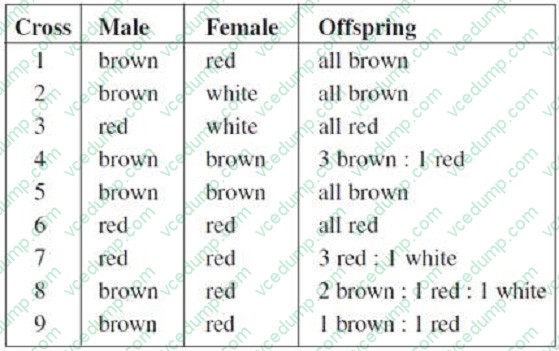
Based on the experimental results, what is the genotype of the male in Cross 6?
A. bw
B. bb
C. bw or bb
D. Bb or bw -
Question 158:
The polymerase chain reaction (PCR) is a powerful biological tool that allows the rapid amplification of any fragment of DNA without purification. In PCR, DNA primers are made to flank the specific DNA sequence to be amplified. These primers are then extended to the end of the DNA molecule with the use of a heat- resistant DNA polymerase. The newly synthesized DNA strand is then used as the template to undergo another round of replication.
The 1st step in PCR is the melting of the target DNA into 2 single strands by heating the reaction mixture to approximately 94 oC, and then rapidly cooling the mixture to allow annealing of the DNA primers to their specific locations. Once the primer has annealed, the temperature is elevated to 72 oC to allow optimal activity of the DNA polymerase. The polymerase will continue to add nucleotides until the entire complimentary strand of the template is completed at which point the cycle is repeated (Figure 1)

Figure 1
One of the uses of PCR is sex determination, which requires amplification of intron 1 of the amelogenin gene. This gene found on the X-Y homologous chromosomes has a 184 base pair deletion on the Y homologue. Therefore, by amplifying intron 1 females can be distinguished from males by the fact that males will have 2 different sizes of the amplified DNA while females will only have 1 unique fragment size.
Which of the following statements could be used to correctly describe the overall polymerase chain reaction?
A. It is an anabolic reaction that breaks down new DNA strands.
B. It is an anabolic reaction that synthesizes new DNA strands.
C. It is a catabolic reaction that breaks down new DNA strands.
D. It is a catabolic reaction that synthesizes new DNA strands. -
Question 159:
The hydrogens of alkanes have pKa values that are over 30 or 40. In contrast, the -hydrogens of aldehydes and ketones have pKa values that range from 19 to 21. These fairly acidic -hydrogens can be removed by strong bases to form anions called enolates. The enolate ions are strongly stabilized by resonance. Protonation of the enolate at oxygen produces an enol. Interconversion between the keto and enol forms is called tautomerization and is illustrated in Figure 1. The keto form is usually highly favored.
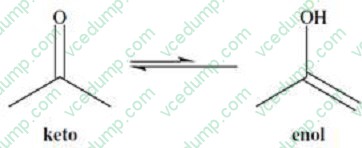
Figure 1
Keto-enol tautomerization has some interesting consequences. For example, if a ketone is treated with acid or base in a solvent of D2O (heavy water), all of the - hydrogens will be exchanged for deuterium. This reaction is shown in Figure 2.
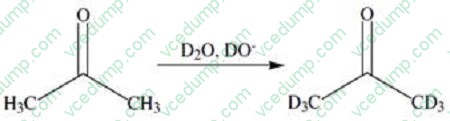
Figure 2 Another consequence of keto-enol tautomerization is the racemization of chiral -carbons. In the enol form, the -carbon adopts a planar configuration and is no longer chiral. Tautomerization back to the ketone produces a racemic mixture of products. This is shown in Figure 3.
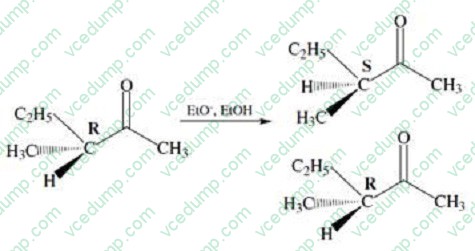
Figure 3
Which of the following best represents the enolate ion intermediate of the racemization reaction shown in Figure 3?
A. Option A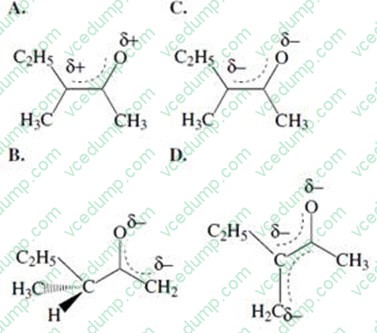
B. Option B
C. Option C
D. Option D -
Question 160:
Saul Hoffman's scientific journal paper published in 2015 in Societies explores the relationship between two topics that at the surface are very distant from each other. As he goes on to state, "It is relatively easy, at least for an economist, to see why economists would be attracted to issues like teen pregnancy and teen childbearing, despite their apparent distance from the core topics of economics. First, economics ?especially microeconomics ?is fundamentally the study of choices that individuals make, traditionally and most often in formal markets with monetary prices, but now more and more frequently outside that sphere. Viewed from that perspective, choices involving sexual and fertility behavior among teens are an incredibly challenging, but inviting, target. Is it possible to identify the role of economic incentives, including government policy, on these behaviors? Is it sensible to apply traditional models of rational choice decision-making to teens?
Second, the traditional concern about teen fertility was predicated on the notion that it was an economically catastrophic act. In a famous and oft-quoted 1968 article, Arthur Campbell wrote that 'The girl who has an illegitimate child at the age of 16 suddenly has 90 percent of her life's script written for her,' including reduced opportunities for schooling, the labor market, and marriage. But it doesn't take too much reflection to appreciate that more may be going on in leading to these poor outcomes than just a teen birth. Disentangling the causal effect of teen childbearing on subsequent socio-economic outcomes from its correlational effect is another deliciously inviting and challenging target, this time well-suited for the applied economist or econometrician.
Just to make all this yet more inviting, the two research strands are closely related. Suppose it could be demonstrated that for some teens the socio-economic impact of a teen birth was negligible. For example, maybe future prospects for some teens were equally poor with or without a birth or perhaps government programs provided substantial benefits, so that the net impact on socio-economic well-being was consequently small or even positive. Then, it might well be 'rational' in an economic sense to have a teen birth in the first place, thereby linking the research on the causal impact of a teen birth with the research on the choice determinants of a teen birth. So what came to be known as the teen birth `causes' literature and the teen birth `consequences' literature were clearly interrelated.
And then, to add yet another layer of challenge, the teen fertility rate in the U.S. has fallen at a rate that is totally unprecedented. Teen fertility was once widespread, with most of it occurring within early and sometimes not entirely voluntary marriage. In 1960, the teen fertility rate was approximately 90 births per 1000, which implied that more than 40% of women ever had a teen birth. When I published my first article on teen births 25 years ago, the teen fertility rate was 60 births per 1000, down one-third from 1960, but it had increased six years in a row in what turned out to be a deviation from the downward trend. Since then the rate has declined every single year, except for a short but puzzling uptick between 2005 and 2007. In 2014, the teen fertility rate was 24.2 births per 1000, the lowest teen fertility rate ever recorded in the U.S., though still shockingly high by European standards. Thus, the rate fell by more than 50% during my professional association with the topic and by 70% since 1960. Of course, at the same time teen marital births largely disappeared, falling from 85% of teen births to 12%.
This adds yet another focus for economic research. Why did the rate fall? Did it have anything to do with changes in the costs of teen childbearing or changes in policy? Is it a good thing or not?
In this article I try to make sense out of these various research strands by providing a personal narrative through the economics literature on teen childbearing, with a special emphasis on the three issues discussed above. My goal is to make the literature, including some reasonably technical content, accessible and valuable to a non-economist."
Hoffman, S. (2015). Teen Childbearing and Economics: A Short History of a 25-Year Research Love Affair. Societies, 5(3), 646-663. doi:10.3390/soc5030646
The author's main point could be most strongly undermined by a sociological or economic study showing that:
A. statistics on teen birth make little apparent sense because even when there is an overall downward trend, the teen birth rate can unpredictably swing upward, and vice versa.
B. many teens who give birth do so not out of desire to be parents, but because they lack access to birth control and effective sex education.
C. in recent years, the economic and career results of teen pregnancy have been getting worse.
D. potential teenage mothers are minimally influenced by economic considerations like career and financial prospects, but make choices based on irrational factors like community beliefs about morality.
Related Exams:
Tips on How to Prepare for the Exams
Nowadays, the certification exams become more and more important and required by more and more enterprises when applying for a job. But how to prepare for the exam effectively? How to prepare for the exam in a short time with less efforts? How to get a ideal result and how to find the most reliable resources? Here on Vcedump.com, you will find all the answers. Vcedump.com provide not only Medical Tests exam questions, answers and explanations but also complete assistance on your exam preparation and certification application. If you are confused on your MCAT-TEST exam preparations and Medical Tests certification application, do not hesitate to visit our Vcedump.com to find your solutions here.