MCAT-TEST Exam Details
-
Exam Code
:MCAT-TEST -
Exam Name
:Medical College Admission Test: Verbal Reasoning, Biological Sciences, Physical Sciences, Writing Sample -
Certification
:Medical Tests Certifications -
Vendor
:Medical Tests -
Total Questions
:812 Q&As -
Last Updated
:Jul 16, 2026
Medical Tests MCAT-TEST Online Questions & Answers
-
Question 141:
A thin layer chromatography is performed on both the reactants and products of a reaction. It is found that the products have an Rf value that is significantly higher than the reactants.
Which of the following could adequately describe this reaction?
A. SN2 reaction converting an alkyl bromide to an alkyl chloride
B. Addition reaction converting an alkene to an alcohol
C. Nucleophilic acyl substitution reaction converting an ester to an anhydride
D. Elimination reaction converting an alcohol to an alkene -
Question 142:
One of the basic principles of ecology is that population size is to some extent a function of available food resources. Recent field experiments demonstrate that the interrelationship may be far more complex than hitherto imagined. Specifically, the browsing of certain rodents appears to trigger biochemical reactions in the plants they feed on that help regulate the size of the rodent populations. Two such examples of phytochemical regulation (regulation involving plant chemistry) have been reported so far. Patricia Berger and her colleagues at the University of Utah have demonstrated that instrumentality of 6- methoxybenzoxazolinone (6-MBOA) in triggering reproductive behavior in the mountain vole (Microtus montanus), a small rodent resembling the field mouse. 6-MBOA forms in young mountain grasses in response to browsing by predators such as voles. The experimenters fed rolled oats coated with 6-MBOA to non-breeding winter populations of Microtus. After three weeks, the sample populations revealed a high incidence of pregnancy among the females and pronounced swelling of the testicles among the males. Control populations receiving no 6- MBOA revealed no such signs. Since the timing of reproductive effort is crucial to the short-lived vole in an environment in which the onset of vegetative growth can vary by as much as two months, the phytochemical triggering of copulatory behavior in Microtus represents a significant biological adaptation. A distinct example is reported by John Bryant of the University of Alaska. In this case, plants seem to have adopted a form of phytochemical self-defense against the depredations of the snowshoe hare (Lepus americanus) of Canada and Alaska. Every ten years or so, for reasons that are not entirely understood, the Lepus population swells dramatically. The result is intense overbrowsing of early and mid-successional deciduous trees and shrubs. Bryant has shown that, as if in response, four common boreal forest trees favored by Lepus produce adventitious shoots high in terpene and phenolic resins which effectively discourage hare browsing. He treated mature, non-resinous willow twigs with resinous extracts from the adventitious shoots of other plants and placed treated and untreated bundles at hare feeding stations, weighing them at the end of each day. Bryant found that bundles containing only half the resin concentration of natural twigs were left untouched. The avoidance of these unpalatable resins, he concludes, may play a significant role in the subsequent decline in the Lepus population to its normal level. These results suggest obvious areas for further research. For example, observational data should be reviewed to see whether the periodic population explosions among the prolific lemming (like the vole and the snowshoe hare, a small rodent in a marginal northern environment) occur during years in which there is an early onset of vegetative growth; if so, a triggering mechanism similar to that found in the vole may be involved. Bryant's interpretation of the results of his experiment (lines 46?8) depends on which of the following assumptions?
A. The response of Lepus to resinous substances in nature may be different from its response under experimental conditions.
B. The decennial rise in the Lepus population is triggered by an unknown phytochemical response.
C. Many Lepus will starve to death rather than eat resinous shoots or change their diet.
D. Lepus learns to search for alternative food sources once resinous shoots are encountered. -
Question 143:
Each of the following is an example of the transmission of knowledge through symbolic culture EXCEPT:
I. A young macaque monkey learning to rinse off food in the ocean from an older monkey, even when the food is not covered in dirt or sand.
II. A child learning the rules of baseball from a parent.
III.
A new group of inductees in a military organization experiencing hazing rituals from older students, which they then later carry out on new recruits.
A. I only
B. III only
C. I and III only
D. II and III only
I. A young macaque monkey learning to rinse off food in the ocean from an older monkey, even when the food is not covered in dirt or sand. II. A child learning the rules of baseball from a parent. III. A new group of inductees in a military organization experiencing hazing rituals from older students, which they then later carry out on new recruits. -
Question 144:
At a recent meeting of the American Public Transit Association, the Environmental Protection Agency unveiled stringent new standards for pollution control. The transit authorities were particularly concerned about the implementation of a proposed "Clean Air Act." They believed the provisions of the Clean Air Act could severely affect basic services to their local communities. Many transit agencies were concerned that it would be difficult to comply with the pollution and emissions control standards while continuing to operate within realistic budgets. The aim of the Clean Air Act is to assure that by the year 2000, there will be a reduction of at least 10 million tons of sulfur dioxide from 1980 levels. The bill also calls for a reduction in pollutants that contribute to the depletion of ozone. Strict regulations of toxic air emissions would have to be established and enforced. Additionally, the Clean Air Act would establish specific acid-rain reduction quotas and enforce severe penalties for transgressors of any of the new clean air regulations. There is little doubt that mass-transit suppliers will be considerably affected by this new legislation, just as the chemical and petroleum industries have already been affected by similar legislation. Transit authorities are challenged to strike a difficult balance between complying with the government's new standards and developing an official concern for the environment, while continuing to fulfill the transportation needs of the general population. Among the areas addressed by the Clean Air Act, the topic of mobile resources is of particular interest to mass transit authorities. Provisions contained in the Act under this title are aimed at encouraging the development and practical use of alternative fuel sources, like solar energy and methane fuel. The goal of this section of the Act is to eradicate toxic fuel emissions in order to provide cleaner air and a more favorable environment. The Act even goes so far as to declare that in cities like New York, Los Angeles and Houston -- where air quality is particularly noxious and toxins exceed the limits of federal regulations -- forms of mass transit should run on so-called "clean-burning fuels" by the year 2000. Such fuels include reformulated gasoline, propane, electricity, natural gas, ethanol, methanol, or any similar type of low-emission fuel. In addition, the Act proposes that, by 1994, all new urban buses in cities with populations exceeding one million must operate solely on clean-burning fuels. The topics of alternative fuels and alternative fuel vehicles represent, by far, the most controversial issue in the Clean Air Act. President Bush has called alternative fuels "bold and innovative" means to control pollution, but according to many transportation experts, the Act's proposals on alternative fuel usage are unrealistic. The transit authorities recognize that concern for the environment and health hazards like pollution are global issues. However, most transit officials concur that inventing and developing new ways to fuel mass transit will take at least 50 years to realize. They point out that the Act does not mention the political and social ramifications of usurping the role of the petroleum industries. The Act does not mention if or how the thousands of people employed by the oil industry will get retrained to produce and implement the use of "clean" fuel. No one disputes the fact that people need some form of transportation to get from place to place. Preserving the environment should be a priority, yet we need to remember that even if toxic emissions are completely eliminated sometime in the future, the challenge of moving mass numbers of people where they want to go will still exist and must remain a priority. Transit authorities contend that unless the Clean Air Act also acknowledges this, and develops a way to encourage mass transit over personal transportation, the problems of pollution might not be significantly altered. They suggest that there are many areas in this country that have little or no mass transit and that, if the Clean Air Act's goal is to reduce pollution, perhaps the most practical and realistic means to achieve that goal is to encourage the development and maintenance of mass transit systems.
The majority of transit officials seem to agree that developing new ways to power mass transit:
A. is an unrealistic goal, at least for the short term.
B. must be preceded by governmental restrictions on petroleum products.
C. should be subsidized at the state and federal levels.
D. will increase the cost of transportation to consumers. -
Question 145:
The nuclei of certain unstable isotopes will spontaneously decay, producing a more stable nucleus and releasing a particle or quantity of energy. Alpha decay releases a helium nucleus, beta decay emits an electron, while gamma decay is the emission of a high energy photon. Each type of radioactive decay is characterized, in part, by the half-life of the radioactive material--the time required for half of the nuclei in a sample to undergo decay. Examples of such decays are
shown in Figure 1.
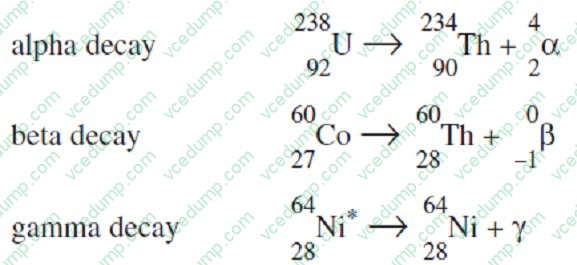
Figure 1
A Geiger counter can be used to detect the decay of radioactive materials. A simple Geiger counter consists of a hollow metal cylinder with a wire along its axis. The cylinder is filled with low pressure argon gas and a high voltage difference is
applied between the wire and the cylinder. When alpha, beta, or gamma radiation passes through the cylinder, it interacts with the gas particles and leads to the formation of ions which cause a discharge between the wire and the cylinder.
The consequent current may be used to drive a speaker, producing the characteristic clicking sound of the Geiger counter each time a pulse of current occurs. The Geiger counter circuitry is shown in Figure 2.

Figure 2
Beta radiation differs from gamma rays in the following way:
A. gamma rays can penetrate the Geiger counter cylinder, while beta rays cannot.
B. beta particles and gamma rays will be deflected in opposite directions by a magnetic field.
C. beta particles and gamma rays will be deflected in opposite directions by an electric field.
D. beta particles will be deflected in a magnetic field while gamma rays will not. -
Question 146:
A study examined admissions to exceptionally selective colleges. When examining the correlates of admission acceptance, two obvious factors that strongly correlated with admissions were GPA and standardized test scores, with correlation values of +0.41 and +0.55 respectively. However, the study also demonstrated that those students who had social networks that overlapped with the alumni networks of the selective colleges were even more likely to be admitted, with a correlation between social network and alumni network of +0.61. This correlation demonstrates:
A. the value of cultural capital.
B. a meritocracy.
C. the value of social capital.
D. a false association. -
Question 147:
Hemophilia is a genetically inherited disease that causes the synthesis of an abnormal clotting factor. As a result, hemophiliacs bleed excessively from the slightest injury. The figure below is a partial pedigree for the hemophilia trait in Queen Victoria's descendants. The pedigree indicates no history of hemophilia for either parent prior to the F1 generation.
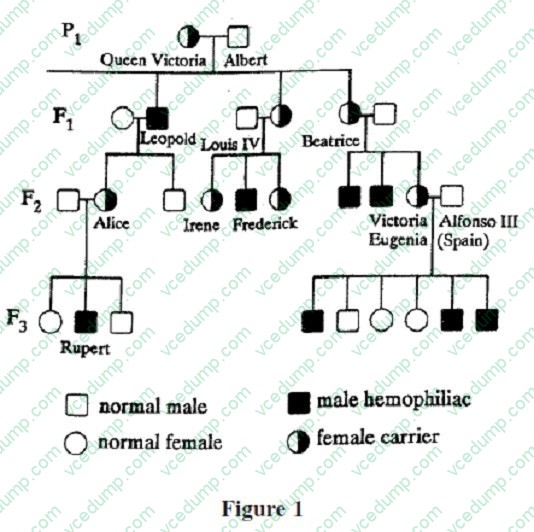
Based on the pedigree, what is the most reasonable explanation for Rupert's hemophilia?
A. A mutation occurred on the Y chromosome that he inherited from his father.
B. His mother was a hemophiliac and transmitted the gene to him.
C. His father was a carrier of the gene for hemophilia.
D. His maternal grandfather was a hemophiliac. -
Question 148:
There are two opposing theories of light: the particle theory and the wave theory. According to the particle theory, light is composed of a stream of tiny particles that are subject to the same physical laws as other types of elementary particles.
One consequence of this is that light particles should travel in a straight line unless an external force acts on them. According to the wave theory, light is a wave that shares the characteristics of other waves. Among other things, this means
that light waves should interfere with each other under certain conditions.
In support of the wave theory of light, Thomas Young's double slit experiment proves that light does indeed exhibit interference. Figure 1 shows the essential features of the experiment. Parallel rays of monochromatic light pass through two
narrow slits and are projected onto a screen. Constructive interference occurs at certain points on the screen, producing bright areas of maximum light intensity. Between these maxima, destructive interference produces light intensity minima.
The positions of the maxima are given by the equation dsin = n, where d is the distance between the slits, is the angle shown in Figure 1, the integer n specifies the particular maxima, and is the wavelength of the incident light. (Note: sin tan
for small angles.)
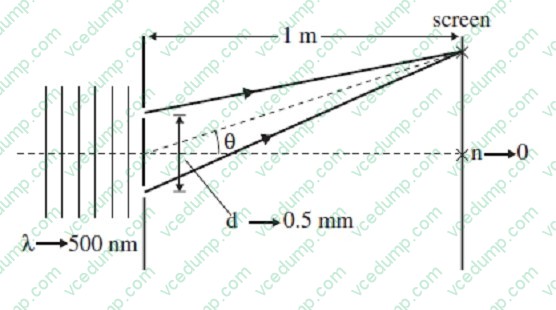
Figure 1
Which of the following is sufficient information to determine the approximate speed of a ray of light in water?
A. The angle of incidence and the angle of refraction of the light ray as it enters water from air
B. The wavelength in water and the wavelength in air of the light ray as it enters water from air
C. The speed of light in a vacuum and the density of water
D. The speed of light in a vacuum and the index of refraction of water -
Question 149:
The magnetic field is produced by:
A. moving protons.
B. stationary protons.
C. stationary electrons.
D. moving electrons. -
Question 150:
The mechanism for the acid-catalyzed esterification of a carboxylic acid, carried out with R'OH, is shown below. The tagged alcohol R'18OH is used to study the reaction mechanism. The resulting ester is separated from the reaction mixture; the water from the reaction mixture is then distilled off completely and collected as a separate fraction.

Which of the following alkyl halides would be most likely to react with sodium butanoate to form an ester?
A. Option A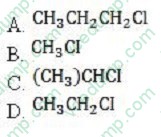
B. Option B
C. Option C
D. Option D
Related Exams:
Tips on How to Prepare for the Exams
Nowadays, the certification exams become more and more important and required by more and more enterprises when applying for a job. But how to prepare for the exam effectively? How to prepare for the exam in a short time with less efforts? How to get a ideal result and how to find the most reliable resources? Here on Vcedump.com, you will find all the answers. Vcedump.com provide not only Medical Tests exam questions, answers and explanations but also complete assistance on your exam preparation and certification application. If you are confused on your MCAT-TEST exam preparations and Medical Tests certification application, do not hesitate to visit our Vcedump.com to find your solutions here.