MCAT-TEST Exam Details
-
Exam Code
:MCAT-TEST -
Exam Name
:Medical College Admission Test: Verbal Reasoning, Biological Sciences, Physical Sciences, Writing Sample -
Certification
:Medical Tests Certifications -
Vendor
:Medical Tests -
Total Questions
:812 Q&As -
Last Updated
:Jul 16, 2026
Medical Tests MCAT-TEST Online Questions & Answers
-
Question 131:
One of the most common methods that scientists use to determine the age of fossils is known as carbon dating. 14C is an unstable isotope of carbon that undergoes beta decay with a half-life of approximately 5,730 years. Beta decay occurs when a neutron in the nucleus decays to form a proton and an electron which is ejected from the nucleus. 14C is generated in the upper atmosphere when 14N, the most common isotope of nitrogen, is bombarded by neutrons. This mechanism yields a global production rate of 7.5 kg per year of 14C, which combines with oxygen in the atmosphere to produce carbon dioxide. Both the production and the decay of 14C occur simultaneously. This process continues for many half-lives of 14C, until the total amount of 14C approaches a constant. A fixed fraction of the carbon ingested by all living organisms will be 14C. Therefore, as long as an organism is alive, the ratio of 14C to 12C that it contains is constant. After the organism dies, no new 14C is ingested, and the amount of 14C contained in the organism will decrease by beta decay. The amount of 14C that must have been present in the organism when it died can be calculated from the amount of 12C present in a fossil. By comparing the amount of 14C in the fossil to the calculated amount of
14C that was present in the organism when it died, the age of the fossil can be determined.
In determining the age of the galaxy, a technique similar to carbon dating is used on stars with the radioactive isotope 232Th, which has a half-life of 1010 years. 14C is less suitable for this application because:
A. its half-life is too long.
B. 14C is more abundant than 232Th is in stars.
C. 14C is unstable.
D. its half-life is too short. -
Question 132:
Band theory explains the conductivity of certain solids by stating that the atomic orbitals of the individual atoms in the solid merge to produce a series of atomic orbitals comprising the entire solid. The closely-spaced energy levels of the orbitals form bands. The band corresponding to the outermost occupied subshell of the original atoms is called the valence band. If partially full, as in metals, it serves as a conduction band through which electrons can move freely. If the valence band is full, then electrons must be raised to a higher band for conduction to occur. The greater the band gap between the separate valence and conduction bands, the poorer the material's conductivity. Figure 1 shows the valence and conduction bands of a semiconductor, which is intermediate in conductivity between conductors and insulators.
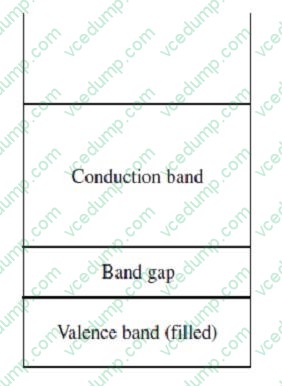
Figure 1
When silicon, a semiconductor with tetrahedral covalent bonds, is heated, a few electrons escape into the conduction band. Doping the silicon with a few phosphorus atoms provides unbonded electrons that escape more easily, increasing conductivity. Doping with boron produces holes in the bonding structure, which may be filled by movement of nearby electrons within the lattice. When a semiconductor in an electric circuit has excess electrons on one side and holes on the other, electron flow occurs more easily from the side with excess electrons to the side with holes than in the reverse direction.
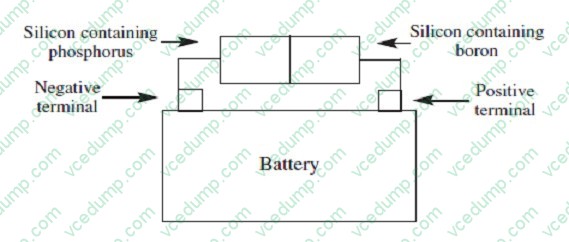
Figure 2
How does heat increase the conductivity of a semiconductor?
I) By reducing collisions between moving electrons
II) By breaking covalent bonds
III) By raising electrons to a higher energy level
A. I only
B. III only
C. I and III only
D. II and III only -
Question 133:
When Gwendolyn Brooks published her first collection of poetry A Street In Bronzeville in 1945 most reviewers recognized Brooks' versatility and craft as a poet. Yet, while noting her stylistic successes few of her contemporaries discussed the critical question of Brooks' relationship to the Harlem Renaissance. How had she addressed herself, as a poet, to the literary movement's assertion of the folk and African culture, and its promotion of the arts as the agent to define racial integrity? The New Negro poets of the Harlem Renaissance expressed a deep pride in being Black; they found reasons for this pride in ethnic identity and heritage; and they shared a common faith in the fine arts as a means of defining and reinforcing racial pride. But in the literal expression of this impulse, the poets were either romantics, or realists and, quite often within the same poem, both. The realistic impulse, as defined best in the poems of McKay's Harlem Shadows (1922), was a sober reflection upon Blacks as second class citizens, segregated from the mainstream of American socio-economic life, and largely unable to realize the wealth and opportunity that America promised. The romantic impulse, on the other hand, as defined in the poems of Sterling Brown's Southern Road (1932), often found these unrealized dreams in the collective strength and will of the folk masses. In comparing the poems in A Street in Bronzeville with various poems from the Renaissance, it becomes apparent that Brooks brings many unique contributions to bear on this tradition. The first clue that A Street In Bronzeville was, at its time of publication, unlike any other book of poems by a Black American is its insistent emphasis on demystifying romantic love between Black men and women. During the Renaissance, ethnic or racial pride was often focused with romantic idealization upon the Black woman. A casual streetwalker in Hughes' poem, "When Sue Wears Red," for example, is magically transformed into an Egyptian Queen. In A Street In Bronzeville, this romantic impulse runs headlong into the biting ironies of racial discrimination. There are poems in which Hughes, McKay and Brown recognize the realistic underside of urban life for Black women. But for Brooks, unlike the Renaissance poets, the victimization of poor Black women becomes not simply a minor chord but a predominant theme. ...Brooks' relationship with the Harlem Renaissance poets, as A Street in Bronzeville ably demonstrates, was hardly imitative. As one of the important links with the Black poetic tradition of the 1920s and 1930s, she enlarged the element of realism that was an important part of the Renaissance world-view. Although her poetry is often conditioned by the optimism that was also a legacy of the period, Brooks rejects outright their romantic prescriptions for the lives of Black women. And in this regard, she serves as a vital link with the Black Arts Movement of the 1960s that, while it witnessed the flowering of Black women as poets and social activists as well as the rise of Black feminist aesthetics in the 1970s, brought about a curious revival of romanticism in the Renaissance mode.
Which of the following best expresses the main idea of the passage?
A. The evolution of realism in Black women's poetry can be traced from Gwendolyn Brooks to the present day.
B. Gwendolyn Brooks' first poems were unique in the context of early twentieth-century poetry.
C. Contemporary scholars misinterpreted the crucial issue of Gwendolyn Brooks' relationship to the Harlem Renaissance.
D. Gwendolyn Brooks' poetry brought a new emphasis on the realistic elements of the Harlem Renaissance tradition. -
Question 134:
The periodic beating of the heart is controlled by electrical impulses that originate within the cardiac muscle itself. These pulses travel to the sinoatrial node and from there to the atria and the ventricles, causing the cardiac muscles to contract. If a current of a few hundred milliamperes passes through the heart, it will interfere with this natural system, and may cause the heart to beat erratically. This condition is known as ventricular fibrillation, and is life-threatening. If, however, a larger current of about 5 to 6 amps is passed through the heart, a sustained ventricular contraction will occur. The cardiac muscle cannot relax, and the heart stops beating. If at this point the muscle is allowed to relax, a regular heartbeat will usually resume.
The large current required to stop the heart is supplied by a device known as a defibrillator. A schematic diagram of a defibrillator is shown below. This device is essentially a "heavy-duty" capacitor capable of storing large amounts of energy. To charge the capacitor quickly (in 1 to 3 seconds), a large DC voltage must be applied to the plates of the capacitor. This is achieved using a step-up transformer, which creates an output voltage that is much larger than the input voltage. The transformer used in this defibrillator has a step-up ratio of 1:50.
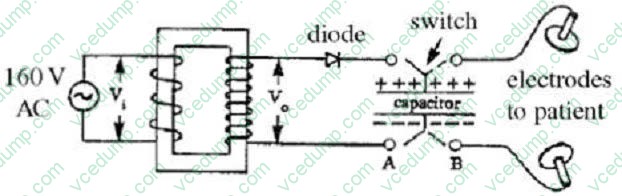
The AC voltage that is obtained from the transformer must then be converted to DC voltage in order to charge the capacitor. This is accomplished using a diode, which allows current flow in one direction only. Once the capacitor is fully charged, the charge remains stored until the switch is moved to position B and the plates are placed on the patient's chest. To cut down the resistance between the patient's body and the defibrillator, the electrodes are covered with a wetting gel before use. Care must be taken to insure that the patient is not in electrical contact with the ground while the defibrillator is in use.
If the defibrillator has a capacitance of 10 F, how much charge will build up on the two plates?
A. 0.08 coulombs
B. 0.8 coulombs -
Question 135:
Although nihilism is commonly defined as a form of extremist political thought, the term has a broader meaning. Nihilism is in fact a complex intellectual stance with venerable roots in the history of ideas, which forms the theoretical basis for many positive assertions of modern thought. Its essence is the systematic negation of all perceptual orders and assumptions. A complete view must account for the influence of two historical crosscurrents: philosophical skepticism about the ultimacy of any truth, and the mystical quest for that same pure truth. These are united by their categorical rejection of the "known". The outstanding representative of the former current, David Hume (1711?776), maintained that external reality is unknowable, since sense impressions are actually part of the contents of the mind. Their presumed correspondence to external "things" cannot be verified, since it can be checked only by other sense impressions. Hume further asserts that all abstract conceptions turn out, on examination, to be generalizations from sense impressions. He concludes that even such an apparently objective phenomenon as a cause-and-effect relationship between events may be no more than a subjective fabrication of the observer. Stanley Rosen notes: "Hume terminates in skepticism because he finds nothing within the subject but individual impressions and ideas". For mystics of every faith, the "experience of nothingness" is the goal of spiritual practice. Buddhist meditation techniques involve the systematic negation of all spiritual and intellectual constructs to make way for the apprehension of pure truth. St. John of the Cross similarly rejected every physical and mental symbolization of God as illusory. St. John's spiritual legacy is, as Michael Novak puts it, "the constant return to inner solitude, an unbroken awareness of the emptiness at the heart of consciousness. It is a harsh refusal to allow idols to be placed in the sanctuary. It requires also a scorching gaze upon all the bureaucracies, institutions, manipulators, and hucksters who employ technology and its supposed realities to bewitch and bedazzle the psyche". Novak's interpretation points to the way these philosophical and mystical traditions prepared the ground for the political nihilism of the nineteenth and twentieth centuries. The rejection of existing social institutions and their claims to authority is in the most basic sense made possible by Humean skepticism. The political nihilism of the Russian intelligentsia combined this radical skepticism with a near mystical faith in the power of a new beginning. Hence, their desire to destroy becomes a revolutionary affirmation; in the words of Stanley Rosen, "Nihilism is an attempt to overcome or repudiate the past on behalf of an unknown and unknowable, yet hoped-for, future." This fusion of skepticism and mystical re-creation can be traced in contemporary thought, for example as an element in the counterculture of the 1960s.
In the last paragraph, the author quotes Stanley Rosen in order to make the point that modern nihilism is:
A. impractical because of its faith in an unknowable future.
B. more than just a movement to do away with existing institutions.
C. a living doctrine rather than merely a part of the history of political theory.
D. based more on the tradition of philosophical skepticism than on that of mystical affirmation. -
Question 136:
A certain drug inhibits ribosomal RNA synthesis. Which of the following eukaryotic organelles would be most affected by the administration of this drug?
A. 1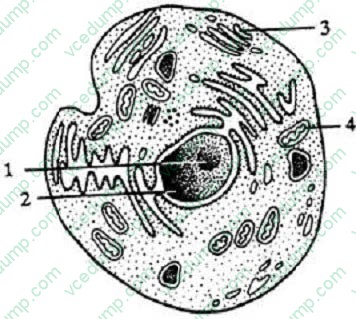
B. 2
C. 3
D. 4 -
Question 137:
Electromagnetic radiation from space constantly bombards the earth. Most wavelengths are absorbed by the atmosphere; however, there are two "windows" of nonabsorption through which significant amounts of radiation reach the ground. The first transmits ultraviolet and visible light, as well as infrared light or heat; the second transmits radio waves. As a result, terrestrial organisms have evolved a number of pigments that interact with light in various ways: some capture light energy, some provide protection from light- induced damage, and some serve camouflage or signaling purposes.
Among these compounds are many conjugated polyenes, which play important roles as photoreceptors. For every chemical compound, there are certain wavelengths of light whose quanta possess exactly the correct amount of energy to raise electrons from their ground state to higher-energy orbitals. For most organic compounds, these wavelengths are in the UV range. However, conjugated double bond systems stabilize the electrons, so that they can be excited by lower-frequency photons with wavelengths in the visible spectrum. Such a pigment, known as a chromophore, will then transmit the "subtraction color," a color complementary to the one absorbed. For instance, carotene, a hydrocarbon compound with eleven conjugated double bonds, absorbs blue light and transmits orange. The wavelength that is absorbed generally increases with the number of conjugated bonds; rings and side-chains also affect wavelength.
Wavelength Color Subtraction Color 480 nm blue orange 580 nm yellow violet 680 nm red green
Among the many biological molecules that are affected by light is DNA, the genetic material of living organisms. DNA absorbs ultraviolet light, and may be damaged by UVC (< 280 nm) and UVB (280-315 nm). UVA (315-400 nm) and visible light can actually repair light-induced damage to DNA by a process called photorepair. For this reason, UVA, which also stimulates tanning, was once considered beneficial. However, there is now increasing evidence that UVA can damage skin.
The four compounds represented by the electronic spectra below were evaluated as potential sunscreens. What is the correct sequence of sunscreen strength, from strongest to weakest, among these four?
A. I, II, III, IV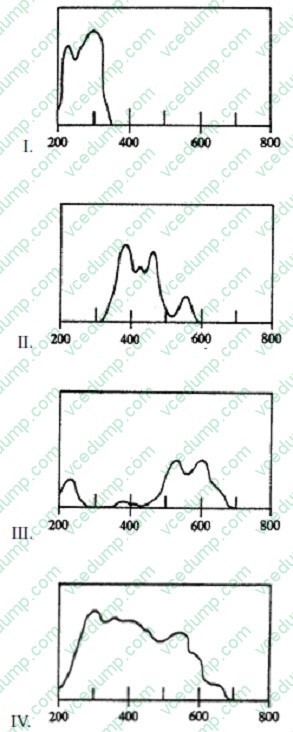
B. IV, III, II, I
C. III, II, I, IV
D. IV, I, II, III -
Question 138:
The automobile airbag was designed to inflate upon impact and decrease the risk of injury to drivers and passengers. Among the challenges to its development was the need to find a reliable inflation mechanism that was sufficiently rapid, controllable, and nontoxic. Prototypes employing compressed gases failed to meet these criteria. Researchers thus turned their attention to chemical alternatives.
The ideal inflatant requires a chemical reaction in which the reactants are stable and relatively dense in the condensed phase while the products are mostly or completely gaseous at ambient temperature and pressure. Additionally, the ideal chemical reaction would require a low activation energy and have a high kinetic rate constant, without the large exothermicity characteristic of most such reactions. Traditional explosives such as nitroglycerin, C3H5N3O9(l), were rejected almost immediately because of the extremely exothermic nature of their conversion. Benign solids such as calcium carbonate, CaCO3 , were similarly rejected, because of their large activation requirements. The desired attributes were finally found in sodium azide, NaN3, a stable, dense, ionic solid which rapidly decomposes into elemental sodium and nitrogen gas when ignited by an electrical impulse.

Reaction 1
The gas generating mixture includes excess KNO3 which reacts with the sodium metal from Reaction 1 to produce additional N2 and potassium and sodium oxides (Reactions 2 and 3). These oxides react with SiO2 to produce a non-toxic and stable alkaline silica (glass).

Reaction 2

Reaction 3
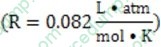
A researcher wishes to make the decomposition of sodium azide (Reaction 1) less favorable. Which of the following adjustments to the reaction would NOT drive it to the left?
A. Option A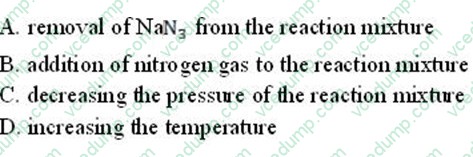
B. Option B
C. Option C
D. Option D -
Question 139:
Many nutrients required by plants exist in soil as basic cations:

A soil's cation-exchange capacity is a measure of its ability to adsorb these basic cations as well as exchangeable hydrogen and aluminum ions. The cation-exchange capacity of soil is derived from two sources: small clay particles called micelles consisting of alternating layers of alumina and silica crystals, and organic colloids.

Replacement of + and + by other cations of lower valence creates a net negative charge within the inner layers of the micelles. This is called the soil's permanent charge. For example, replacement of an atom of aluminum by calcium within a section where the net charge was previously zero, as shown below, produces a net charge of ?, to which other cations can become adsorbed.

Figure 1
A pH-dependent charge develops when hydrogen dissociates from hydroxyl moieties on the outer surfaces of the clay micelles. This leaves negatively-charged oxygen atoms to which basic cations may adsorb. Likewise, a large pH-
dependent charge develops when hydrogen dissociates from carboxylic acids and phenols in organic matter.
In most clays, permanent charges brought about by substitution account for anywhere from half to nearly all of the total cation-exchange capacity. Soils very high in organic matter contain primarily pH-dependent charges. In a research study,
three samples of soil were leached with a 1 N solution of neutral KCl, and the displaced A13+ and basic cations measured. The sample was then leached again with a buffered solution of BaCl2 and triethanolamine at pH 8.2, and the
displaced H+ measured. Table 1 gives results for three soils tested by this method.
Table 1
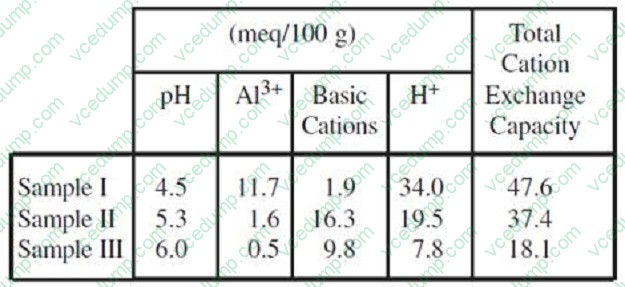
Due to the buffering effect of the soil's cation exchange capacity, just measuring the soil solution's pH will not indicate how much base is needed to change the soil pH. In another experiment, measured amounts of acid and base were added to 10-gram samples of well-mixed soil that had been collected from various locations in a field. The volumes of the samples were equalized by adding water. The results were recorded in Figure 2.
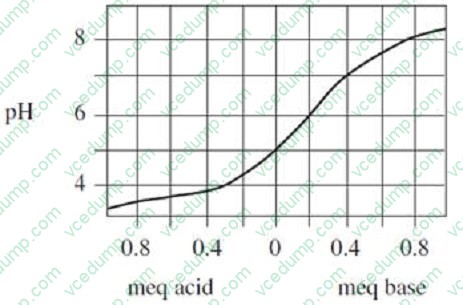
Figure 2.
How much solid NaOH is required to neutralize 700 mL of 2 N HNO3?
A. 40 g
B. 48 g
C. 56 g
D. 64 g -
Question 140:
Family violence, such as domestic violence, child abuse, and elder abuse, are serious and pervasive problems in the United States. On an annual basis, the National Crime Survey has found domestic violence results in 21000 hospitalizations, 99800 days of hospitalization, 28700 emergency department visits, and 39900 visits to physicians.
Currently there is little consensus about the definitions of intimate violence. Even the terms employed are varied; for example, domestic violence, conjugal violence, intimate abuse, and partner abuse. Similarly, there are a range of causal explanations, and these are contingent upon the theoretical perspective employed. There is also controversy whether the term "violence," "abuse," or "aggression" should be used. Finally, within the terms adopted, there is no consensus about the victim-perpetrator relationship. For example, do the terms refer to a married co-habiting couple? Two heterosexual individuals who do not reside together but are dating? All this has implications for research, practice, and policy.
The National Violence Against Women Survey was one of the largest studies sponsored by the National Institute of Justice and the Centers for Disease Control and Prevention. It systematically analyzed crime against women in the United States. A total of 8000 men and 8000 women in the United States were interviewed on the phone using a closed-ended survey. Table 1 displays the breakdown of figures when examining life time victimization by racial groups.
Table 1 Percentage of people victimized by an intimate partner in lifetime, by victim gender, type of victimization, and victim race
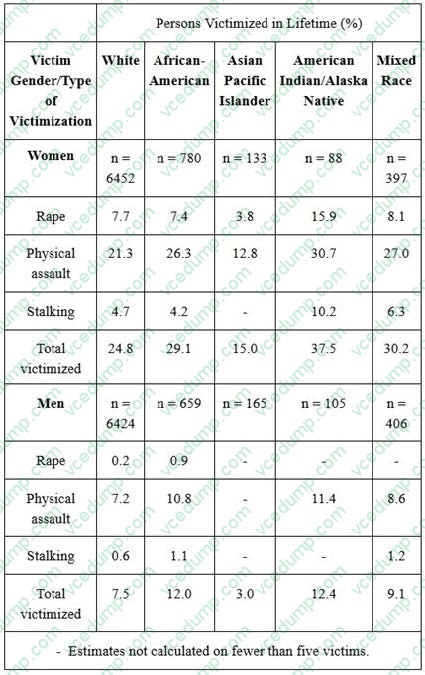
Source: Adapted from P Tjaden and N. Thoennes, "Consequences of Intimate Partner Violence: Findings from the National Violence Against Women Survey."
When interpreting the data about lifetime prevalence rates of physical assault, as experienced by women in the four different racial minority groups, which of the following sociological theories is least helpful at explaining found differences?
A. Attribution theory
B. Feminist theory
C. Social desirability theory
D. Conflict theory
Related Exams:
Tips on How to Prepare for the Exams
Nowadays, the certification exams become more and more important and required by more and more enterprises when applying for a job. But how to prepare for the exam effectively? How to prepare for the exam in a short time with less efforts? How to get a ideal result and how to find the most reliable resources? Here on Vcedump.com, you will find all the answers. Vcedump.com provide not only Medical Tests exam questions, answers and explanations but also complete assistance on your exam preparation and certification application. If you are confused on your MCAT-TEST exam preparations and Medical Tests certification application, do not hesitate to visit our Vcedump.com to find your solutions here.