MCAT-TEST Exam Details
-
Exam Code
:MCAT-TEST -
Exam Name
:Medical College Admission Test: Verbal Reasoning, Biological Sciences, Physical Sciences, Writing Sample -
Certification
:Medical Tests Certifications -
Vendor
:Medical Tests -
Total Questions
:812 Q&As -
Last Updated
:Jul 16, 2026
Medical Tests MCAT-TEST Online Questions & Answers
-
Question 121:
The pigment in blue-green algae that distinguishes them from other algae is:
A. chlorophyll a.
B. phycobillin.
C. chlorophyll b.
D. xanthophylls. -
Question 122:
When food passes through alimentary canal, the proteins are digested in:
A. mouth, stomach and duodenum.
B. stomach, pancreas and caecum.
C. stomach, duodenum and ileum.
D. duodenum, ileum and live. -
Question 123:
Alleles are created when a single gene undergoes several distinct mutations. These alleles may have different dominance relationships with one another; for example, there are three alleles coding for the human blood groups, the IA, IB, and i alleles. Both the IA and IB alleles are dominant to the i allele, but IA and IB are codominant to each other.
A multiple-allele system has recently been discovered in the determination of hair coloring in a species of wild rat. The rats are found to have one of three colors: brown, red, or white. Let B = the gene for brown hair; b = the gene for red hair; and w = the gene for white hair. The results from nine experimental crosses are shown below. The males and females in Crosses 1, 2, and 3 are all homozygous for hair color.

A white male is crossed with the heterozygous red female from Cross 9. What is the expected ratio of red to white offspring?
A. 3:1
B. 1:3
C. 1:1
D. 2:1 -
Question 124:
Four major blood types exist in the human ABO blood system: types A, B, AB, and O; and there are three alleles that code for them. The A and B alleles are codominant, and the O allele is recessive. Blood types are derived from the presence of specific polysaccharide antigens that lie on the outer surface of the red blood cell membrane. The A allele codes for the production of the A antigen; the B allele codes for the production of the B antigen; the O allele does not code for any antigen. While there are many other antigens found on red blood cell membranes, the second most important antigen is the Rh antigen. Rh is an autosomally dominant trait coded for by 2 alleles. If this antigen is present, an individual is Rh+; if it is absent, an individual is Rh-. For example, a person with type AB blood with the Rh antigen is said to be AB+.
These antigens become most important when an individual comes into contact with foreign blood. Because of the presence of naturally occurring substances that closely mimic the A and B antigens, individuals who do not have these antigens on their red blood cells will form antibodies against them. This is inconsequential until situations such as blood transfusion, organ transplant, or pregnancy occur.
Erythroblastosis fetalis is a condition in which the red blood cells of an Rh+ fetus are attached by antibodies produced by its Rh- mother. Unlike ABO incompatibility, in which there are naturally occurring antibodies to foreign antigens, the Rh system requires prior sensitization to the Rh antigen before antibodies are produced. This sensitization usually occurs during the delivery of an Rh+ baby. So while the first baby will not be harmed, any further Rh+ fetuses are at risk.
The Coombs tests provide a method for determining whether a mother has mounted an immune response again her baby's blood. The tests are based on whether or not agglutination occurs when Coombs reagent is added to a sample. Coombs reagent contains antibodies against the anti-Rh antibodies produced by the mother. The indirect Coombs test takes the mother's serum, which contains her antibodies but no red blood cells, and mixes it with Rh+ red blood cells. Coombs reagent is then added. If agglutination occurs, the test is positive, and the mother must be producing anti-Rh antibodies. The direct Coombs test mixes the baby's red blood cells with Coombs reagent. If agglutination occurs, the test is positive, and the baby's red blood cells must have been attacked by its mother's anti-Rh antibodies.
If a man with type AB blood needed a transfusion of red blood cells, which of the following individuals could safely donate blood?
A. A man with type A blood
B. A man with the genotype BO
C. A woman with the genotype AB
D. All four blood types are equally safe -
Question 125:
Millenialism is, generally speaking, the religious belief that salvation and material benefits will be conferred upon a society in the near future as the result of some apocalyptic event. The term derives from the Latin word for 1,000; in early Christian theology, believers held that Christ would return and establish his kingdom on earth for a period of a thousand years.
Millenialist movements, Christian and non-Christian, have arisen at various points throughout history, usually in times of great crisis or social upheaval. In "nativistic" millenialist movements, a people threatened with cultural disintegration attempts to earn its salvation by rejecting foreign customs and values and returning to the "old ways." One such movement involving the Ghost Dance cults, named after the ceremonial dance which cult members performed in hope of salvation, flourished in the late 19th century among Indians of the western United States.
By the middle of the 19th century, western expansion and settlement by whites was seriously threatening Native American cultures. Mining, agriculture and ranching encroached on and destroyed many Indian land and food sources. Indian resistance led to a series of wars and massacres, culminating in the U.S. Government's policy of resettlement of Indians onto reservations which constituted a fraction of their former territorial base. Under these dire circumstances, a series of millenialist movements began among western tribes.
The first Ghost Dance cult arose in western Nevada around 1870. A Native American prophet named Wodziwob, a member of a Northern Paiute tribe, received the revelation of an imminent apocalypse which would destroy the white man, restore all dead Indians to life, and return to the Indians their lands, food supplies (such as the vanishing buffalo), and old way of life. The apocalypse was to be brought about with the help of a ceremonial dance and songs, and by strict adherence to a moral code which, oddly enough, strongly resembled Christian teaching. In the early 1870s, Wodziwob's Ghost Dance cult spread to several tribes in California and Oregon, but soon died out or was absorbed into other cults.
A second Ghost Dance cult, founded in January 1889, evolved as the result of a similar revelation. This time Wovoka -- another Northern Paiute Indian, whose father had been a disciple of Wodziwob -- received a vision during a solar eclipse in which he died, spoke to God, and was assigned the task of teaching the dance and the millennial message. With white civilization having pushed western tribes ever closer to the brink of cultural disintegration during the previous twenty years, the Ghost Dance movement spread rapidly this time, catching on among tribes from the Canadian border to Texas, and from the Missouri River to the Sierra Nevadas -- an area approximately one-third the size of the continental United States.
Wovoka's Ghost Dance doctrine forbade Indian violence against whites or other Indians; it also involved the wearing of "ghost shirts," which supposedly rendered the wearers invulnerable to the white man's bullets. In 1890, when the Ghost Dance spread to the Sioux Indians, both the ghost shirts and the movement itself were put to the test. Violent resistance to white domination had all but ended among the Sioux by the late 1880s, when government- ordered reductions in the size of their reservations infuriated the Sioux, and made them particularly responsive to the millenialist message of the Ghost Dance. As the Sioux organized themselves in the cult of the dance, an alarmed federal government resorted to armed intervention which ultimately led to the massacre of some 200 Sioux men, women and children at Wounded Knee, South Dakota in December of 1890. The ghost shirts had been worn to no avail, and Wounded Knee marked the end of the second Ghost Dance cult.
Which of the following was NOT part of the spiritual revelation described in the fourth paragraph of the passage?
A. Unity among all Indian tribes
B. Restoration of traditional Indian ways
C. Resurrection of the dead
D. Return of the buffalo -
Question 126:
One of the basic principles of ecology is that population size is to some extent a function of available food resources. Recent field experiments demonstrate that the interrelationship may be far more complex than hitherto imagined. Specifically, the browsing of certain rodents appears to trigger biochemical reactions in the plants they feed on that help regulate the size of the rodent populations. Two such examples of phytochemical regulation (regulation involving plant chemistry) have been reported so far. Patricia Berger and her colleagues at the University of Utah have demonstrated that instrumentality of 6- methoxybenzoxazolinone (6-MBOA) in triggering reproductive behavior in the mountain vole (Microtus montanus), a small rodent resembling the field mouse. 6-MBOA forms in young mountain grasses in response to browsing by predators such as voles. The experimenters fed rolled oats coated with 6-MBOA to non-breeding winter populations of Microtus. After three weeks, the sample populations revealed a high incidence of pregnancy among the females and pronounced swelling of the testicles among the males. Control populations receiving no 6- MBOA revealed no such signs. Since the timing of reproductive effort is crucial to the short-lived vole in an environment in which the onset of vegetative growth can vary by as much as two months, the phytochemical triggering of copulatory behavior in Microtus represents a significant biological adaptation. A distinct example is reported by John Bryant of the University of Alaska. In this case, plants seem to have adopted a form of phytochemical self-defense against the depredations of the snowshoe hare (Lepus americanus) of Canada and Alaska. Every ten years or so, for reasons that are not entirely understood, the Lepus population swells dramatically. The result is intense over browsing of early and mid- successional deciduous trees and shrubs. Bryant has shown that, as if in response, four common boreal forest trees favored by Lepus produce adventitious shoots high in terpene and phenolic resins which effectively discourage hare browsing. He treated mature, non-resinous willow twigs with resinous extracts from the adventitious shoots of other plants and placed treated and untreated bundles at hare feeding stations, weighing them at the end of each day. Bryant found that bundles containing only half the resin concentration of natural twigs were left untouched. The avoidance of these unpalatable resins, he concludes, may play a significant role in the subsequent decline in the Lepus population to its normal level. These results suggest obvious areas for further research. For example, observational data should be reviewed to see whether the periodic population explosions among the prolific lemming (like the vole and the snowshoe hare, a small rodent in a marginal northern environment) occur during years in which there is an early onset of vegetative growth; if so, a triggering mechanism similar to that found in the vole may be involved.
The statement: "The interrelationship may be far more complex than hitherto imagined" (lines 4?) suggests that scientists previously believed that:
A. the amount of food available is the only food based factor that affects population size.
B. reproductive behavior is independent of environmental factors.
C. food resources biochemically affect reproduction and the lifespan of some species.
D. population size is not influenced by available food resources. -
Question 127:
The sexual reproduction in Rhizopus is:
A. anisogamous.
B. conjugation.
C. oogamous.
D. ogamous and anisogamous. -
Question 128:
A hovercraft is a versatile vehicle capable of traveling over land, water, or any other essentially flat surface. The hovercraft consists of a body or hull onto which a rotor (lift fan) is mounted. The lift fan provides the vertical lift by propelling air into an area beneath the hovercraft called the skirt. The pocket of air in the skirt supports the moving hovercraft and reduces the friction between the vehicle and the ground to almost zero. As such, there is no contact between the hovercraft and the ground.
A second fan, which generates a horizontal thrust, propels the hovercraft forward. Rudders which direct the airflow from this second fan are used by the pilot to control the movement of the hovercraft. The horizontal movement of the

hovercraft is opposed by air resistance which generates aerodynamic drag.
The thrust fan of a hovercraft is turned on at time t1 and turned off at time t2. In the absence of air resistance, which of the following graphs represents the velocity of this hovercraft as a function of time?
A. Option A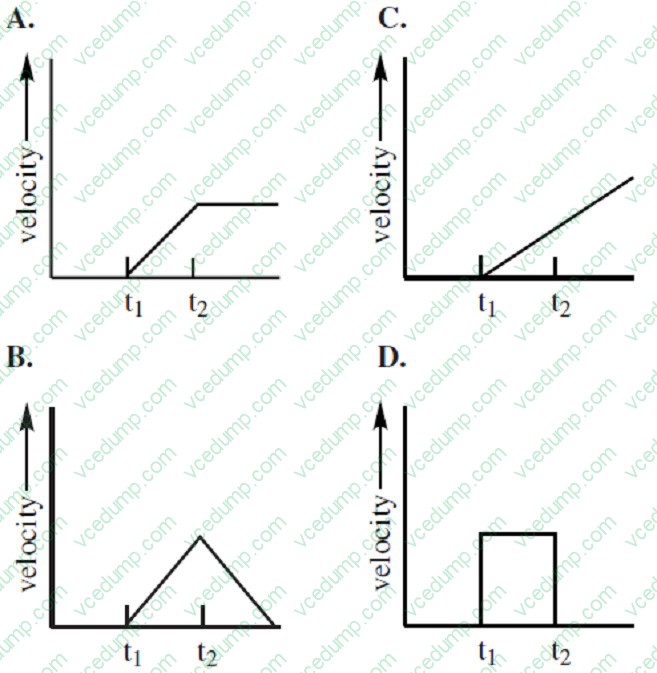
B. Option B
C. Option C
D. Option D -
Question 129:
Muzak, the intentionally unobtrusive music that most people associate with elevators and dentists' waiting rooms, represents the paradoxical success story of a product designed to be ignored. Although few people admit to enjoying its blandly melodic sounds, Muzak reaches over 100 million listeners in 14 countries and has played in the White House, the Apollo lunar spacecraft, and countless supermarkets, offices, and factories. This odd combination of criticism and widespread acceptance is not surprising, however, when one considers that Muzak is not created for the enjoyment of its listeners: rather, its purpose is to modify physiological and psychological aspects of an environment. In the workplace, Muzak is credited with increasing both productivity and profitability. Research into the relationship between music and productivity can be traced to the earliest days of the Muzak Corporation. Developed by a military officer in 1922 as a way of transmitting music through electrical wires, Muzak blossomed in the 1930's following a study which reported that people work harder when they listen to certain kinds of music. Impressed by these findings, the BBC began to broadcast music in English munitions factories during World War II in an effort to combat fatigue. When workers assembling weapons increased their output by 6 percent, the U.S. War Production Board contracted the Muzak Corporation to provide uplifting music to American factories. Today, the corporation broadcasts its "Environmental Music" to countless businesses and institutions throughout the world. And while most people claim to dislike Muzak's discreet cadences, it seems to positively influence both productivity and job satisfaction.
Researchers speculate that listening to Muzak and other soft music improves morale and reduces stress by modifying our physiology. Physiological changes such as lowered heart rate and decreased blood pressure have been documented in hospital studies testing the effect of calming music on cardiac patients. In addition, certain kinds of music seem to effect one's sense of emotional, as well as physical, well being. It is just this sort of satisfaction which is thought to result in increased performance in the workplace. In a study of people performing repetitive clerical tasks, those who listened to music performed more accurately and quickly than those who worked in silence; those who listened to Muzak did better still. Moreover, while Muzak was conceived as a tool for productivity, it also seems to influence a business' profitability. In an experiment in which supermarket shoppers shopped to the mellow sounds of Muzak, sales were increased by as much as 12 percent. What makes Muzak unique is a formula by which familiar tunes are modified and programmed. Careful instrumentation adds to an overall sound that is neither monotonous nor rousing. But it is the precisely timed programming that separates Muzak from other "easy listening" formats. At the core of the programming is the concept of the "Stimulus Progression". Muzak programs are divided into quarter-hour groupings of songs, and are specifically planned for the time of day at which they will be heard. Each composition is assigned a mood rating between 1 and 6 called a stimulus value; a song with a rating of 2, for example, is slower and less invigorating than one with a value of 5. Approximately six compositions with ascending stimulus values play during any given quarter hour; each 15-minute segment ends in silence. Each segment of a 24-hour program is carefully planned. Segments that are considered more stimulating air at 11 a.m. and 3 p.m. (the times when workers typically tire), while more soothing segments play just after lunchtime and towards the end of the day, when workers are likely to be restless.
From the point of view of management, then, Muzak is a useful tool in the effort to maximize both productivity and profits. However, some people object to its presence, labeling it as a type of unregulated air pollution. Still others see it as an Orwellian nightmare, a manipulation of the subconscious. But Muzak's effectiveness seems to lie in the fact that most people never really listen to it. While it may be true that no one actually likes this carefully crafted aural atmosphere, many simply ignore it, allowing its forgettable sounds to soften the contours of the day.
Of the following, the author is most interested in discussing:
A. the origins of the Muzak Corporation.
B. how Muzak modifies physical states and psychological atmospheres.
C. how Muzak increases productivity in the workplace.
D. the ways in which Muzak differs from other "easy listening" formats. -
Question 130:
The Russia which emerged from the terrible civil war after the 1917 Revolution was far from the Bolsheviks' original ideal of a non-exploitative society governed by workers and peasants. By 1921, the regime was weakened by widespread famine, persistent peasant revolts, a collapse of industrial production stemming from the civil war, and the consequent dispersal of the industrial working class -- the Bolsheviks' original base of support. To buy time for recovery, the government in 1921 introduced the New Economic Policy, which allowed private trade in farm products (previously banned) and relied on a fixed grain tax instead of forced requisitions to provide food for the cities. The value of the ruble was stabilized. Trade unions were again allowed to seek higher wages and benefits, and even to strike. However, the Bolsheviks maintained a strict monopoly of power by refusing to legalize other parties. After the death of the Revolution's undisputed leader, Lenin, in January 1924, disputes over the long-range direction of policy led to an open struggle among the main Bolshevik leaders. Since open debate was still possible within the Bolshevik Party in this period, several groups with differing programs emerged in the course of this struggle. The program supported by Nikolai Bukharin -- a major ideological leader of the Bolsheviks with no power base of his own -- called for developing agriculture through good relations with wealthy peasants, or "kulaks." Bukharin favored gradual industrial development, or "advancing towards Socialism at a snail's pace". In foreign affairs, Bukharin's policy was to ally with non-Socialist regimes and movements that were favorable to Russia. A faction led by Leon Trotsky, head of the Red Army and the most respected revolutionary leader after Lenin, called for rapid industrialization and greater central planning of the economy, financed by a heavy tax on the kulaks. Trotsky rejected the idea that a prosperous, human Socialist society could be built in Russia alone (Stalin's slogan of "Socialism in One Country"), and therefore called for continued efforts to promote working-class revolutions abroad. As time went on, he became bitterly critical of the new privileged elite emerging within both the Bolshevik Party and the Russian state. Joseph Stalin, General Secretary of the Bolshevik Party, was initially considered a "center", conciliating figure, not clearly part of a faction. Stalin's eventual supremacy was ensured by three successive struggles within the party, and only during the last did his own program become clear. First, in 1924?5, Stalin isolated Trotsky, allying for this purpose with Grigori Zinoviev and Lev Kamenev, Bolshevik leaders better known than Stalin himself, whom Trotsky mistakenly considered his main rivals. Stalin maneuvered Trotsky out of leadership of the Red Army, his main potential power base. Next, Stalin turned on Zinoviev and Kamenev, using his powers as head of the Party organization to remove them from party leadership in Leningrad and Moscow, their respective power bases. Trotsky, Zinoviev, and Kamenev then belatedly formed the "Joint Opposition" (1926?7). With Bukharin's help, Stalin easily outmaneuvered the Opposition: Bukharin polemicized against Trotsky, while Stalin prevented the newspapers from printing Trotsky's replies, organized gangs of toughs to beat up his followers, and transferred his supporters to administrative posts in remote regions. At the end of 1927, Stalin expelled Trotsky from the Bolshevik Party and exiled him. (Later, in 1940, he had him murdered.) Zinoviev and Kamenev, meanwhile, recanted their views in order to remain within the Party. The final act now began. A move by kulaks to gain higher prices by holding grain off the market touched off a campaign against them by Stalin. Bukharin protested, but with the tradition of Party democracy now all but dead, Stalin had little trouble silencing Bukharin. Meanwhile, he began a campaign to force all peasants -- not just kulaks -- onto state-controlled "collective farms", and initiated a crash industrialization program during which he deprived the trade unions of all rights and cut real wages by 50%. Out of the factional struggle in which he emerged by 1933 as sole dictator of Russia, Stalin's political program of building up heavy industry on the backs of both worker and peasant emerged with full clarity.
All of the following were among the factors contributing to the weakness of the Bolshevik regime in 1921 EXCEPT:
A. the aftereffects of the civil war.
B. low industrial production.
C. opposition by peasants.
D. lack of democracy within the Party.
Related Exams:
Tips on How to Prepare for the Exams
Nowadays, the certification exams become more and more important and required by more and more enterprises when applying for a job. But how to prepare for the exam effectively? How to prepare for the exam in a short time with less efforts? How to get a ideal result and how to find the most reliable resources? Here on Vcedump.com, you will find all the answers. Vcedump.com provide not only Medical Tests exam questions, answers and explanations but also complete assistance on your exam preparation and certification application. If you are confused on your MCAT-TEST exam preparations and Medical Tests certification application, do not hesitate to visit our Vcedump.com to find your solutions here.