MCAT-TEST Exam Details
-
Exam Code
:MCAT-TEST -
Exam Name
:Medical College Admission Test: Verbal Reasoning, Biological Sciences, Physical Sciences, Writing Sample -
Certification
:Medical Tests Certifications -
Vendor
:Medical Tests -
Total Questions
:812 Q&As -
Last Updated
:Jul 16, 2026
Medical Tests MCAT-TEST Online Questions & Answers
-
Question 111:
Muzak, the intentionally unobtrusive music that most people associate with elevators and dentists' waiting rooms, represents the paradoxical success story of a product designed to be ignored. Although few people admit to enjoying its blandly melodic sounds, Muzak reaches over 100 million listeners in 14 countries and has played in the White House, the Apollo lunar spacecraft, and countless supermarkets, offices, and factories. This odd combination of criticism and widespread acceptance is not surprising, however, when one considers that Muzak is not created for the enjoyment of its listeners: rather, its purpose is to modify physiological and psychological aspects of an environment.
In the workplace, Muzak is credited with increasing both productivity and profitability. Research into the relationship between music and productivity can be traced to the earliest days of the Muzak Corporation. Developed by a military officer in 1922 as a way of transmitting music through electrical wires, Muzak blossomed in the 1930's following a study which reported that people work harder when they listen to certain kinds of music. Impressed by these findings, the BBC began to broadcast music in English munitions factories during World War II in an effort to combat fatigue. When workers assembling weapons increased their output by 6 percent, the U.S. War Production Board contracted the Muzak Corporation to provide uplifting music to American factories. Today, the corporation broadcasts its "Environmental Music" to countless businesses and institutions throughout the world. And while most people claim to dislike Muzak's discreet cadences, it seems to positively influence both productivity and job satisfaction.
Researchers speculate that listening to Muzak and other soft music improves morale and reduces stress by modifying our physiology. Physiological changes such as lowered heart rate and decreased blood pressure have been documented in hospital studies testing the effect of calming music on cardiac patients. In addition, certain kinds of music seem to effect one's sense of emotional, as well as physical, well being. It is just this sort of satisfaction which is thought to result in increased performance in the workplace. In a study of people performing repetitive clerical tasks, those who listened to music performed more accurately and quickly than those who worked in silence; those who listened to Muzak did better still. Moreover, while Muzak was conceived as a tool for productivity, it also seems to influence a business' profitability. In an experiment in which supermarket shoppers shopped to the mellow sounds of Muzak, sales were increased by as much as 12 percent. What makes Muzak unique is a formula by which familiar tunes are modified and programmed. Careful instrumentation adds to an overall sound that is neither monotonous nor rousing. But it is the precisely timed programming that separates Muzak from other "easy listening" formats. At the core of the programming is the concept of the "Stimulus Progression". Muzak programs are divided into quarter-hour groupings of songs, and are specifically planned for the time of day at which they will be heard. Each composition is assigned a mood rating between 1 and 6 called a stimulus value; a song with a rating of 2, for example, is slower and less invigorating than one with a value of 5. Approximately six compositions with ascending stimulus values play during any given quarter hour; each 15-minute segment ends in silence. Each segment of a 24-hour program is carefully planned. Segments that are considered more stimulating air at 11 a.m. and 3 p.m. (the times when workers typically tire), while more soothing segments play just after lunchtime and towards the end of the day, when workers are likely to be restless.
From the point of view of management, then, Muzak is a useful tool in the effort to maximize both productivity and profits. However, some people object to its presence, labeling it as a type of unregulated air pollution. Still others see it as an Orwellian nightmare, a manipulation of the subconscious. But Muzak's effectiveness seems to lie in the fact that most people never really listen to it. While it may be true that no one actually likes this carefully crafted aural atmosphere, many simply ignore it, allowing its forgettable sounds to soften the contours of the day.
It can be inferred from the statements in the passage that the author regards Muzak as:
A. a paradoxical phenomenon.
B. an unnecessary evil.
C. a violation of privacy.
D. a pleasurable diversion. -
Question 112:
Yeast can be used to covert simple sugars into:
A. ethanoic acid and oxygen.
B. ethanol and oxygen.
C. ethanol and carbon dioxide.
D. starch and carbon dioxide. -
Question 113:
Which category of memory would explicit memory be classed as?
A. short-term memory
B. sensory memory
C. long-term memory
D. procedural memory -
Question 114:
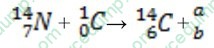
One of the most common methods that scientists use to determine the age of fossils is known as carbon dating. 14C is an unstable isotope of carbon that undergoes beta decay with a half-life of approximately 5,730 years. Beta decay occurs when a neutron in the nucleus decays to form a proton and an electron which is ejected from the nucleus. 14C is generated in the upper atmosphere when 14N, the most common isotope of nitrogen, is bombarded by neutrons. This mechanism yields a global production rate of 7.5 kg per year of 14C, which combines with oxygen in the atmosphere to produce carbon dioxide. Both the production and the decay of 14C occur simultaneously. This process continues for many half-lives of 14C, until the total amount of 14C approaches a constant. A fixed fraction of the carbon ingested by all living organisms will be 14C. Therefore, as long as an organism is alive, the ratio of 14C to 12C that it contains is constant. After the organism dies, no new 14C is ingested, and the amount of 14C contained in the organism will decrease by beta decay. The amount of 14C that must have been present in the organism when it died can be calculated from the amount of 12C present in a fossil. By comparing the amount of 14C in the fossil to the calculated amount of 14C that was present in the organism when it died, the age of the fossil can be determined.
In generating 14C in the upper atmosphere, a 14C nucleus combines with a neutron to form a 14C nucleus and:
A. a proton.
B. an electron.
C. a 4He nucleus.
D. a neutron. -
Question 115:
The Russia which emerged from the terrible civil war after the 1917 Revolution was far from the Bolsheviks' original ideal of a non-exploitative society governed by workers and peasants. By 1921, the regime was weakened by widespread famine, persistent peasant revolts, a collapse of industrial production stemming from the civil war, and the consequent dispersal of the industrial working class -- the Bolsheviks' original base of support. To buy time for recovery, the government in 1921 introduced the New Economic Policy, which allowed private trade in farm products (previously banned) and relied on a fixed grain tax instead of forced requisitions to provide food for the cities. The value of the ruble was stabilized. Trade unions were again allowed to seek higher wages and benefits, and even to strike. However, the Bolsheviks maintained a strict monopoly of power by refusing to legalize other parties. After the death of the Revolution's undisputed leader, Lenin, in January 1924, disputes over the long-range direction of policy led to an open struggle among the main Bolshevik leaders. Since open debate was still possible within the Bolshevik Party in this period, several groups with differing programs emerged in the course of this struggle. The program supported by Nikolai Bukharin -- a major ideological leader of the Bolsheviks with no power base of his own -- called for developing agriculture through good relations with wealthy peasants, or "kulaks." Bukharin favored gradual industrial development, or "advancing towards Socialism at a snail's pace." In foreign affairs, Bukharin's policy was to ally with non-Socialist regimes and movements that were favorable to Russia. A faction led by Leon Trotsky, head of the Red Army and the most respected revolutionary leader after Lenin, called for rapid industrialization and greater central planning of the economy, financed by a heavy tax on the kulaks. Trotsky rejected the idea that a prosperous, human Socialist society could be built in Russia alone (Stalin's slogan of "Socialism in One Country"), and therefore called for continued efforts to promote working-class revolutions abroad. As time went on, he became bitterly critical of the new privileged elite emerging within both the Bolshevik Party and the Russian state. Joseph Stalin, General Secretary of the Bolshevik Party, was initially considered a "center," conciliating figure, not clearly part of a faction. Stalin's eventual supremacy was ensured by three successive struggles within the party, and only during the last did his own program become clear. First, in 1924?5, Stalin isolated Trotsky, allying for this purpose with Grigori Zinoviev and Lev Kamenev, Bolshevik leaders better known than Stalin himself, whom Trotsky mistakenly considered his main rivals. Stalin maneuvered Trotsky out of leadership of the Red Army, his main potential power base. Next, Stalin turned on Zinoviev and Kamenev, using his powers as head of the Party organization to remove them from party leadership in Leningrad and Moscow, their respective power bases. Trotsky, Zinoviev, and Kamenev then belatedly formed the "Joint Opposition" (1926?7). With Bukharin's help, Stalin easily outmaneuvered the Opposition: Bukharin polemicized against Trotsky, while Stalin prevented the newspapers from printing Trotsky's replies, organized gangs of toughs to beat up his followers, and transferred his supporters to administrative posts in remote regions. At the end of 1927, Stalin expelled Trotsky from the Bolshevik Party and exiled him. (Later, in 1940, he had him murdered.) Zinoviev and Kamenev, meanwhile, recanted their views in order to remain within the Party. The final act now began. A move by kulaks to gain higher prices by holding grain off the market touched off a campaign against them by Stalin. Bukharin protested, but with the tradition of Party democracy now all but dead, Stalin had little trouble silencing Bukharin. Meanwhile, he began a campaign to force all peasants -- not just kulaks -- onto state-controlled "collective farms," and initiated a crash industrialization program during which he deprived the trade unions of all rights and cut real wages by 50%. Out of the factional struggle in which he emerged by 1933 as sole dictator of Russia, Stalin's political program of building up heavy industry on the backs of both worker and peasant emerged with full clarity.
In his struggle with rival factions of the Bolshevik Party, Stalin was apparently most helped by:
A. his control of the party organization.
B. his control of the army.
C. Trotsky's misjudgment of threats to his position.
D. the appearance of standing above factional politics. -
Question 116:
If iron sheet is dipped in a solution of zinc chloride and heated, then a layer of zinc is formed that protects iron from rusting. This process is called:
A. anodizing.
B. chrome plating.
C. galvanizing.
D. tin plating. -
Question 117:
Which expression correctly expresses the Ksp of a solution of XmYn?
A. Option A
B. Option B
C. Option C
D. Option D -
Question 118:
Which of the following addictive drug is sometimes injected for relief from a severe pain?
A. Heroin
B. Alcohol
C. Aspirin
D. Nicotine -
Question 119:
By now the image of California in decline looms as large in the conventional media wisdom as the Golden State -- triumphant clich閟 of a generation ago -- "this El Dorado," as Time magazine had put it in 1969, that was to be "the mirror of America as it will become." Hardly anyone mentions the sunshine these days, or the beaches, or the beautiful young families around the pool, or the new lifestyles that all Americans will soon emulate, or how the University of California is wall-to-wall with cyclotrons and Nobel laureates, or how the state's higher-education system is accommodating absolutely all comers at little or no cost.
Today, California classrooms are among the most crowded in the country; many schools operate without libraries, without counselors, without nurses, without art or music, with greatly diminished curricular offerings. And what's true for the schools is true for the other services that have no powerful constituencies: children's protective services, probation, public health. Many cities have shut down swimming and wading pools because they cannot be safely maintained, and fenced playgrounds have been shut because of the danger presented by cracked and splintered structures. The list could be extended indefinitely. As thousands of professors receive golden handshakes from the University of California and California State University, among them some of the stars recruited in the go- go Fifties, the crowding in the lecture halls has increased and the lines at the classroom door have gotten longer and longer ("Don't panic," says the T-shirt on a student waiting to enroll at a Sacramento junior college, but many have been in line since four in the morning). U.C. tuition, which was roughly $800 a year in the early 1980s, is now over $4,000, a figure not out of line with tuitions at public colleges in other states but a far cry from the cost of a California state education in the golden days -- and it is almost certain to increase again next year. More than 200,000 students -- roughly 10 percent -- have vanished from the rolls of the state's colleges and universities in the past two years. While per capita tax revenues have been effectively frozen, and while they have declined relative to other states, client rolls for state services -- schools, prisons, Medicaid, welfare -- have been rising faster than population, leaving a structural gap that no one has yet confronted, much less closed. Again this year, the governor and legislature borrowed $7 billion from the banks and rolled over a $5 billion budget deficit, for which few politicians have proposed any remedies. Thanks to the deficit, California, which a decade ago, had one of the highest bond ratings in the country, has one of the lowest. "Were California a corporation," said John Vasconcellos, the chairman of the State Assembly Ways and Means Committee, "it would have little option but to initiate some sort of bankruptcy proceeding." The new image of California is familiar enough: a state suffering from earthquakes, fires, drought, floods, urban riots, dirty air, schools as overcrowded as the freeways; a legislature -- once said to be the nation's most professional and progressive -- oozing with corruption and stuck in the budgetary gridlock; and of course, recession, unemployment, chronic budget deficits, and financial calamity. For those who know their Nathaniel West, their Raymond Chandler, and their Joan Didion, the California apocalypse imagery is hardly new; it was always there on the dark side of the dream. This was the place, as Didion wrote back in the 1960s, "in which a boom mentality and a sense of Chekhovian loss meet in uneasy suspension; in which the mind is troubled by some buried but ineradicable suspicion that things better work here, because here, beneath that immense bleached sky, is where we run out of continent." os Angeles has burnt before. If you believe people like Governor Wilson, most of the state's problems were created somewhere else, usually in Washington, where the Clinton Administration has, on the one hand, cost California hundreds of thousands of jobs through excessive defense cuts and, on the other, allowed a horde of illegal immigrants to overrun the state's schools and health facilities without paying them for the immense costs that come with them...much has been changed in California since the days of West and Chandler, but the capacity for denial and self-deception is undiminished. In fact, California's trouble is at once more prosaic and more complex than the political rhetoric claims or the apocalyptic imagery suggests. It began before the recent recession, the big 1991 fire in the Oakland hills or the San Francisco earthquake of 1989 (itself a rerun of a classic), before those L.A. cops beat up Rodney King or the riot and the fire that followed their acquittal in the first trial, before the eight-year drought that still may not be over. And contrary to what a lot of Californians believe, a lot of the damage didn't just happen to us: we inflicted it on ourselves.
With which of the following statements concerning California would the author most likely agree?
A. The state services with weak constituencies have suffered.
B. The image of California as an alternate heaven and hell is not universal.
C. The state legislature has always been ineffective.
D. The recent waves of immigration are the key to understanding the overtaxed state infrastructure. -
Question 120:
A researcher in a molecular biology lab planned to carry out an extraction procedure known as an alkaline plasmid prep, which is designed to purify plasmids, small pieces of the hereditary material DNA, from bacterial cells. The bacteria are first placed into a test tube containing liquid nutrient medium and allowed to grow until they reach a high population density. The culture, which consists of solid cells suspended in the medium, is then centrifuged; a solid pellet is formed. The supernatant is poured out, leaving the pellet behind, and the cells are resuspended in a mL of lysis buffer solution (50 mM glucose, 25 mM Tris buffer and 10 mM ethylenediaminetetraacetic acid (EDTA), with 5 mg of the enzyme lysozyme added). They are then incubated for 30 minutes at 0°C, during which time the bacterial cell walls break down and the cell contents are released into the solution. After incubation, 1 mL of 0.4 N sodium hydroxide and 1 mL of 2% sodium dodecyl sulfate (SDS) are added, and the solution is again incubated on ice for 10 minutes. 2 mL of 3 M sodium acetate are added and the mixture is incubated for 30 minutes at 0°C. The test tube is centrifuged once more and the supernatant is decanted into a clean tube, leaving behind the protein and most other cell components in the pellet. Finally, 10 mL of pure ethanol are added to the supernatant from the previous step to precipitate out the DNA, and the test tube is incubated at –20°C for 60 minutes, during which the mixture remains liquid. The mixture is centrifuged a final time and the supernatant removed. The translucent precipitate that results is washed with 70% ethanol (70% ethanol and 30% water by volume), allowed to dry, and resuspended in 1 mL of TE buffer (10 mM Tris, 1 mM EDTA). In preparation for this experiment, the researcher prepared stock solutions of the various chemicals that she will need in the experiment. Stock solutions are highly concentrated solutions of commonly used chemicals in water from which dilute solutions are prepared for daily use. Table 1 shows the chemicals, their molecular formulas and weights, and the composition of commonly used stock solutions.
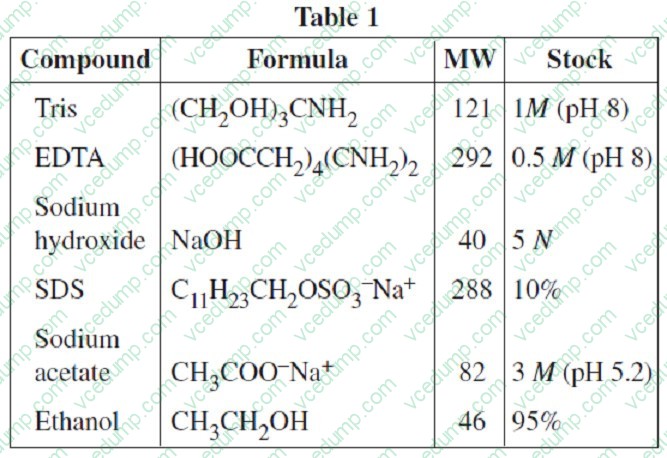
Pure ethanol (CH3CH2OH) is difficult to prepare and therefore expensive; 95% ethanol is much cheaper. Consequently, 95% ethanol is generally used in the preparation of dilute ethanol solutions. How much 95% ethanol would be needed to produce a 500 mL solution of 70% ethanol by volume in water?
A. 333 mL
B. 350 mL
C. 368 mL
D. 475 mL

Related Exams:
Tips on How to Prepare for the Exams
Nowadays, the certification exams become more and more important and required by more and more enterprises when applying for a job. But how to prepare for the exam effectively? How to prepare for the exam in a short time with less efforts? How to get a ideal result and how to find the most reliable resources? Here on Vcedump.com, you will find all the answers. Vcedump.com provide not only Medical Tests exam questions, answers and explanations but also complete assistance on your exam preparation and certification application. If you are confused on your MCAT-TEST exam preparations and Medical Tests certification application, do not hesitate to visit our Vcedump.com to find your solutions here.