H31-161 Exam Details
-
Exam Code
:H31-161 -
Exam Name
:HCIE-Carrier IP (Written) V2.0 -
Certification
:Huawei Certifications -
Vendor
:Huawei -
Total Questions
:180 Q&As -
Last Updated
:Jan 17, 2024
Huawei H31-161 Online Questions & Answers
-
Question 81:
As shown in the figure, PE 1 sets up an MP-IBGP neighbor relationship with PE 2 and they communicate over MPLS LDP. A CE communicates with a PE over EBGP.Add two entries to the routing table of the VRF on PE 1:
VRF1 RD 100:1, IRT 1:1, ERT 2:2VRF2 RD 100:2, IRT 1:1, 2:2, ERT 2:2, 3:3
Add two entries to the routing table of the VRF on PE 2:
VRF1 RD 100:1, IRT 1:1, ERT 2:2
VRF2 RD 100:2, IRT 2:2, ERT 1:1 Import a valid static route 1.1.1.1/32 on CE 1. Suppose CE 2, CE 3, and CE 4 do not have route 1.1.1.1/32 in the local routing table.
Which of the following routers have route 1.1.1.1/32 in the unicast routing table?
A. PE 1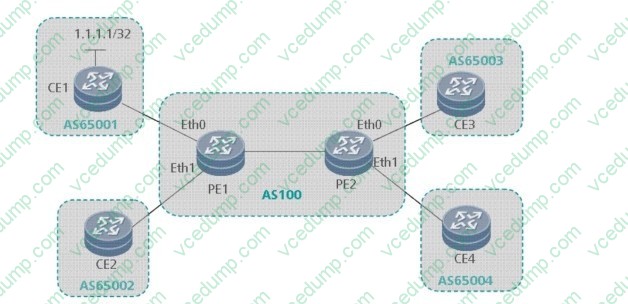
B. CE 2
C. CE 3
D. CE 4 -
Question 82:
When the RSVP LSP FRR protection is enables, which of the following statements about the original RSVP LSP are true?
A. The point of local repair (PLR) and the merge point (MP) can perceive the application of FRR but other nodes on the original RSVP LSP
B. The RESV message is sent by the MP to an upstream node through a bypass LSP after modified.
C. The PATH message is sent by the PLR to the MP through a bypass LSP after modified.
D. The MP sends the ResvTear message to the upstream node of the original RSVP LSP. -
Question 83:
Which statement about the Ethernet clock synchronization technology used m actual solutions is true?
A. The IEEE 1588 technology requites the intermediate node to support transparent clock transmission
B. The CES packet recovery technology requires the intermediate node lo support transparent clock transmission
C. The NTP technology requires the intermediate node to support transparent clock transmission
D. The 802 1aS technology requires the intermediate node to support transparent clock transmission -
Question 84:
1.
On the backbone network , if a PE is connect to a CE, VPN instances need to b reconfigured on the PE, and interface on the PE for connecting to the CE must be bound to a VPN instance. After binding an interface to a VPN instance, you must configure the IP address of the interface between PEs, IS-IS configured for PE interworking. PLSA basic capabilities and MPLS LSP are configured for LSP establishment, and MP _IBGP is configured for VPN route exchange VPN routes exchange , LDAP is short for Label Distribution Protocol, and IBGP is short for interior Border gateway protocol.
2.
A CE exchange route exchange routers with a PE over External Border gateway Protocol (EBGP.Configure interior gateway protocol (IGP) on the IS-IS+MPLS backbone networking to achieve the interworking between PEs and IP routers.
B. -3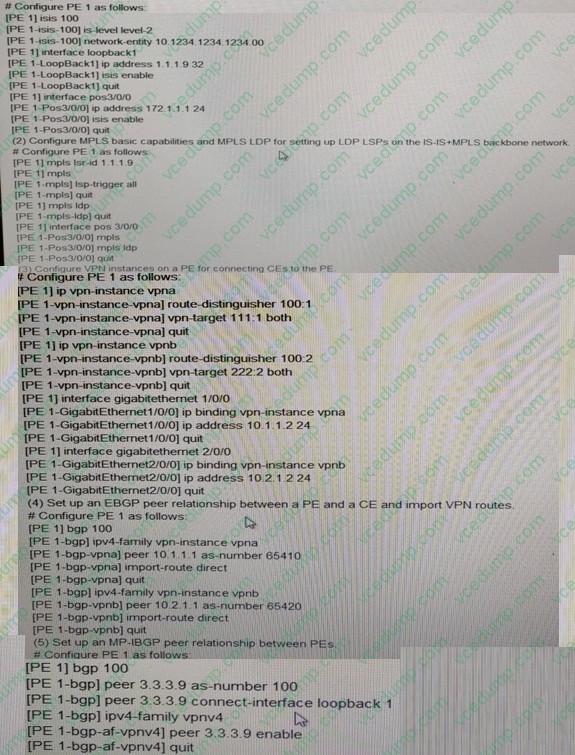
C. -2
D. -5
E. -1 -
Question 85:
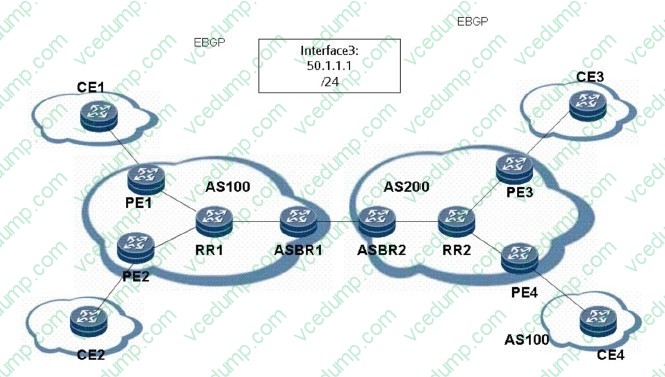
As shown in the figure, the AS number of operator 1 is 100 and that of operator 2 is 200. Option C is used for exchanging VPN routes between AS 100 and AS 200. Which of the following statements about Option C are true?
A. ASBRs are required to exchange VPN-IPv4 routes.
B. ASBRs do not exchange VPN-IPv4 route.
C. PEs in different ASs are connected using multi-hop EBGP for direct exchange of VPN- IPv4 routes.
D. Compared with Option B, Option C greatly reduces the load of the ASBR; therefore, the ASBR will no longer be a bottleneck that hinders network development. -
Question 86:
As shown I the figure, the asymmetric VLL FRR networking is used AC interfaces on PE 1, PE 2 and PE 3 are configured as follows:
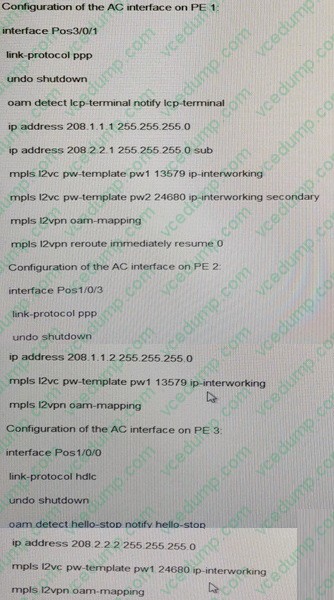
Which of the following statements are the true on the condition that IGP and MPLS are configured correctly on the public network?
A. If a forwarding fault is detected on the PW between PE a and PE 2 , traffic from CE 1 to CE 2 can be switched to the PW between PE 1 and PE 3.
B. If a forwarding fault is detected on the PW between PE a and PE 2 , traffic can be switched to the backup PW on PE 1.
C. If a forwarding fault is detected on the public network side of the between PE 1 and PE 2, traffic from CE 2 to CE 1 can be switched to the PW between PE 1 and PE3.
D. The PW between PE1 and PE 2 is the primary PW. -
Question 87:
Which statements about the edge access layer is true?
A. Using the packet technology it provides a comprehensive transport platform that boasts high reliability, quality of service (QoS) assurance, and large capacity.
B. It implement call control. With the software technology as the core, it completes basic real-time call control and connection control.
C. It connections users to the network by providing various access means, and converts the format of information can be transmitted on the network.
D. It process additional value-added service and operation support for established callas. -
Question 88:
Refer to the exhibit.
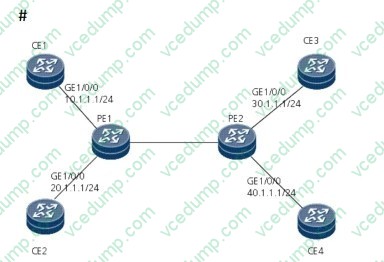
As shown in the figure, CE 1 and CE 3 belong to VPN A, CE 2 and CE 4 belong to VPN B, and users on different VPNs are not allowed to access each other. Which of the following configurations can enable mutual access between CE 1 and CE 4 but forbid cross-VPN access between other CEs? Configuration of PE 1: sysname PE 1 # ip vpn-instance vpna route-distinguisher 100:1vpn-target 1:1 3:3 export-extcommunity vpn-target 1:1 3:3 import-extcommunity # i p vpn-instance vpnb route-distinguisher 100:2 vpn-target 2:2 4:4 export-extcommunity vpn-target 2:2 4:4 import-extcommunity # Configuration of PE 2: # sysname PE 2 # ip vpn-instance vpna route-distinguisher 200:1 vpn-target 1:1 export-extcommunity vpn-target 1:1 import-extcommunity # ip vpn-instance vpnb route-distinguisher 200:2 vpn-target 2:2 4:4 export-extcommunity vpn-target 2:2 4:4 import-extcommunity
A. Run vpn-target 1:1 on VPN b of PE 2 The configuration is as follows: [PE 2]ip vpn vpnb [PE 2-vpn-instance-vpnb]vpn-target 1:1 export-extcommunity [PE 2-vpn-instance-vpnb]vpn-target 1:1 import-extcommunity
B. Run vpn-target 2:2 on VPN a of PE 1The configuration is as follows: [PE 1]ip vpn vpna [PE 1-vpn-instance-vpna]vpn-target 2:2 export-extcommunity [PE 1-vpn-instance-vpna]vpn-target 2:2 import-extcommunity
C. Run vpn-target 3:3 on VPN b of PE 2 The configuration is as follows: [PE 2]ip vpn vpnb [PE 2-vpn-instance-vpnb]vpn-target 3:3 export-extcommunity [PE 2-vpn-instance-vpnb]vpn-target 3:3 import-extcommunity "
D. Run vpn-target 4:4 on VPN a of PE 1 The configuration is as follows: [PE 1]ip vpn vpna [PE 1-vpn-instance-vpna]vpn-target 4:4 export-extcommunity [PE 1-vpn-instance-vpna]vpn-target 4:4 import-extcommunity -
Question 89:
Which of the following are rules for the router to check the RPF after receiving SA messages from the MSDP?
A. Check the RPF based on the source RP contained in the received SA message.
B. Check the RPF based on the next hop of the route that reaches the source RP.
C. Query the MBGP route and then the BGP route
D. Query the BGP route and then the MBGP route -
Question 90:
Which of the following statements about BFD for MPLS LSP are true?
A. An MPLS LSP may be unidirectional .If BFD packets are transmitted along an MPLS LSP in the forward direction., these packets may be forwarded over IP in the reverse direction. Then the forward and reverse paths of a packet may be different As a result, when a fault occurs on the reverse path, BFD detects and reports the fault even if the MPLS LSP is normal.
B. In BFD for MPLS LSP, LSP Ping is used to negotiate the identifier and parameters of a BFD session.
C. BFD for MPLS LSP detects faults only on the forwarding plane. LSP Ping, however, can not only detect faults on the forwarding plane, but also find out inconsistencies between the forwarding plane and the control plain- Therefore, they are often combined for a better fault detection solution.
D. If MPLS LSPs work in load balancing mode, a BFP session should be triggered on each LSP in principle. Only one BFD session. however, can be initialed for load-balancing MPLS LSPs to an intermediate node In this case, the forwarding path ol BFD packets may be different from what expected. As a result may be reported or missed.
Related Exams:
-
H11-821
HCNP-UC-HIPT (Implementing Huawei IP Telephony Solutions) -
H11-828
HCNP-UC(Fast Track)(Unified Communication (Fast Track)) -
H11-851
HCIA-Video Conference V3.0 -
H11-861
HCIP-Video Conference V2.0 -
H11-868
HCNP- VC(Fast Track)-(Video Conference (Fast Track)) -
H12-111
HCIA-IoT V3.0 -
H12-224
HCIP-Routing & Switching (Fast Track) V2.0 -
H12-311
HCIA-WLAN V3.0 -
H12-351
HCIE-WLAN (Written) V1.0 -
H12-411
HCIA-Data Center Facility V2.0
Tips on How to Prepare for the Exams
Nowadays, the certification exams become more and more important and required by more and more enterprises when applying for a job. But how to prepare for the exam effectively? How to prepare for the exam in a short time with less efforts? How to get a ideal result and how to find the most reliable resources? Here on Vcedump.com, you will find all the answers. Vcedump.com provide not only Huawei exam questions, answers and explanations but also complete assistance on your exam preparation and certification application. If you are confused on your H31-161 exam preparations and Huawei certification application, do not hesitate to visit our Vcedump.com to find your solutions here.