H31-161 Exam Details
-
Exam Code
:H31-161 -
Exam Name
:HCIE-Carrier IP (Written) V2.0 -
Certification
:Huawei Certifications -
Vendor
:Huawei -
Total Questions
:180 Q&As -
Last Updated
:Jan 17, 2024
Huawei H31-161 Online Questions & Answers
-
Question 91:
Refer to the exhibit.
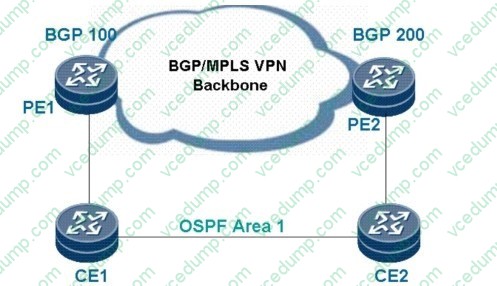
As shown in the figure, Border Gateway Protocol (BGP) is used to advertise VPN routes between PE 1 and PE 2.BGP process 100 is started on PE 1 and BGP process 200 is started on PE 2.OSPF is used between a PE and a CE and between CE 1 and CE 2 within area 1.To avoid routing loops, which of the following route tag configurations is true? (Note: 0Xd0000000=3489660928)
A. Configure the route tag to 3489661028 on PE 1 and leave it blank on PE 2.
B. Configure the route tag to 3489661128 on PE 1 and leave it blank on PE 2.
C. Configure the route tag to 100 on PE 1 and to 200 on PE 2.
D. Configure the route tag to 100 on PE 2 and to 200 on PE 1. -
Question 92:
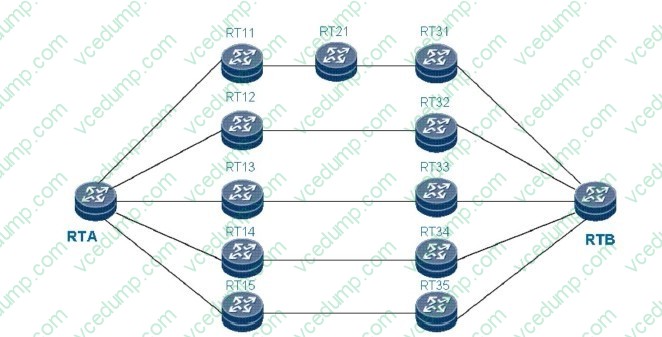
BFD for RSVP is a mechanism that uses BFD to check the connectivity of RSVP neighbors. As shown in the figure, TE FRR node protection is deployed to protect a node, the blue path is the primary LSP (RTA -> RTB -> RTC -> RTD -> RTE) and the red one is the bypass LSP (RTB -> RTF -> RTD). Which of the following statements about BFD for RSVP are true?
A. TE FRR will be triggered only when the link between RTB (acting as the PLR) and RTC (the node under protection) is faulty or RTC is faulty but will not be triggered when the link between RTC and RTD (acting as the MP) is faulty. This problem can be solved by establishing a BFD session between RTB and RTD. In this case, faults may be reported falsely or be missed.
B. Only RSVP HELLO needs to be enabled if RSVP GR instead of TE FRR is deployed on a network.
C. BFD for RSVP needs to be enabled only on RTB if you expect to set up a BFD for RSVP session on RTB to check the connectivity between RTB and RTC.
D. The BFD session triggered by RSVP is for the exclusive use of RSVP. -
Question 93:
With the SA, which of the following, option is correct?
A. KE SA is unidirectional
B. IKE SA is bidirectional
C. IPSec SA is unidirectional
D. IPSec SA is bidirectional -
Question 94:
Exhibit.
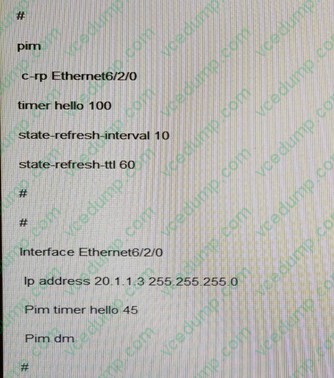
Which of the following statements are false?
A. Ethernet 6/2/0 sends a PIM hello message every 100 seconds.
B. The TTL value is 60 in state-refresh messages sent by the router
C. If the PIM-DM is enabled at Ethernet 6/2/0 on a router, the PIM-SM cannot be enabled at other interfaces on the router.
D. Ethernet 6/2/0 sends a state-refresh messages every 10 seconds -
Question 95:
As shown in the figure, IGP is configured on RT 1 and RT 2, and route 193.3.6.0/24 is configured on RT 2. Which of the following statements is correct? Suppose OSPF is used here. Configure an access control list (ACL) on RT 2 in system mode. ACL 2000 rule 5 permit source 193.3.6.0 0.0.0.255 Configure a routing policy in system mode:
route-policy t permit node 1 if-match acl 2000 apply backup-nexthop 106.108.4.1
apply backup-interface Ethernet4/0/4 Configure the IP FRR in system mode: ip frr route-policy tConfigure the ethe4/0/4 interface of RT 2: ospf cost 100 Configure BFD on RT 2: Enable BFD on Ethernet4/0/3 bfd b1 bind peer-ip 106.108.3.1 interface Ethernet4/0/3 discriminator local 1 discriminator remote 1 min-tx-interval 10 min-rx-interval 10 process-pst commit Configuration on RT 1: Enable BFD on Ethernet7/0/3 bfd b1 bind peer-ip 106.108.3.2 interface Ethernet7/0/3 discriminator local 1 discriminator remote 1 min-tx-interval 10 min-rx-interval 10 process-pst commit
A. The IP FRR function is enabled for the traffic bound for 193.3.6.0/24 on RT 2. It is unnecessary to configure the ethe4/0/4 interface on RT 2.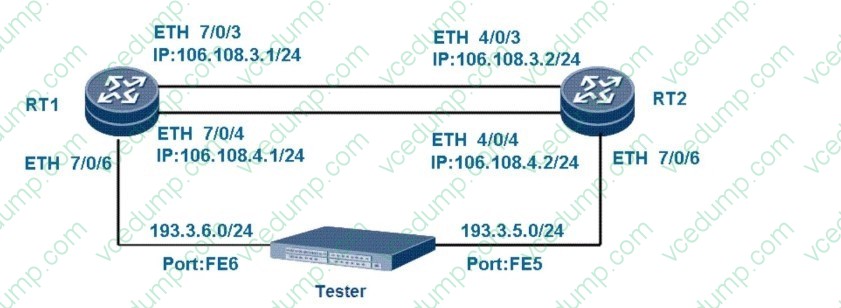
B. Except the entry nexthop:106.108.3.1, a backup forwarding entry nexthop:106.108.3.1 is also generated for the traffic bound for 193.3.6.0/24 in the FIB table.
C. If apply backup-interface Ethernet4/0/4 is deleted, the backup forwarding entry can also be generated because apply backup-nexthop 106.108.4.1 takes effect.
D. Use a tester to send traffic from FE5 to FE6 after the BFD session becomes Up, run the undo ip address command in the ethe7/0/3 interface view on RT 1, and calculate the time for switchover based on the number of lost packets and packet receiving rate measured by the tester. The switchover takes less than 50 ms. -
Question 96:
With the IPSec technology , which of the following description is true?
A. IPSec delivers service for transmission layer
B. ESP provides authentication service
C. ESP is more simple than AH
D. AH provides Data encryption -
Question 97:
[Quidway]multicast routing-enable [Quidway]interface Ethernet10/1/0 [Quidway-Ethernet10/1/0]igmp enable [Quidway-Ethernet10/1/0]igmp robust-count 4 [Quidway-Ethernet10/1/0]quit [Quidway]igmp [Quidway-igmp]timer query 100 [Quidway-igmp]robust-count 3 The default IGMP query interval is 60s and the default query response interval is 10s. If Ethernet 10/1/0 receives an IGMP Report message, how long is the timeout interval for creating a group record?
A. 310s
B. 250s
C. 410s
D. 130s -
Question 98:
Exhibit.
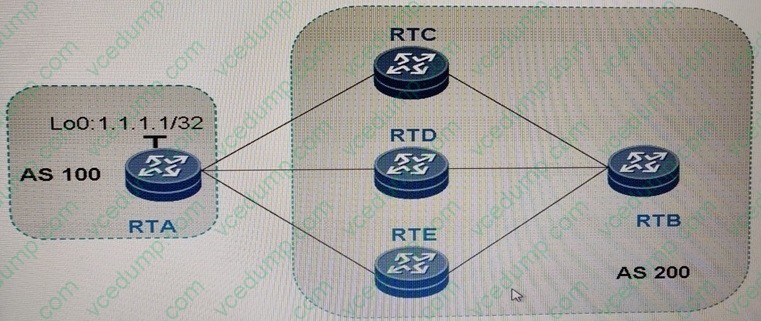
As shown in the figure, RTA belongs to AS 100 and has an EBGP neighbor relationship with RTC, RTD, and TTB is an IBGP neighbor of RTC, RTD, and RTE, and the four router all belong to AS 200. (Note: The attributed not involved In the question use the default values)
1.
Import route 1.1.1/32 from RTA and advertise this route to RTB by way of RTC, RTD, and RTE, respectively (suppose the three routers between is IGP, EGP, and INCOMPL:ETE, respectively. Which route will RTB prefer?
2.
Suppose the preceding policy is retained. Apply inbound routing policies on RTC, RTD, and RTE so that the values of the MED attribute of route 1.1.1.32 learned by RTB are 40, and 20 respectively. Which route will RTB prefer?
3.
Suppose the preceding policy is retained. Apply an inbound routing policy on RTB so that the values of the AS_ PATH attribute of route 1.1.1.1/32 Learned from RTC, RTD, and RTE are 10 20 30,and 10 20, respectively. Which route will RTB prefer?
4.
Suppose the preceding policy is retained. Apply an inbound routing policy on RTB so that the values of the local-preference attribute of route 1.1.1.1.32 learned from RTC and RTE are 30 and 120 , respectively. Which route will RTB prefer.
5.
Suppose the preceding policy is retained. Apply inbound policies on RTC. RTD and RTE so that the values of the preferred-value attribute of route 1.1.1.132 are 50.40 and 30 respectively. Which route will RTB prefer?
A. RTC., RTC, RTE, RTC, RTE
B. RTC, RTD, RTD, RTE. RTE
C. RTC, RTC, RTD, RTC, RTE
D. RTC, RTC, RTD, RTE, RTE -
Question 99:
RTA is a leaf router that directly connects to host A through interface GigabiteEthernet 1/0/0. The interface is configured as follows:
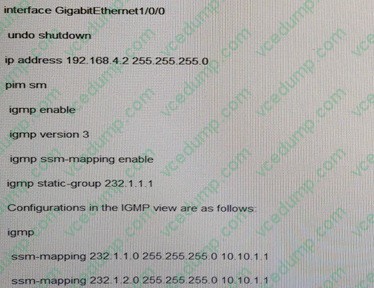
Hos a sends a IGMPv2 Report message to group 2321.2.3. Which entry can be displayed by the displayed by the igmp ssm-mapping group command?
A. (10.10.1.1, 232.1.2.2)
B. (10.10.1.1, 232.1.1.) and (10.10.1., 2321.2.3)
C. (10.10.1.1, 232.1.1.1) -
Question 100:
Refer to the exhibit.
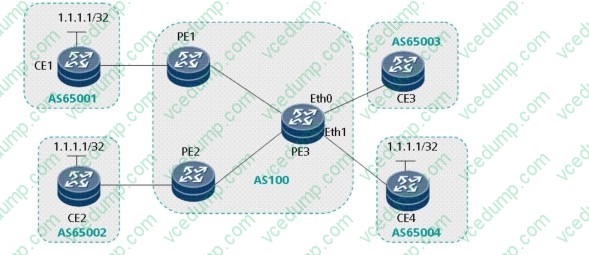
Eth0 and Eth1 on PE 3 are bound to VRF1 and VRF2, respectively. A valid static route 1.1.1.1/32 is imported to BGP domains from CE 1, CE 2, and CE 4, respectively. Which of the following statements are false?
A. CE 3 can learn route 1.1.1.1/32 on CE 4.
B. CE 3 cannot learn route 1.1.1.1/32 on CE 1 because the RD of this route is the same as that of the VRF.
C. CE 3 cannot learn route 1.1.1.1/32 on CE 2 because the RD of this route is different from that of the VRF.
D. Local VRFs must use different RDs
Related Exams:
-
H11-821
HCNP-UC-HIPT (Implementing Huawei IP Telephony Solutions) -
H11-828
HCNP-UC(Fast Track)(Unified Communication (Fast Track)) -
H11-851
HCIA-Video Conference V3.0 -
H11-861
HCIP-Video Conference V2.0 -
H11-868
HCNP- VC(Fast Track)-(Video Conference (Fast Track)) -
H12-111
HCIA-IoT V3.0 -
H12-224
HCIP-Routing & Switching (Fast Track) V2.0 -
H12-311
HCIA-WLAN V3.0 -
H12-351
HCIE-WLAN (Written) V1.0 -
H12-411
HCIA-Data Center Facility V2.0
Tips on How to Prepare for the Exams
Nowadays, the certification exams become more and more important and required by more and more enterprises when applying for a job. But how to prepare for the exam effectively? How to prepare for the exam in a short time with less efforts? How to get a ideal result and how to find the most reliable resources? Here on Vcedump.com, you will find all the answers. Vcedump.com provide not only Huawei exam questions, answers and explanations but also complete assistance on your exam preparation and certification application. If you are confused on your H31-161 exam preparations and Huawei certification application, do not hesitate to visit our Vcedump.com to find your solutions here.