H31-161 Exam Details
-
Exam Code
:H31-161 -
Exam Name
:HCIE-Carrier IP (Written) V2.0 -
Certification
:Huawei Certifications -
Vendor
:Huawei -
Total Questions
:180 Q&As -
Last Updated
:Jan 17, 2024
Huawei H31-161 Online Questions & Answers
-
Question 71:
Which statement about the OSPF VPN is true? (B)
A. A VPN instance can include multiple OSPF processes. An OSPF process can be bound to multiple VPN instances.
B. OSPF ASs are differentiated by domain ID. Therefore, devices within one AS must be configured with the same domain ID.
C. An OSPF process can be configured with one or multiple primary domain IDs.
D. When a PE is an OSPF ABR, the PE is connected to a CE only in a non-backbone OSPF area. -
Question 72:
Which statement about the Ethernet clock synchronization technology used in actual solutions is true?
A. The IEEE1588 technology requires the intermediate node to support transparent clock transmission.
B. The NTP technology requires the intermediate node to support transparent clock transmission.
C. The CES packet recovery technology requires the intermediate node to support transparent clock transmission.
D. The 802.1as technology requires the intermediate node to support transparent clock transmission. -
Question 73:
Which of the following statements about the working principle of LDP FRR are true?
A. After LDP FRR is enabled, a backup LSP is generated. Both the primary and backup LSPs are stored in the forwarding table.
B. LDP FRR can be deployed on the ingress node and the intermediate node.The primary and backup LSPs are recorded in the ILM table on the intermediate node and in the FIB table on the ingress node.
C. Multiple LSPs can be backed up on the ingress node, that is, entries about multiple backup LSPs are generated in the forwarding table according to the priority of the LDR FRR, implementing multilayer protection.
D. After LDP FRR is enabled, a backup LSP can be generated for a primary LSP to prevent serious packet loss during fast flapping of the primary LSP -
Question 74:
If a (*, G) entry exists in the RP, which of the following statements about the source registration process are true in PIM-SM?
A. The first hop DR connecting to the source encapsulates received multicast data into PIM registration information and unicasts the encapsulated information to the RP.
B. The first-hop DR connecting to the source sends received multicast data to the RP hop by hop.
C. The RP decapsulates registration information and uses RPT to send data packets to be sent to the multicast group to the outbound interface.
D. The RP sends an (S, G) Join message hop by hop to the first hop DR connected to the multicast source to add the multicast source to the SPT.
E. The RP unicasts a registration stop message to the first hop router connected to the multicast source. -
Question 75:
Which command is used to query the aging time of the firewall session .
A. display firewall session table
B. display firewall session table verbose
C. display firewall packet-filter default all
D. display firewall server-map -
Question 76:
Exhibit.
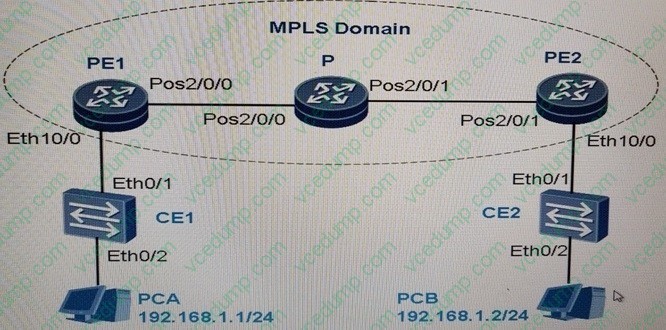
As shown in the figure, virtual private LAN service (VPLS) is enabled on routers PE 1 and PE 2.CEs are connected to PEs through QinQ and PC A and PC B are connected to the two CEs. The two PCs belong to the same VPN and can communicate with each other properly. Which of the following statements about the communication process when you ping PC B from PC A are true?
A. PE 1 receives packets with a VLAN tag from CE 1 and adds a VLAN tag to these packets.
B. If the penultimate hop popping (PHP) feature of MPLS is enabled on PEs, a packet received by PE 2 from a P router has two VLAN tags one MPLS label.
C. PE 1 add two MPLS labels to a packet before sending the packet to a router.
D. A packet received by CE 2 from PE 2 has two VLAN tags CE 2 removed the outer tab and forwards the packets to PC B based on the inner tag -
Question 77:
Exhibit.
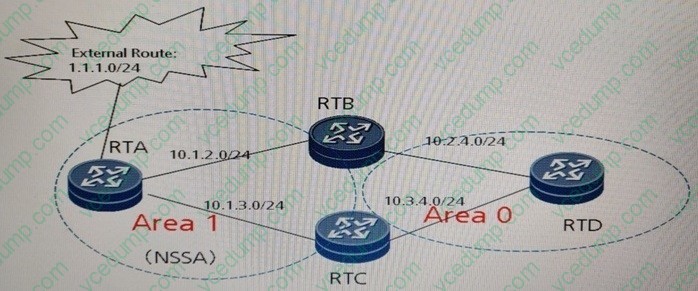
As shown in the figure, external route 1.1.1.0/24 is imported to RTA that is located in the NSSA area RTD is a backbone area router. RTB and RTC are both area border router (ABRs). OSPF configuration are as follows.
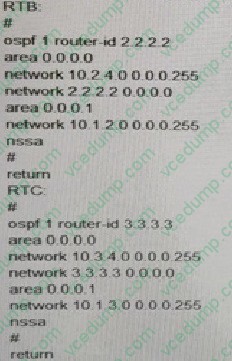
Which statement is true?
A. RTD receive two external LSAs whose LS_ID is 1.1.1.0
B. RTD receive an external LSAs whose LS_ID is 1.1.1.0 and advRouter is 2.2.2.2.
C. RTD receive an external LSAs whose LS_ID is 1.1.1.0 and advRouter is 3.3.3.3.
D. RTD receive an external LSAs whose LS_ID is 1.1.10/24 based on category 7 LSAs sent by RTA -
Question 78:
The RADIUS or Huawei Terminal Access Controller Access Control System (HWTACACS) protocol can be used for authentication during network access. Which of the following statements about these two protocols are false?
A. The HWTACACS uses TCP to transmit data while the RADIUS uses UDP to transmit data.
B. Both the HWTACACS and RADIUS encrypt all data in the packet body.
C. The RADIUS uses the Triple Data Encryption Standard (3Des) to encrypt passwords and some important data packets. The RADIUS provides a higher level of security than the HWTACACS.
D. The RADIUS implements authentication and authorization separately to improve security -
Question 79:
acl number 2000 rule 15 permit source 225.0.0.0 0.0.0.255 # interface Ethernet6/1/1 ip address 40.1.1.4 255.255.255.0 igmp version 3 igmp group-policy 2000 igmp enable pim sm
#
The preceding are partial router configurations. Which of the following behaviors does Ethernet 6/1/1 perform after receiving Internet Group Management Protocol Version 2 (IGMPv2) Report messages for multicast groups 225.0.0.1 and 225.0.1.1?
A. Create a record for group 225.0.0.1.
B. Create a record for group 225.0.1.1.
C. Do not create a record for group 225.0.1.1.
D. Do not create a record for group 225.0.0.1. -
Question 80:
Which statement about the tunnel policy configuration is false?(A)
A. The tunnel policy is configured in the system view. You can run the tunnel-policy policy- name command to create tunnel policies and enter the tunnel policy view. One VPN instance supports multiple tunnel policies, and multiple VPN instances can share a tunnel policy.
B. You can run tunnel select-seq { gre | lsp | cr-lsp } * load-balance-number load-balance- number in the tunnel policy view to configure the priorities of tunnels and the number of tunnels among which load is balanced.
C. You can run the tnl-policy policy-name command in the VPN instance view to apply tunnel policies to VPN instances. If the required tunnel policy does not exist, the configuration is saved but does not take effect. If you create this tunnel policy in the system view later, the saved configuration will take effect.
D. If a VPN instance does not have a tunnel policy, an LSP is used and the number of tunnels configured for load balancing is set to 1
Related Exams:
-
H11-821
HCNP-UC-HIPT (Implementing Huawei IP Telephony Solutions) -
H11-828
HCNP-UC(Fast Track)(Unified Communication (Fast Track)) -
H11-851
HCIA-Video Conference V3.0 -
H11-861
HCIP-Video Conference V2.0 -
H11-868
HCNP- VC(Fast Track)-(Video Conference (Fast Track)) -
H12-111
HCIA-IoT V3.0 -
H12-224
HCIP-Routing & Switching (Fast Track) V2.0 -
H12-311
HCIA-WLAN V3.0 -
H12-351
HCIE-WLAN (Written) V1.0 -
H12-411
HCIA-Data Center Facility V2.0
Tips on How to Prepare for the Exams
Nowadays, the certification exams become more and more important and required by more and more enterprises when applying for a job. But how to prepare for the exam effectively? How to prepare for the exam in a short time with less efforts? How to get a ideal result and how to find the most reliable resources? Here on Vcedump.com, you will find all the answers. Vcedump.com provide not only Huawei exam questions, answers and explanations but also complete assistance on your exam preparation and certification application. If you are confused on your H31-161 exam preparations and Huawei certification application, do not hesitate to visit our Vcedump.com to find your solutions here.