H31-161 Exam Details
-
Exam Code
:H31-161 -
Exam Name
:HCIE-Carrier IP (Written) V2.0 -
Certification
:Huawei Certifications -
Vendor
:Huawei -
Total Questions
:180 Q&As -
Last Updated
:Jan 17, 2024
Huawei H31-161 Online Questions & Answers
-
Question 161:
In PIM-DM, which of the following scenarios about sending Join messages is true?
A. The leaf router in the idle state receives host Join messages.
B. The router receives prune messages of the RPF neighbor from other routers when it is receiving data from the upstream.
C. The intermediate router receives graft messages from the downstream router when all downstream interfaces of the intermediate router are in the prune state.
D. The router receives state-refresh messages. -
Question 162:
The Huawei router is the hop RD where the SSM mapping function is enabled at the interface. Some IGMPv2 hosts expect to receive (1.0.01,232.1.0.1) (1.0.0.1232.1.0.2), and (2.0.0,232.1.3.2) data. How can you satisfy the preceding requirement with the least configurations?
A. ssm-mapping 232.1.3.2 16.2.0.0.1
B. ssm mapping 232.1.3.1.24.2.0.0.1
C. ssm-mapping 232. 1 308 2 00.1
D. ssm-mapping 232 1.0. 1 32. 1. 0. 0. 1
E. ssm-mapping 232. 1.0. 2. 32. 1. 0. 0. 1
F. ssm-mapping 232. 1. 0. 0. 24. 1. 0. 0. 1 -
Question 163:
Configure VRFs and relevant policies on a PE as follows:
If a route is imported to the routing table of VRF 1, which VRF can the route match?
A. vrf4
B. vrf3
C. vrf2 -
Question 164:
In the inter-AS multicast, which statement about transmitting MSDP SA messages is false?
A. SA messages can be transmitted only between RPs in different PIM networks.
B. The router uses the SA cache to store SA messages.
C. The SA message contains the multicast source and group information
D. The router checks the RPF after receiving SA messages. -
Question 165:
Which of the following statements about the fault notification in VLL FRR are true?
A. A forwarding fault occurs on the public network side of the primary PW. If BFD for PW (detection interval: 300 ms) is enabled on the primary PW, BFD fast detects the fault and sends a notification to the L2VPN for PW switching.
B. A forwarding fault occurs on the public network side of the primary PW. If BFD for PW is not enabled on the primary PW, the L2VPN cannot perceive the fault on the PSN side and therefore PW switching is not triggered.
C. The primary PW is carried over an LDP LSP tunnel on the public network side and BFD for LDPLSP (detection interval: 30 ms) is enabled on the LDP LSP tunnel. If a forwarding fault occurs on the public network side of an LSP tunnel, BFD fast detects the fault and sends a notification to the L2VPN for PW switching.
D. The primary PW is carried over a GRE tunnel on the public network side and BFD for PW (detection interval: 30 ms) is enabled on the GRE tunnel. If a forwarding fault occurs on the PSN side of the primary PW, BFD cannot detect the fault because the PW is carried over a GRE tunnel. In this case, the L2VPN needs to detect the fault itself and triggers PW switching. -
Question 166:
On a VPLS network a PE router receive a packet that containers layer 2 user data from a PE. How does the PE router determine the source VSI of this packet?
A. Outer label of the packets
B. Destination MAC address in the L2 PDU encapsulation in the packet
C. MAC address and VLAN ID in the PDU encapsulated in the packet
D. Inner label of the packet -
Question 167:
Which of the following statements about the relationship between the SPE and the UPE are false?
A. The UPE provides access service for users. It maintains the routes of the VPN sites it is directly connected to and sometimes aggregates routes of remote VPN sites. In addition, a UPE allocates inner labels for routes of the sites directly connected to the UPE and advertises VPN routes with these labels to an SPE through MP-BGP.
B. The SPE manages and advertises VPN routes. It maintains all routes on the VPN it is connected to through UPEs, including routes of local and remote sites. The SPE, however, does not advertise routes of remote sites to the UPE, but only advertises the labeled default routes or aggregate routes of VPN instances.
C. The SPE and UPE are relative to each other. In a hierarchical PE structure, a PE on the upper layer is the SPE to PEs on the lower layer, and these lower-layer PEs are UPEs to the SPE. However, the hierarchical PE cannot coexist with common PEs on an MPLS network.
D. When MP-IBGP is deployed between an SPE and UPEs, the SPE can function as the RR of these UPEs so that routes can be advertised between IBGP peers. It is not recommended that an SPE serving as the RR of UPEs still reflect routes between other PEs so that routes on UPEs can be reduced. A UPE and an SPE communicate through a physical interface, subinterface, or tunnel interface. When the tunnel interface is configured, only one MPLS network is allowed between them and labeled packets are transferred through tunnels. Their communication may fail if the MPLS network is replaced with an IP network.
E. The SPE has a large routing table, which provides excellent forwarding performance and access capability, whereas the UPE has a small routing table and poor forwarding performance, but occupies fewer interface resources. -
Question 168:
Refer to the exhibit.

As shown in the figure, a CE requires access to the Internet, and PE 1 is connected to the Internet gateway. Configurations on PE 1 are as follows: PE 1: # nat address-group 0 175.31.1.3 175.31.1.10 # ip vpn-instance vrf1route-distinguisher 192.168.1.1:100 vpn-target 100:1 export-extcommunity vpn-target 100:1 import-extcommunity # acl number 2000 rule 5 permit vpn-instance vrf1 # # interface Serial0/0/1:0 link-protocol ppp ip binding vpn-instance vrf1 ip address 150.1.1.1 255.255.0.0 nat outbound acl 2000 address-group 0 # interface Pos2/1/0 clock master link-protocol ppp ip address 175.31.1.1 255.255.0.0 # bgp 100 group ibgp internal peer ibgp connect-interface LoopBack0peer 192.168.1.2 as-number 100 peer 192.168.1.2 group ibgp # ipv4-family unicast undo synchronization peer ibgp enable peer 192.168.1.2 enable peer 192.168.1.2 group ibgp
# ipv4-family vpnv4 policy vpn-target peer ibgp enable peer 192.168.1.2 enable peer 192.168.1.2 group ibgp # ipv4-family vpn-instance vrf1 default-route imported import-route direct import-route static group nei_vrf1 external peer nei_vrf1 as-number 65004 peer 150.1.1.2 as-number 65004peer 150.1.1.2 group nei_vrf1 # ip route-static vpn-instance vrf1 0.0.0.0 0.0.0.0 175.31.1.2 PE 1 is connected to the Internet gateway through interface 175.31.1.2. CE 1 and CE 2 cannot ping this interface. Which of the following statements are true?
A. A default route must be configured on CE 1 and CE 2.
B. A private network route must be configured on the Internet gateway.
C. The public parameter of a static default route must be configured.
D. NAT translation must be configured on interface pos2/1/0 instead of interface s0/0/1:0. -
Question 169:
As shown in the figure, one enterprise has VPN A, the other has VPN B, and the two VPNs each have two CEs. The following requirements need to be met.VPNA-CE 1 can interwork with VPNA-CE 2. 2>VPNB-CE 1 can interwork with VPNBCE 2.
The figure shows the types of links between CEs and PEs and the VC IDs used in Martini mode.
Which of the following VC ID configurations are correct?
A. VCID1 = 2, VCID2 = 2, VCID3 = 2, VCID4 = 2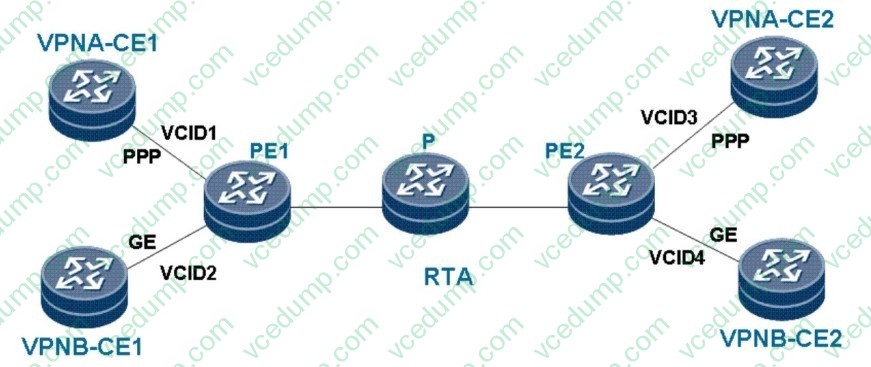
B. VCID1 = 1, VCID2 = 2, VCID3 = 3, VCID4 = 4
C. VCID1 = 1, VCID2 = 2, VCID3 = 1, VCID4 = 2
D. VCID1 = 1, VCID2 = 1, VCID3 = 2, VCID4 = 2 -
Question 170:
Which of the following is the maximum length of the Ethernet frame encapsulated by QinQ?
A. 1518
B. 1522
C. 1526
D. 1530
Related Exams:
-
H11-821
HCNP-UC-HIPT (Implementing Huawei IP Telephony Solutions) -
H11-828
HCNP-UC(Fast Track)(Unified Communication (Fast Track)) -
H11-851
HCIA-Video Conference V3.0 -
H11-861
HCIP-Video Conference V2.0 -
H11-868
HCNP- VC(Fast Track)-(Video Conference (Fast Track)) -
H12-111
HCIA-IoT V3.0 -
H12-224
HCIP-Routing & Switching (Fast Track) V2.0 -
H12-311
HCIA-WLAN V3.0 -
H12-351
HCIE-WLAN (Written) V1.0 -
H12-411
HCIA-Data Center Facility V2.0
Tips on How to Prepare for the Exams
Nowadays, the certification exams become more and more important and required by more and more enterprises when applying for a job. But how to prepare for the exam effectively? How to prepare for the exam in a short time with less efforts? How to get a ideal result and how to find the most reliable resources? Here on Vcedump.com, you will find all the answers. Vcedump.com provide not only Huawei exam questions, answers and explanations but also complete assistance on your exam preparation and certification application. If you are confused on your H31-161 exam preparations and Huawei certification application, do not hesitate to visit our Vcedump.com to find your solutions here.