AICPA CPA-TEST Online Practice
Questions and Exam Preparation
CPA-TEST Exam Details
Exam Code
:CPA-TEST
Exam Name
:Certified Public Accountant Test: Auditing and Attestation, Business Environment and Concepts, Financial Accounting and Reporting, Regulation
Certification
:AICPA Certifications
Vendor
:AICPA
Total Questions
:1241 Q&As
Last Updated
:Jun 03, 2026
AICPA CPA-TEST Online Questions &
Answers
Question 501:
ABC, Inc. sold a warehouse and used the proceeds to acquire a new warehouse. The excess of the proceeds over the carrying amount of the warehouse sold should be reported as a(an):
A. Extraordinary gain, net of income taxes. B. Part of continuing operations. C. Gain from discontinued operations, net of income taxes. D. Reduction of the cost of the new warehouse.
B. Part of continuing operations. Choice "b" is correct. Part of continuing operations. Rule: When a fixed asset is sold, gain or loss is recognized as part of income from continuing operations. The amount of the gain or loss is equal to the difference between the proceeds from the sale and the carrying amount (FMV) of the fixed asset sold. Choice "a" is incorrect. The gain is not extraordinary and is shown gross - not net of tax. Choice "c" is incorrect. The gain is part of continuing operations - not discontinued operations. Choice "d" is incorrect. The gain is not reported as a reduction of the cost of the new warehouse.
Question 502:
In order to increase production capacity, ABC Industries is considering replacing an existing production machine with a new technologically improved machine effective January 1, 1997. The following information is being considered by ABC
Industries.
?The new machine would be purchased for $160,000 in cash. Shipping, installation, and testing would cost an additional $30,000.
?The new machine is expected to increase annual sales by 20,000 units at a sales price of $40 per unit. Incremental operating costs are comprised of $30 per unit in variable costs and total fixed costs of $40,000 per year.
?The investment in the new machine will require an immediate increase in working capital of $35,000. ?ABC uses straight-line depreciation for financial reporting and tax reporting purposes. The new machine has an estimated useful life of
five years and zero salvage value. ?ABC is subject to a 40 percent corporate income tax rate. ABC uses the net present value method to analyze investments and will employ the following factors and rates.
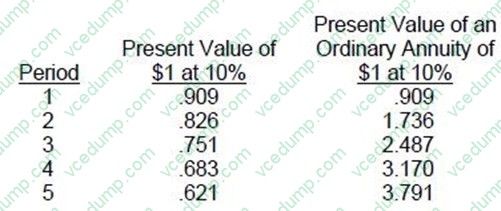
The acquisition of the new production machine by ABC Industries will contribute a discounted net-of-tax contribution margin of:
A. $242,624 B. $303,280 C. $363,936 D. $454,920
D. $454,920 Explanation Explanation/Reference:Choice "d" is correct. $454,920 discounted net-of-tax contribution margin. Choices "a", "b", and "c" are incorrect based on the above Explanation.
Question 503:
Which of the following matters generally is included in an auditor's engagement letter?
A. Management's responsibility for the entity's compliance with laws and regulations. B. The factors to be considered in setting preliminary judgments about materiality. C. Management's vicarious liability for illegal acts committed by its employees. D. The auditor's responsibility to search for significant internal control deficiencies.
A. Management's responsibility for the entity's compliance with laws and regulations. Choice "a" is correct. An understanding with the client should be established regarding management's responsibilities, which include identifying and ensuring that the entity complies with applicable laws and regulations. The understanding should be documented through a written communication, such as an engagement letter. Choice "b" is incorrect. Judgments about materiality are the auditor's responsibility and would not be included in an engagement letter. Choice "c" is incorrect. Management would not necessarily be responsible for illegal acts committed by employees. Choice "d" is incorrect. The auditor is not responsible for searching for significant internal control deficiencies.
Question 504:
Under the Revised Model Business Corporation Act, which of the following actions by a corporation would entitle a stockholder to dissent from the action and obtain payment of the fair value of his/her shares?
A. An amendment to the articles of incorporation that materially and adversely affects rights in respect of a dissenter's shares because it alters or abolishes a preferential right of the shares. II. Consummation of a plan of share exchange to which the corporation is a party as the corporation whose shares will be acquired, if the stockholder is entitled to vote on the plan. B. I only. C. II only. D. Both I and II. E. Neither I nor II.
C. II only. Choice "c" is correct. "Both I and II." Rule: Shareholders who vote against a share exchange are entitled to payment for fair value of their shares. Rule: Preferred shareholders who dissent to having their preferential rights altered or abolished have dissenters' rights to be paid the fair value of their shares. Choices "a", "b", and "d" are incorrect, per the above rules.
Question 505:
ABC, Inc., a for-profit provider of healthcare services, recently purchased two smaller companies and is researching accounting issues arising from the two business combinations. Which of the following accounting pronouncements are the most authoritative?
A. AICA Statements of Position. B. AICPA Industry and Audit Guides. C. FASB Statements of Financial Accounting Concepts. D. FASB Statements of Financial Accounting Standards.
D. FASB Statements of Financial Accounting Standards. Choice "d" is correct. Since ABC is a for-profit provider of healthcare services, it is covered under normal GAAP. Thus, the most authoritative pronouncements are the FASB Statements of Financial Accounting Standards (SFAS). Choice "a" is incorrect. AICPA Statements of Position are not the most authoritative pronouncement for almost anything (other than for some issues that only they cover). They are normally "merely" the opinion of the AICPA. Choice "b" is incorrect. AICPA Industry and Audit Guides are not the most authoritative pronouncement for almost anything (other than for some issues that only they cover). Choice "c" is incorrect. FASB Statements of Financial Accounting Concepts are not authoritative pronouncements except where they have been incorporated by reference into an SFAS. They are the basis on which SFAS can be constructed.
Question 506:
In obtaining an understanding of an entity's internal control in a financial statement audit, an auditor is not obligated to:
A. Determine whether the control activities have been implemented. B. Perform procedures to understand the design of internal control. C. Document the understanding of the entity's internal control components. D. Search for significant deficiencies in the operation of internal control.
D. Search for significant deficiencies in the operation of internal control. Choice "d" is correct. When obtaining an understanding of an entity's internal control in a financial statement audit, an auditor is not obligated to search for significant deficiencies in the operation of internal control. Choice "a" is incorrect. In order to determine the nature, timing and extent of tests to be performed, an auditor must determine whether the control activities have been implemented. Choice "b" is incorrect. An auditor is required to perform procedures to confirm his/her understanding of the internal control systems' design, and to determine whether relevant controls have been implemented. Choice "c" is incorrect. An auditor is required to document his or her understanding of the entity's internal control components, even if he or she intends to use a substantive approach.
Question 507:
Inflation can be caused by:
A. Increases in aggregate demand only. B. Increases in aggregate supply only. C. Decreases in aggregate demand and increases in aggregate supply. D. Increases in aggregate demand and decreases in aggregate supply.
D. Increases in aggregate demand and decreases in aggregate supply. Choice "d" is correct. Both an increase in aggregate demand and a decrease in aggregate supply can cause inflation. Choice "a" is incorrect. While an increase in aggregate demand can cause inflation, it is not the only cause of inflation. Choice "b" is incorrect. An increase in aggregate supply would lower the overall price level, not increase the overall price level. Choice "c" is incorrect. A decrease in aggregate demand would lower the overall price level, not increase the overall price level.
Question 508:
According to the FASB conceptual framework, the process of reporting an item in the financial statements of an entity is:
A. Allocation. B. Matching. C. Realization. D. Recognition.
D. Recognition. Choice "d" is correct. Recognition is the process of recording an item in the financial statements of an entity. SFAC 5 para. 6. Choice "a" is incorrect. Allocation is the accounting process of assigning or distributing an amount according to a plan or a formula. SFAC 6 para. 142. Choice "b" is incorrect. Matching of costs and revenues is simultaneous or combined recognition of the revenues and expenses that result directly and jointly from the same transactions or other events. SFAC 6 para. 146. Choice "c" is incorrect. Realization is the process of converting noncash resources and rights into money. SFAC 6 para. 143.
Question 509:
Which of the following statements is incorrect regarding the inputs that can be used to measure fair value?
A. Level I inputs are the most reliable fair value measurements and Level III inputs are the least reliable. II. Level I measurements are quoted prices in active markets for identical or similar assets or liabilities. III. A fair value measurement based on management assumptions only (no market data) would not be acceptable per GAAP. IV. The level in the fair value hierarchy of a fair value measurement is determined by the level of the highest level significant input. B. I only. C. I, II, IV. D. II, III, IV. E. I, II, III, IV.
C. I, II, IV. Choice "c" is correct. Statement I is correct and statements II, III, and IV are incorrect. Statement II is incorrect because Level I measurements are quoted prices in active markets for identical assets or liabilities only. Quoted prices in active markets for similar assets or liabilities are Level II inputs. Statement III is incorrect because a fair value measurement based on management assumptions only is a Level III measurement and is acceptable when there are no Level I or Level II inputs or when undo cost or effort is required to obtain Level I or Level II inputs. Statement IV is incorrect because the level in the fair value hierarchy of a fair value measurement is determined by the level of the lowest level significant input.
Question 510:
An auditor is required to obtain an understanding of the entity's business, including business cycles and reasons for business fluctuations. What is the audit purpose most directly served by obtaining this understanding?
A. To enable the auditor to accurately identify significant deficiencies. B. To assist the auditor to accurately interpret information obtained during an audit. C. To allow the auditor to more accurately perform tests of controls. D. To decide whether it will be necessary to perform analytical procedures.
B. To assist the auditor to accurately interpret information obtained during an audit. Choice "b" is correct. As part of audit planning, the auditor should obtain an understanding of the entity's business. This understanding enables the auditor to better understand events, transactions, and practices that may affect the financial statements, to plan and perform appropriate audit tests, and to properly understand and evaluate the results of those tests. Choice "a" is incorrect. Obtaining an understanding of the entity's business would not be particularly helpful in identifying significant deficiencies. Significant deficiencies in internal control are typically identified during the fieldwork stage of the audit. Choice "c" is incorrect. Obtaining an understanding of the entity's business would not result in a more accurate performance of tests of controls. Accurate performance of audit tests is dependent upon factors such as existence of an appropriate audit trail, client cooperation, training and supervision of audit staff, etc. Choice "d" is incorrect. Analytical procedures are always required in an audit during the planning and overall review stages.
Nowadays, the certification exams become more and more important and required by more and more
enterprises when applying for a job. But how to prepare for the exam effectively? How to prepare
for the exam in a short time with less efforts? How to get a ideal result and how to find the
most reliable resources? Here on Vcedump.com, you will find all the answers.
Vcedump.com provide not only AICPA exam questions,
answers and explanations but also complete assistance on your exam preparation and certification
application. If you are confused on your CPA-TEST exam preparations
and AICPA certification application, do not hesitate to visit our
Vcedump.com to find your solutions here.