AICPA CPA-TEST Online Practice
Questions and Exam Preparation
CPA-TEST Exam Details
Exam Code
:CPA-TEST
Exam Name
:Certified Public Accountant Test: Auditing and Attestation, Business Environment and Concepts, Financial Accounting and Reporting, Regulation
Certification
:AICPA Certifications
Vendor
:AICPA
Total Questions
:1241 Q&As
Last Updated
:Jun 03, 2026
AICPA CPA-TEST Online Questions &
Answers
Question 361:
ABC Corp. has three manufacturing divisions, each of which has been determined to be a reportable segment. In 1989, Clay division had sales of $3,000,000, which was 25% of ABC's total sales, and had operating costs of $1,900,000, as reported to the CFO. In 1989, ABC incurred operating costs of $500,000 that were not directly traceable to any of the divisions. In addition, ABC incurred corporate interest expense of $300,000 in 1989. In reporting segment information, what amount should be shown as Clay's operating profit for 1989?
A. $875,000 B. $900,000 C. $975,000 D. $1,100,000
D. $1,100,000 Choice "d" is correct. $1,100,000 operating profit for clay. Rule: Operating profit by segments is based on the measure of profit reported to the "chief operating decision maker." Allocations for general operating costs and interest, etc., should not be made solely for purposes of segment disclosures.
Question 362:
Tennis rackets and tennis balls are:
A. Substitute goods. B. Independent goods. C. Inferior goods. D. Complementary goods.
D. Complementary goods. Choice "d" is correct. Complementary goods are ones whose demand fluctuates together. If Good A and Good B are complements, then if the demand for Good A increases, the demand for Good B will also increase, tennis rackets and tennis balls are complements. Choice "a" is incorrect. For substitutive goods, as the price of one of the goods increases, the other good experiences an increase in demand as it is substituted for the first good. An example of substitute goods is apple and orange juice. Choice "b" is incorrect. Independent goods have demand functions that are not interrelated. An example would be bread and vacuum cleaners. Choice "c" is incorrect. Inferior goods experience a decrease in demand when income levels rise. An example is hamburger, which experiences decrease in demand as incomes rise and buyers switch to higher priced meats.
Question 363:
To determine whether internal control relative to the revenue cycle of a wholesaling entity is operating effectively in minimizing the failure to prepare sales invoices, an auditor most likely would select a sample of transactions from the population represented by the:
A. Sales order file. B. Customer order file. C. Shipping document file. D. Sales invoice file.
C. Shipping document file. Choice "c" is correct. Shipping documents provide evidence that a sale occurred, and therefore selecting from a population of shipping documents allows the auditor to test whether corresponding invoices exist for each sale. Choices "a" and "b" are incorrect. The existence of customer orders and sales orders does not necessarily imply that a sale occurred. For example, the particular item requested may be out of stock. In such cases, there would properly be no sales invoice. Choice "d" is incorrect. Since the weakness the auditor is concerned about involves missing sales invoices, selecting from a sample of existing sales invoices would not identify this problem.
Question 364:
Which of the following internal controls most likely would assure that all billed sales are correctly posted to the accounts receivable ledger?
A. Daily sales summaries are compared to daily postings to the accounts receivable ledger. B. Each sales invoice is supported by a prenumbered shipping document. C. The accounts receivable ledger is reconciled daily to the control account in the general ledger. D. Each shipment on credit is supported by a prenumbered sales invoice.
A. Daily sales summaries are compared to daily postings to the accounts receivable ledger. Choice "a" is correct. Comparison of daily sales summaries to daily postings to the accounts receivable ledger would ensure the completeness of the accounts receivable ledger. Choice "b" is incorrect. Comparison of sales invoices to shipping documents verifies occurrence of the sale, not completeness of the accounts receivable ledger. Choice "c" is incorrect. Reconciliation of the accounts receivable ledger to the general ledger would not assure the accuracy and completeness of the accounts receivable ledger because a sale which was improperly excluded from receivables would likely be omitted from both ledgers. Choice "d" is incorrect. Ensuring that all shipments are billed verifies completeness of sales transactions, but does not provide evidence that all sales are recorded in the accounts receivable ledger. In other words, the fact that a shipment was billed does not mean that the invoice was also recorded in the accounts receivable ledger.
Question 365:
An auditor traced a sample of purchase orders and the related receiving reports to the purchases journal and the cash disbursements journal. The purpose of this substantive audit procedure most likely was to:
A. Identify unusually large purchases that should be investigated further. B. Verify that cash disbursements were for goods actually received. C. Determine that purchases were properly recorded. D. Test whether payments were for goods actually ordered.
C. Determine that purchases were properly recorded. Choice "c" is correct. In general, an audit procedure can be restated as the question to be answered. In this case, tracing a sample of purchase orders and related receiving reports to the purchases journal and the cash disbursements journal seeks to answer the question, "Were all purchases properly recorded?" (the completeness assertion). Choice "a" is incorrect. Tracing a sample of source documents to summary records would not identify unusually large transactions requiring additional attention. Choice "b" is incorrect. In order to verify that cash disbursements were for goods actually received, a sample of cash disbursements should be vouched back to receiving reports. Choice "d" is incorrect. In order to verify that cash disbursements were for goods actually ordered, a sample of cash disbursements should be vouched back to purchase orders.
Question 366:
Which of the following matters is an auditor required to communicate to those charged with governance?
A. The basis for his or her assessment of control risk. B. The process used by management in formulating sensitive accounting estimates. C. The auditor's preliminary judgments about materiality levels. D. The justification for performing substantive procedures at interim dates.
B. The process used by management in formulating sensitive accounting estimates. Choice "b" is correct. The auditor should ensure that those charged with governance are informed about the process used by management in formulating particularly sensitive accounting estimates and about the basis for the auditor's conclusions regarding the reasonableness of the estimates. Choices "a", "c", and "d" are incorrect. The basis for assessing control risk, preliminary judgments about materiality levels, and the justification for performing substantive procedures at interim dates are matters of auditor judgment that need not be shared with those charged with governance.
Question 367:
Which of the following conditions or events most likely would cause an auditor to have substantial doubt about an entity's ability to continue as a going concern?
A. Significant related party transactions are pervasive. B. Usual trade credit from suppliers is denied. C. Arrearages in preferred stock dividends are paid. D. Restrictions on the disposal of principal assets are present.
B. Usual trade credit from suppliers is denied. Choice "b" is correct. Indications of possible financial difficulties, such as denial of usual trade credit from suppliers, may cause an auditor to have substantial doubt about an entity's ability to continue as a going concern. Choice "a" is incorrect. The existence of related parties and the occurrence of related party transactions do not indicate doubt about the entity's ability to continue as a going concern. Choice "c" is incorrect. Payment of preferred stock dividends in arrears might very well indicate an improvement in the entity's financial situation. It is the lack of payment of preferred, cumulative dividends (a possible indication of financial difficulty) that might cause an auditor to have substantial doubt about an entity's ability to continue as a going concern. Choice "d" is incorrect. Restrictions on the disposal of assets might limit the options available to management as far as mitigating adverse conditions, but it would not in and of itself cause the auditor to have substantial doubt about an entity's ability to continue as a going concern.
Question 368:
Investment and property schedules are presented for purposes of additional analysis in an auditor submitted document. The schedules are not required parts of the basic financial statements, but accompany the basic financial statements. When reporting on such additional information, the measurement of materiality is the:
A. Same as that used in forming an opinion on the basic financial statements taken as a whole. B. Lesser of the individual schedule of investments or schedule of property taken by itself. C. Greater of the individual schedule of investments or schedule of property taken by itself. D. Combined total of both the individual schedules of investments and property taken as a whole.
A. Same as that used in forming an opinion on the basic financial statements taken as a whole. Choice "a" is correct. When reporting on additional information accompanying the audited financial statements, the measure of materiality would be the same as that used in forming an opinion on the financial statements taken as a whole. Choices "b", "c", and "d" are incorrect, based on the above explanation.
Question 369:
ABC Corp. experienced a $50,000 decline in the market value of its inventory in the first quarter of its fiscal year. ABC had expected this decline to reverse in the third quarter, and in fact, the third quarter recovery exceeded the previous decline by $10,000. ABC's inventory did not experience any other declines in market value during the fiscal year. What amounts of loss and/or gain should ABC report in its interim financial statements for the first and third quarters?
A. Option A B. Option B C. Option C D. Option D
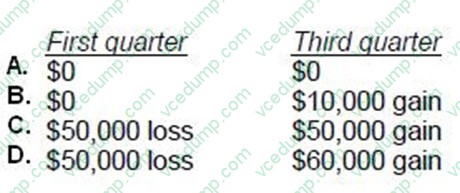
A. Option A Choice "a" is correct. Temporary market declines in inventory need not be recognized at interim when a turn-around can reasonably be expected to occur before the end of the fiscal year.
Question 370:
When do cost leadership strategies fail?
A. Buyers have large amounts of bargaining power in the market. B. Heavy price competition exists in the market. C. Buyers become less price sensitive and start to have brand loyalty. D. New entry firms are able to influence buyers to switch to their product by cutting the price of their product for a period of time in an effort to gain market share and increase profits.
C. Buyers become less price sensitive and start to have brand loyalty. Choice "c" is correct. If firms overlook the fact that few customers care about the fact that a product is priced lower than others and care more about brand loyalty, cost leadership strategies will fail. Choices "a", "b", and "d" are incorrect, as these are all situations in which cost leadership strategies work well.
Nowadays, the certification exams become more and more important and required by more and more
enterprises when applying for a job. But how to prepare for the exam effectively? How to prepare
for the exam in a short time with less efforts? How to get a ideal result and how to find the
most reliable resources? Here on Vcedump.com, you will find all the answers.
Vcedump.com provide not only AICPA exam questions,
answers and explanations but also complete assistance on your exam preparation and certification
application. If you are confused on your CPA-TEST exam preparations
and AICPA certification application, do not hesitate to visit our
Vcedump.com to find your solutions here.