AICPA CPA-TEST Online Practice
Questions and Exam Preparation
CPA-TEST Exam Details
Exam Code
:CPA-TEST
Exam Name
:Certified Public Accountant Test: Auditing and Attestation, Business Environment and Concepts, Financial Accounting and Reporting, Regulation
Certification
:AICPA Certifications
Vendor
:AICPA
Total Questions
:1241 Q&As
Last Updated
:Jun 03, 2026
AICPA CPA-TEST Online Questions &
Answers
Question 331:
According to the FASB conceptual framework, an entity's revenue may result from:
A. A decrease in an asset from primary operations. B. An increase in an asset from incidental transactions. C. An increase in a liability from incidental transactions. D. A decrease in a liability from primary operations.
D. A decrease in a liability from primary operations. Explanation Explanation/Reference:Rule: Revenues are inflows or other enhancements of assets and/or settlements (decreases) in liabilities resulting from the entity's ongoing major operations, not from "incidental" operations. Choice "d" is correct. An entity's revenue may result from a decrease in a liability from primary operations.
Question 332:
Under the Revised Uniform Limited Partnership Act and in the absence of a contrary agreement by the partners, which of the following events is most likely to dissolve a limited partnership?
A. A majority vote in favor by the partners. B. A two-thirds vote in favor by the partners. C. A withdrawal of a majority of the limited partners. D. Withdrawal of the only general partner.
D. Withdrawal of the only general partner. Choice "d" is correct. Absent a contrary agreement of the partners, a limited partnership can be dissolved by written consent of all the general partners, withdrawal or death of a general partner, or judicial decree. Thus, withdrawal of the only general partner would cause dissolution. (There has to be at least one general partner in a limited partnership.) Choice "a" is incorrect. It takes unanimous written consent of all general partners to dissolve the limited partnership, not majority vote. Choice "b" is incorrect. It takes unanimous written consent of all general partners to dissolve the limited partnership, not two-thirds vote. Choice "c" is incorrect. Death or withdrawal of a limited partner does not cause dissolution. Only death or withdrawal of a general partner causes dissolution.
Question 333:
DAC Foundation awarded Kent $75,000 in recognition of lifelong literary achievement. Kent was not required to render future services as a condition to receive the $75,000. What condition(s) must have been met for the award to be excluded from Kent's gross income?
A. Kent was selected for the award by DAC without any action on Kent's part. II. Pursuant to Kent's designation, DAC paid the amount of the award either to a governmental unit or to a charitable organization. B. I only. C. II only. D. Both I and II. E. Neither I nor II.
C. II only. Choice "c" is correct. Generally, the fair market value of prizes and awards is taxable income. However, an exclusion from income for certain prizes and awards applies where the winner is selected for the award without entering into a contest (i.e., without any action on their part) and then assigns the award directly to a governmental unit or charitable organization. Therefore, conditions "I" and "II" must be met in order for Ken to exclude the award from his gross income. Choice "a" is incorrect. "II" is a necessary condition as well. See explanation above. Choice "b" is incorrect. "I" is a necessary condition as well. See explanation above. Choice "d" is incorrect. "I" and "II" are both necessary conditions. See explanation above.
Question 334:
A member of a limited liability company may generally do all of the following, except:
A. Transfer his membership in the company without the consent of the other members. B. Participate in the management of the company absent an agreement to the contrary. C. Have limited liability. D. Order office supplies for the company.
A. Transfer his membership in the company without the consent of the other members. Choice "a" is correct. The transfer of a member interest requires the consent of the other members. Members may not assign their interest without the other members' consent. Choice "b" is incorrect. Unless the members have agreed to operate as a manager managed limited liability company, all members have the power to participate in management. Choice "c" is incorrect. Members in a limited liability company all have limited personal liability. Choice "d" is incorrect. Unless otherwise agreed, members have the right to manage the everyday operations of a limited liability company. This can include the ordering of office supplies.
Question 335:
Which of the following internal control procedures most likely would deter lapping of collections from customers?
A. Independent internal verification of dates of entry in the cash receipts journal with dates of daily cash summaries. B. Authorization of write-offs of uncollectible accounts by a supervisor independent of credit approval. C. Segregation of duties between receiving cash and posting the accounts receivable ledger. D. Supervisory comparison of the daily cash summary with the sum of the cash receipts journal entries.
C. Segregation of duties between receiving cash and posting the accounts receivable ledger. Choice "c" is correct. Lapping is a defalcation in which a cash shortage is concealed by applying later customer remittances to a receivable account from which money was stolen. Lapping can be deterred by appropriate segregation of duties between receiving cash and posting to the accounts receivable ledger. This makes it more difficult for the employee who is stealing the cash to cover it up through inappropriate remittance credits. Choice "a" is incorrect. Even with a lapping scheme, the dates of cash receipts journal entries and the dates of daily cash summaries would still agree, since the stolen funds would be excluded from both places and subsequent receipts would be included in both places. Choice "b" is incorrect. The authorization of write-offs of uncollectible accounts by a supervisor independent of credit approval would not deter lapping, since lapping schemes do not involve write-offs. Choice "d" is incorrect. Even with a lapping scheme, the daily cash summary would still agree with the sum of the cash receipts journal entries. Stolen funds would be excluded from both places and subsequent receipts would be included in both places.
Question 336:
Dunn, CPA, is auditing the financial statements of ABC Co. ABC uses Quick Service Center (QSC) to process its payroll. Price, CPA, is expressing an opinion on a description of the controls placed in operation at QSC regarding the processing of its customers' payroll transactions. Dunn expects to consider the effects of Price's report on the ABC engagement. Price's report should contain a (an):
A. Description of the scope and nature of Price's procedures. B. Statement that Dunn may assess control risk based on Price's report. C. Assertion that Price assumes no responsibility to determine whether QSC's controls are suitably designed. D. Opinion on the operating effectiveness of QSC's internal controls.
A. Description of the scope and nature of Price's procedures. Choice "a" is correct. Price, CPA (the "service auditor") should include in his or her report a description of the scope and nature of the procedures performed. Choices "b" and "d" are incorrect. A report on controls placed in operation does not provide an opinion on operating effectiveness, and therefore may not be used to assess control risk. Choice "c" is incorrect. A report on controls placed in operation includes a statement that, "our examination included procedures to obtain reasonable assurance about whether the controls were suitably designed."
Question 337:
For which of the following judgments may an independent auditor share responsibility with an entity's internal auditor who is assessed to be both competent and objective?
A. Option A B. Option B C. Option C D. Option D
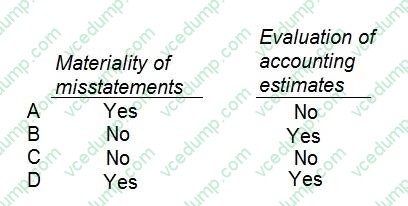
C. Option C Choice "c" is correct. Because the auditor has the ultimate responsibility to express an opinion on the financial statements, judgments about assessments of risk, the materiality of misstatements, the sufficiency of tests performed, the evaluation of significant accounting estimates, and other matters affecting the auditor's report should always be those of the auditor. Choices "a", "b", and "d" are incorrect, based on the above explanation.
Question 338:
ABC Inc. is considering implementing a lock-box collection system at a cost of $80,000 per year. Annual sales are $90 million, and the lock-box system will reduce collection time by 3 days. If ABC can invest funds at 8 percent, should it use the lock-box system? Assume a 360-day year.
A. Yes, producing savings of $60,000 per year. B. No, producing a loss of $20,000 per year. C. No, producing a loss of $60,000 per year. D. No, producing a loss of $140,000 per year.
B. No, producing a loss of $20,000 per year. Choice "b" is correct. No, do not use the lock-box system, which produces a loss of $20,000 per year.
Question 339:
If ABC Corporation's bonds are currently yielding 8 percent in the marketplace, why would the firm's cost of debt be lower?
A. Market interest rates have increased. B. Additional debt can be issued more cheaply that the original debt. C. Interest is deductible for tax purposes. D. There is a mixture of old and new debt.
C. Interest is deductible for tax purposes. Choice "c" is correct. Because interest expense is a tax deduction, the cost to ABC is lower than the market yield rate on debt. Choice "a" is incorrect. If market interest rates increase, then ABC's bonds would have to be offered at a discount to stay competitive with the market. This discount would increase (not lower) ABC's cost of debt. Choice "b" is incorrect. Issuance of cheaper additional debt will lower future cost of debt, but have no impact on current cost of debt. Choice "d" is incorrect. Presumably, the 8% yield already includes new and old debt.
Question 340:
A change from the cost approach to the market approach of measuring fair value is considered to be what type of accounting change?
A. Change in accounting estimate. B. Change in accounting principle. C. Change in valuation technique. D. Error correction.
A. Change in accounting estimate. Choice "a" is correct. A change in the valuation technique used to measure fair value is a change in accounting estimate. Choice "b" is incorrect. Per SFAS No. 157, a change in valuation technique is a change in accounting estimate, not a change in accounting principal. Choice "c" is incorrect. Although a change from the cost approach to the market approach is a change in valuation technique, a change in valuation technique is not defined as a type of accounting change, but instead falls into the category of changes in accounting estimate. Choice "d" is incorrect. Both the market approach and the cost approach are acceptable methods of measuring fair value per SFAS No. 157; therefore, switching between these methods is not the correction of an error. Additionally, an error correction is not a type of accounting change.
Nowadays, the certification exams become more and more important and required by more and more
enterprises when applying for a job. But how to prepare for the exam effectively? How to prepare
for the exam in a short time with less efforts? How to get a ideal result and how to find the
most reliable resources? Here on Vcedump.com, you will find all the answers.
Vcedump.com provide not only AICPA exam questions,
answers and explanations but also complete assistance on your exam preparation and certification
application. If you are confused on your CPA-TEST exam preparations
and AICPA certification application, do not hesitate to visit our
Vcedump.com to find your solutions here.