AICPA CPA-TEST Online Practice
Questions and Exam Preparation
CPA-TEST Exam Details
Exam Code
:CPA-TEST
Exam Name
:Certified Public Accountant Test: Auditing and Attestation, Business Environment and Concepts, Financial Accounting and Reporting, Regulation
Certification
:AICPA Certifications
Vendor
:AICPA
Total Questions
:1241 Q&As
Last Updated
:Jun 03, 2026
AICPA CPA-TEST Online Questions &
Answers
Question 321:
In which case would the accountant be least likely to perform a review of interim financial information under PCAOB (auditing) standards?
A. Quarterly reports are required to be filed with the SEC. B. Selected quarterly financial data is included in an annual report. C. Quarterly financial data is included in the financial statements of a nonissuer. D. The accountant is performing an initial audit of financial statements that include selected quarterly data.
C. Quarterly financial data is included in the financial statements of a nonissuer. Choice "c" is correct. A review of data included in financial statements of a nonissuer is performed under Statements on Standards for Accounting and Review Services, not under PCAOB (auditing) standards. A review of interim financial information under PCAOB (auditing) standards is only conducted for public companies (or companies anticipating going public). Choice "a" is incorrect. When an entity is required by the SEC to file a quarterly report, the SEC also requires that an independent accountant perform a review (of the interim financial information) in accordance with PCAOB (auditing) standards before the report is filed. Choice "b" is incorrect. When a company is required by the SEC to include selected quarterly financial data in its annual report or in other SEC filings, a review (of the interim financial information) in accordance with PCAOB (auditing) standards is required. Choice "d" is incorrect. An accountant performing an initial audit of financial statements that include selected quarterly data should also perform a review (of the interim financial information) in accordance with PCAOB (auditing) standards as part of the overall audit.
Question 322:
ABC Corporation has the following capital structure:
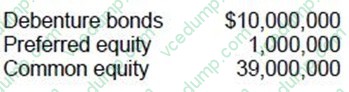
The financial leverage of ABC Corp. would increase as a result of:
A. Issuing common stock and using the proceeds to retire preferred stock. B. Issuing common stock and using the proceeds to retire debenture bonds. C. Financing its future investments with a higher percentage of bonds. D. Financing its future investments with a higher percentage of equity funds.
C. Financing its future investments with a higher percentage of bonds. Choice "c" is correct. Financial leverage increases when the debt to equity ratio increases. Using a higher percentage of debt (bonds) for future investments would increase financial leverage. Choice "a" is incorrect. This results in no change in total equity and, consequently, no change in financial leverage. Choice "b" is incorrect. This would result in increased equity and decreased debt, which would decrease financial leverage. Choice "d" is incorrect. This would increase equity, decrease the debt to equity ratio and decrease financial leverage.
Question 323:
Management of ABC Industries plans to disclose an uncertainty as follows:
The Company is a defendant in a lawsuit alleging infringement of certain patent rights and claiming damages. Discovery proceedings are in progress. The ultimate outcome of the litigation cannot presently be determined. Accordingly, no
provision for any liability that may result upon adjudication has been made in the accompanying financial statements.
The auditor is satisfied that sufficient audit evidence supports management's assertions about the nature and disclosure of the uncertainty. What type of opinion should the auditor express under these circumstances?
A. Unqualified without an explanatory paragraph. B. "Subject to" qualified. C. "Except for" qualified. D. Disclaimer of opinion.
A. Unqualified without an explanatory paragraph. Choice "a" is correct. The note presented describes an uncertainty that is properly disclosed. An explanatory paragraph is not required in the unqualified opinion. Choice "b" is incorrect. A "subject to" qualified opinion should never be issued. Choice "c" is incorrect. Since the auditor is satisfied that the assertion and disclosure are supported by the existing evidence, a qualified opinion is not required. Choice "d" is incorrect. Since the auditor is satisfied that the assertion and disclosure are supported by the existing evidence, there is no need for the auditor to disclaim an opinion.
Question 324:
Which of the following statements is the best definition of real property?
A. Real property is only land. B. Real property is all tangible property including land. C. Real property is land and intangible property in realized form. D. Real property is land and everything permanently attached to it.
D. Real property is land and everything permanently attached to it. Choice "d" is correct. Real property includes land and all items permanently affixed to the land (e.g., buildings, paving, etc.) Choice "a" is incorrect. Real property includes more than just the land (as per the explanation above); it includes all items permanently affixed to land. Choice "b" is incorrect. "All" tangible property could include moveable personal property and is therefore, incorrect. Choice "c" is incorrect. "Intangible property in realized form" is a distracter and a contradiction in terms.
Question 325:
Which one of the following provides a spontaneous source of financing for a firm?
A. Accounts payable. B. Accounts receivable. C. Debentures. D. Preferred stock.
A. Accounts payable. Choice "a" is correct. Accounts payable provide a spontaneous source of financing for a firm. Choice "b" is incorrect. Accounts receivable take time to factor. Choices "c" and "d" are incorrect. Each of the following take time to issue: C. Debentures. D. Preferred stock.
Question 326:
The concept of materiality would be least important to an auditor when considering the:
A. Adequacy of disclosure of a client's illegal act. B. Discovery of weaknesses in a client's internal control. C. Effects of a direct financial interest in the client on the CPA's independence. D. Decision whether to use positive or negative confirmations of accounts receivable.
C. Effects of a direct financial interest in the client on the CPA's independence. Choice "c" is correct. Any direct financial interest in a client impairs independence, even if it is immaterial. Choice "a" is incorrect. A material illegal act may require disclosure in or adjustment to the financial statements, whereas an immaterial illegal act may not require disclosure. Choice "b" is incorrect. A material weakness in internal control will affect the nature, timing, and extent of audit procedures, whereas an immaterial weakness in internal control may have little impact on the audit. Choice "d" is incorrect. An auditor is likely to use positive confirmations for material accounts receivable, but may consider negative confirmations for immaterial receivable balances.
Question 327:
Which of the following methods is designed to measure transaction exposure in terms of the maximum one day loss related to holdings denominated in foreign currency?
A. Measurement of currency variability. II. Measurement of currency correlations. III. Value at risk. B. I only. C. II only. D. III only. E. I, II, and III.
C. II only. Choice "c" is correct. The value at risk method seeks to quantify the exposure of business to a one day loss in the value of its positions in foreign currencies. Choices "a", "b", and "d" are incorrect, per above Explanation.
Question 328:
A company obtained a short-term bank loan of $500,000 at an annual interest rate of eight percent. As a condition of the loan, the company is required to maintain a compensating balance of $100,000 in its checking account. The checking account earns interest at an annual rate of three percent. Ordinarily, the company maintains a balance of $50,000 in its account for transaction purposes. What is the effective interest rate of the loan?
A. 7.77 percent. B. 8.50 percent. C. 9.44 percent. D. 8.56 percent.
D. 8.56 percent. Choice "d" is correct. 8.56%. To calculate the effective annualized percentage cost of financing: Choices "a", "b", and "c" are incorrect, per the above calculation.
Question 329:
Under the uniform capitalization rules applicable to property acquired for resale, which of the following costs should be capitalized with respect to inventory if no exceptions are met?
A. Option A B. Option B C. Option C D. Option D
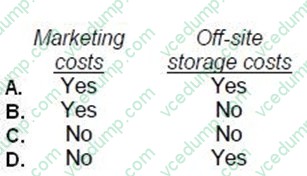
D. Option D Choice "d" is correct. Under the uniform capitalization rules, purchasers of inventory for resale may deduct their marketing costs but must capitalize their off-site storage costs. Choices "a", "b", and "c" are incorrect. Marketing costs are deductible, but off-site storage must be capitalized.
Question 330:
ABC Co. is considering the acquisition of a new, more efficient press. The cost of the press is $360,000, and the press has an estimated six-year life with zero salvage value. ABC uses straightline depreciation for both financial reporting and income tax reporting purposes and has a 40 percent corporate income tax rate. In evaluating equipment acquisitions of this type, ABC uses a goal of a four-year payback period. To meet ABC's desired payback period, the press must produce a minimum annual before-tax, operating cash savings of:
A. $90,000 B. $110,000 C. $114,000 D. $150,000
B. $110,000 Explanation Explanation/Reference:Choice "b" is correct. $110,000 minimum annual before-tax operating cash savings. Step 1: Determine the after-tax annual cash savings. The question provides the cash outflow and the desired payback period (which is calculated using after-tax cash flows). The $90,000 annual after-tax cash flows is calculated as follows: Step 2: Determine the amount of the annual depreciation expense. Because the question asks for annual before-tax cash savings, we will need to convert the $90,000 after-tax cash savings we calculated in Step 1, above, to a before-tax amount. The depreciation tax shield plays a role in the after-tax cash flows, so the annual depreciation of $60,000 must be calculated, as follows: Step 3: Use algebra to determine the before-tax cash savings. Before-tax cash savings is equal to the after-tax cash savings plus the taxes paid. So: Let B = annual before-tax operating cash savings $90,000 after tax cash savings + [(B - $60,000 depreciation expense ) (.40 tax rate)] = B $90,000 + [(B - $60,000) (.40)] = B $90,000 + [.40B - $24,000] = B $90,000 - $24,000 = .60B $66,000 = .60B $110,000 = B = annual before-tax operating cash savings
Nowadays, the certification exams become more and more important and required by more and more
enterprises when applying for a job. But how to prepare for the exam effectively? How to prepare
for the exam in a short time with less efforts? How to get a ideal result and how to find the
most reliable resources? Here on Vcedump.com, you will find all the answers.
Vcedump.com provide not only AICPA exam questions,
answers and explanations but also complete assistance on your exam preparation and certification
application. If you are confused on your CPA-TEST exam preparations
and AICPA certification application, do not hesitate to visit our
Vcedump.com to find your solutions here.