AICPA CPA-TEST Online Practice
Questions and Exam Preparation
CPA-TEST Exam Details
Exam Code
:CPA-TEST
Exam Name
:Certified Public Accountant Test: Auditing and Attestation, Business Environment and Concepts, Financial Accounting and Reporting, Regulation
Certification
:AICPA Certifications
Vendor
:AICPA
Total Questions
:1241 Q&As
Last Updated
:Jun 03, 2026
AICPA CPA-TEST Online Questions &
Answers
Question 261:
The sampling unit in a test of controls pertaining to the existence of payroll transactions ordinarily is a (an):
A. Clock card or time ticket. B. Employee Form W-2. C. Employee personnel record. D. Payroll register entry.
D. Payroll register entry. Choice "d" is correct. To test controls pertaining to the existence of payroll transactions, entries in the payroll register would be the population from which the sample is selected. (To test existence, the auditor needs to start with the accounting records and vouch backward to the source documents.) Choice "a" is incorrect. After the sample is taken from the payroll register, the selected samples are traced to clock cards or time tickets to verify that payroll transactions really exist/ occurred. Choices "b" and "c" are incorrect. Sampling employee form W-2s and employee personnel records would test controls related to the completeness of recorded payroll, not existence of specific transactions.
Question 262:
A transaction that is unusual in nature and infrequent in occurrence should be reported separately as a component of income:
A. After cumulative effect of accounting changes and before discontinued operations of a segment of a business. B. After cumulative effect of accounting changes and after discontinued operations of a segment of a business. C. Before cumulative effect of accounting changes and before discontinued operations of a segment of a business. D. After discontinued operations of a segment of a business.
D. After discontinued operations of a segment of a business. Choice "d" is correct. An extraordinary item (a transaction that is both "unusual in nature" and "infrequent in occurrence") should be reported separately as a component of income after discontinued operations of a segment of a business. The cumulative effect of a change in accounting principle is shown on the retained earnings statement. This is why memorizing the mnemonic "idea" is so important.
Question 263:
Which one of the following financial instruments generally provides the largest source of short-term credit for small firms?
A. Installment loans. B. Commercial paper. C. Trade credit. D. Bankers' acceptances.
C. Trade credit. Choice "c" is correct. Trade credit generally provides the largest source of short-term credit for small firms. Choices "a", "b", and "d" are incorrect, per the above Explanation.
Question 264:
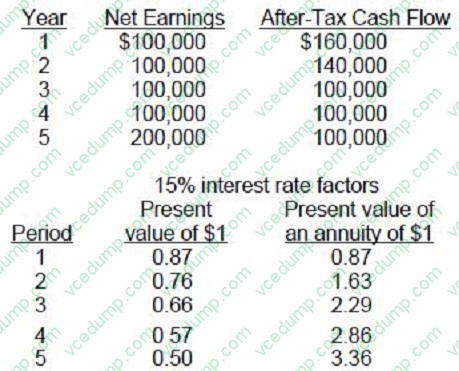
ABC, Inc. has a cost of capital of 15 percent and is considering the acquisition of a new machine, which costs $400,000 and has a useful life of five years. ABC projects that earnings and cash flow will increase as follows.
What is the payback period of this investment?
A. 1.50 years B. 3.00 years C. 3.33 years D. 4.00 years
B. 3.00 years Explanation Explanation/Reference:Choice "b" is correct. 3.00 year payback period. Note: After 3 years, the initial investment is recovered, as the cumulative cash inflows equal $400,000. The cash flows are not discounted when the payback method is used.
Question 265:
Mosh, a sole proprietor, uses the cash basis of accounting. At the beginning of the current year, accounts receivable were $25,000. During the year, Mosh collected $100,000 from customers. At the end of the year, accounts receivable were $15,000. What was Mosh's gross taxable income for the current year?
A. $75,000 B. $90,000 C. $100,000 D. $110,000
C. $100,000 Choice "c" is correct. The facts state that cash collections from customers were $100,000 and as a cash basis taxpayer this is the amount of Mosh's gross taxable income for the year. Note that according to the formula BASE - we can determine the amount of sales = $90,000, but that would give us accrual, not cash basis, income. Choice "a" is incorrect. See explanation above. Choice "b" is incorrect. $90,000 is the amount of sales that would be Mosh's taxable income if Mosh were an accrual basis taxpayer. Choice "d" is incorrect. See explanation above.
Question 266:
Additional Data
?The long-term debt was originally issued at par ($1,000/bond) and is currently trading at $1,250 per bond. ?ABC Corporation can now issue debt at 150 basis points over U.S. treasury bonds. ?The current risk-free rate (U.S. treasury bonds)
is 7 percent. ?ABC's common stock is currently selling at $32 per share.
?The expected market return is currently 15 percent.
?The beta value for ABC is 1.25.
?ABC's effective corporate income tax rate is 40 percent.
Using the Capital Asset Pricing Model (CAPM), Corporation's current cost of common equity is:
A. 10.00 percent. B. 15.00 percent. C. 17.00 percent. D. 18.75 percent.
C. 17.00 percent. Choice "c" is correct. 17.00 percent. Using the CAPM model, ABC's current cost of common equity would be: Cost of equity = Capital risk free rate + Beta (market rate - risk free rate) Cost of equity = 7% + 1.25 (15% - 7%) Cost of equity = 7% + 1.25 (8%) Cost of equity = 7% + 10% Cost of equity = 17%
Question 267:
A government price support program will:
A. Lead to surpluses. B. Lead to shortages. C. Improve the rationing function of prices. D. Not influence the rationing function of prices.
A. Lead to surpluses. Choice "a" is correct. A government price support program acts as a subsidy that will encourage suppliers to increase supply beyond an equilibrium point (the point where supply and demand curves intersect). This excess of supply over demand will create surpluses in the market. Choices "b", "c", and "d" are incorrect, per the above Explanation.
Question 268:
Hill, CPA, has been retained to audit the financial statements of ABC Co. ABC's predecessor auditor was Post, CPA, who has been notified by ABC that Post's services have been terminated. Under these circumstances, which party should initiate the communications between Hill and Post?
A. Hill, the successor auditor. B. Post, the predecessor auditor. C. ABC's controller or CFO. D. The chairman of Monday's board of directors.
A. Hill, the successor auditor. Choice "a" is correct. The initiative to communicate with the predecessor auditor rests with the successor auditor. Note, however, that the successor auditor must first receive permission from the client. Choice "b" is incorrect. The predecessor auditor should respond promptly and fully to reasonable inquiries. However, the predecessor is not responsible for initiating communications. Choice "c" is incorrect. The prospective client should authorize the predecessor to respond fully to the successor's inquiries. However, the client is not responsible for initiating communications. Choice "d" is incorrect. The prospective client should authorize the predecessor to respond fully to the successor's inquiries. However, the client is not responsible for initiating communications.
Question 269:
Which of the following is true regarding the presentation of "comprehensive income."
A. Option A B. Option B C. Option C D. Option D
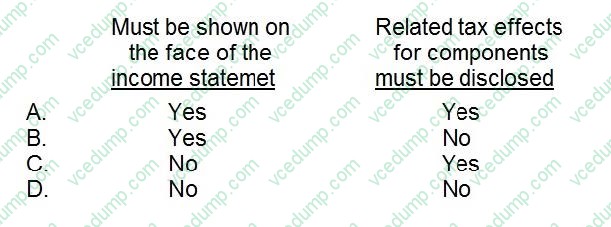
C. Option C Explanation Explanation/Reference:Choice "c" is correct. No - Yes. Comprehensive income may be shown on the face of a combined "statement of income and comprehensive income" a separate section below net income, or in: 1. Separate "statement of comprehensive income," or as a 2. Component of the "statement of changes of owners' equity." The income tax expense or benefit allocated to components must be disclosed, either on the face of the statement or in notes to the statement. Choices "a", "b", and "d" are incorrect, per the above rules.
Question 270:
Deficits accumulated during the development stage of a company should be:
A. Reported as organization costs. B. Reported as a part of stockholders' equity. C. Capitalized and written off in the first year of principal operations. D. Capitalized and amortized over a five year period beginning when principal operations commence.
B. Reported as a part of stockholders' equity. Choice "b" is correct. Deficits accumulated during the development stage of a company should be reported as a part of stockholders' equity. Rule: Development stage enterprises should present FS in accordance with GAAP and make additional disclosures such as: cumulative net losses, cumulative deficit (as part of equity), cumulative sales and expenses (part of I/S), cumulative statement of cash flows and supplementary "shareholders equity." Choices "a", "c", and "d" are incorrect, per the rule above.
Nowadays, the certification exams become more and more important and required by more and more
enterprises when applying for a job. But how to prepare for the exam effectively? How to prepare
for the exam in a short time with less efforts? How to get a ideal result and how to find the
most reliable resources? Here on Vcedump.com, you will find all the answers.
Vcedump.com provide not only AICPA exam questions,
answers and explanations but also complete assistance on your exam preparation and certification
application. If you are confused on your CPA-TEST exam preparations
and AICPA certification application, do not hesitate to visit our
Vcedump.com to find your solutions here.