Test Prep CPA-REGULATION Online Practice
Questions and Exam Preparation
CPA-REGULATION Exam Details
Exam Code
:CPA-REGULATION
Exam Name
:CPA Regulation
Certification
:Test Prep Certifications
Vendor
:Test Prep
Total Questions
:69 Q&As
Last Updated
:Jul 14, 2026
Test Prep CPA-REGULATION Online Questions &
Answers
Question 1:
Fred Berk bought a plot of land with a cash payment of $40,000 and a mortgage of $50,000. In addition, Berk paid $200 for a title insurance policy. Berk's basis in this land is:
A. $40,000 B. $40,200 C. $90,000 D. $90,200
D. $90,200
Choice "d" is correct. $90,200 is Berk's basis in the land.
Rule: The basis of the property acquired will be the property's cost consisting of the amount of cash paid plus any amount of related debt assumed. Cost will be adjusted to reflect any additional costs incurred in purchasing the property.
Choices "a", "b", and "c" are incorrect, per the above rule.
Question 2:
Allen owns 100 shares of Prime Corp., a publicly-traded company, which Allen purchased on January 1, 2001, for $10,000. On January 1, 2003, Prime declared a 2-for-1 stock split when the fair market value (FMV) of the stock was $120 per share. Immediately following the split, the FMV of Prime stock was $62 per share. On February 1, 2003, Allen had his broker specifically sell the 100 shares of Prime stock received in the split when the FMV of the stock was $65 per share. What amount should Allen recognize as long-term capital gain income on his Form 1040, U.S. Individual Income Tax Return, for 2003?
A. $300 B. $750 C. $1,500 D. $2,000
C. $1,500
Choice "c" is correct. The receipt of a nontaxable stock dividend will require the shareholder to spread the basis of his original shares over both the original shares and the new shares received, resulting in the same total basis but a lower
basis per share of stock helD. Therefore, Allen's total basis remains the same, $10,000, but is now split between 200 shares (a 2-for-1 split and he originally owned 100 shares).
Therefore, his basis per share goes from $100/share ($10,000/100) to $50/share ($10,000/200).
Consequently, his basis in the 100 shares sold is 100 x $50 = $5,000. Calculate his gain as follows:
Choices "a", "b", and "d" are incorrect.
Question 3:
Conner purchased 300 shares of Zinco stock for $30,000 in 1980. On May 23, 1994, Conner sold all the stock to his daughter Alice for $20,000, its then fair market value. Conner realized no other gain or loss during 1994. On July 26, 1994,
Alice sold the 300 shares of Zinco for $25,000.
What amount of the loss from the sale of Zinco stock can Conner deduct in 1994?
A. $0 B. $3,000 C. $5,000 D. $10,000
A. $0
Choice "a" is correct. Even though Conner has a realized loss of $10,000 on this transaction he cannot deduct the loss since it was incurred in a transaction with his daughter, a related party. Choice "b" is incorrect. $3,000 is the limit on deductible net capital losses. However, Conner cannot deduct this loss, since it was incurred in a transaction with his daughter, a related party. Choice "c" is incorrect. Conner's realized loss on the sale is $10,000 ($20,000 proceeds less $30,000 basis). However, Conner cannot deduct this loss, since it was incurred in a transaction with his daughter, a related party. Choice "d" is incorrect. $10,000 is Conner's realized loss on the sale. However, Conner cannot deduct this loss, since it was incurred in a transaction with his daughter, a related party.
Question 4:
Which of the following is subject to the Uniform Capitalization Rules of Code Sec. 263A?
A. Editorial costs incurred by a freelance writer. B. Research and experimental expenditures. C. Mine development and exploration costs. D. Warehousing costs incurred by a manufacturing company with $12 million in annual gross receipts.
D. Warehousing costs incurred by a manufacturing company with $12 million in annual gross receipts.
Choice "d" is correct. Uniform capitalization rules apply to the following: (1) real or tangible personal property produced by the taxpayer for use in his or her trade or business; (2) real or tangible personal property produced by the taxpayer for sale to his or her customers; and (3) real or tangible personal property acquired by the taxpayer for resale, provided the taxpayer's annual average gross receipts for the preceding three years exceeds $10,000,000. Warehousing costs incurred by a manufacturing company (making inventory for sale to its customers) are subject to the Uniform Capitalization Rules. Further, they are the only item on the list that is real or tangible personal property. In this case, the inventory is not acquired for resale (it is produced by the taxpayer for sale to his or her customers), so the fact that the annual sales are $12,000,000 does not matter in this case. The sales could have been less than $10,000,000 annually, and the Uniform Capitalization Rules would still have applied. Choices "a", "b", and "c" are incorrect, based on the above discussion.
Question 5:
Tom and Joan Moore, both CPAs, filed a joint 1994 federal income tax return showing $70,000 in taxable income. During 1994, Tom's daughter Laura, age 16, resided with Tom. Laura had no income of her own and was Tom's dependent.
Determine the amount of income or loss, if any that should be included on page one of the Moores' 1994 Form 1040.
In 1994, Joan received $3,500 as beneficiary of the death benefit, which was provided by her brother's employer. Joan's brother did not have a nonforfeitable right to receive the money while living.
A. $0 B. $500 C. $900 D. $1,000 E. $1,250 F. $1,300 G. $1,500 H. $2,000 I. $2,500 J. $3,000
A. $0
"A" is correct. $0. Life insurance proceeds received by reason of the death of the insured are not taxable income to the recipient.
Question 6:
John and Mary were divorced in 1991. The divorce decree provides that John pay alimony of $10,000 per year, to be reduced by 20% on their child's 18th birthday. During 1992, John paid $7,000 directly to Mary and $3,000 to Spring College for Mary's tuition. What amount of these payments should be reported as income in Mary's 1992 income tax return?
A. $5,600 B. $8,000 C. $8,600 D. $10,000
B. $8,000
Choice "b" is correct. Alimony would be income to Mary while child support would not. Funds qualify as child support only if 1) a specific amount is fixed or is contingent on the child's status (e.g., reaching a certain age), 2) it is paid solely for
the support of minor children, and 3) it is payable by decree, instrument or agreement. The actual use of the funds is irrelevant to the issue. In this case, $2,000 (20% ?$10,000) qualifies as child support. The other $8,000 is alimony, which
would be income to Mary.
Choice "a" is incorrect. Take 80% of the $10,000 paid, not 80% of the $7,000 received by Mary.
Choice "c" is incorrect. Only $8,000 would be alimony per the divorce decree (80% ?$10,000).
Choice "d" is incorrect. The 20% reduction when the child turns 18 makes 20% of the $10,000 payment, or $2,000, child support, which is nontaxable to Mary.
Question 7:
Tom and Joan Moore, both CPAs, filed a joint 1994 federal income tax return showing $70,000 in taxable income. During 1994, Tom's daughter Laura, age 16, resided with Tom. Laura had no income of her own and was Tom's dependent.
Determine the amount of income or loss, if any that should be included on page one of the Moores' 1994 Form 1040.
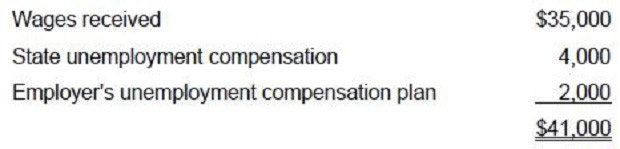
In 1994, Joan received $1,300 in unemployment compensation benefits. Her employer made a $100 contribution to the unemployment insurance fund on her behalf.
A. $0 B. $500 C. $900 D. $1,000 E. $1,250 F. $1,300 G. $1,500 H. $2,000 I. $2,500 J. $3,000
F. $1,300
"F" is correct. $1,300. Unemployment compensation benefits are fully taxable (when received by the employee), but contributions made by the employer to the insurance fund are not taxable.
Question 8:
Which one of the following will result in an accruable expense for an accrual-basis taxpayer?
A. An invoice dated prior to year end but the repair completed after year end. B. A repair completed prior to year end but not invoiced. C. A repair completed prior to year end and paid upon completion. D. A signed contract for repair work to be done and the work is to be completed at a later date.
B. A repair completed prior to year end but not invoiced.
RULE: An accruable expense is one is which the services have been received/performed but have not been paid for by the end of the reporting period.
Choice "b" is correct. The facts indicate that a repair was completed prior to year end but not yet invoiced. If it has not yet been invoiced, it is assumed that it has also not yet been paid for. Therefore, this is a situation in which the repair expense would be accrued at year end. Services have been performed, but they have not been paid for, as they have not even been invoiced yet. Choice "a" is incorrect. If the repair was completed after year end, then the expense is not accruable, as the benefit of the services hasn't been received as of year end. The fact that the repair was invoiced prior to year end does not impact the situation. Choice "c" is incorrect. If a repair was completed and paid for prior to year end, no accrual is appropriate. On the accrual basis, the expense is taken in the year the repair is completed and the benefit is received. In this case, the account payable was also paid in the same year, but this has no effect on the expense. Choice "d" is incorrect. The facts indicate that the work is to be completed at a date later than year end. Therefore, the expense is not accruable at year end, as the benefit of the repair hasn't been received as of year end. It is reasonable that a signed contract for the repair work exists, but this has no effect on the accrual.
Question 9:
Tom and Joan Moore, both CPAs, filed a joint 1994 federal income tax return showing $70,000 in taxable income. During 1994, Tom's daughter Laura, age 16, resided with Tom. Laura had no income of her own and was Tom's dependent.
Determine the amount of income or loss, if any that should be included on page one of the Moores' 1994 Form 1040.
During 1994, the Moores received a $2,500 federal tax refund and a $1,250 state tax refund for 1993 overpayments. In 1993, the Moores were not subject to the alternative minimum tax and were not entitled to any credit against income tax.
The Moores' 1993 adjusted gross income was $80,000 and itemized deductions were $1,450 in excess of the standard deduction. The state tax deduction for 1993 was $2,000.
A. $0 B. $500 C. $900 D. $1,000 E. $1,250 F. $1,300 G. $1,500 H. $2,000 I. $2,500 J. $3,000
E. $1,250
"E" is correct. $1,250. The Moores itemized deductions in 1993 because such deductions were $1,450 in excess of the standard deduction. The amount of state taxes deducted in 1993 was $2,000, which (along with the fact that the Moores were not subject to alternative minimum tax, which may have reduced their tax benefit) indicates that the Moores received a tax benefit in 1993 from deducting the $1,250 state tax refund they received in 1994. The $1,250 is taxable in 1994.
Question 10:
For a cash basis taxpayer, gain or loss on a year-end sale of listed stock arises on the:
A. Trade date. B. Settlement date. C. Date of receipt of cash proceeds. D. Date of delivery of stock certificate.
A. Trade date.
Choice "a" is correct. Trade date.
Gain or loss on a year-end sale of listed stock arises on the trade date.
Rule: Whether on the cash or accrual method of accounting taxpayers who sell stock or securities on an established securities market must recognize gains and losses on the trade date, rather than on the settlement date.
Choices "b", "c", and "d" are incorrect, per the above rule.
Nowadays, the certification exams become more and more important and required by more and more
enterprises when applying for a job. But how to prepare for the exam effectively? How to prepare
for the exam in a short time with less efforts? How to get a ideal result and how to find the
most reliable resources? Here on Vcedump.com, you will find all the answers.
Vcedump.com provide not only Test Prep exam questions,
answers and explanations but also complete assistance on your exam preparation and certification
application. If you are confused on your CPA-REGULATION exam preparations
and Test Prep certification application, do not hesitate to visit our
Vcedump.com to find your solutions here.