AZ-700 Real Exam Questions

Designing and Implementing Microsoft Azure Networking Solutions

440 questions available · Page 1 of 44

Updated Exam DumpsVerified AnswersPass Guarantee

Get Complete Exam Dumps
Question 1 Hotspot

HOTSPOT

You have two Azure subscriptions.

You need to perform the following actions in the East US Azure region of each subscription:

1. Deploy 50 virtual machines to availability zone 1.
2. Deploy 50 virtual machines to availability zone 2.
3. Deploy 50 virtual machines to availability zone 3.

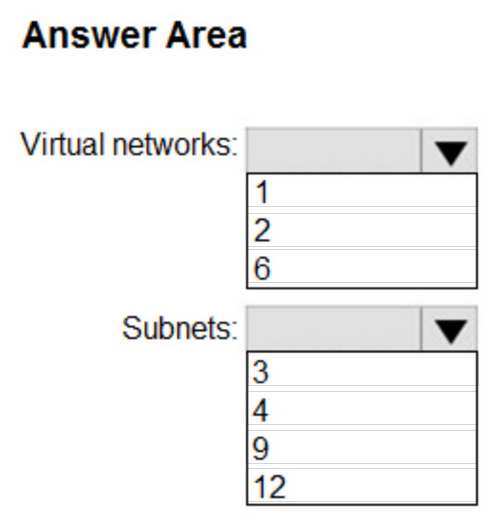
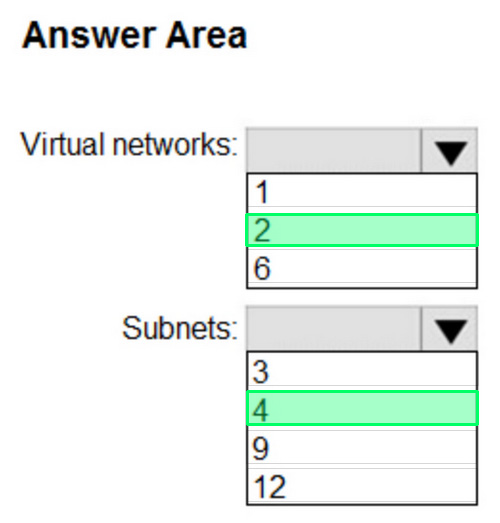
What is the minimum number of virtual networks and /25 subnets you should create? To answer, select the appropriate options in the answer area.

NOTE: Each correct selection is worth one point.

stem image

Question diagram
Show answer and explanation
Correct answer diagram
Question 2 Hotspot

HOTSPOT

You have an Azure subscription. The subscription contains multiple Azure SQL Database resources and a virtual network named VNet1 that has five subnets. All the subnets are associated with a network security group (NSG) named NSG1. NSG1 blocks all outbound traffic, unless specifically allowed by a rule.

Each subnet contains 50 virtual machines. Multiple virtual machines host instances of SQL Server on Virtual Machines and will be configured to replicate with the Azure SQL Database resources.

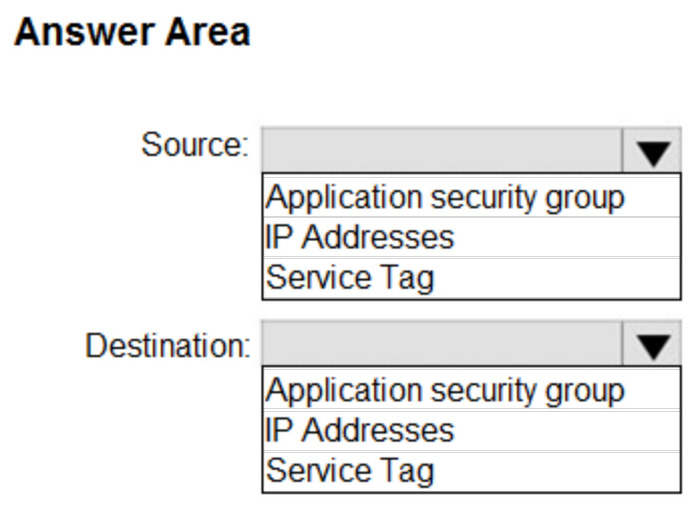
You need to configure a new outbound rule in NSG1 to allow the SQL Server on Virtual Machines instances to connect to the Azure SQL Database resources. The solution must meet the following requirements:

1. Minimize modifications to NSG1 when additional instances of SQL Server on Virtual Machines are deployed.
2. Ensure that only SQL Server on Virtual Machines instances can connect to the Azure SQL Database resources.

How should you configure each setting for the new outbound rule? To answer, select the appropriate options in the answer area.

NOTE: Each correct selection is worth one point.

stem image

Question diagram
Show answer and explanation
Correct answer diagram
Explanation

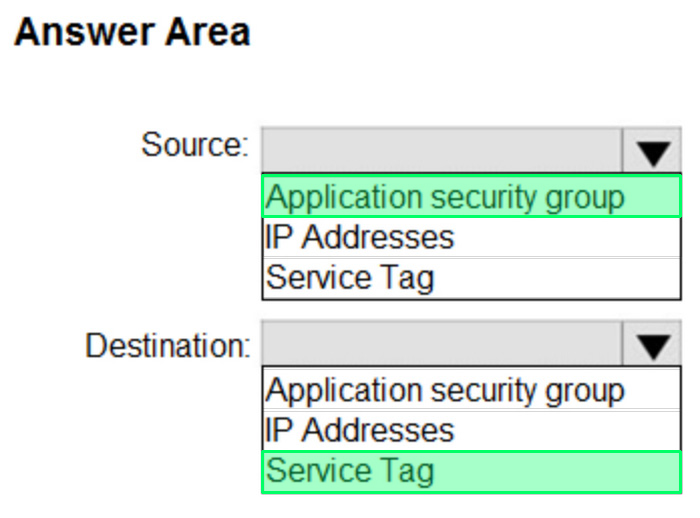
Box 1: Application security groups Source Application security groups You can use application security groups to configure network security as natural extension of an application's structure, by arbitrarily grouping VMs and defining network security policies based on those groups. You can reuse your security policy and scale without manual maintenance of explicit IP addresses. The platform handles the complexity of explicit IP addresses and multiple rule sets, so you can focus on your business logic.

Box 2: Service Tag Destination

Service tags for NSGs Service tags simplify security for Azure Virtual Machines and Azure Virtual Networks by enabling you to easily restrict network access to just the Azure services that you use. You can use service tags in your NSG rules to allow or deny traffic *to* a specific Azure service globally or per Azure region. Azure provides the maintenance of IP addresses underlying each tag. This preview includes Storage, Sql, and AzureTrafficManager tags.

References:
https://azure.microsoft.com/en-us/updates/public-preview-features-for-nsgs/

Question 3 Single choice

You have an Azure environment that contains two subscriptions named Subscription1 and Subscription2.

Each subscription is associated to a different Azure AD tenant.

Subscription1 contains a virtual network named VNet1.

VNet1 contains an Azure virtual machine named VM1 and has an IP address space of 10.0.3.0/24.

Subscription2 contains a virtual network named VNet2.

Vnet2 contains an Azure virtual machine named VM2 and has an IP address space of 10.190.0.0/24.

You need to connect VNet1 to VNet2.

What should you do first?

  1. A

    Modify the IP address space of VNet2

  2. B

    Provision virtual network gateways

  3. C

    Move VM1 to Subscription2

  4. D

    Move VNet1 to Subscription2

Show answer and explanation

Correct answer: B

Explanation

The address spaces 10.0.3.0/24 and 10.190.0.0/24 do not overlap, so an address change is unnecessary. Provisioning virtual network gateways supplies the endpoints needed for a gateway-based VNet-to-VNet connection across the two environments. Neither VM1 nor VNet1 must be moved between subscriptions to establish that network path.

Question 4 Hotspot

HOTSPOT

You have an Azure subscription. The subscription contains 500 virtual machines that run either Windows 11 or Linux.

You need to identify which Linux virtual machines are accessible from the internet. The solution must minimize administrative effort.

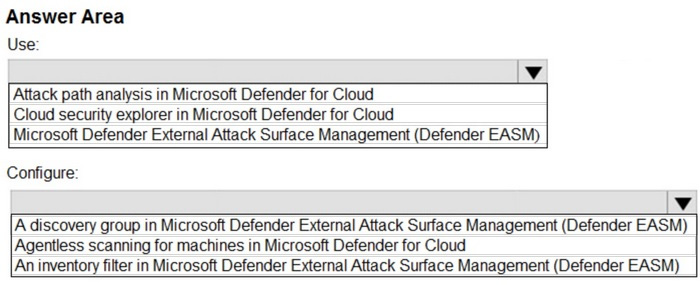
What should you use, and what should you configure? To answer, select the appropriate options in the answer area.
NOTE: Each correct selection is worth one point.

stem image

Question diagram
Show answer and explanation
Correct answer diagram
Explanation

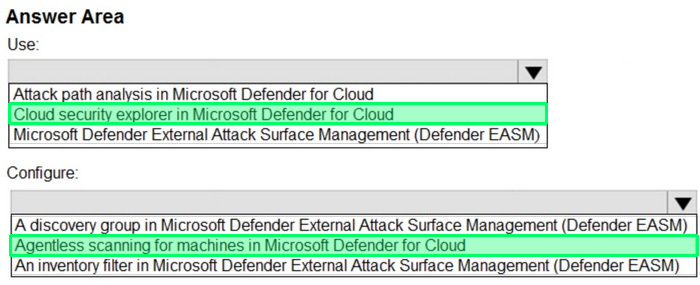
Box 1: Cloud Security Explorer in Microsoft Defender for Cloud Use

Microsoft Defender for Cloud, Build queries with cloud security explorer With the cloud security explorer, you can query all of your security issues and environment context such as assets inventory, exposure to internet, permissions, and lateral movement between resources and across multiple clouds (Azure AWS, and GCP).

Box 2: Agentless scanning for machines in Microsoft Defender for Cloud Configure Microsoft Defender for Cloud improves compute posture for Azure, AWS and GCP environments with machine scanning. For requirements and support, see the compute support matrix in Defender for Cloud.

Agentless scanning for virtual machines (VM) provides:

*-> Broad, frictionless visibility into your software inventory using Microsoft Defender Vulnerability Management. Deep analysis of operating system configuration and other machine meta data. Vulnerability assessment using Defender Vulnerability Management. Secret scanning to locate plain text secrets in your compute environment. Threat detection with agentless malware scanning, using Microsoft Defender Antivirus.

Incorrect:
* A discovery group in Microsoft Defender External Attack Surface Management (Defender EASM) Discovered assets are indexed and classified in your Defender EASM Inventory, providing a dynamic record of all web infrastructure under the organization's management. Assets are categorized as recent (currently active) or historic, and can include web applications, third party dependencies, and other asset connections.

Discovery groups Custom discoveries are organized into discovery groups. They're independent seed clusters that comprise a single discovery run and operate on their own recurrence schedules. You organize your discovery groups to delineate assets in whatever way best benefits your company and workflows. Common options include organizing by the responsible team or business unit, brands, or subsidiaries.

* An inventory filter in Microsoft Defender External Attack Surface Management (Defender EASM) Defender EASM inventory filters Filtering helps you find specific subsets of inventory assets based on selected parameters. This article outlines each filter and operator and provides guidance on input options that yield the best results. It also explains how to save queries for easy accessibility to the filtered results.

References:
https://learn.microsoft.com/en-us/azure/defender-for-cloud/how-to-manage-cloud-security-explorer
https://learn.microsoft.com/en-us/azure/defender-for-cloud/concept-agentless-data-collection
https://learn.microsoft.com/en-us/azure/external-attack-surface-management/inventory-filters
Question 5 Single choice

You have a web application that uses a hostname of www.healthengine.com

You have an Azure Front Door instance that provides access to the web application.

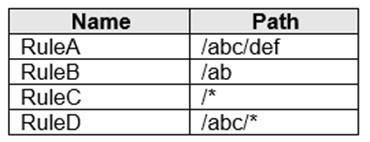
You have the routing rules shown in the following table.

Which rule will apply to www.healthengine.com/abc/def/default.htm incoming request?

  1. A

    RuleA

  2. B

    RuleB

  3. C

    RuleC

  4. D

    RuleD

Show answer and explanation

Correct answer: D

Explanation

Front Door chooses the most specific configured path pattern that matches the incoming URL. The request path /abc/def/default.htm is below /abc/, so it matches RuleD's /abc/* pattern. RuleA's /abc/def path does not include the additional /default.htm segment, while the catch-all /* in RuleC is valid but less specific than /abc/*.

Question 6 Hotspot

HOTSPOT

Your company has 40 branch offices across North America and Europe.

You have an Azure subscription that contains the following virtual networks:

1. Two networks in the East US Azure region
2. Three networks in the West Europe Azure region

You need to implement Azure Virtual WAN. The solution must meet the following requirements:

1. Each branch office in North America must have an ExpressRoute circuit and a Site-to-Site VPN that connects to the East US region.
2. Each branch office in Europe must have an ExpressRoute circuit and a Site-to-Site VPN that connects to the West Europe region.
3. Transitive connections must be supported between all the branch offices and all the virtual networks.
4. Costs must be minimized.

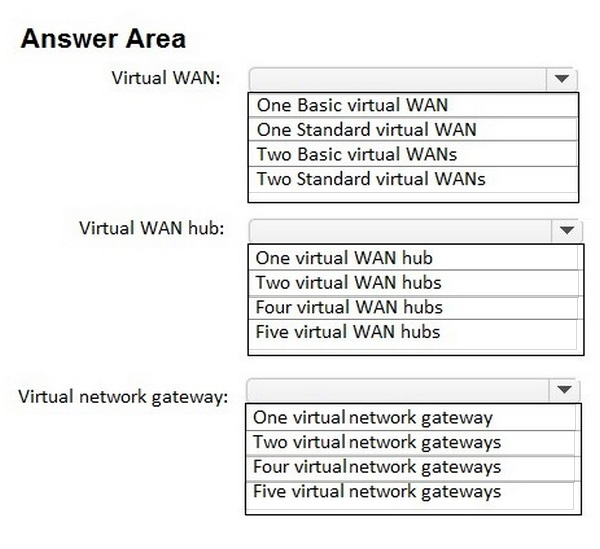
What is the minimum number of Virtual WAN resources required? To answer, select the appropriate options in the answer area.

NOTE: Each correct selection is worth one point.

stem image

Question diagram
Show answer and explanation
Correct answer diagram
Explanation

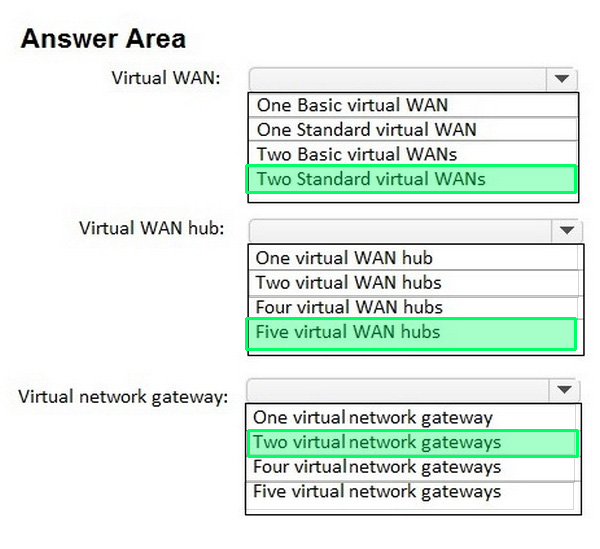
Box 1: Two Standard virtual WANs.
Need Standard for ExpressRoute.
Two VLANs: One for North America, and one for Europe.

Note: Virtual WAN: The virtualWAN resource represents a virtual overlay of your Azure network and is a collection of multiple resources. It contains links to all your virtual hubs that you would like to have within the virtual WAN. Virtual WANs are isolated from each other and can't contain a common hub. Virtual hubs in different virtual WANs don't communicate with each other.

Virtual WAN types
There are two types of virtual WANs: Basic and Standard. The following table shows the available configurations for each type.

* Basic
Site-to-site VPN only

* Standard
ExpressRoute
User VPN (P2S)
VPN (site-to-site)
Inter-hub and VNet-to-VNet transiting through the virtual hub Azure Firewall

NVA in a virtual WAN

Box 2: Five Virtual WAN hubs
One virtual WAN hub for each site; two in East US and three in West Europe.

Note: Hub: A virtual hub is a Microsoft-managed virtual network. The hub contains various service endpoints to enable connectivity. From your on-premises network (vpnsite), you can connect to a VPN gateway inside the virtual hub, connect ExpressRoute circuits to a virtual hub, or even connect mobile users to a point-to-site gateway in the virtual hub. The hub is the core of your network in a region. Multiple virtual hubs can be created in the same region.

A hub gateway isn't the same as a virtual network gateway that you use for ExpressRoute and VPN Gateway. For example, when using Virtual WAN, you don't create a site-to-site connection from your on-premises site directly to your VNet. Instead, you create a site-to-site connection to the hub. The traffic always goes through the hub gateway. This means that your VNets don't need their own virtual network gateway. Virtual WAN lets your VNets take advantage of scaling easily through the virtual hub and the virtual hub gateway.

Box 3: Two virtual network gateways
One virtual gateway for East US and one for West Europe.

References:
https://learn.microsoft.com/en-us/azure/virtual-wan/virtual-wan-about

Question 7 Single choice

You need to ensure that the URL is accessible through the application gateway.

To achieve the requirement, you add a rewrite rule for the host header.

Did you achieve the requirement?

  1. A

    Yes

  2. B

    No

Show answer and explanation

Correct answer: B

Explanation

A rewrite rule can modify HTTP request or response headers, including the Host header, but it does not override a Web Application Firewall rule that is blocking the request. If access to the URL is denied by the WAF policy, rewriting the Host header will not resolve the issue. The WAF configuration must be adjusted to allow the required request while maintaining the appropriate security controls.

Question 8 Single choice

You have an Azure subscription that contains the following resources:

A virtual network named Vnet1

A subnet named Subnet1 in Vnet1

A virtual machine named VM1 that connects to Subnet1

Three storage accounts named storage1, storage2, and storage3

You need to ensure that VM1 can access storage1. VM1 must be prevented from accessing any other storage accounts.

To achieve the requirement, you create a network security group (NSG). You configure a service tag for Microsoft Storage and link the tag to Subnet1.

Did you achieve the requirement?

  1. A

    Yes

  2. B

    No

Show answer and explanation

Correct answer: B

Explanation

The Microsoft Storage service tag represents the network ranges for the storage service rather than one named storage account. An NSG rule using that tag can allow traffic to storage1, but it can also allow the same type of traffic to storage2 and storage3. It therefore cannot enforce the requirement that VM1 reach only storage1; a resource-specific service endpoint policy is needed.

Question 9 Single choice

You have an Azure subscription.
You plan to deploy an app named App1 that will be accessed by using Azure Application Gateway. You need to deploy the application gateway for App1.

What should you create first?

  1. A

    a user-assigned managed identity

  2. B

    a subnet

  3. C

    an X.509 certificate

  4. D

    an Azure Web Application Firewall (WAF) policy

Show answer and explanation

Correct answer: B

Explanation

Azure Application Gateway must be deployed into a virtual network subnet, so that network placement has to exist before the gateway can be created. The subnet provides addresses for the gateway instances and forms the required deployment boundary. A managed identity, certificate, or WAF policy may be needed for particular later features, but none replaces the prerequisite subnet.

Question 10 Single choice

Note: This question is part of a series of questions that present the same scenario. Each question in the series contains a unique solution that might meet the stated goals. Some question sets might have more than one correct solution, while others might not have a correct solution.

After you answer a question in this section, you will NOT be able to return to it. As a result, these questions will not appear in the review screen.

You have an Azure application gateway that has Azure Web Application Firewall (WAF) enabled.

You configure the application gateway to direct traffic to the URL of the application gateway.

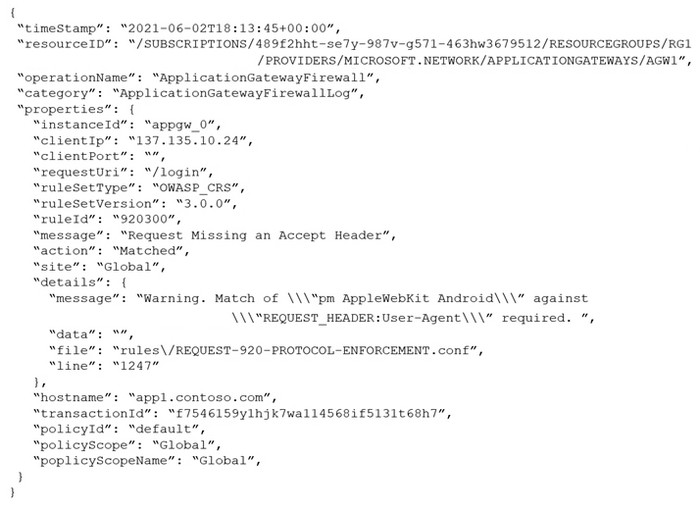
You attempt to access the URL and receive an HTTP 403 error. You view the diagnostics log and discover the following error.

You need to ensure that the URL is accessible through the application gateway.

Solution: You disable the WAF rule that has a ruleld of 920300.

Does this meet the goal?

  1. A

    Yes

  2. B

    No

Show answer and explanation

Correct answer: A

Explanation

The firewall log identifies rule 920300 as the matched rule and records the action as Matched for the request that lacks an Accept header. Disabling that rule removes the specific WAF check producing the HTTP 403 response, allowing the request to proceed through the application gateway. Therefore, the proposed solution meets the goal.