AZ-700 Exam Details
-
Exam Code
:AZ-700 -
Exam Name
:Designing and Implementing Microsoft Azure Networking Solutions -
Certification
:Microsoft Certifications -
Vendor
:Microsoft -
Total Questions
:452 Q&As -
Last Updated
:Jul 08, 2026
Microsoft AZ-700 Online Questions & Answers
-
Question 431:
You have two Azure virtual networks named VNet1 and VNet2.
VNet1 contains an Azure virtual machine named VM1.
VNet2 contains an Azure virtual machine named VM2.
VM1 hosts a frontend application that connects to VM2 to retrieve data. Users report that the frontend application is slower than usual. You need to view the average round-trip time (RTT) of the packets from
VM1 to VM2.
Which Azure Network Watcher feature should you use?
A. IP flow verify
B. Connection troubleshoot
C. Connection monitor
D. NSG flow logs -
Question 432:
HOTSPOT
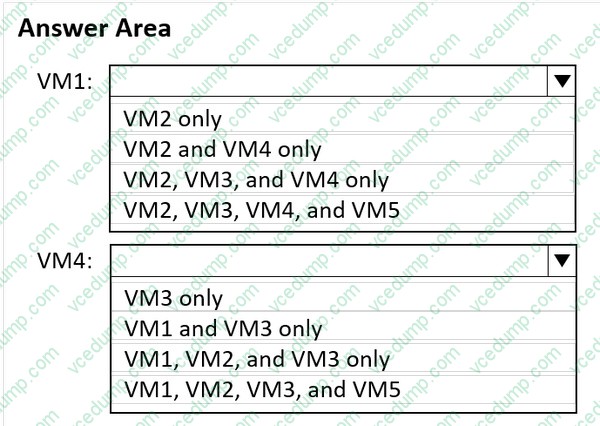
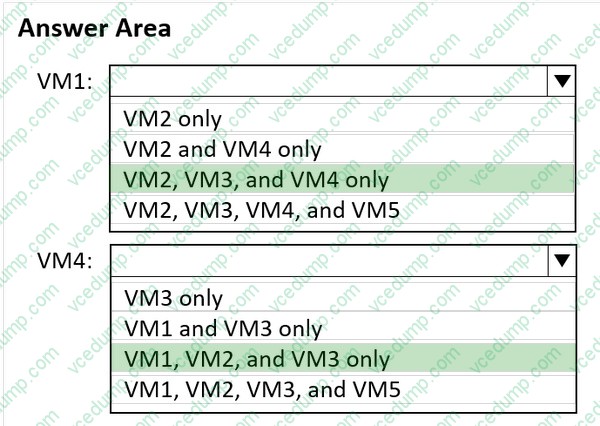
Which virtual machines can VM1 and VM4 ping successfully before NSG10 and NSG11 are created? To answer, select the appropriate options in the answer area.
NOTE: Each correct selection is worth one point.
-
Question 433:
You have a web app named App1 that is hosted in on-premises servers and on four Azure virtual machines (VMs).
Each Azure region has one virtual machine.
You need to recommend a solution to ensure that users will always connect to the closest instance of App1.
The solution must prevent the users from attempting to connect to a failed instance of App1.
Which two possible should you recommendation achieve the goal?
A. Azure Front Door Service
B. Azure Load Balancer
C. round-robin DNS
D. Azure Traffic Manager
E. Azure Application Gateway -
Question 434:
DRAG DROP
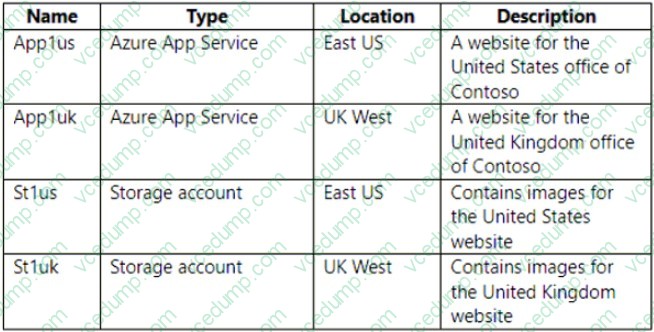
Your company, named Contoso, Ltd., has an Azure subscription that contains the resources shown in the following table.
You plan to deploy Azure Front Door. The solution must meet the following requirements:
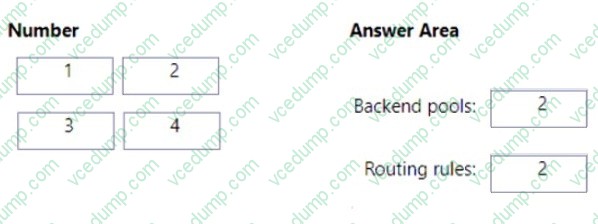
1. Requests to a URL of https://contoso.azurefd.net/uk must be routed to App1uk.
2. Requests to a URL of https://contoso.azurefd.net/us must be routed to App1us.
3. Requests to a URL of https://contoso.azurefd.net/images must be routed to the storage account closest to the user.
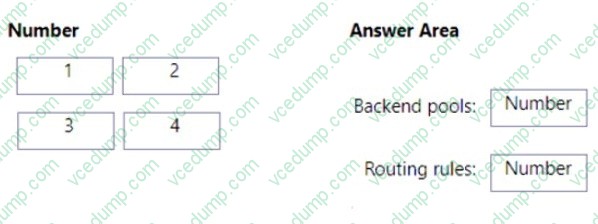
What is the minimum number of backend pools and routing rules you should create? To answer, drag the appropriate number to the correct components. Each number may be used once, more than once, or not at all. You may need to drag the split bar between panes or scroll to view content.
NOTE: Each correct selection is worth one point.
Select and Place:
-
Question 435:
You have an Azure subscription that contains the resources shown in the following table.
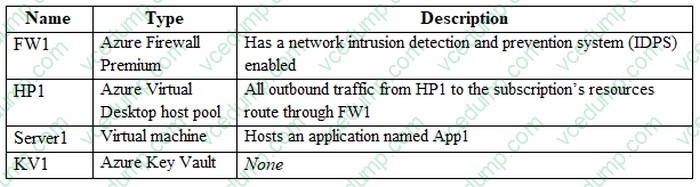
Users on HP1 connect to App1 by using a URL of https://app1.contoso.com.
You need to ensure that the IDPS on FW1 can identify security threats in the connections from HP1 to Server1.
Which two actions should you perform? Each correct answer presents part of the solution.
NOTE: Each correct selection is worth one point.
A. Enable TLS inspection for FW1.
B. Import a server certificate to KV1.
C. Enable threat intelligence for FW1.
D. Add an application group to HP1.
E. Add a secured virtual network to FW1. -
Question 436:
HOTSPOT
You have an Azure subscription that contains an Azure key vault named Vault1 and an app registration for an Azure AD app named App1.
You have a DNS domain named contoso.com that is hosted by a third-party DNS provider.
You plan to deploy App1 by using Azure App Service. App1 will have the following configurations:
1. App1 will be hosted across five App Service apps.
2. Users will access App1 by using a URL of https://app1.contoso.com.
3. The user traffic of App1 will be managed by using Azure Front Door.
4. The traffic between Front Door and the App Service apps will be sent by using HTTP.
5. App1 will be secured by using an SSL certificate from a third-party certificate authority (CA).
You need to support the Front Door deployment.
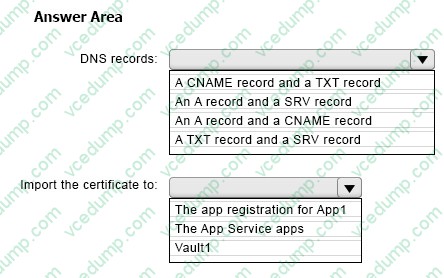
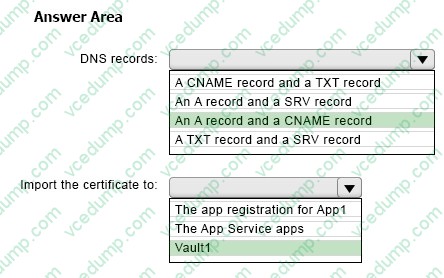
Which two DNS records should you create, and to where should you import the SSL certificate for App1?
To answer, select the appropriate options in the answer area.
NOTE: Each correct selection is worth one point.
-
Question 437:
You need to recommend a configuration for the ExpressRoute connection from the Boston datacenter. The solution must meet the hybrid networking requirements and business requirements.
What should you recommend minimizing latency of traffic to Vnet2?
A. Create a dedicated ExpressRoute circuit for Vnet2
B. Connect Vnet2 directly to the ExpressRoute circuit
C. Configure gateway transit for the peering between Vnet1 and Vnet2 -
Question 438:
HOTSPOT
You have an Azure load balancer that has the following configurations:
1. Name: LB1
2. Location: East US 2
3. SKU: Standard
4. Private IP address: 10.3.0.7
5. Load balancing rule: rule1 (Tcp/80)
6. Health probe: probe1 (Http:80)
7. NAT rules: 0 inbound
The backend pool of LB1 has the following configurations:
1. Name: backend1
2. Virtual network: Vnet2
3. Backend pool configuration: NIC
4. IP version: IPv4
5. Virtual machines: VM1, VM2, VM3
You have an Azure virtual machine named VM4 that has the following network configurations:
1. Network interface: vm4981
2. Virtual network/subnet: Vnet3/Subnet3
3. NIC private IP address: 10.4.0.4
4. Accelerated networking: Enabled
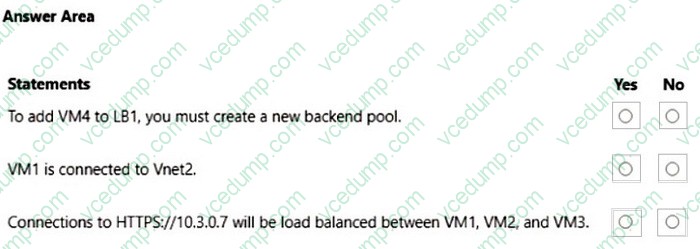
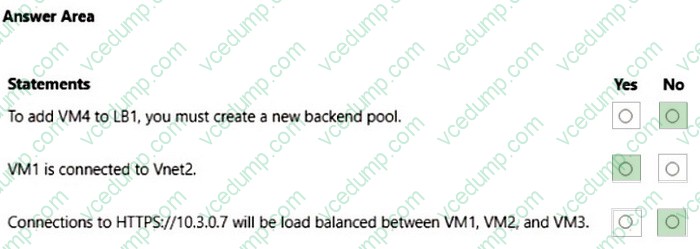
For each of the following statements, select Yes if the statement is true. Otherwise, select No.
NOTE: Each correct selection is worth one point.
-
Question 439:
You have an Azure subscription that contains the resources is shown in the following table.

You need to ensure that the apps hosted on VM1 can resolve the IP address of the private endpoint for azsql1.database.windows.net.
What should you create first?
A. a public DNS zone named database.windows.net
B. a private DNS zone named database.windows.net
C. a public DNS zone named private link.database.windows.net
D. a private DNS zone named private link.database.windows.net -
Question 440:
SIMULATION
Username and password
Use the following login credentials as needed: To enter your username, place your cursor in the Sign in box and click on the username below.
To enter your password, place your cursor in the Enter password box and click on the password below.
Azure Username: [email protected] Azure Password: xxxxxxxxxx
If the Azure portal does not load successfully in the browser, press CTRL-K to reload the portal in a new browser tab.
The following information is for technical support purposes only:
Lab Instance: 12345678
You need to ensure that requests for www.relecloud.com from any of your Azure virtual networks resolve to frontdoor1.azurefd.net.
To complete this task, sign in to the Azure portal.
A. See explanation below.
B. PlaceHolder
C. PlaceHolder
D. PlaceHolder
Related Exams:
-
62-193
Technology Literacy for Educators -
70-243
Administering and Deploying System Center 2012 Configuration Manager -
70-355
Universal Windows Platform – App Data, Services, and Coding Patterns -
77-420
Excel 2013 -
77-427
Excel 2013 Expert Part One -
77-725
Word 2016 Core Document Creation, Collaboration and Communication -
77-726
Word 2016 Expert Creating Documents for Effective Communication -
77-727
Excel 2016 Core Data Analysis, Manipulation, and Presentation -
77-728
Excel 2016 Expert: Interpreting Data for Insights -
77-731
Outlook 2016 Core Communication, Collaboration and Email Skills
Tips on How to Prepare for the Exams
Nowadays, the certification exams become more and more important and required by more and more enterprises when applying for a job. But how to prepare for the exam effectively? How to prepare for the exam in a short time with less efforts? How to get a ideal result and how to find the most reliable resources? Here on Vcedump.com, you will find all the answers. Vcedump.com provide not only Microsoft exam questions, answers and explanations but also complete assistance on your exam preparation and certification application. If you are confused on your AZ-700 exam preparations and Microsoft certification application, do not hesitate to visit our Vcedump.com to find your solutions here.