AZ-700 Exam Details
-
Exam Code
:AZ-700 -
Exam Name
:Designing and Implementing Microsoft Azure Networking Solutions -
Certification
:Microsoft Certifications -
Vendor
:Microsoft -
Total Questions
:452 Q&As -
Last Updated
:Jul 08, 2026
Microsoft AZ-700 Online Questions & Answers
-
Question 421:
DRAG DROP
You need to prepare Vnet1 for the deployment of an ExpressRoute gateway. The solution must meet the hybrid connectivity requirements and the business requirements.
Which three actions should you perform in sequence for Vnet1? To answer, move the appropriate actions from the list of actions to the answer area and arrange them in the correct order.
Select and Place:

-
Question 422:
Your company has four branch offices and an Azure subscription. The subscription contains an Azure VPN gateway named GW1.
The branch offices are configured as shown in the following table.

The branch office routers provide internet connectivity and Site-to-Site VPN connections to GW1.
The users in Branch1 report that they can connect to internet resources, but cannot access Azure resources.
You need to ensure that the Branch1 users can connect to the Azure resources. The solution must meet the following requirements:
1. Minimize downtime for all users.
2. Minimize administrative effort.
What should you do first?
A. Recreate LNG1.
B. Reset RTR1.
C. Reset Connection1.
D. Reset GW1. -
Question 423:
HOTSPOT
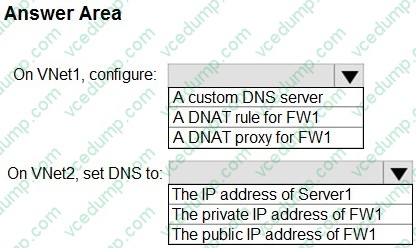
You have an on-premises server named Server1 that runs Windows Server and has the DNS Server role installed.
You have an Azure subscription that contains two virtual networks named VNet1 and VNet2. VNet1 contains an Azure Firewall instance named FW1. VNet1 peers with VNet2.
The on-premises network is connected to VNet1 by using ExpressRoute. The on-premises network is inaccessible from VNet2.
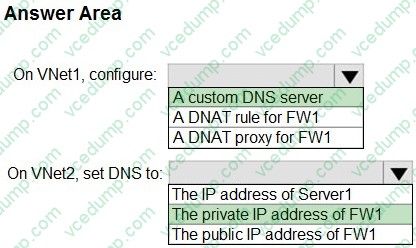
You need to ensure that virtual machines connected to VNet2 use Server1 to perform name resolution.
The solution must minimize administrative effort.
What should you do? To answer, select the appropriate options in the answer area.
NOTE: Each correct answer is worth one point.
-
Question 424:
You have an Azure subscription that contains an Azure Virtual WAN named VWAN1. VWAN1 contains a hub named Hub1.
Hub1 has a security status of Unsecured.
You need to ensure that the security status of Hub1 is marked as Secured.
Solution: You implement an Azure Front Door profile.
Does this meet the requirement?
A. Yes
B. No -
Question 425:
HOTSPOT
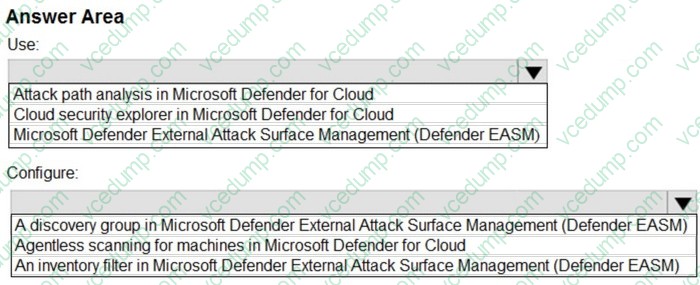
You have an Azure subscription. The subscription contains 500 virtual machines that run either Windows 11 or Linux.
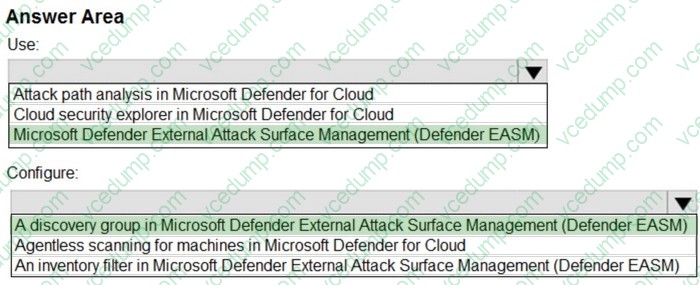
You need to identify which Linux virtual machines are accessible from the internet. The solution must minimize administrative effort.
What should you use, and what should you configure? To answer, select the appropriate options in the answer area.
NOTE: Each correct selection is worth one point.
-
Question 426:
You need to ensure that the URL is accessible through the application gateway.
To achieve the requirement, you disable the WAF rule that has a ruleId 920300.
Did you achieve the requirement?
A. Yes
B. No -
Question 427:
SIMULATION
Username and password
Use the following login credentials as needed:
To enter your username, place your cursor in the Sign in box and click on the username below.
To enter your password, place your cursor in the Enter password box and click on the password below.
Azure Username: [email protected] Azure Password: xxxxxxxxxx
If the Azure portal does not load successfully in the browser, press CTRL-K to reload the portal in a new browser tab.
The following information is for technical support purposes only:
Lab Instance: 12345678
You need to ensure that traffic to host.fabrikam.com is directed to the Traffic Manager profile.
To complete this task, sign in to the Azure portal.
A. See explanation below.
B. PlaceHolder
C. PlaceHolder
D. PlaceHolder -
Question 428:
You have the Azure virtual networks shown in the following table.
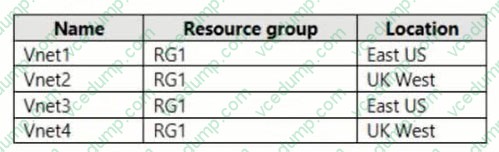
You have the Azure resources shown in the following table.
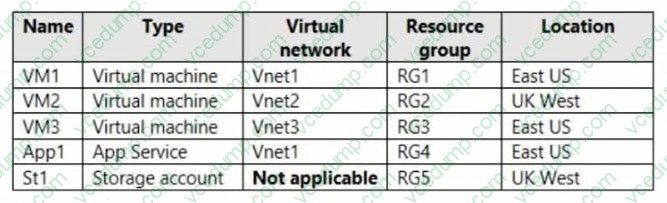
You need to check latency between the resources by using connection monitors in Azure Network Watcher.
What is the minimum number of connection monitors that you must create?
A. 1
B. 2
C. 3
D. 4
E. 5 -
Question 429:
HOTSPOT
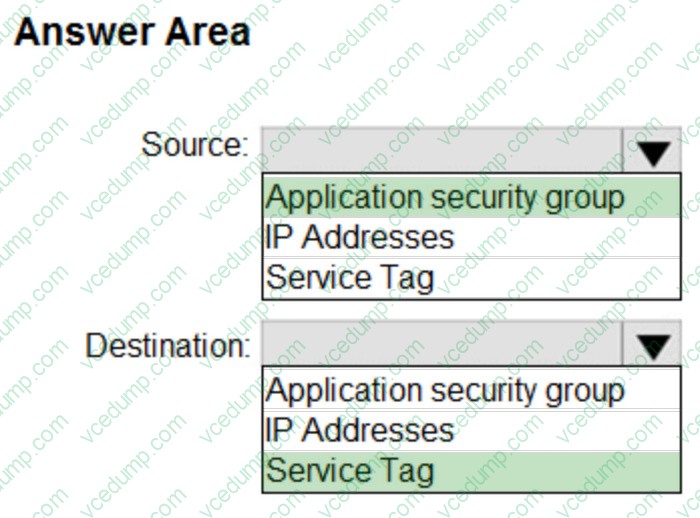
You have an Azure subscription. The subscription contains multiple Azure SQL Database resources and a virtual network named VNet1 that has five subnets. All the subnets are associated with a network security group (NSG) named NSG1. NSG1 blocks all outbound traffic, unless specifically allowed by a rule.
Each subnet contains 50 virtual machines. Multiple virtual machines host instances of SQL Server on Virtual Machines and will be configured to replicate with the Azure SQL Database resources.
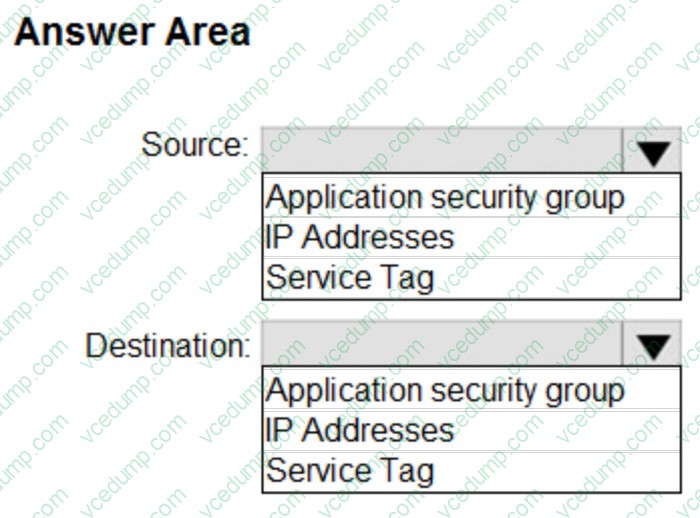
You need to configure a new outbound rule in NSG1 to allow the SQL Server on Virtual Machines instances to connect to the Azure SQL Database resources. The solution must meet the following requirements:
1. Minimize modifications to NSG1 when additional instances of SQL Server on Virtual Machines are deployed.
2. Ensure that only SQL Server on Virtual Machines instances can connect to the Azure SQL Database resources.
How should you configure each setting for the new outbound rule? To answer, select the appropriate options in the answer area.
NOTE: Each correct selection is worth one point.
-
Question 430:
You need to identify a security rule that prevents a network packet from reaching an Azure virtual machine.
What should you use?
A. IP flow verify
B. Next hop
C. Packet capture
D. Security group view
E. Traffic Analytics

Related Exams:
-
62-193
Technology Literacy for Educators -
70-243
Administering and Deploying System Center 2012 Configuration Manager -
70-355
Universal Windows Platform – App Data, Services, and Coding Patterns -
77-420
Excel 2013 -
77-427
Excel 2013 Expert Part One -
77-725
Word 2016 Core Document Creation, Collaboration and Communication -
77-726
Word 2016 Expert Creating Documents for Effective Communication -
77-727
Excel 2016 Core Data Analysis, Manipulation, and Presentation -
77-728
Excel 2016 Expert: Interpreting Data for Insights -
77-731
Outlook 2016 Core Communication, Collaboration and Email Skills
Tips on How to Prepare for the Exams
Nowadays, the certification exams become more and more important and required by more and more enterprises when applying for a job. But how to prepare for the exam effectively? How to prepare for the exam in a short time with less efforts? How to get a ideal result and how to find the most reliable resources? Here on Vcedump.com, you will find all the answers. Vcedump.com provide not only Microsoft exam questions, answers and explanations but also complete assistance on your exam preparation and certification application. If you are confused on your AZ-700 exam preparations and Microsoft certification application, do not hesitate to visit our Vcedump.com to find your solutions here.