AZ-700 Exam Details
-
Exam Code
:AZ-700 -
Exam Name
:Designing and Implementing Microsoft Azure Networking Solutions -
Certification
:Microsoft Certifications -
Vendor
:Microsoft -
Total Questions
:452 Q&As -
Last Updated
:Jul 08, 2026
Microsoft AZ-700 Online Questions & Answers
-
Question 71:
You have an Azure virtual network that contains two subnets named Subnet1 and Subnet2. Subnet1 contains a virtual machine named VM1. Subnet2 contains a virtual machine named VM2.
You have two network security groups (NSGs) named NSG1 and NSG2. NSG1 has 100 inbound security rules and is associated to VM1. NSG2 has 200 inbound security rules and is associated to Subnet1.
VM2 cannot connect to VM1.
You suspect that an NSG rule blocks connectivity.
You need to identify which rule blocks the connection. The issue must be resolved as quickly as possible.
Which Azure Network Watcher feature should you use?
A. Effective security rules
B. Connection troubleshoot
C. NSG diagnostic
D. NSG flow logs -
Question 72:
HOTSPOT
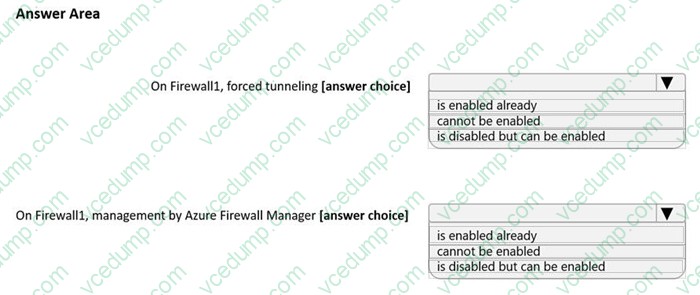
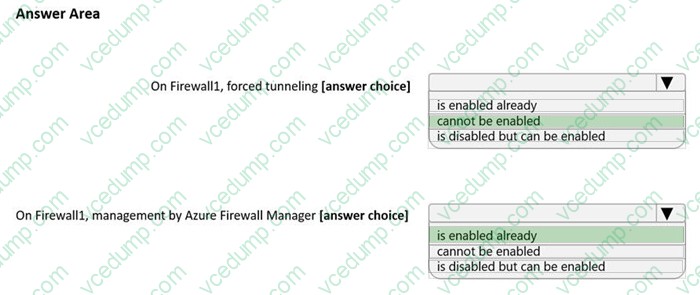
You have an Azure firewall shown in the following exhibit.
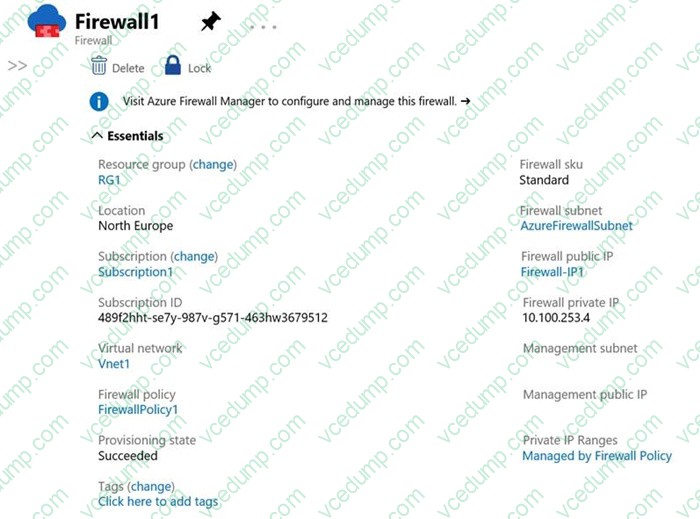
Use the drop-down menus to select the answer choice that completes each statement based on the information presented in the graphic.
NOTE: Each correct selection is worth one point.
-
Question 73:
You have an Azure virtual network named VNet1 that contains the subnets shown in the following table.

You need to deploy an Azure application gateway named AppGW1 to VNet1.
To where can you deploy AppGW1?
A. GatewaySubnet only
B. Subnet2 only
C. Subnet1 or Subnet2 only
D. Subnet2 or GatewaySubnet only
E. Subnet1, Subnet2, and GatewaySubnet -
Question 74:
HOTSPOT
You have two on-premises sites named Site1 and Site2. Each site connects to the internet by using a local firewall device.
You have an Azure subscription that contains two virtual networks named VNet1 and VNet2. VNet1 and VNet2 reside in the East US Azure region and are connected by using virtual network peering.
You need to configure a Site-to-Site (S2S) VPN solution that meets the following requirements:
1. Site1 and Site2 must connect directly to the Azure subscription by using their local firewall device.
2. The computers in Site1 and Site2 must be able to connect to the resources on VNet1 and VNet2.
3. The solution must include a virtual network gateway that uses three availability zones.
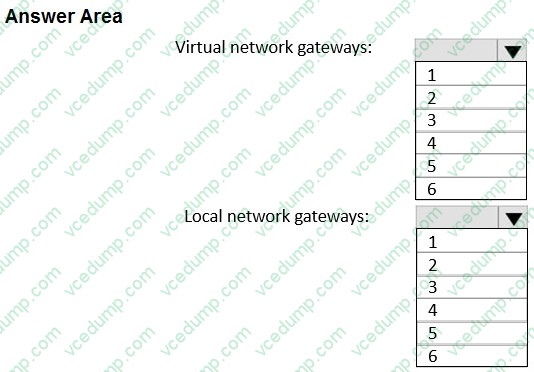
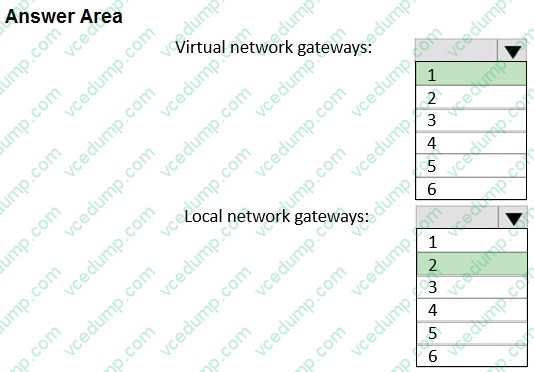
What is the minimum number of virtual network gateways and local network gateways that you should deploy to Azure? To answer, select the appropriate options in the answer area.
NOTE: Each correct selection is worth one point.
-
Question 75:
Note: This question is part of a series of questions that present the same scenario. Each question in the series contains a unique solution that might meet the stated goals. Some question sets might have more than one correct solution, while others might not have a correct solution.
After you answer a question in this section, you will NOT be able to return to it. As a result, these questions will not appear in the review screen.
You have two Azure virtual networks named Vnet1 and Vnet2.
You have a Windows 10 device named Client1 that connects to Vnet1 by using a Point-to-Site (P2S) IKEv2
VPN.
You implement virtual network peering between Vnet1 and Vnet2. Vnet1 allows gateway transit. Vnet2 can use the remote gateway.
You discover that Client1 cannot communicate with Vnet2.
You need to ensure that Client1 can communicate with Vnet2.
Solution: You download and reinstall the VPN client configuration.
Does this meet the goal?
A. Yes
B. No -
Question 76:
SIMULATION
Username and password
Use the following login credentials as needed:
To enter your username, place your cursor in the Sign in box and click on the username below.
To enter your password, place your cursor in the Enter password box and click on the password below.
Azure Username: [email protected] Azure Password: xxxxxxxxxx
If the Azure portal does not load successfully in the browser, press CTRL-K to reload the portal in a new browser tab.
The following information is for technical support purposes only:
Lab Instance: 12345678
You plan to configure a VPN tunnel for VNET2.
You need to ensure that all internet traffic from subnet2-1 is routed through an on-premises firewall before reaching the destination. The solution must be achieved without using dynamic routing protocols.
To complete this task, sign in to the Azure portal.
A. See explanation below.
B. PlaceHolder
C. PlaceHolder
D. PlaceHolder -
Question 77:
You plan to implement an Azure virtual network that will contain 10 virtual subnets. The subnets will use IPv6 addresses. Each subnet will host up to 200 load-balanced virtual machines.
You need to recommend which subnet mask size to use for the virtual subnets.
What should you recommend?
A. /64
B. /120
C. /48
D. /24 -
Question 78:
HOTSPOT
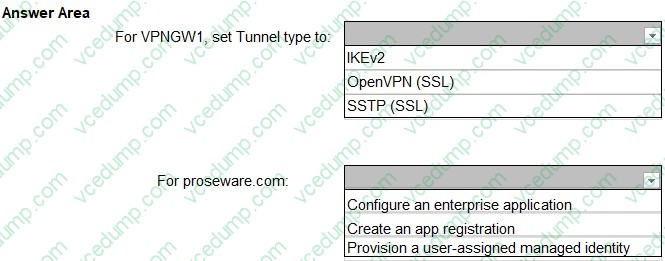
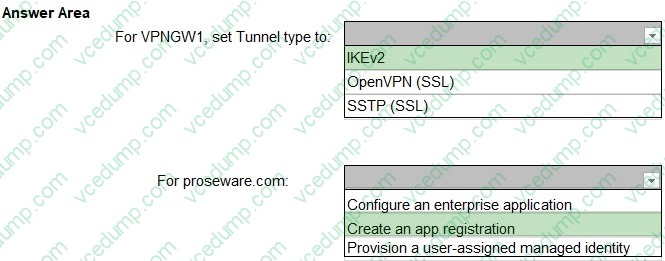
You need to configure the P2S VPN to meet the connectivity requirements.
What should you do? To answer, select the appropriate options in the answer area.
NOTE: Each correct selection is worth one point.
-
Question 79:
You have an Azure subscription that contains the resources shown in the following table.

You test DDoSplan1 by running a simulation that targets IP1.
You need to review the DDoS Protection mitigation reports.
What should you use?
A. DDos protection plan in the Azure portal
B. Log Analytics
C. Microsoft Defender for Cloud
D. Azure Monitor Network Insights -
Question 80:
DRAG DROP
You have an on-premises network.
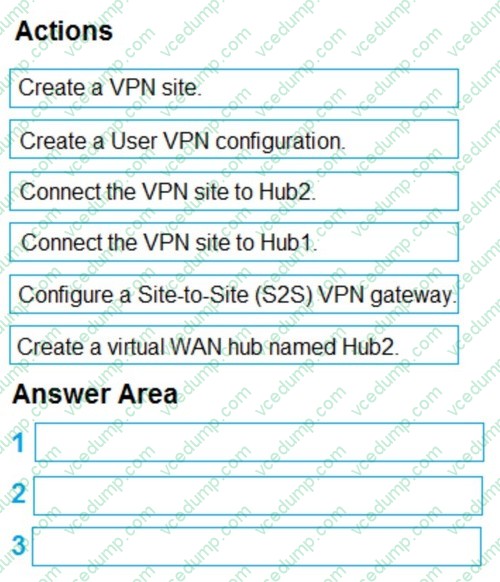
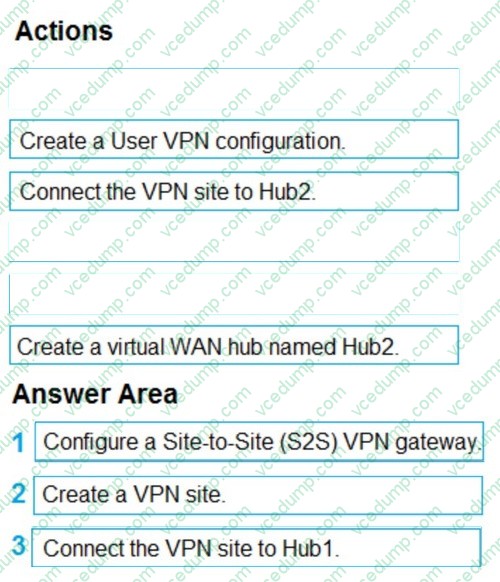
You have an Azure subscription that contains a virtual network named VNet1. VNet1 is connected to an Azure Virtual WAN hub named Hub1. You need to enable connectivity between the on-premises network and VNet1 by using Hub1.
Which three actions should you perform in sequence? To answer, move the appropriate actions from the list of actions to the answer area and arrange them in the correct order.
Select and Place:
Related Exams:
-
62-193
Technology Literacy for Educators -
70-243
Administering and Deploying System Center 2012 Configuration Manager -
70-355
Universal Windows Platform – App Data, Services, and Coding Patterns -
77-420
Excel 2013 -
77-427
Excel 2013 Expert Part One -
77-725
Word 2016 Core Document Creation, Collaboration and Communication -
77-726
Word 2016 Expert Creating Documents for Effective Communication -
77-727
Excel 2016 Core Data Analysis, Manipulation, and Presentation -
77-728
Excel 2016 Expert: Interpreting Data for Insights -
77-731
Outlook 2016 Core Communication, Collaboration and Email Skills
Tips on How to Prepare for the Exams
Nowadays, the certification exams become more and more important and required by more and more enterprises when applying for a job. But how to prepare for the exam effectively? How to prepare for the exam in a short time with less efforts? How to get a ideal result and how to find the most reliable resources? Here on Vcedump.com, you will find all the answers. Vcedump.com provide not only Microsoft exam questions, answers and explanations but also complete assistance on your exam preparation and certification application. If you are confused on your AZ-700 exam preparations and Microsoft certification application, do not hesitate to visit our Vcedump.com to find your solutions here.