70-497 Exam Details
-
Exam Code
:70-497 -
Exam Name
:Software Testing with Visual Studio -
Certification
:Microsoft Certifications -
Vendor
:Microsoft -
Total Questions
:100 Q&As -
Last Updated
:Dec 06, 2021
Microsoft 70-497 Online Questions & Answers
-
Question 71:
You are using Microsoft Visual Studio 2012 to manage test environments for your company.
You need to set up a two-computer environment for running tests. The environment needs to include:

A client computer running Windows 7 and
A server computer running Windows Server 2008 R2 SP 1, which acts as the web server and the database server.
The server computer has already been created using Microsoft System Center Virtual Machine Manager (SCVMM).
You need to create a lab environment for testing this configuration.
What should you do?
A. Install a physical machine with the client configuration. Connect both the client and the existing SCVMM server computers with Visual Studio 2012 through the Server Explorer window.
B. Install and configure a virtual machine with the client configuration by using Hyper-V. Connect both the client and the existing SCVMM server computers with Visual Studio 2012 through the Team Explorer window.
C. Install a physical machine with the client configuration. Create a new SCVMM lab environment by combining both the client and the existing SCVMM server computers by using Lab Center in Microsoft Test Manager (MTM) 2012.
D. Install a physical machine with the client configuration. Create a new standard environment, combining the client and the server machines by using Lab Center in Microsoft Test Manager (MTM) 2012. -
Question 72:
You are using Microsoft Test Manager (MTM).
Your company has configured multiple test configurations.
You need to set all active test configurations as the default for all new test plans.
What should you do?
A. Select the Active state option for each test configuration.
B. Select the Default option for each test configuration.
C. Select multiple test configurations from the test plan.
D. Select the Assign to new test plans option for each test configuration. -
Question 73:
You are using Microsoft Test Manager (MTM). You are using the Microsoft Solution Framework (MSF) for Agile Software Development process template.
You want to organize your test cases by relating them to the user stories for the application under test.
You need to use a test suite that creates the Tests link type as you add test cases.
Which type of test suite should you create?
A. Static
B. Query-based
C. Linked
D. Requirements-based -
Question 74:
You are a test developer using Microsoft Test Manager (MTM).
You are editing a test plan for a product.
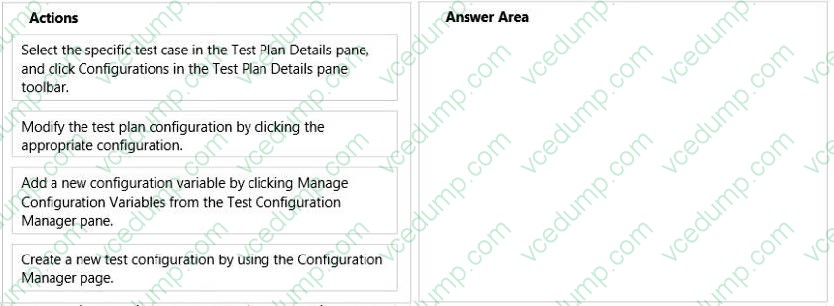
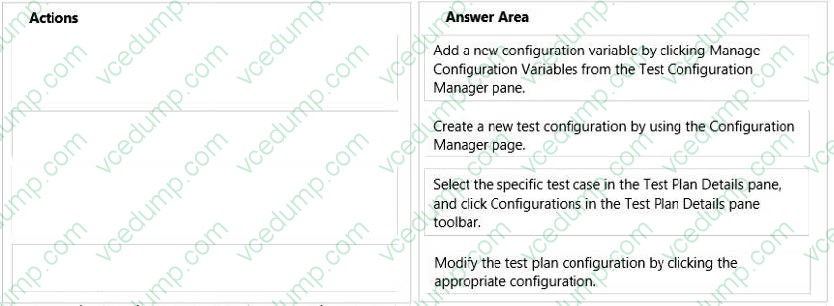
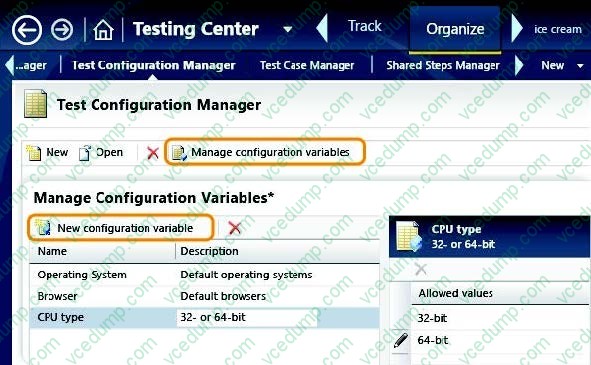
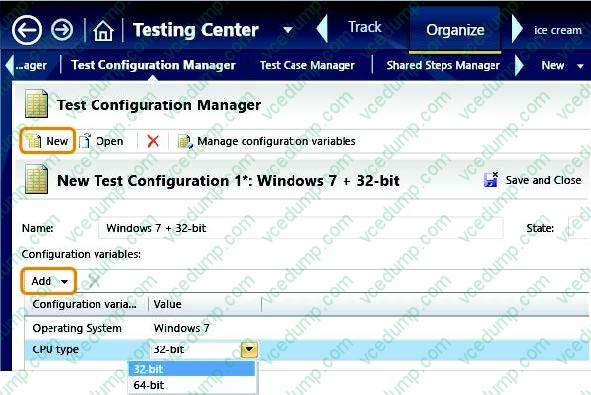
You need to supply a new custom configuration variable in the configuration setting for one of the test cases.
In which order should you perform the actions in MTM? To answer, move all actions from the list of actions to the answer area and arrange them in the correct order.
Select and Place:
-
Question 75:
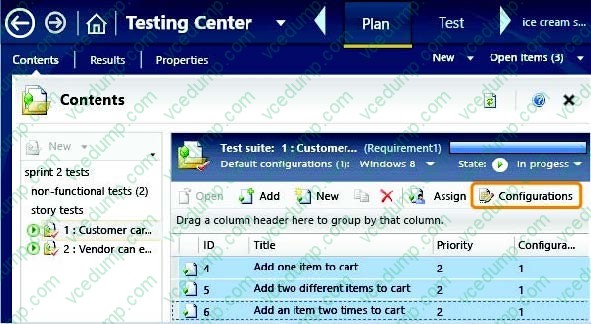
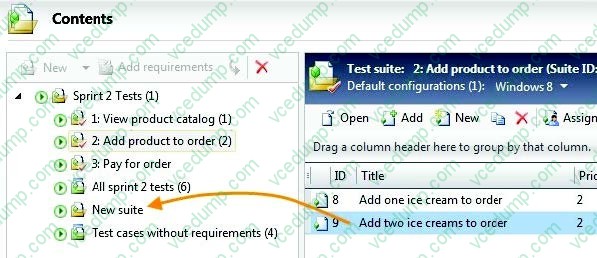
Your team uses Microsoft Test Manager (MTM) to manage test cases. Your team organizes test cases so that the same test case can be associated with multiple test suites.
You plan to create a test case and associate it to two different static test suites named Test Suite 1 and Test Suite 2.
You need to ensure that the test suites reference the same version of the new test case.
Which two actions should you perform? Each correct answer presents part of the solution.
A. Drag the test case from Test Suite 1 into Test Suite 2.
B. Create the test case inside Test Suite 1.
C. Copy the test case from Test Suite 1, and paste it onto Test Suite 2.
D. Right-click on the test case, and select Create a copy and add to test suite. -
Question 76:
You are using Microsoft Test Manager (MTM). You are using the Microsoft Solution Framework (MSF) for Agile Software Development process template. You plan to validate that all the user stories for the current iteration will be covered by
your testing efforts.
You need to create test suites that will allow you to validate user story test coverage.
Which type of test suites should you create?
A. Query-based
B. Feature-based
C. Requirements-based
D. Static -
Question 77:
You run a manual test on an application by using Microsoft Test Manager (MTM). You have the following testing requirements:
Collect the diagnostic data from the local machine.
Collect the diagnostic data from a remote SQL Server.
You need to identify the components required to configure the test environment to comply with these requirements.
Which two components should you choose? (Each correct answer presents part of the solution. Choose two.)
A. Configuration variables
B. Data collectors
C. Local and remote roles
D. Build controller -
Question 78:
You plan to roll out Microsoft Test Manager (MTM). Phase 1 testing will include manual testing only. In Phase 2, you will introduce automated test suites to complement manual testing.
You plan to use diagnostic data adapters for each phase. You need to provide the correct diagnostic data adapters.
Which data diagnostic adapter is only applicable to manual testing and would accomplish this goal?
A. Code coverage
B. Actions
C. Video Recording
D. Event Log
E. Test impact -
Question 79:
You are a test developer using Microsoft Test Manager (MTM).
A test case that you maintain needs to be modified to test for a series of values returned after a price calculation. You add a test step to test for these data values.
You need to add a parameter to the test case that represents the expected results.
What are two possible ways to achieve this goal? (Each correct answer presents a complete solution. Choose two.)
A. Click in the test step Action column, then click Insert parameter and type the parameter name.
B. Enter the parameter name into the Parameter Values field and press Enter.
C. Click in the test step Expected Result column and type the parameter name preceded by the @ symbol.
D. Click in the test step Expected Result column, then click Insert parameter and type the parameter name.
E. Click in the test step Expected Result column and type the parameter name. -
Question 80:
You are using Microsoft Test Manager (MTM).
You plan to redesign a group of test cases that have similar steps but test for different conditions.
You need to make the test cases easy to maintain.
What should you do?
A. Create a shared steps work item from the Shared Steps Manager view for every test case in the group and replace the test steps in the appropriate test case.
B. Convert the manual test cases to automated tests.
C. Open a test case, create a shared steps work item from the recurring test steps, and reuse this shared steps work item for the other test cases in the group.
D. Find recurring test steps in the test cases and use them to create new test cases. Replace the recurring test steps with a reference to the new test cases.
Related Exams:
-
62-193
Technology Literacy for Educators -
70-243
Administering and Deploying System Center 2012 Configuration Manager -
70-355
Universal Windows Platform – App Data, Services, and Coding Patterns -
77-420
Excel 2013 -
77-427
Excel 2013 Expert Part One -
77-725
Word 2016 Core Document Creation, Collaboration and Communication -
77-726
Word 2016 Expert Creating Documents for Effective Communication -
77-727
Excel 2016 Core Data Analysis, Manipulation, and Presentation -
77-728
Excel 2016 Expert: Interpreting Data for Insights -
77-731
Outlook 2016 Core Communication, Collaboration and Email Skills
Tips on How to Prepare for the Exams
Nowadays, the certification exams become more and more important and required by more and more enterprises when applying for a job. But how to prepare for the exam effectively? How to prepare for the exam in a short time with less efforts? How to get a ideal result and how to find the most reliable resources? Here on Vcedump.com, you will find all the answers. Vcedump.com provide not only Microsoft exam questions, answers and explanations but also complete assistance on your exam preparation and certification application. If you are confused on your 70-497 exam preparations and Microsoft certification application, do not hesitate to visit our Vcedump.com to find your solutions here.