200-105 Exam Details
-
Exam Code
:200-105 -
Exam Name
:Interconnecting Cisco Networking Devices Part 2 (ICND2) -
Certification
:Cisco Certifications -
Vendor
:Cisco -
Total Questions
:709 Q&As -
Last Updated
:Dec 12, 2021
Cisco 200-105 Online Questions & Answers
-
Question 201:
Which Layer 2 protocol encapsulation type supports synchronous and asynchronous circuits and has built-in security mechanisms?
A. HDLC
B. PPP
C. X.25
D. Frame Relay -
Question 202:
Which interior routing protocol reduces the size of route tables by advertising default routes for all destinations outside of the default area?
A. OSPF
B. BGP
C. EIGRP
D. RIP -
Question 203:
Which purpose of the network command in the BGP configuration of a router is true?
A. It enables route advertisement in the BGP routing process on the router.
B. It advertises any route in BGP with no additional configuration.
C. It advertises a valid network as local to the autonomous system of a router.
D. It indicates whether a neighbor supports route refresh. -
Question 204:
Which protocol can cause overload on a CPU of a managed device?
A. Netflow
B. WCCP
C. IP SLA D. SNMP -
Question 205:
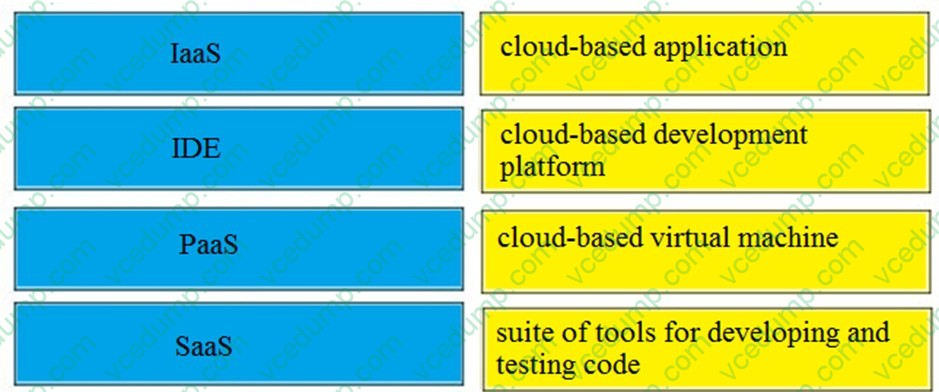
DRAG DROP
Drag and drop the cloud-based resources from the left onto the correct definitions on the right.
Select and Place:
-
Question 206:
Which two tasks use OSPFv3 hello packets? (Choose two.)
A. Beginning neighbor discovery
B. Requesting topology changes
C. Sharing link-state databases
D. Acknowledging message receipt
E. Performing DR election -
Question 207:
Which two statements about the PPPoE client physical interface configuration are true? (Choose two.)
A. It must be physically connected to an ATM switch
B. It must be linked to a dialer interface
C. It must be in shutdown mode while the PPPoE configuration is enabled
D. It must be configured without an IP address
E. It must be configured as a trunk port -
Question 208:
Refer to the exhibit.
Which WAN protocol is being used?
A. ATM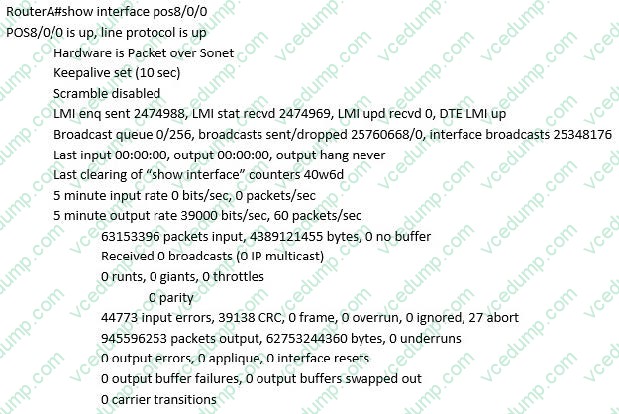
B. HDLC
C. Frame Relay
D. PPP -
Question 209:
A network administrator is configuring the routers in the graphic for OSPF. The OSPF process has been started and the networks have been configured for Area 0 as shown in the diagram. The network administrator has several options for configuring RouterB to ensure that it will be preferred as the designated router (DR) for the 172.16.1.0 /24 LAN segment.
What configuration tasks could be used to establish this preference? (Choose three.)
A. Configure the priority value of the Fa0/0 interface of RouterB to a higher value than any other interface on the Ethernet network.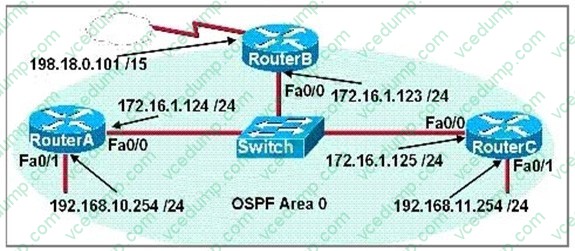
B. Change the router id of Router B by assigning the IP address 172.16.1.130/24 to the Fa0/0 interface of RouterB.
C. Configure a loopback interface on RouterB with an IP address higher than any IP address on the other routers.
D. Change the priority value of the Fa0/0 interface of RouterB to zero.
E. Change the priority values of the Fa0/0 interfaces of RouterA and RouterC to zero.
F. No further configuration is necessary. -
Question 210:
Which three features are QoS congestion-management tools? (Choose three.)
A. PPPoE
B. PQ
C. FIFO
D. PPP
E. PDQ
F. WFQ

Related Exams:
-
300-745
Designing Cisco Security Infrastructure (300-745 SDSI) v1.0 -
350-101
Implementing and Operating Cisco Wireless Core Technologies (350-101 WLCOR)v1.0 -
352-011
Cisco Certified Design Expert Practical -
500-052
Cisco Unified Contact Center Express -
500-173
Designing the FlexPod Solution (FPDESIGN) -
500-201
Deploying Cisco Service Provider Mobile Backhaul Solutions -
500-210
SP Optical Technology Field Engineer Representative -
500-220
Engineering Cisco Meraki Solutions (ECMS) v2.2 -
500-230
Cisco Service Provider Routing Field Engineer -
500-240
Cisco Mobile Backhaul for Field Engineers
Tips on How to Prepare for the Exams
Nowadays, the certification exams become more and more important and required by more and more enterprises when applying for a job. But how to prepare for the exam effectively? How to prepare for the exam in a short time with less efforts? How to get a ideal result and how to find the most reliable resources? Here on Vcedump.com, you will find all the answers. Vcedump.com provide not only Cisco exam questions, answers and explanations but also complete assistance on your exam preparation and certification application. If you are confused on your 200-105 exam preparations and Cisco certification application, do not hesitate to visit our Vcedump.com to find your solutions here.