200-105 Exam Details
-
Exam Code
:200-105 -
Exam Name
:Interconnecting Cisco Networking Devices Part 2 (ICND2) -
Certification
:Cisco Certifications -
Vendor
:Cisco -
Total Questions
:709 Q&As -
Last Updated
:Dec 12, 2021
Cisco 200-105 Online Questions & Answers
-
Question 1:
Refer to the exhibit. Each of these four switches has been configured with a hostname, as well as being configured to run RSTP. No other configuration changes have been made.
Which three of these show the correct RSTP port roles for the indicated switches and interfaces? (Choose three.)
A. SwitchA, Fa0/2, designated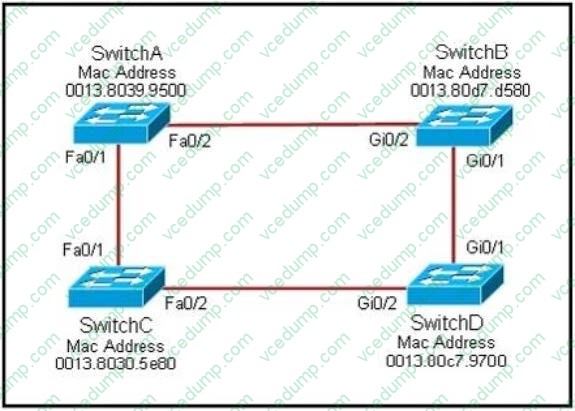
B. SwitchA, Fa0/1, root
C. SwitchB, Gi0/2, root
D. SwitchB, Gi0/1, designated
E. SwitchC, Fa0/2, root
F. SwitchD, Gi0/2, root -
Question 2:
Which of the following HSRP router states does an active router enter when it is preempted by a higher priority router?
A. Active
B. Speak
C. Learn
D. Listen
E. Init
F. Standby -
Question 3:
What is the effect of the switchport access vlan 300 command?
A. It configures the interface to perform Layer 2 switching
B. It displays the VLAN configuration of the interface
C. It configures the interface as an access port
D. It assigns the interface to a VLAN -
Question 4:
Instructions
This item contains several questions that you must answer. You can view these questions by clicking on the corresponding button to the left. Changing questions can be accomplished by clicking the numbers to the left of each question. In
order to complete the questions, you will need to refer to the topology.
To gain access to the topology, click on the topology button at the bottom of the screen. When you have finished viewing the topology, you can return to your questions by clicking on the Questions button to the left.
Each of the windows can be minimized by clicking on the [-]. You can also reposition a window by dragging it by the title bar.
Scenario
Refer to the topology. Using the information shown, answer the four questions shown on the Questions tab.
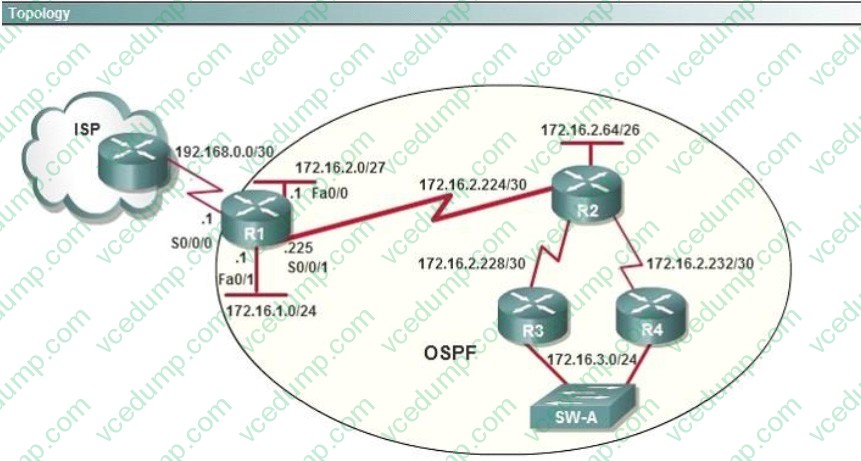
After the network has converged, what type of messaging, if any, occurs between R3 and R4?
A. No messages are exchanged.
B. Hellos are sent every 10 seconds.
C. The full database from each router is sent every 30 seconds.
D. The routing table from each router is sent every 60 seconds. -
Question 5:
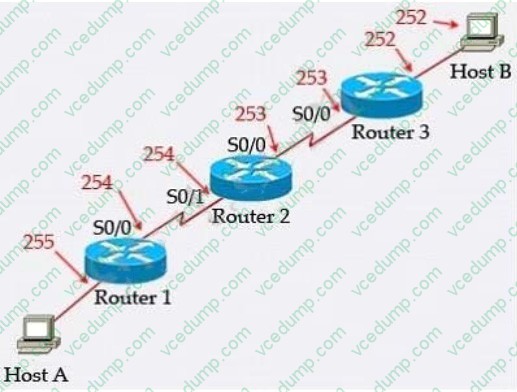
Refer to the exhibit. Host A pings interface S0/0 on router 3. What is the TTL value for that ping?
A. 252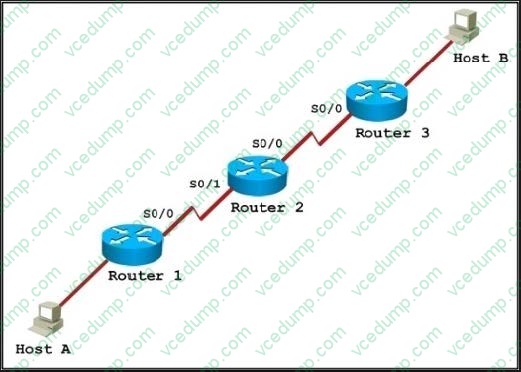
B. 253
C. 254
D. 255 -
Question 6:
Which channel mode is available to static EhterChannels?
A. On
B. Passive
C. Active
D. Desirable -
Question 7:
Which two factors can affect the price of leased point-to-point WAN links? (Choose two.)
A. amount of bandwidth used
B. type of traffic
C. amount of bandwidth requested
D. number of sites interconnected
E. distance between two points -
Question 8:
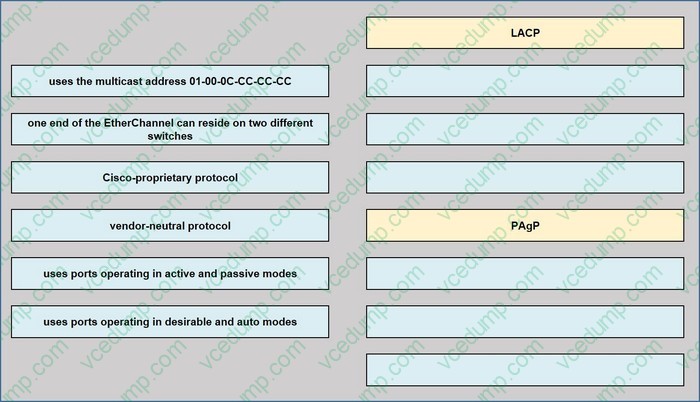
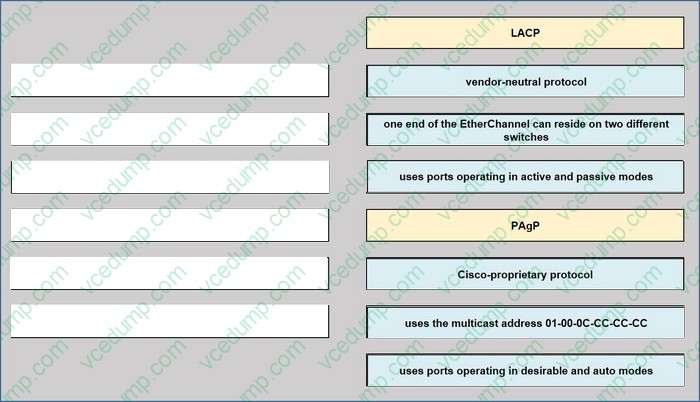
Drag and drop the descriptions of EtherChannel protocols from the left onto the correct protocols on the right.
Select and Place:
-
Question 9:
Which protocol authenticates connected devices before allowing them to access the LAN?
A. 802.1d
B. 802.11
C. 802.1w
D. 802.1x -
Question 10:
You are working in a data center environment and are assigned the address range 10.188.31.0/23. You are asked to develop an IP addressing plan to allow the maximum number of subnets with as many as 30 hosts each.
Which IP address range meets these requirements?
A. 10.188.31.0/26
B. 10.188.31.0/25
C. 10.188.31.0/28
D. 10.188.31.0/27
E. 10.188.31.0/29
Related Exams:
-
300-745
Designing Cisco Security Infrastructure (300-745 SDSI) v1.0 -
350-101
Implementing and Operating Cisco Wireless Core Technologies (350-101 WLCOR)v1.0 -
352-011
Cisco Certified Design Expert Practical -
500-052
Cisco Unified Contact Center Express -
500-173
Designing the FlexPod Solution (FPDESIGN) -
500-201
Deploying Cisco Service Provider Mobile Backhaul Solutions -
500-210
SP Optical Technology Field Engineer Representative -
500-220
Engineering Cisco Meraki Solutions (ECMS) v2.2 -
500-230
Cisco Service Provider Routing Field Engineer -
500-240
Cisco Mobile Backhaul for Field Engineers
Tips on How to Prepare for the Exams
Nowadays, the certification exams become more and more important and required by more and more enterprises when applying for a job. But how to prepare for the exam effectively? How to prepare for the exam in a short time with less efforts? How to get a ideal result and how to find the most reliable resources? Here on Vcedump.com, you will find all the answers. Vcedump.com provide not only Cisco exam questions, answers and explanations but also complete assistance on your exam preparation and certification application. If you are confused on your 200-105 exam preparations and Cisco certification application, do not hesitate to visit our Vcedump.com to find your solutions here.