USMLE-STEP-3 Exam Details
-
Exam Code
:USMLE-STEP-3 -
Exam Name
:United States Medical Licensing Step 3 -
Certification
:USMLE Certifications -
Vendor
:USMLE -
Total Questions
:804 Q&As -
Last Updated
:Jul 29, 2026
USMLE USMLE-STEP-3 Online Questions & Answers
-
Question 71:
Vitamin D supplementation can be helpful in treating which disease?
A. hyperparathyroidism
B. hypoparathyroidism
C. alcoholic neuritis
D. pernicious anemia
E. scurvy -
Question 72:
A 29-year-old married male is seen in the emergency room with the chief complaint of, "I'm afraid I'm having a heart attack." He states a 2-month history of experiencing recurrent episodes of chest pain and shortness of breath that last 1020 minutes. He also describes associated tachypnea, lightheadedness, tingling in his extremities, nausea, diaphoresis, anxiety, and fears that he may die. These symptoms are now occurring almost daily but are not provoked by any situations or activities such as exertion or exercise. He is significantly worried about having future episodes and is genuinely concerned that he will suffer a myocardial infarction. He denies having any medical illnesses or taking any medications. He drinks three beers on the weekends only and does not use illicit drugs. His physical examination reveals a slightly elevated BP and pulse. An ECG demonstrates sinus tachycardia.
Which of the following medications would be most appropriate in the acute management of this patient's symptoms?
A. bupropion (Wellbutrin)
B. buspirone (Buspar)
C. imipramine (Tofranil)
D. lorazepam (Ativan)
E. paroxetine (Paxil) -
Question 73:
Which of the following patients is most likely to have symptoms of the carcinoid syndrome?
A. patient with carcinoid tumor localized to the appendix
B. patient with carcinoid tumor of the small intestine and a 3-cm nodule in the liver seen on CT scan
C. patient with an apple core lesion seen on barium enema
D. patient with adrenal mass and elevated levels of urinary vanillylmandelic acid(VMA)
E. patient with a retroperitoneal carcinoid tumor -
Question 74:
Biopsy of a 4-cm sessile polyp of the cecum during a routine screening colonoscopy reveals it to be a villous adenoma with atypia. Attempt at piecemeal snare polypectomy through the colonoscope is unsuccessful. Which of the following is the most appropriate management?
A. right hemicolectomy
B. colonoscopy with electrocoagulation of the tumor
C. colonoscopy with repeat biopsy in 6 months
D. open surgery with colotomy and excision of polyp
E. external beam radiation -
Question 75:
A 19-year-old woman comes in for a routine obstetrical follow-up visit at 24 weeks' gestation. She is here with her boyfriend, who is the father of the baby. She is wearing dark sunglasses in the examination room. When you ask her to remove the glasses, you see that she has a bruise around her left eye. Her boyfriend quickly states that she accidentally bumped into a door and she quietly nods in agreement. Which of the following statements about domestic violence is true?
A. All states require that physicians report partner violence to the police.
B. Domestic violence is rare in same sex couples.
C. A woman cannot make a sexual assault claim against her husband.
D. Domestic violence is less likely when one partner is ill or disabled.
E. Psychological intimidation without violence is considered a form of abuse. -
Question 76:
A39-year-old woman with a long-standing history of normal pap smears undergoes a total abdominal hysterectomy for a large uterine fibroid and menorrhagia. Six months after her hysterectomy she had a negative vaginal pap smear from the vaginal apex. She presents to your clinic today for a routine physical examination. Based on the American College of Obstetricians and Gynecologists recommendations, when should this patient have pap smears?
A. yearly
B. every 3 years
C. every 5 years
D. never again
E. only if she develops risk factors -
Question 77:
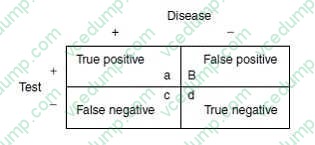
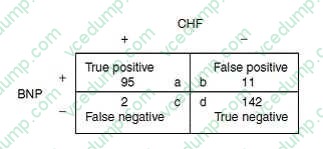
You are evaluating a journal article describing a test for the diagnosis of congestive heart failure (CHF). In the study described, 250 consecutive patients were given the test. Of the 250 subjects, 106 tested positive for CHF and 144 tested negative. All 250 subjects were then evaluated by expert cardiologists who were blinded to the results of the experimental test. These cardiologists determined that of the 106 persons who tested positive, 95 actually had CHF. Further, the cardiologists found that of the 144 who tested negative, 2 truly had CHF.
What is the sensitivity of this test for the diagnosis of CHF?
A. 98%
B. 93%
C. 75%
D. 61%
E. 39% -
Question 78:
A24-year-old male medical student is admitted to the hospital for the evaluation of a 3-month history of bloody stools. The patient has approximately six blood stained or blood streaked stools per day, associated with relatively little, if any, pain. He has not had any weight loss, and he has been able to attend classes without interruption. He denies any fecal incontinence. He has no prior medical history. Review of systems is remarkable only for occasional fevers and the fact that the patient quit smoking approximately 8 months ago. A colonoscopy is performed and reveals a granular, friable colonic mucosal surface with loss of normal vascular pattern from the anal verge to the hepatic flexure of the colon. Biopsies reveal prominent neutrophils in the epithelium and cryptitis with focal crypt abscesses, and no dysplasia. The patient is diagnosed with ulcerative colitis.
In addition to an increased lifetime risk of colon cancer, the patient is also at increased risk for which of the following tumors?
A. hepatocellular carcinoma
B. hepatoblastoma
C. desmoid tumors
D. small bowel lymphoma
E. cholangiocarcinoma -
Question 79:
You are asked to see a 74-year-old man who has been admitted for evaluation of abdominal pain. During his workup, he was found to have hemoccult positive stool and a CT scan that was concerning for a mass in his sigmoid colon.
Which should be the next step in his treatment?
A. cardiology consultation for preoperative clearance
B. contrast enema to evaluate the lesion
C. colonoscopy to biopsy the mass and rule out synchronous lesions
D. sigmoidectomy to resect the mass and obtain mesenteric lymph nodes for staging
E. positron emission tomography (PET) scan to determine if the lesion is cancerous -
Question 80:
A30-year-old separated female with borderline personality disorder is brought in by her roommate after she admitted to feeling suicidal and taking several handfuls of "an old prescription" some hours ago. Her vitals demonstrate a slight fever, elevated BP, and tachycardia. On physical examination, her pupils are dilated, she has a tremor, and she complains of "seeing scary faces." She also has noticeably dry mucous membranes.
Which of the following medications should be immediately administered in the above case?
A. benztropine
B. flumazenil
C. naloxone
D. phentolamine
E. physostigmine
Tips on How to Prepare for the Exams
Nowadays, the certification exams become more and more important and required by more and more enterprises when applying for a job. But how to prepare for the exam effectively? How to prepare for the exam in a short time with less efforts? How to get a ideal result and how to find the most reliable resources? Here on Vcedump.com, you will find all the answers. Vcedump.com provide not only USMLE exam questions, answers and explanations but also complete assistance on your exam preparation and certification application. If you are confused on your USMLE-STEP-3 exam preparations and USMLE certification application, do not hesitate to visit our Vcedump.com to find your solutions here.