USMLE USMLE-STEP-3 Online Practice
Questions and Exam Preparation
USMLE-STEP-3 Exam Details
Exam Code
:USMLE-STEP-3
Exam Name
:United States Medical Licensing Step 3
Certification
:USMLE Certifications
Vendor
:USMLE
Total Questions
:804 Q&As
Last Updated
:Jul 29, 2026
USMLE USMLE-STEP-3 Online Questions &
Answers
Question 611:
A 25-year-old female presents for evaluation of a breast mass and tenderness. She describes the breast soreness as varying with her menstrual cycles. On examination, you feel a firm, movable, irregular 2 cm mass. Her breast tissue is diffusely dense bilaterally. Of the options listed, which is the most likely?
A. lipoma B. fibroadenoma C. hemangioma D. intraductal papilloma E. phylloides tumor, benign
B. fibroadenoma
Explanation
Fibroadenoma is the most common benign neoplasm of the breast and is composed of two types of tissues. A mesenchymal element most commonly composed of edematous or collagenized fibrous tissue and an epithelial component, which consists of compressed, and sometimes hyperplastic, irregular ductal lumens. They are usually found in young women and may be hormonally reactive during pregnancy or menopause.
Question 612:
A 28-year-old woman presents to your clinic complaining of feeling "on edge." Upon further questioning, you discover that she has also noticed problems with irritability, insomnia, fatigue, and restlessness. She also has a history of worrying about things that seem to not bother those around her. She states these symptoms have been present for years but have recently become worse. When you try to gather more information, she interrupts to say that she cannot stay much longer because she is afraid that she will lose her new job as a machinist.
Which of the following medications would be most appropriate in this patient?
A. diazepam B. amitriptyline C. doxepin D. oxazepam E. buspirone
E. buspirone
Explanation
This patient's symptoms are consistent with an anxiety disorder. Given her occupation, an anxiolytic medication with no sedative properties would be most preferable. Buspirone is a nonsedating anxiolytic agent that is a partial agonist at 5-HT1A receptors. Unlike benzodiazepines, such as diazepam and oxazepam (Serax), it has no hypnotic, anticonvulsant, or muscle relaxant properties. Amitriptyline and doxepin have also been used to treat anxiety, especially when associated with depression; however, these drugs are also sedating.
Question 613:
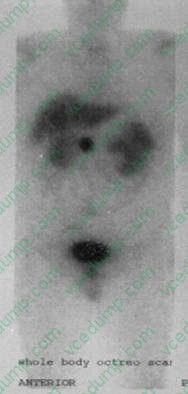
A40-year-old man presents with chronic diarrhea and peptic ulcer disease refractory to medical management with proton pump inhibitors. An octreotide scan is shown in Figure
which corresponds to an area near the head of the pancreas. Which of the following factors directly results in the release of the hormone produced by this tumor?
A. secretin B. glucagon C. antral pH <2.0 D. vagus nerve E. somatostatin
D. vagus nerve
Explanation
This patient has a gastrinoma, seen in Zollinger-Ellison syndrome, and should also be evaluated for possible MEN I. Gastrin is a GI hormone that is released from the antral G cells of the stomach to regulate acid secretion by the gastric parietal cells. It is released when the stomach gets the signal that is needed to initiate the digestion process, and also acts to stimulate chief cells to secrete pepsinogen and to increase gastric mucosal blood flow. Known stimulants for the release of gastrin include: vagal stimulation, calcium, alcohols in the stomach, proteins/amino acids in the stomach, antral distention, and gastric pH greater than 3. Antral pH less than 2 inhibits gastrin release, as does somatostatin. Secretin has no effect or decreases gastrin levels in healthy patients, but it increases gastrin release in patients with Zollinger-Ellison syndrome.
Glucagon has little or no effect on gastrin release.
Question 614:
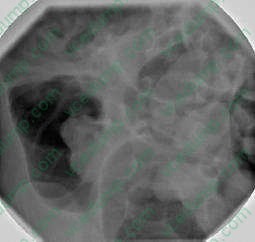
A 10-month-old male presents with a 12-hour history of episodes of crying, holding his stomach, and bending over in pain. The parents report one "reddish" stool. He has no past medical history or episodes of similar events. He did have 24 hours of viral symptoms, which resolved a few days ago.
The following study was obtained.
Which of the following statements is true?
A. The initial treatment for this child involves emergent laparotomy. B. Air contrast enema can be diagnostic AND therapeutic. C. Colonic mass is the usual source of this problem in a child. D. "Dance's sign" is the appearance on xray of "telescoped" intestine. E. Recurrence is likely after treatment.
B. Air contrast enema can be diagnostic AND therapeutic.
Explanation
Intussusception is usually seen in children 812 months of age. They present with paroxysmal, crampy abdominal pain, and sometimes emesis. "Currant-jelly" stools are sometimes seen. They usually report a history of GI viral infection in the recent past. Enlarged Peyer's patches are usually the lead point of the intussusception. Polyps, tumors, and Meckel's diverticulum are less frequent causes. On examination, these children may have a mass in the epigastrium or right upper quadrant with an absence of intestine in the right lower quadrant. This is referred to as "Dance's sign." The diagnostic tool of choice is air contrast enema. This is also therapeutic in 6090% of cases. If the intussusception cannot be reduced by the enema, laparotomy is required to prevent bowel ischemia. Compromised bowel is resected at that time. Only 5% of children have a recurrence after successful reduction.
Question 615:
You perform an upper endoscopy on a patient and find changes suggestive of Barrett's esophagus. How do you explain this to the patient and his family?
A. Is a condition where the normal esophageal lining is replaced by columnar epithelium. B. Is a condition where the normal esophageal lining is replaced by dysplastic squamous cells. C. Two biopsies with histologic changes are needed to confirm the diagnosis. D. The main risk associated with Barrett's esophagus is bleeding. E. It is related to peptic ulcer disease.
A. Is a condition where the normal esophageal lining is replaced by columnar epithelium.
Explanation
Barrett's esophagus is related to GERD. It is found proximal to the LES and is thought to be a result of constant acidic exposure. It is a condition where the normal esophageal squamous cell epithelium is replaced by columnar epithelium, similar to intestinal metaplasia. A single biopsy is all that is needed to confirm the diagnosis. In fact, many biopsies should be taken during endoscopy if the diagnosis is suspected in an effort to find dypslasia. The risk of malignant degeneration is the most important risk associated with Barrett's esophagus.
Question 616:
A 61-year-old postmenopausal woman, who has been on continuous combined hormone replacement therapy for 5 years, presents to your office complaining of vaginal bleeding.
Which of the following is the most appropriate next step in her management?
A. pap smear B. endocervical curettage (ECC) C. pelvic ultrasound D. endometrial biopsy E. dilation and curettage
D. endometrial biopsy
Explanation
Vaginal bleeding in a postmenopausal woman may be caused by numerous etiologies including an endometrial polyp, endometrial hyperplasia, atrophic endometrium, a submucosal fibroid, or endometrial cancer to name a few. In this group of women, endometrial cancer must be ruled out. Although this woman may need a pap smear as part of her routine gynecologic screening, a pap smear is inadequate to rule out the diagnosis of endometrial cancer. ECC is a sampling of the endocervical canal, not of the endometrium. Thus, again, an ECC is not adequate to rule out endometrial cancer. The ECC is more commonly used in the workup for cervical dysplasia to assess extension into the cervical canal. Athickened endometrial stripe on pelvic ultrasound can aid in making the diagnosis of an endometrial abnormality, but the ultrasound itself is not diagnostic for endometrial cancer. Athickened endometrium on ultrasound may be the result of a submucosal fibroid, hyperplasia, a polyp, or endometrial cancer. A dilation and curettage is an outpatient surgical procedure that involves dilation of the cervix and a thorough sampling of the endometrium with a curette. This procedure will obtain adequate endometrial tissue to make a diagnosis of tissue. In general, this procedure is reserved for patients in which endometrial biopsy is unsuccessful or for patients who have continued symptoms with a negative endometrial biopsy. Endometrial biopsy is a simple office procedure for sampling the endometrium, and it is 95% accurate. Thus, it is the preferred method of sampling the endometrium to rule out endometrial cancer.
Question 617:
A74 year-old widowed man presents for evaluation to his physician. He has a history of several episodes of major depression, with one prior hospitalization many years ago although he cannot remember the medication he was prescribed. He complains of 3 months of depression, crying spells, terminal insomnia, poor appetite with weight loss, anhedonia, and passive suicidal ideation without plan. His medical history is significant for hypertension, peripheral vascular disease, hypercholesterolemia, and unstable angina. He is currently prescribed diltiazem, aspirin, metoprolol, and simvastatin. Which of the following antidepressants would be the most appropriate treatment option?
A. amitriptyline (Elavil) B. citalopram (Celexa) C. fluoxetine (Prozac) D. paroxetine (Paxil) E. phenelzine (Parnate)
B. citalopram (Celexa)
Explanation
Explanations:
This patient is having a recurrence of his major depression. While all of the listed antidepressants are equally efficacious, the tricyclics such as amitriptyline and monoamine oxidase inhibitors such as phenelzine are not considered to be first-line treatments. This is especially true in the elderly considering medication side effects, dietary restrictions, druginteractions, and lethality in overdose. The remaining listed serotonin-specific reuptake inhibitors are also equally efficacious, but they inhibit the liver cytochrome P450 enzymes 2D6 and 3A4 to varying degrees. This is especially concerning in this elderly patient who is on a beta-blocker and calcium channel locker, both of which are metabolized by these hepatic enzymes; therefore, blood levels of each can increase appreciably and cause or exacerbate side effects. Fluoxetine inhibits both cytochrome P450 2D6 and 3A4, while paroxetine primarily inhibits cytochrome P450 2D6. Citalopram and sertraline are not believed to considerably inhibit P450 enzymes, so in this patient with polypharmacy, either would be appropriate first choices
Question 618:
A 19-year-old female presents to the ED complaining of swelling in her left lower extremity. She reports that she had arthroscopy of the right knee about a week ago for a torn meniscus. The swelling started last night and is uncomfortable.
Which of the following statements most accurately describes the situation?
A. This condition is less likely to occur in women than men. B. The patient should be put on strict bed rest with leg elevation until her swelling resolves. C. Her surgically treated knee should be aspirated immediately to rule out a septic joint. D. Prophylaxis to prevent this complication includes subcutaneous heparin or daily coumadin. E. Directed lytic therapy is indicated for this patient if her lower extremity becomes bluish and has evidence of vascular compromise.
E. Directed lytic therapy is indicated for this patient if her lower extremity becomes bluish and has evidence of vascular compromise.
Explanation
This patient has developed a DVT of her left leg. This is a complication following surgery that can be prevented in part by the use of subcutaneous heparin and sequential compression devices. Coumadin is not used as a prophylaxis, but rather as a treatment modality. Risk factors for developing DVTs include female gender, obesity, orthopedic surgery, use of oral contraceptives, smoking, and long periods of being sedentary. Her knee should be aspirated if she has a red, hot, or swollen joint; as these symptoms are not mentioned and the DVT is in the leg opposite to the surgically treated joint, aspiration is not necessary at this time.
Question 619:
A 16-year-old woman comes to see you for a yearly physical examination. Her only concern is that her periods are very irregular, and she desires oral contraceptives to regulate them. She relates that menarche was at 12 years, of age and that her periods have always been irregular. On examination, she is a markedly obese woman with a body mass index of 35 and with normal linear growth. She has some coarse facial hair down both of her checks as well as cystic acne along her hairline. On the nape of her neck she is noted to have acanthosis nigricans. She has tanner 4 breast development as well as tanner 4 pubic hair.
Her urinalysis in the office is normal.
What would be the best intervention to achieve the best long-term outcome in this woman?
A. Begin low-dose subcutaneous insulin to prevent diabetes mellitus. B. Begin daily corticosteroid therapy to suppress testosterone secretion. C. Begin a regimen of lifestyle changes, including dietary and exercise alterations. D. Begin levothyroxine (Synthroid) for control of weight gain. E. Oophorectomy to decrease hormone levels.
C. Begin a regimen of lifestyle changes, including dietary and exercise alterations.
Explanation
This clinical vignette describes an adolescent female with PCOS. PCOS is commonly seen in obese adolescent females with anovulatory menstrual cycles, hirsutism, and generalized virilization (acne). Commonly, PCOS patients will have glucose insensitivity and manifest features of type II diabetes mellitus. The diagnosis of PCOS may be difficult to ascertain. A pelvic ultrasound demonstrating "polycystic ovaries" (the string of pearls sign) may be quite helpful. Girls with PCOS will typically have elevated triglycerides, low HDL cholesterol, and a suppressed prolactin. As indicated above, PCOS girls also often have glucose insensitivity and an abnormal glucose tolerance test. The most effective therapy in PCOS involves lifestyle alterations (weight loss and exercise) and hormonal regulation of ovulation. The hypoglycemic agent metformin is now being used to assist in the management of PCOS. Occasionally, subcutaneous insulin may be effective in controlling hyperglycemia, but this will not prevent diabetes mellitus.
Question 620:
A 10-year-old boy presents to your clinic with right knee pain for 2 weeks. He is physically active at school and plays soccer and basketball. He describes pain in his knees when he runs or jumps. He denies any recent trauma. His physical examination is normal except for mild edema and tenderness over the right tibial tubercle. What is the most likely diagnosis?
A. slipped capital femoral epiphysis B. Osgood-Schlatter disease C. patellar tendonitis D. iliotibial band friction syndrome E. septic joint
B. Osgood-Schlatter disease
Explanation
Osgood-Schlatter disease is a repetitive stress injury to the inferior end of the patellar tendon at its insertion into the tibial tubercle. These patients are usually young, athletic males between the ages 10 and 15 years. The diagnosis is made when a young male presents with knee pain that increases with exercise without a history of trauma. Treatment consists of rest, activity restriction, and anti- inflammatory agents. Slipped capital femoral epiphysis occurs most commonly in African American obese adolescent males. It refers to a slipping of the epiphysis off the metaphysis. The "slipping" is caused by weakening of the perichondral ring of the growth plate, which allows the epiphysis and metaphysis to gradually or acutely displace from each other. This results in pain in the groin, thigh, or knee as well as a limp. Treatment is primarily operative internal fixation. Patellar tendonitis is caused by injury to the patellar tendon. Most of these patients have tenderness in the inferior portion of the patella and complain of chronic anterior knee pain. Iliotibial band friction syndrome causes lateral knee pain in runners.
Nowadays, the certification exams become more and more important and required by more and more
enterprises when applying for a job. But how to prepare for the exam effectively? How to prepare
for the exam in a short time with less efforts? How to get a ideal result and how to find the
most reliable resources? Here on Vcedump.com, you will find all the answers.
Vcedump.com provide not only USMLE exam questions,
answers and explanations but also complete assistance on your exam preparation and certification
application. If you are confused on your USMLE-STEP-3 exam preparations
and USMLE certification application, do not hesitate to visit our
Vcedump.com to find your solutions here.