USMLE USMLE-STEP-3 Online Practice
Questions and Exam Preparation
USMLE-STEP-3 Exam Details
Exam Code
:USMLE-STEP-3
Exam Name
:United States Medical Licensing Step 3
Certification
:USMLE Certifications
Vendor
:USMLE
Total Questions
:804 Q&As
Last Updated
:Jul 29, 2026
USMLE USMLE-STEP-3 Online Questions &
Answers
Question 431:
A 29-year-old woman presents to the primary care clinic complaining of frequent headaches for several months. During the interview she appears tearful and withdrawn, with minimal eye contact and reluctance to answer questions. With further encouragement and support, she is able to describe intense feelings of sadness, along with significant insomnia, poor concentration, fatigue, anhedonia, and little appetite with a 20-lb weight loss It is decided to begin treatment for her depressive symptoms with pharmacotherapy. Regarding the selection of the specific class of medication, a family history of what would be crucial?
A. allergies B. depressive symptoms C. manic symptoms D. medical illnesses E. substance abuse
C. manic symptoms
Explanation
This woman likely suffers from a major depressive episode. While asking about substance abuse, current medications, medical problems, and a past history of depression are very important in a complete psychiatric evaluation, assessment of suicidality is essential. The risk of suicide in patients with major depressive disorder is about 20 times higher than those without the illness. The estimated lifetime risk of suicide is approximately 15% in those individuals with major depressive disorder. The choice of a specific antidepressant may be influenced by many factors, including prior response in the patient or a family member and comorbid medical problems or substance abuse in the family (and, therefore, potentially the patient). If a patient or family member has a history of manic symptoms or bipolar disorder, consideration should be given to beginning a mood stabilizer prior to initiating antidepressant therapy, as antidepressants can cause a switch into mania in those individuals.
Question 432:
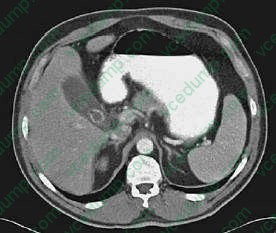
Apatient is evaluated for left-sided abdominal pain and undergoes a CT scan of the abdomen that shows renal calculi. The radiologist reports an incidental finding that is shown in Figure. She has never been symptomatic from this disease. All of her hepatobiliary serologies are within normal limits. Which of the following is an indication for elective surgical treatment?
A. patient is over 50 years old B. two small (<1 cm) stones and sludge present in gallbladder C. absence of calcifications in the gallbladder wall D. type II diabetes mellitus E. sickle cell disease
E. sickle cell disease
Explanation
The incidental finding is a gallstone within the gallbladder without evidence for inflammation. For most patients with asymptomatic cholelithiasis, a cholecystectomy is not routinely performed. Only 2030% of these patients will develop symptoms within 20 years. Moreover, only 12% per year will develop serious symptoms or complications from their gallstones. However, certain patients are at greater risk for developing complications and should be considered for elective cholecystectomy. This population includes patients with stones greater than 2.5 cm in size since they are at greater risk for obstruction. Children with cholelithiasis have a high frequency of becoming symptomatic and also should be considered for early intervention. In patients with sickle cell disease, acute cholecystitis can induce a sickle crisis, which can complicate surgery and as such should undergo elective cholecystectomy. Finally, the finding of calcifications in the gallbladder wall, also known as a "porcelain gallbladder" is associated with increased risk of gallbladder carcinoma and an elective cholecystectomy should be considered. Diabetes mellitus is associated with increased surgical risks with both emergent and elective cholecystectomy, and therefore diabetics should not be recommended for surgery for asymptomatic gallstones.
Question 433:
A 37-year-old female presented to your office with an ultrasound report suggestive of bilateral ovarian masses. You take her to the operating room for an exploratory laparotomy and note the left ovary to be replaced by an 8 9 cm neoplastic process. The right ovary appears to have a small 2 x 2 cm cystic process, similar in appearance to the left ovary, involving only a small portion of the right ovary. After obtaining pelvic and upper abdominal washings, you remove the left ovary and then perform a cystectomy on the right ovary, removing all visible disease without rupture. The frozen section on both resected specimens reveals a serous tumor of low malignant potential (LMP). The best procedure for the patient at this point is which of the following?
A. termination of the procedure; await final pathology report on the resected specimens B. total abdominal hysterectomy and right salpingo-oophorectomy C. omentectomy and peritoneal biopsies D. omentectomy, peritoneal biopsies, selected pelvic and peritoneal lymph node sampling E. terminate procedure and prescribe postoperative chemotherapy
D. omentectomy, peritoneal biopsies, selected pelvic and peritoneal lymph node sampling
Explanation
Borderline tumors of the ovary, or tumors of low malignant potential (LMP), represent approximately 15% of all epithelial ovarian tumors. The average age at diagnosis is 40 years of age, 1520 years earlier than is the average age at diagnosis for the invasive ovarian counterpart. Roughly 50% of all borderline tumors are serous. Because most borderline serous tumors occur in women of reproductive age and are classified as stage I at the time of diagnosis, treatment is usually conservative. Most patients can be managed with cystectomy or oophorectomy alone; in fact, cystectomy is the treatment of choice in the presence of bilateral borderline ovarian cystic tumors, or when only one ovary remains and fertility is desired. If the patient is perimenopausal, postmenopausal, or has no desire for fertility, hysterectomy with bilateral salpingo-oophorectomy is recommended. When the diagnosis of borderline tumor is made on the basis of an intraoperative frozen section evaluation, a complete staging procedure is still recommended in the event the final pathology report reveals an invasive cancer. The staging information will be critical in that setting in order to determine the stage of disease present and the need for chemotherapy postoperatively. Surgical staging should include pelvic and abdominal cytology, random peritoneal biopsies (right hemidiaphragm, paracolic gutters, ovarian fossa bilaterally, cul-de-sac, and bladder flap), partial omentectomy, and lymph node sampling.
Question 434:
A75-year-old man undergoes a right colectomy for stage 3 colon cancer. He has a history of emphysema requiring chronic steroid use. He also has diabetes and coronary heart disease. On postoperative day 2, the surgeon is called because the patient acutely began to have a large amount of pinkish, serous drainage from the wound.
There is no evidence of infection. Which of the following factors probably contributed to this complication?
A. the surgeon used a running stitch to close the fascia instead of interrupted sutures B. coronary artery disease C. early mobilization of patient D. aggressive abdominal examination performed on postoperative day 1 by a medical student E. pulmonary disease
E. pulmonary disease
Explanation
Dehiscence refers to a separation of the fascial layer. Evisceration is when peritoneal contents extrude through the fascial separation. Malnutrition, obesity, diabetes, uremia, malignancy, immunologic abnormalities, steroid use, infection, and coughing which increases intraabdominal pressures are all factors that increase the risk of wound dehiscence. Technical factors are also very important in preventing the dehiscence, but there is no proof that interrupted sutures are better than a running stitch for fascial closure
Question 435:
A 5-year-old male is admitted to the hospital following a 3-week history of spiking fevers and fatigue. Your examination reveals pale mucous membranes and skin. You also find splenomegaly.
This child has an extensive evaluation by the Hematology-Oncology consultants. Their evaluation excludes the presence of a malignancy. The extensive evaluation did reveal that the child has a WBC count of 22,000 with 41% monocytes and 12% "atypical" lymphocytes. His hematocrit is 28% and erythrocyte sedimentation rate (ESR) is 5.
This child likely has which of the following diseases?
A. Lyme disease B. acute Epstein-Barr virus (EBV) infection C. systemic lupus erythematosus (SLE) D. juvenile rheumatoid arthritis (JRA) E. acute hematogenous tuberculosis (TB)
B. acute Epstein-Barr virus (EBV) infection
Explanation
The most common malignancy in childhood is leukemia/lymphoma. The most common solid tumors of childhood are CNS tumors, followed by neuroblastoma and Wilms tumors. The mildly elevated WBC with lymphocyte predominance with the presence of "atypical" lymphocytes would indicate that his child most likely has acute EBV infection (infectious mononucleosis). This acute EBV infection is usually subclinical in younger children, but can be manifested by acute hemolytic anemia and splenomegaly.
Testing for the diagnosis of EBV includes EBV DNA PCR and heterophile antibody response testing (monospot test). Diagnosis usually is made based upon serology testing for anti-EBV IgG and IgM levels. There is no specific therapy indicated for the acute EBV infections. Acute Lyme disease is very uncommon in children. The early stage of acute Lyme disease is characterized by a distinctive rash (erythema migrans). This is then followed by a multiple annular rash of disseminated Lyme disease. Often seen in this stage is cranial nerve palsies, specifically facial nerve (CN VII) palsy. Late Lyme disease is characterized by recurrent arthritis and arthralgia. Serologic testing is only recommended if there is a very high clinical index of suspicion, unlike this child. Acute systemic-onset JRA (Still disease) can present in a child of this age in a nonspecific manner (i.e., fever of unknown origin). Children with Still disease will typically have dramatic elevations in acute- phase reactants (i.e., ESR). This child's ESR being 5 would go against JRA.
Question 436:
A 41/2-year-old girl is brought to your office during summertime hours for ear pain. She has been swimming at camp for the past few days and now has copious cloudy discharge from her left external auditory canal with pain on movement of the pinna.
What is the best course of treatment for this patient?
A. amoxicillin PO B. erythromoycin PO C. erythromycin topical D. cefuroxime PO E. neomycin/polymyxin B/hydrocortisone topical
E. neomycin/polymyxin B/hydrocortisone topical
Explanation
The constellation of ear pain, pain with movement of the pinna, and cloudy discharge from the ear canal in a child who has been swimming frequently is most probably OE, also known as "swimmer's ear." Perforated TMs can occur, often as the result of an untreated otitis media, a foreign body inserted deep in the ear or from barotrauma. This can cause ear pain and may have a cloudy drainage if the perforation is the result of otitis media. Neither otitis media nor perforated TMs typically cause pain on movement of the pinna. Mastoiditis is a rare infection that usually results from extension of an untreated otitis media into the mastoid air cells. The common findings on examination would be an acute otitis media and tenderness over the mastoid area behind the ear. Temporomandibular joint dysfunction can cause ear pain, but the common finding is tenderness anterior to the ear, not pain with movement of the ear or drainage from the ear canal. It would also be uncommon in a child this age.
The most common cause of acute OE is Pseudomonas aeruginosa. Treatment for acute OE will involve topical antimicrobials which cover P. aeruginosa, often in combination with a topical steroid. A commonly used treatment consists of eardrops containing neomycin, polymyxin B, and hydrocortisone (Cortisporin Otic), four drops into the affected ear four times a day for 710 days. Alternative therapy consists of oflaxacin drops twice a day into the affected ear for 710 days. For chronic OE, yeast becomes a more important pathogen, and therapy should be directed as such.
Question 437:
A third-year medicine resident has taken a trip to Guatemala to assist in a medical clinic for 2 weeks. After returning to work at the hospital, she faints during her grand rounds presentation of a case and is admitted to the teaching hospital where she works. She has a high temperature that cycles every few hours. The attending physician, a professor in her program, works her up for Dengue Fever and Malaria. Blood and urine laboratory tests are drawn and she receives many visitors from her concerned colleagues and coworkers. A fellow resident in her program, who is not directly involved in her care, reviews her chart and sees that her urine test came back positive for a pregnancy. Another resident sees him with the chart and asks, "So does she have Dengue or Malaria?" How should he respond to this request for information?
A. Order another pregnancy test to confirm. B. Talk to the patient before sharing any information. C. Refrain from sharing the test results with the other resident. D. Share the information with the other resident in confidence. E. Only share the information with the attending physician.
C. Refrain from sharing the test results with the other resident.
Explanation
The actions of the resident who reviewed the patient's chart were unethical. He is not involved in the case and the fact that he is a physician and colleague of the patient does not free him of the requirements that protect patient confidentiality, backed by federal regulations (see discussion of HIPAA above). He should not have pulled her chart. He would only be making matters worse by further violating the patient's right to confidentiality in sharing her results with the other resident. The attending clinicians involved in the case are the only people who should have privileged access to the patient's sensitive health information.
Question 438:
A 25-year-old woman presents to your office complaining of cold hands. She describes them turning white as she reaches for orange juice in the frozen food section of the supermarket. It seems to be getting worse lately. She has no other symptoms but does note that she and her husband are contemplating pregnancy. Her examination today is unremarkable. In this patient, which of the following studies would be most likely to describe an increased risk of future systemic disease?
A. echocardiogram B. nerve conduction study C. ANA D. joint aspiration E. arterial Doppler of the upper limbs with cold stimulation
C. ANA
Explanation
Vasospasm severe enough to reduce flow and produce cyanosis after exposure to cold is called Raynaud phenomenon. Some make a further distinction between Raynaud syndrome when the phenomenon is associated with another systemic disorder and Raynaud disease when there is no established systemic process. Similarly, Raynaud phenomenon in the absence of a systemic illness may also be referred to as primary Raynaud phenomenon, and Raynaud in the presence of another systemic illness may be termed secondary Raynaud phenomenon. In this case, there is no evidence of another systemic illness. Clinical features suggesting SLE or RA are absent. Subacute bacterial endocarditis likewise would be expected to be associated with fever, which is absent in this patient. In addition, one would expect to see areas of necrosis either in the soft tissue (Janeway spots) or under the fingernails (splinter hemorrhages) were any kind of embolic phenomenon is present. (Harrison's Principles of Internal Medicine, 15th ed., pp. 1438- 1439) Given the patient's age, it is reasonable to explore the possibility of an associated systemic illness. If one were present, basic laboratories such as blood count, urinalysis, and chemistries are important. ANAis a reasonable screening study in this case. It does have a prognostic value increasing the likelihood of the development of a systemic process in the future.
If positive, further serologic studies might then be helpful in establishing a more specific diagnosis. The arterial Doppler with cold stimulation can be a useful test in showing a marked drop in blood flow with cold exposure. Still, with such a classical description, it is hard to imagine how this test would be helpful either diagnostically or therapeutically. Antidouble-stranded DNA antibodies would establish the diagnosis of SLE. Likewise, the antiscleroderma antibodies (anti-Scl-70) would be a very important prognostic marker once the ANA is positive and certainly would occasion a rheumatic disease consultation. Patients with hypercoagulable states, including those with positive cardiolipin antibodies, can often mimic Raynaud's. Given that the patient wants to become pregnant, this would be an important study to obtain. Sjren antibodies, both SSA and SSB, are important in this case because of the contemplated pregnancy. Sjren antibodies can cross the placenta and create the syndrome of neonatal lupus (complete heart block, thrombocytopenia, and rash).
Question 439:
A 68-year-old White male, with a history of hypertension, an 80 pack-year history of tobacco use and emphysema, is brought into the ER because of 4 days of progressive confusion and lethargy. His wife notes that he takes amlodipine for his hypertension. He does not use over-the-counter (OTC) medications, alcohol, or drugs. Furthermore, she indicates that he has unintentionally lost approximately 30 lbs in the last 6 months. His physical examination shows that he is afebrile with a blood pressure of 142/85, heart rate of 92 (no orthostatic changes), and a room-air O2 saturation of 91%. He is 70 kg. The patient appears cachectic. He is arousable but lethargic and unable to follow any commands. His mucous membranes are moist, heart rate regular without murmurs or a S3/S4 gallop, and extremities without any edema. His pulmonary examination shows mildly diminished breath sounds in the right lower lobe with wheezing bilaterally. The patient is unable to follow commands during neurologic examination but moves all his extremities spontaneously. Laboratory results are as follows:
Hgb: 15.8 Hematocrit (HCT): 45.3 Platelets: 410 Arterial blood gas: pH 7.36/pCO2 60/pO2 285 A chest x-ray (CXR) reveals a large right hilar mass.
Which of the following is the correct statement regarding the treatment of hyponatremia?
A. Desmopressin acetate (DDAVP), used in conjunction with intravenous saline, will help correct the serum sodium. B. Correction of sodium slowly by 3 meq/day will prevent any subsequent neurologic injury. C. Correction of serum sodium by 15 meq over 24 hours could lead to permanentneurologic injury. D. Diuretics should be avoided in the treatment of hyponatremia. E. Potassium should always be added to IV saline solutions when treating both hyponatremia and hypokalemia.
C. Correction of serum sodium by 15 meq over 24 hours could lead to permanentneurologic injury.
Explanation
The patient has hypotonic hyponatremia, which can lead to increased water shifting into the brain, resulting in cerebral edema. This patient has nothing in history or physical examination to suggest a stroke or the presence of sepsis as the etiology of his altered mental status. Central pontine myelinolysis is a potentially devastating neurologic complication that can result from the treatment of hyponatremia, not hyponatremia itself. While respiratory acidosis could potentially contribute to this patient's change in mental status, cerebral edema due to hypotonicity is the most likely etiology. The patient's laboratory studies indicate a low plasma osmolality with an inappropriately increased urine osmolality. With this degree of hypotonicity, the urine should be maximally dilute (osmolality of <100 mOsmol/kg H2O). The high urine osmolality suggests the presence of antidiuretic hormone. In psychogenic polydipsia, the urine would be maximally dilute. Choice C is unlikely since his physical examination does not suggest volume depletion; furthermore, the patient is taking a calcium channel blocker, not a diuretic, for the treatment of his hypertension. Decreased expression of renal collecting duct water channels would lead to water wasting and, thus, the development of diabetes insipidus and hypernatremia. The patient has symptomatic hypotonic hyponatremia with signs of cerebral edema.
This requires immediate attention. Choices A, C, and E are essentially hypotonic solutions which should be withheld in patients with hyponatremia. The serum sodium in this case should be increased by at least 5% for the treatment of cerebral edema. The use of 0.9% saline would require nearly 5 L of infusate to address this cerebral edema. This could lead to pulmonary edema and volume overload. The use of hypertonic saline (3% saline) is the ideal solution to use in this scenario, as the infusion of 3% saline will correct the symptoms while avoiding volume overload. As in all cases of hyponatremia management, frequent serum sodium assays are necessary in order to avoid too rapid of a correction, which could result in neurologic injury--pontine myelinolysis.
Question 440:
You are a second-year surgery resident and have just left work after a 30-hour shift. On your way home you witness a recent collision where there is an obviously injured pedestrian. Several bystanders are providing care for the injured victim. You elect to keep driving. Awitness at the scene recognizes you as a physician and reports you to the authorities for neglecting to stop to provide care. As a consequence of your actions, which of the following will most likely happen?
A. You will lose your medical license. B. You will be found guilty of negligence in a court of law. C. You will have your medical license suspended. D. You will have no legal action taken against you. E. You will be subject to a malpractice suit.
D. You will have no legal action taken against you.
Explanation
As a practicing physician, you are not required to stop at an accident and care for the injured, as you have not established a doctorpatient relationship. As such, there are no legal requirements for physicians to assist in the care of accident victims outside of their employment (i.e., hospital, ER, clinic). It is also important to realize that under the Good Samaritan law, individuals who provide aid to the injured or ill are protected from prosecution for unintentional injury or wrongful death. It is also important to be familiar with local laws. For example, in some states, this law only applies to people who are trained in basic first aid. (The state of Vermont requires any bystander to render aid until proper authorities arrive). In the situation presented above, you most probably would not be faulted for not assisting in the care of the injured person and there would be no grounds for legal action.
Nowadays, the certification exams become more and more important and required by more and more
enterprises when applying for a job. But how to prepare for the exam effectively? How to prepare
for the exam in a short time with less efforts? How to get a ideal result and how to find the
most reliable resources? Here on Vcedump.com, you will find all the answers.
Vcedump.com provide not only USMLE exam questions,
answers and explanations but also complete assistance on your exam preparation and certification
application. If you are confused on your USMLE-STEP-3 exam preparations
and USMLE certification application, do not hesitate to visit our
Vcedump.com to find your solutions here.