USMLE-STEP-3 Exam Details
-
Exam Code
:USMLE-STEP-3 -
Exam Name
:United States Medical Licensing Step 3 -
Certification
:USMLE Certifications -
Vendor
:USMLE -
Total Questions
:804 Q&As -
Last Updated
:Jul 29, 2026
USMLE USMLE-STEP-3 Online Questions & Answers
-
Question 131:
A 25-year-old male presents to his psychiatrist for follow-up after a lengthy psychiatric hospitalization. He was diagnosed with schizophrenia and discharged on risperidone 6 mg daily. He has no known medical problems and is without physical complaints. He continues to have some paranoia and ideas of reference regarding CNN, but he is not overtly delusional. He denies hallucinations as well. Although he feels "depressed" regarding his illness, he denies suicidal or homicidal ideation.
Which of the following should be routinely monitored in this patient?
A. body mass index (BMI)
B. BP
C. complete blood count (CBC)
D. electrocardiogram (ECG)
E. liver function tests (LFTs) -
Question 132:
Which anatomic location is the most common site of extra-adrenal pheochromocytomas?
A. duodenum
B. inferior pole of the kidney
C. paraaortic area
D. parasplenic area
E. peripancreatic area -
Question 133:
A 45-year-old woman, mother of four children, comes to the ER complaining of the sudden onset of epigastric and right upper quadrant pain, radiating to the back, associated with vomiting. On examination, tenderness is elicited in the right upper quadrant, bowel sounds are decreased, and laboratory data show leukocytosis as well as normal serum levels of amylase, lipase, and bilirubin Which of the following is the most useful diagnostic test to confirm the diagnosis?
A. two-way roentgenogram of the abdomen
B. ultrasonography of the upper abdomen
C. CT scan of the abdomen and pelvis with oral contrast
D. HIDA (hydroxy iminodiacetic acid) scan
E. magnetic resonance cholangiopancreatography (MRCP) -
Question 134:
A 54-year-old male with uncontrolled type II diabetes and well-controlled hypertension presents with complaints of erectile dysfunction. The patient requests Viagra (sildenafil), as his friends have used it with success. However, he is concerned as he was told by someone that Viagra can be fatal if used with some blood pressure medications. You would advise the patient that the use of which of the following is contraindicated in patients taking sildenafil?
A. isosorbide mononitrate
B. metoprolol
C. verapamil
D. captopril
E. clonidine -
Question 135:
A 65-year-old man presents to your office for evaluation of abdominal pain. The patient states that he has epigastric pain that radiates to his back. The pain is worse with eating and improves with fasting. The pain has been present for 6 months and is gradually worsening. The patient has lost 15 lbs but feels his oral intake has been adequate. He complains of greasy stools and frequent thirst and urination. Examination reveals a thin male with temporal wasting and oderate abdominal pain with palpation. The patient consumes approximately 1015 beers per day and smokes a pack of cigarettes per day for the past 20 years.
On further questioning, the patient reports that he recently had a motor vehicle accident at night because he felt he could not see clearly. The most likely cause of this symptom is which of the following?
A. vitamin B12 deficiency
B. vitamin C deficiency
C. vitamin D deficiency
D. vitamin A deficiency
E. vitamin K deficiency -
Question 136:
Vital capacity is best described as the volume of air which is:
A. inhaled during normal respiration
B. expelled during passive expiration
C. remaining in the lungs after passive expiration
D. actively exchanging with pulmonary venous blood
E. able to be expelled following maximal inspiration -
Question 137:
A 22-year-old male arrives in the trauma bay via ambulance. He was intubated in the field after suffering a gunshot wound to the head. On examination, he has both an entrance and exit wound suggesting a transcranial trajectory of the bullet. On physical examination, you note that there are no brain stem reflexes present and his pupils are fixed and dilated. Given his
A. Explain to them the process of organ transplantation and its benefits to others.
B. Withdraw mechanical ventilator support and allow the patient to expire.
C. Add a narcotic drip to the patient's treatment in order to ease his pain prior to withdrawing mechanical ventilation.
D. Contact the donor services agency to have a professional trained in addressing organ donation come to speak with the family.
E. Contact the transplant team and prepare the patient for the OR because the organs are too vital to waste regardless of the family's wishes. -
Question 138:
A42-year-old man without prior significant medical history comes to your office for evaluation of chronic diarrhea of 12 months duration, although the patient states he has had loose stools for many years. During this time he has lost 25 lbs. The diarrhea is large volume, occasionally greasy, and nonbloody. In addition, the patient has mild abdominal pain for much of the day. He has been smoking a pack of cigarettes a day for 20 years and drinks approximately five beers per day. His physical examination reveals a thin male with temporal wasting and generalized muscle loss. He has glossitis and angular cheilosis. He has excoriations on his elbows and knees and scattered papulovesicular lesions in these regions as well. Which of the following is the most likely diagnosis for this patient?
A. chronic pancreatitis
B. Crohn's disease
C. celiac sprue
D. Whipple disease
E. ulcerative colitis -
Question 139:
A 53-year-old Black male, with a history of hypertension, hepatitis C, and newly diagnosed nonsmall cell lung cancer, undergoes his first round of chemotherapy, which includes cisplatin. You are called to see this patient 5 days into his hospitalization for oliguria and laboratory abnormalities. Other than the chemotherapy, he is receiving lansoprazole, acetaminophen, and an infusion of D5-- 0.9% normal saline at 50 mL/h. On examination, his BP is 98/60 and heart rate is irregular, between 40 and 50 bpm. His physical examination shows a middle-aged male in no acute distress. His cardiac examination is unremarkable, his lungs show bibasilar crackles, and the abdominal examination is positive for a palpable spleen tip without any hepatomegaly or abdominal tenderness. He has trace bilateral ankle edema. His distal pulses are irregular. The neurologic examination was unremarkable. His laboratory (serum sample) results are as follows
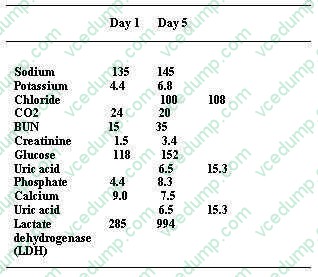
What is the mechanism that best explains this patient's hyperkalemia?
A. DKA
B. acute kidney failure leading to an inability to excrete potassium in the urine
C. release of potassium from the destruction of neoplastic cells
D. chemotherapy-induced hyperkalemia
E. type 4 renal tubular acidosis -
Question 140:
You are called to see a newborn in the nursery because the nurse is concerned that the baby may have Down syndrome.
If you were to perform an abdominal x-ray, what is the most likely finding that would be seen?
A. "double-bubble" sign
B. scimitar sign
C. normal gas patterns
D. free fluid in the abdomen
E. pneumatosis intestinalis
Tips on How to Prepare for the Exams
Nowadays, the certification exams become more and more important and required by more and more enterprises when applying for a job. But how to prepare for the exam effectively? How to prepare for the exam in a short time with less efforts? How to get a ideal result and how to find the most reliable resources? Here on Vcedump.com, you will find all the answers. Vcedump.com provide not only USMLE exam questions, answers and explanations but also complete assistance on your exam preparation and certification application. If you are confused on your USMLE-STEP-3 exam preparations and USMLE certification application, do not hesitate to visit our Vcedump.com to find your solutions here.