PMP Exam Details
-
Exam Code
:PMP -
Exam Name
:Project Management Professional - (PMP) 2025 New Version -
Certification
:PMI Certifications -
Vendor
:PMI -
Total Questions
:2678 Q&As -
Last Updated
:Jul 24, 2026
PMI PMP Online Questions & Answers
-
Question 1241:
During a sprint, the team is experiencing conflict because the customer asks for additional features that increase the complexity. The scrum master is trying to resolve the conflict. Which approach should the scrum master use?
A. Discuss the definition of done (DoD) with the customer.
B. Approach the product owner to determine the next course of action and update the backlog.
C. Discuss the acceptance criteria with customer.
D. Perform backlog prioritization to ensure that everyone is working on the highest value features. -
Question 1242:
A project manager implementing a hybrid project is dealing with multiple stakeholders in a rapidly changing business environment. How should the project manager ensure that the needs of stakeholders are consistently met?
A. Assign one team member to one stakeholder to ensure that the responsible team member is conversant with the needs of the stakeholder.
B. Add more iterative techniques to improve stakeholder learning.
C. Identify all the critical stakeholders during the project initiation.
D. Use iterative life cycles involving stakeholders to enable the team to improve the product end result through successive prototypes. -
Question 1243:
A complex project has a well-established responsibility assignment matrix (RAM). One of the critical stakeholders flagged a task as an issue because it was not completed and has remained open for some time.
What should the project manager do?
A. Assign a project team member to complete the open task.
B. Influence the stakeholder not to flag the task as an issue.
C. Identify who owns this task and discuss the situation with them.
D. Determine a decision-making authority for task accountability. -
Question 1244:
A project manager takes over a project team and notices that the team members always wait for management to make decisions during team meetings. In previous work, the project manager discovered that a team is more committed to the deliverables when team members make decisions themselves. However, this team is not willing to be put on the spot.
What should the project manager do?
A. Encourage the team to start making one decision in every meeting.
B. Develop decision-making behavior, such as team key performance indicators (KPIs).
C. Continue the current practice as long as the team members can still perform.
D. Understand the team members' obstacles and discuss means of improvement. -
Question 1245:
While reviewing prototypes, the quality team found some deviations that do not affect the mam functionality but have the potential to be an issue in the future. To avoid major problems in the future, the team recommends corrective actions that will require additional funds. The project is already struggling to stay on budget and has even used some of the contingency reserves.
What should the project manager do?
A. Ask the product designer why the deviation was not considered in the design phase
B. Report to the project sponsor that the product is working and the project is struggling with the budget.
C. Evaluate and initiate the change request process with the stakeholders
D. Ask the quality team to discard the sample and test again with a new sample -
Question 1246:
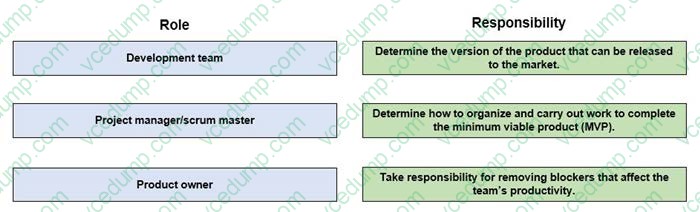
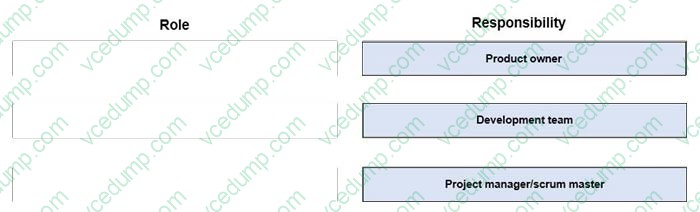
DRAG DROP
A company has created a cross-functional team to drive the digital transformation project for the business. The team is expected to deliver the minimum viable product (MVP) that addresses market need in the shortest possible time.
Match the roles for the team on the left to their corresponding responsibilities on the right.
Select and Place:
-
Question 1247:
A project's planning process is finished, and all resources were budgeted for and approved by senior management. Just before the kickoff meeting, a member of the production department realizes that the plan does not meet the requirements for their area.
What should the project manager have done during the planning process?
A. Monitored the budget variations during the planning process
B. Developed a good resource estimation in the planning process
C. Included all functional managers in the planning process
D. Distributed the resource estimates to all areas during the planning process -
Question 1248:
A complex project is in the execution phase. A key stakeholder who is new to the project has not been approving project deliverables, which could impact the overall progress. What should the project manager do next?
A. Capture this in the issue log and escalate it to the project sponsor.
B. Meet with the stakeholder to understand what is causing the delays.
C. Facilitate a brainstorming session to find potential workarounds.
D. Discuss the need to influence this stakeholder with the sponsor. -
Question 1249:
A product owner is continuously adding requirements to a project that will significantly impact project delivery. How should the project manager address this?
A. Reprioritize the work and add all new work to the product backlog.
B. Check with the project team about their availability to continue project work.
C. Consult with senior managers on how to address this to ensure the product owner's expectations are fully met.
D. Ask the product owner to reprioritize and consider the project done when the highest priorities are delivered. -
Question 1250:
A project manager is trying to define a project time line despite having incomplete and ambiguous information on requirements and regulations. What should the project manager do to finish planning?
A. Review project documents to identify and eliminate uncertainties and inconsistencies.
B. Execute a root cause analysis to discover the underlying factors that might lead to risks and issues.
C. Perform an assumption and constraint analysis to provide more opportunities and remove limiting factors.
D. Conduct a strengths, weaknesses, opportunities, and threats (SWOT) analysis.
Related Exams:
-
CAPM
Certified Associate in Project Management (CAPM) -
CPMAI
Cognitive Project Management in AI CPMAI v7 - Training & Certification -
DASM
Disciplined Agile Scrum Master (DASM) -
DASSM
Disciplined Agile Senior Scrum Master (DASSM) -
PFMP
Portfolio Management Professional (PfMP) -
PGMP
Program Management Professional (PgMP) -
PMI-ACP
PMI Agile Certified Practitioner (PMI-ACP) -
PMI-CPMAI
PMI Certified Professional in Managing AI -
PMI-PBA
PMI Professional in Business Analysis (PMI-PBA) -
PMI-PMOCP
PMI Project Management Office Certified Professional
Tips on How to Prepare for the Exams
Nowadays, the certification exams become more and more important and required by more and more enterprises when applying for a job. But how to prepare for the exam effectively? How to prepare for the exam in a short time with less efforts? How to get a ideal result and how to find the most reliable resources? Here on Vcedump.com, you will find all the answers. Vcedump.com provide not only PMI exam questions, answers and explanations but also complete assistance on your exam preparation and certification application. If you are confused on your PMP exam preparations and PMI certification application, do not hesitate to visit our Vcedump.com to find your solutions here.