PMI PMI-SP Online Practice
Questions and Exam Preparation
PMI-SP Exam Details
Exam Code
:PMI-SP
Exam Name
:PMI Scheduling Professional (PMI-SP)
Certification
:PMI Certifications
Vendor
:PMI
Total Questions
:323 Q&As
Last Updated
:Aug 07, 2026
PMI PMI-SP Online Questions &
Answers
Question 161:
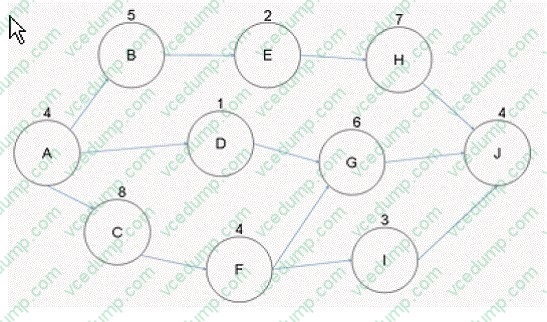
Examine the figure given below.
In this project network diagram, what is the total float for Activity I?
A. Three B. Zero C. Five D. One
A. Three
The float for Activity I is three days. The early start for Activity I is Day 17 and the late start for Activity I is Day 20. Therefore, the difference of the early start and the late start reveals the float as three days. It is possible, and acceptable, to use
the difference of the early finish and the late finish to find the float, as the value will be the same amount.
Answer options B, D, and C are incorrect. These are not the valid calculation for the total float.
Question 162:
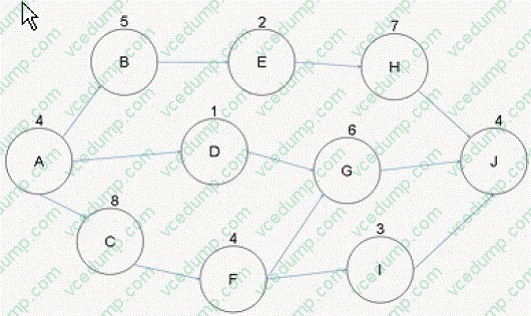
Examine the figure given below:
You are the project manager of this project. Tom, a project team member, reports that Activity D will be delayed by 12 days due to the unavailability of the resources from the vendor. What will this delay do to your project completion, if you allow the delay to enter into the project?
A. The project will be one day late. B. The float for activity D will be consumed. C. The project can still finish on time. D. The project will be seven days late.
A. The project will be one day late.
The project will be just one day late due to this delay. The path ADGJ takes a total of 15 days. If Activity D takes a total of 13 days (i.e. 12 + 1), then the path will now take 27 days to complete. This causes the critical path to shift to ADGJ and the project will end on day 27 rather than day 26. Answer options D, B, and C are incorrect. These are not the valid answers, as the project will now take 27 days to complete, rather than 26.
Question 163:
Your project is installing 8,000 light fixtures in a new building. Each of the light fixtures is to be installed exactly the same way but you have discovered that some of the fixtures are installed incorrectly. You and the project team meet and agree to fix the fixtures and to install all future fixtures the same way. This is an example of what executing activity?
A. Risk response B. Team development C. Risk mitigation D. Corrective action
D. Corrective action
This is an example of corrective action. The project team will fix the mistake and they have learned from their mistake so it won't happen again.
Answer option C is incorrect. Risk mitigation is defined as monies spent or actions taken to reduce the probability and impact of an identified risk event.
Answer option A is incorrect. A risk response is an action to counteract an identified risk. Answer option B is incorrect. There may be some team development happening in this instance but we don't have enough information to know for
certain. Team development is an activity that brings the whole team cohesion, interdependency, and trust.
Question 164:
You are the project manager for your organization. You want to record some details about the work that the project team has to complete. You want to document the level of effort, where the work is to be performed, and the person who will be responsible for completing the work. Which of the following is the best place to document this information?
A. Activity attributes B. Project management plan C. Schedule Management Plan D. Roles and Responsibilities Matrix
A. Activity attributes
The activity attributes initially include the Activity ID, WBS ID, and the Activity Name, but it can evolve over time to include other components about the work. Activity attributes are an output of the Define Activity process. These attributes refer to the multiple components that frame up an activity. The components for each activity during the early stages of the project are the Activity ID, WBS ID, and Activity name. At the later stages, the activity attributes include Activity codes, Predecessor activity, activity description, logical relationship, successor activity, leads and lags, imposed dates, and constraints and assumptions. Activity attributes are used for schedule development and for ordering, selecting, and sorting the planned schedule activities in a number of ways within reports. Answer option B is incorrect. A project management plan is a formal document that defines how the project is being monitored, controlled, and executed. It is not the best answer. Answer option D is incorrect. The roles and responsibilities matrix records the work and the person to record the work, but does not offer additional information such as locale for the work, level of effort, and other information. Answer option C is incorrect. The Schedule Management Plan defines how the schedule will be created, executed, and controlled.
Question 165:
You have 83 project stakeholders from all across your organization. Some of the stakeholders, such as functional management, require weekly communication from you, while other stakeholders, such as the end users, only need quarterly progress updates. Where can you record this communication requirements based on your stakeholder analysis?
A. Project communications management plan B. Project reporting structure C. Project schedule D. Project scope management plan
A. Project communications management plan
The project communications management plan is a document to define who needs what information, when the information is needed, and the modality the information is expected. Stakeholder communication preferences are also recorded here. What is Project Communication Management? Project Communications Management is one of the nine Knowledge Areas. It employs the processes required to ensure timely and appropriate generation, collection, distribution, storage, retrieval, and ultimate disposition of project information. The following processes are part of Project Communications Management: Identify Stakeholders Plan Communications Distribute information Manage Stakeholder Expectations Report Performance The Project Communications Management processes provide the critical links among people and information that are necessary for successful communications. These processes interact with each other and with the processes in the other Knowledge Areas as well. Answer option D is incorrect as the project scope management plan defines how the scope is created, managed, how changes to the scope are managed, and how the scope is validated. Answer option B is incorrect as the project reporting structure defines who reports to whom, not the preferences and requirements for communication. Answer option C is incorrect as the project schedule defines when project activities are to occur.
Question 166:
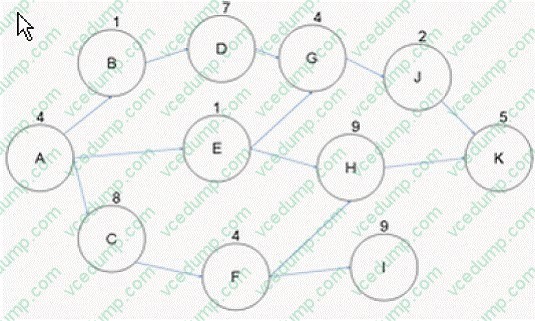
You are the project manager for the NGH project. The figure given below represents the small project you are completing for your organization.
How much float can you use on Activity G if Activity B actually takes eight days to complete?
A. Four B. Three C. Seven D. Zero
D. Zero
If Activity B uses seven days of float, which it can, it does not allow Activity D, G, or J to have any float available. This is because the total duration of path ABDGJK cannot exceed 30 days, the duration of the project. If Activity B uses the seven days of float, then the path meets the project's duration at Day 30. Answer options B and A are incorrect. These are not the valid calculation. Answer option C is incorrect. Seven represents the amount of float available on Activity G before Activity B uses the available float.
Question 167:
You are the project manager of a project that has a budget of $675,000 and you have completed 40 percent of the project work. Your project is supposed to be 60 percent complete but you are actually only 40 percent complete. Due to some errors, however, you have actually spent $335,000 of the budget. Management wants to know what the project's cost performance index (CPI) is. What value do you report?
A. -$135,000 B. .67 C. .81 D. -$65,000
C. .81
Cost performance index (CPI) is used to calculate performance efficiencies. It is used in trend analysis to predict future performance. CPI is the ratio of earned value to actual cost. The CPI is calculated based on the following formula: CPI = Earned Value (EV) / Actual Cost (AC) If the CPI value is greater than 1, it indicates better than expected performance, whereas if the value is less than 1, it shows poor performance. The CPI value of 1 indicates that the project is right on target. In this instances it is $270,000 divided by $335,000 for a CPI of .81. Answer option B is incorrect. .67 is actually the schedule performance index. Answer option D is incorrect. -$65,000 is the cost variance for the project. Answer option A is incorrect. -$135,000 is the schedule variance of the project.
Question 168:
You are the project manager of the JKM Project for your organization. Your project is supposed to be 60 percent complete but you are only 45 percent complete. The project has an assigned budget of $765,000 but you have already spent $365,000 to reach this point in the project due to some errors and rework. Management is pressing you on when you'll complete the project and how much the project will likely cost based on the current performance. You need to tell management what the project's current cost performance index (CPI) is. What value should you report to management based on your project's performance?
A. $306,000 B. .94 C. $344,250 D. .75
B. .94
Management wants to know the cost performance index (CPI). You can find the CPI by first finding the earned value (EV) and then dividing it by the actual costs (AC) spent to date on the project. You find EV by multiplying percent complete by the project's budget; in this instance that's $344,250. The actual costs are reported as $365,000. The formula for the CPI on this project is $344,250 / $365,000 for a value of .94. What is CPI? Cost performance index (CPI) is used to calculate performance efficiencies. It is used in trend analysis to predict future performance. CPI is the ratio of earned value to actual cost. The CPI is calculated based on the following formula: CPI = Earned Value (EV) / Actual Cost (AC) If the CPI value is greater than 1, it indicates better than expected performance, whereas if the value is less than 1, it shows poor performance. The CPI value of 1 indicates that the project is right on target. What is BCWP (or EV)? Budgeted cost of work performed (BCWP) or Earned Value (EV) is the value of completed work. It is the budgeted amount for the work actually completed on the schedule activity during a given time period. Answer options C, A, and D are incorrect. These do not reflect an accurate value for the project's cost performance index. The project is performing moderately well on cost as the closer the CPI is to 1 the better the project's performance.
Question 169:
You work as a project manager for BlueWell Inc. You are going through a project with your project team. Some of your project team members are reporting that their activities are running late because there are lag times between activities that do not need to be there. You examine the schedule and see that the lag times have been incorporated into the project schedule for quality control reviews. You also learn that the quality control reviews are not being completed as planned. What is the best approach in this scenario?
A. Since the quality control inspections are not being completed, remove the lag time from the project. B. Take corrective action and determine when the quality control inspection has happened so far in the project, perform quality control on the deliverables where the inspection was skipped, and ensure that quality control will happen from this point forward. C. Since the quality control inspections are not being completed, take corrective action and ensure that the inspections continue from this point forward. D. Discuss with the project team that the lag times should not affect the project schedule because they were built into the project schedule to begin with. Even if the quality control inspections were happening the time was allotted in the schedule for the inspections.
B. Take corrective action and determine when the quality control inspection has happened so far in the project, perform quality control on the deliverables where the inspection was skipped, and ensure that quality control will happen from this point forward.
The best answer is to make certain quality control happens in the project. This means reviewing past work and ensuring that future inspections are met.
Answer option A is incorrect. Removing the lag time does not solve the problem. It actually removes quality control requirements.
Answer option C is incorrect. Only inspecting future work for quality control ignores potential past quality issues in the project.
Answer option D is incorrect. While this answer is technically correct, it does not address the quality faults that may be creeping into the project deliverables.
Question 170:
You are the project manager for your organization. You have recorded the following duration estimates for an activity in your project: optimistic 20, most likely 45, pessimistic 90. What time will you record for this activity?
A. 48 B. 20o, 45m, 90p C. 90 D. 45
A. 48
This is an example of a three-point estimate. A three-point estimate records the optimistic, most likely, and the pessimistic duration, and then records an average for the predicted duration Three-point estimate is a way to enhance the
accuracy of activity duration estimates. This concept is originated with the Program Evaluation and Review Technique (PERT). PERT charts the following three estimates:
Most likely (TM): The duration of activity based on realistic factors such as resources assigned, interruptions, etc.
Optimistic (TO): The activity duration based on the best-case scenario Pessimistic (TP): The activity duration based on the worst-case scenario The expected (TE) activity duration is a weighted average of these three estimates: TE = (TO + 4TM + TP) / 6 Duration estimates based on the above equations (sometimes simple average of the three estimates is also used) provide more accuracy. It can be calculated as follows: TE = ( 20 + 45*4 + 90) / 6 = 290/6 =48 Answer options B, C, and D are incorrect. These are not the valid answers for this question.
Nowadays, the certification exams become more and more important and required by more and more
enterprises when applying for a job. But how to prepare for the exam effectively? How to prepare
for the exam in a short time with less efforts? How to get a ideal result and how to find the
most reliable resources? Here on Vcedump.com, you will find all the answers.
Vcedump.com provide not only PMI exam questions,
answers and explanations but also complete assistance on your exam preparation and certification
application. If you are confused on your PMI-SP exam preparations
and PMI certification application, do not hesitate to visit our
Vcedump.com to find your solutions here.