Which CLI command is used to verify the high availability state of a Palo Alto Networks firewall?
Show answer and explanation
Correct answer: C
PCNSC Real Exam Questions
141 questions available · Page 1 of 15
Updated Exam DumpsVerified AnswersPass Guarantee
Which CLI command is used to verify the high availability state of a Palo Alto Networks firewall?
Correct answer: C
Winch three steps will reduce the CPU utilization on the management plane? (Choose three. )
Correct answers: A, B, C
When a malware-infected host attempts to resolve a known command-and-control server, the traffic matches a security policy with DNS sinhole enabled, generating a traffic log.
What will be the destination IP Address in that log entry?
Correct answer: C
https://live.paloaltonetworks.com/t5/Management-Articles/How-to-Verify-DNS-Sinkhole-Function-is-Working/ta-p/65864
What is the purpose of the WildFire Analysis Profile in a security policy?
Correct answer: A
What will be the egress interface if the traffic's ingress interface is Ethernet 1/6 sourcing form 192.168.11.3
and to the destination 10.46.41.113.during the.
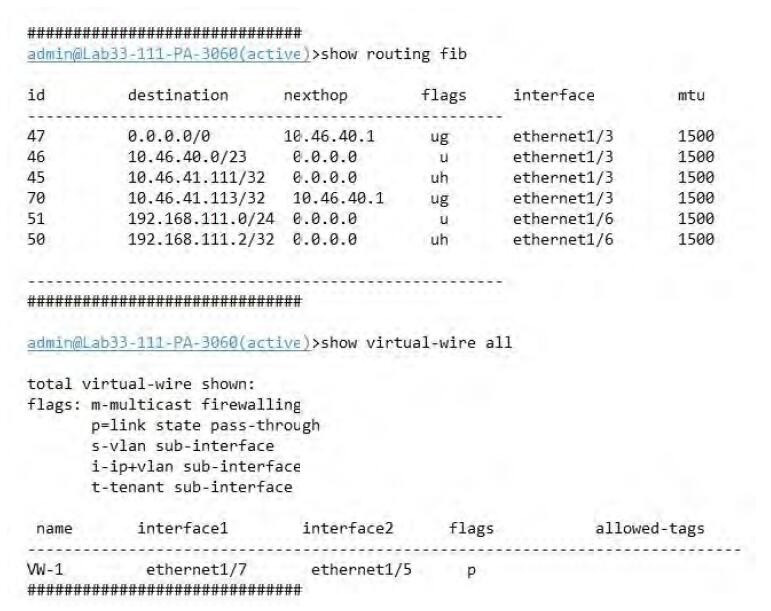
Correct answer: C
DRAG DROP
In Panorama the web interface displays the security rules in evaluation order Organize the security rules m the order in which they will be evaluated?
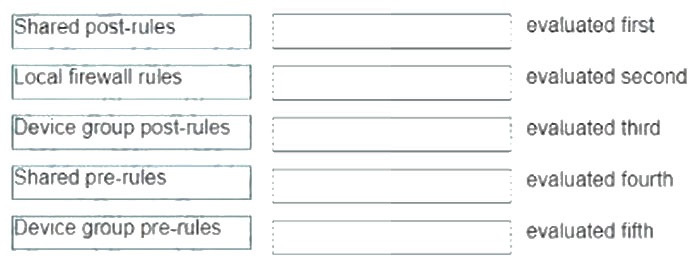
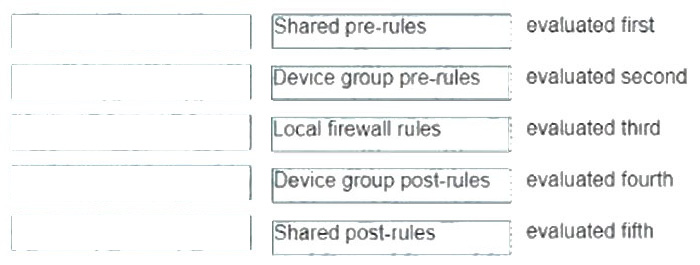
In Panorama, security rules are evaluated in a specific order to determine which rule applies to the traffic.
The correct evaluation order is as follows: Shared pre-rules(evaluated first)
Device group pre-rules(evaluated second)
Local firewall rules(evaluated third)
Device group post-rules(evaluated fourth)
Shared post-rules(evaluated fifth)
This order ensures that the most generic rules (shared across all devices) are evaluated first, followed by more specific rules at the device group and local firewall levels, and then the post-rules.
References:
Palo Alto Networks - Panorama Admin Guide: (https://docs.paloaltonetworks.com/panorama/10-0/panorama-admin/policy/policy-precedence-and-evaluation-order)
Palo Alto Networks - Security Policy Evaluation: (https://knowledgebase.paloaltonetworks.com)
In High Availability, which information is transferred via the HA data link?
Correct answer: C
In Panorama, what is the correct order of precedence for security policies?
Correct answer: C
An administrator has enabled OSPF on a virtual router on the NGFW OSPF is not adding new routes to the virtual router.
Which two options enable the administrator top troubleshoot this issue? (Choose two.)
Correct answers: B, D
A firewall administrator has been asked to configure a Palo Alto Networks NGFW to prevent against compromised hosts trying to phone-number or bacon out to eternal command-and-control (C2) servers.
Which Security Profile type will prevent these behaviors?
Correct answer: D