OAT Real Exam Questions

Optometry Admission

274 questions available · Page 1 of 28

Updated Exam DumpsVerified AnswersPass Guarantee

Get Complete Exam Dumps
Question 1 Single choice

5 friends just got hired for a job. 4 of them will earn $12 an hour, and the fifth person will earn $3 more than the average of all five salaries.

How much does the fifth person make?

  1. A

    $13

  2. B

    $13.75

  3. C

    $14.25

  4. D

    $15

  5. E

    $15.75

Show answer and explanation

Correct answer: E

Explanation

Solve this algebraically. Solve for x (amount fifth person gets paid). x = [((4 x 12) + x) / 5] + 3
5x = 48 + x + 15
5x = 63 + x
4x = 63
x = 15.75

The 5th friend makes $15.75. This can be confirmed by adding up all 5 people's pay and finding the average: (12 + 12 + 12 + 12 + 15.75) / 5 = 12.75.

$15.75 is $3 higher than the average of $12.75
Question 2 Single choice

A 1-gallon bottle containing 20% apple juice is mixed with a 2-gallon bottle containing 30% apple juice.

What is the percentage of apple juice in the 3-gallon mixture?

  1. A

    23%

  2. B

    27%

  3. C

    30%

  4. D

    50%

  5. E

    59%

Show answer and explanation

Correct answer: B

Explanation

This question can be solved in numerous ways. If 1 gallon has 20% apple juice, it means apple juice consists of 0.2 gallons. If the 2 gallon has 30% apple juice, it means apple juice consists of 0.6 gallons.
Thus, there are a total of 0.8 gallons of apple juice in the mixture of the total 3 gallons.

Find the percentage: (0.8 gallons of apple juice / 3 total gallons) x 100 = ~27%

Question 3 Single choice

Which of the following functions in regulating and allowing chyme to pass from the stomach to the duodenum of the small intestine?

  1. A

    Cardiac sphincter

  2. B

    Pyloric sphincter

  3. C

    Ileocecal sphincter

  4. D

    Esophageal sphincter

  5. E

    Sphincter of Oddi

Show answer and explanation

Correct answer: B

Explanation

Pyloric sphincter is indeed the function that the question describes. Sphincter of Oddi functions in allowing digestive juices (bile) through the hepatopancreatic duct. Cardiac sphincter functions between the esophagus and the stomach, preventing stomach juice (acid) from coming up the esophagus. The Ileocecal sphincter borders the small and large intestine, preventing contents from the colon spilling back into the ileum (small intestine). The esophageal sphincter functions in opening to allow food from the mouth to enter the esophagus. It is very important to know and understand the functions of these main sphincters in the body.

Question 4 Single choice

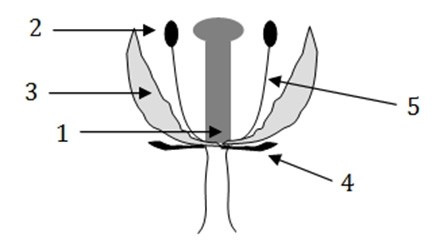
The structures composed solely of diploid cells:

  1. A

    1, 2, and 3

  2. B

    3, 4, and 5

  3. C

    1, 4, and 5

  4. D

    2, 3, and 4

  5. E

    1, 2, and 4

Show answer and explanation

Correct answer: B

Explanation

In flowering plants, the anthers house the male gametophytes (which produce sperm) and the pistils house the female gametophytes (which produce eggs). Eggs and sperm are haploid. All other tissues are solely diploid.

Question 5 Single choice

A bowling ball with a mass of 4 kilograms moving at a speed of 10 meters per second hits a stationary 1 kg bowling ball in a head-on elastic collision.

What is the speed of the stationary ball after the collision?

  1. A

    0 m/s

  2. B

    10 m/s

  3. C

    Less than 10 m/s, but not 0 m/s

  4. D

    More than 10 m/s

Show answer and explanation

Correct answer: D

Explanation

Since this is a head-on elastic collision, you could use conservation of kinetic energy and momentum to actually solve this problem. However, in this case, you only need to think through the answers to arrive at a correct conclusion. Clearly the ball after it's struck won't be going 0 m/s. And since this is an elastic collision, and it is hit by a much larger ball, it must be going faster than the larger ball was originally moving. Therefore, the ball will be moving at more than 10 m/s. If this were an inelastic collision where the balls stuck together, the ball would final velocity would be less than 10 m/s.

Question 6 Single choice

Which of the following possesses the highest ionization energy?

  1. A

    Lithium

  2. B

    Carbon

  3. C

    Nitrogen

  4. D

    Sodium

  5. E

    Fluorine

Show answer and explanation

Correct answer: E

Explanation

Ionization energy increases as you go right and up in the periodic table. Fluorine is the right and upper-most choice.

Question 7 Single choice

A joule is equal to:

  1. A

    (kg x m) / s

  2. B

    kg2/s3

  3. C

    (kg x m2) / s2

  4. D

    m/s3

  5. E

    N x m4

Show answer and explanation

Correct answer: C

Explanation

A joule is indeed equal to this. Joule, the unit of work, can be identified as equal to force x distance.

Force (in newtons), is equal to mass x acceleration.

Mass = kg
Acceleration = m/s2
Distance = m

Thus, combining all these terms by multiplying them: kg x (m/s2) x m = (kg x m2) / s2

Question 8 Single choice

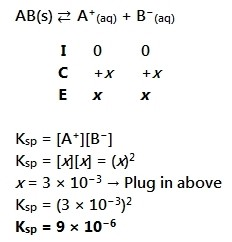
The molar solubility of an hypothetical salt, AB, is 3.0 x 10⁻³. Find the Ksp

  1. A

    27 x 10-9

  2. B

    9 x 10⁻⁶

  3. C

    6 x 10⁻³

  4. D

    1.5 x 10⁻³

  5. E

    3.0 x 10⁻³

Show answer and explanation

Correct answer: B

Explanation
Question 9 Single choice

Which statement best explains why the work done by a gravitational force on an object does not depend on the path the object takes?

  1. A

    Work depends on the path when there is friction. The longer the path the more energy is required to overcome friction.

  2. B

    Gravitational fields that arise from the interaction between point masses always produce elliptical paths of motion.

  3. C

    A falling object experiences a change in potential energy.

  4. D

    When an object falls down the work done by gravity is positive and when an object is thrown up the work done by gravity is negative.

Show answer and explanation

Correct answer: C

Explanation

To determine how much work is done by a gravitational force, you should calculate the change in that object's potential energy = mgh, where m = mass, g = the gravitational acceleration 9.8 m/s2 and h = height. Therefore, the work done only depends on the change in height and not on the path taken. In Answer [Work depends on the path when...], the work done by gravity doesn't have anything to do with friction, so this is not a good explanation. Friction is a separate force.
Answer [When an object falls down...], although true, doesn't explain why the work doesn't depend on the path.

Question 10 Single choice

A ray of light traveling in the air strikes water (n = 1.33).
In which direction does the light bend?

  1. A

    Towards the normal.

  2. B

    Away from the normal.

  3. C

    It will not bend.

  4. D

    It depends on the angle of refraction.

  5. E

    Need more information to solve this problem.

Show answer and explanation

Correct answer: A

Explanation

Since light is going from a lower index of refraction (n) to a higher index of refraction, it will always bends towards the normal.