MULESOFT-INTEGRATION-ARCHITECT-I Exam Details
-
Exam Code
:MULESOFT-INTEGRATION-ARCHITECT-I -
Exam Name
:Salesforce Certified MuleSoft Platform Integration Architect (Mule-Arch-202) -
Certification
:Salesforce Certifications -
Vendor
:Salesforce -
Total Questions
:273 Q&As -
Last Updated
:May 29, 2026
Salesforce MULESOFT-INTEGRATION-ARCHITECT-I Online Questions & Answers
-
Question 121:
An organization designing a hybrid, load balanced, single cluster production environment. Due to performance service level agreement goals, it is looking into running the Mule applications in an active-active multi node cluster configuration.
What should be considered when running its Mule applications in this type of environment?
A. All event sources, regardless of time , can be configured as the target source by the primary node in the cluster
B. An external load balancer is required to distribute incoming requests throughout the cluster nodes
C. A Mule application deployed to multiple nodes runs in an isolation from the other nodes in the cluster
D. Although the cluster environment is fully installed configured and running, it will not process any requests until an outage condition is detected by the primary node in the cluster. -
Question 122:
A REST API is being designed to implement a Mule application.
What standard interface definition language can be used to define REST APIs?
A. Web Service Definition Language(WSDL)
B. OpenAPI Specification (OAS)
C. YAML
D. AsyncAPI Specification -
Question 123:
An API has been unit tested and is ready for integration testing. The API is governed by a Client ID Enforcement policy in all environments.
What must the testing team do before they can start integration testing the API in the Staging environment?
A. They must access the API portal and create an API notebook using the Client ID and Client Secret supplied by the API portal in the Staging environment
B. They must request access to the API instance in the Staging environment and obtain a Client ID and Client Secret to be used for testing the API
C. They must be assigned as an API version owner of the API in the Staging environment
D. They must request access to the Staging environment and obtain the Client ID and Client Secret for that environment to be used for testing the API -
Question 124:
What is an example of data confidentiality?
A. Signing a file digitally and sending it using a file transfer mechanism
B. Encrypting a file containing personally identifiable information (PV)
C. Providing a server's private key to a client for secure decryption of data during a two-way SSL handshake
D. De-masking a person's Social Security number while inserting it into a database -
Question 125:
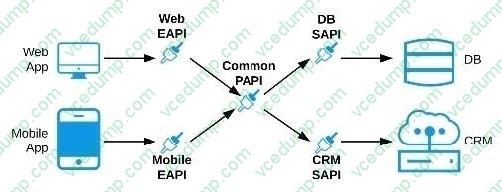
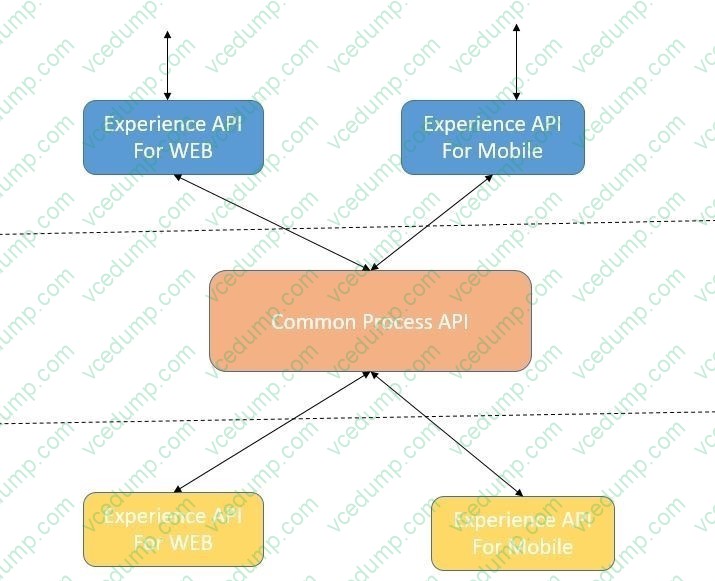
An organization needs to enable access to their customer data from both a mobile app and a web application, which each need access to common fields as well as certain unique fields. The data is available partially in a database and partially in a 3rd-party CRM system. What APIs should be created to best fit these design requirements?
A. A Process API that contains the data required by both the web and mobile apps, allowing these applications to invoke it directly and access the data they need thereby providing the flexibility to add more fields in the future without needing API changes.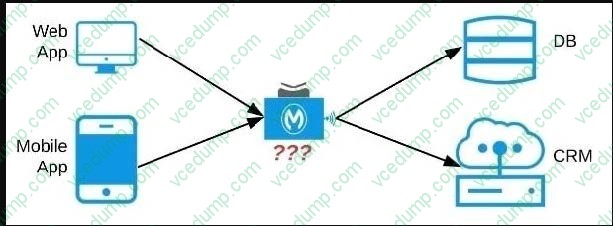
B. One set of APIs (Experience API, Process API, and System API) for the web app, and another set for the mobile app.
C. Separate Experience APIs for the mobile and web app, but a common Process API that invokes separate System APIs created for the database and CRM system
D. A common Experience API used by both the web and mobile apps, but separate Process APIs for the web and mobile apps that interact with the database and the CRM System. -
Question 126:
According to MuleSoft, which system integration term describes the method, format, and protocol used for communication between two system?
A. Component
B. interaction
C. Message
D. Interface -
Question 127:
Refer to the exhibit.
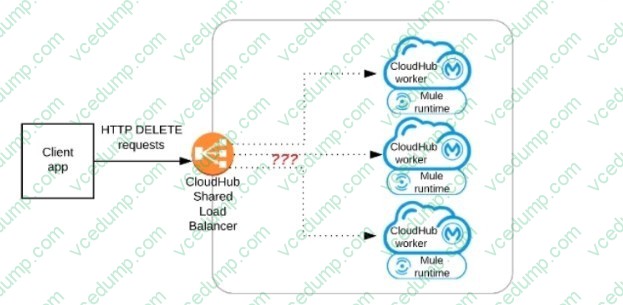
A Mule application has an HTTP Listener that accepts HTTP DELETE requests. This Mule application Is deployed to three CloudHub workers under the control of the CloudHub Shared Load Balancer.
A web client makes a sequence of requests to the Mule application's public URL.
How is this sequence of web client requests distributed among the HTTP Listeners running in the three CloudHub workers?
A. Each request is routed to the PRIMARY CloudHub worker in the PRIMARY Availability Zone (AZ)
B. Each request is routed to ONE ARBiTRARY CloudHub worker in the PRIMARY Availability Zone (AZ)
C. Each request Is routed to ONE ARBiTRARY CloudHub worker out of ALL three CloudHub workers
D. Each request is routed (scattered) to ALL three CloudHub workers at the same time -
Question 128:
Refer to the exhibit.
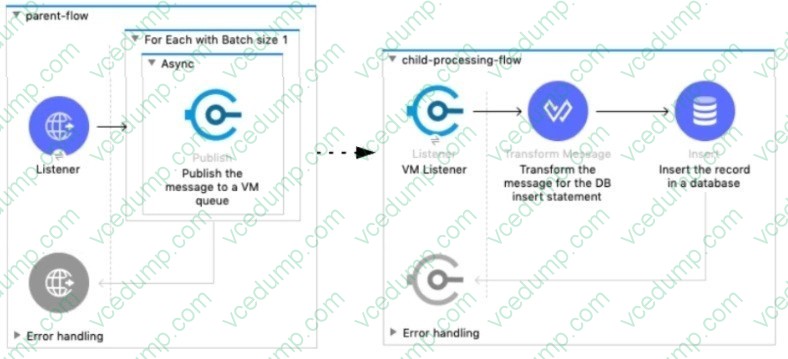
A Mule 4 application has a parent flow that breaks up a JSON array payload into 200 separate items, then sends each item one at a time inside an Async scope to a VM queue.
A second flow to process orders has a VM Listener on the same VM queue. The rest of this flow processes each received item by writing the item to a database.
This Mule application is deployed to four CloudHub workers with persistent queues enabled.
What message processing guarantees are provided by the VM queue and the CloudHub workers, and how are VM messages routed among the CloudHub workers for each invocation of the parent flow under normal operating conditions where all the CloudHub workers remain online?
A. EACH item VM message is processed AT MOST ONCE by ONE CloudHub worker, with workers chosen in a deterministic round-robin fashion Each of the four CloudHub workers can be expected to process 1/4 of the Item VM messages (about 50 items)
B. EACH item VM message is processed AT LEAST ONCE by ONE ARBITRARY CloudHub worker Each of the four CloudHub workers can be expected to process some item VM messages
C. ALL Item VM messages are processed AT LEAST ONCE by the SAME CloudHub worker where the parent flow was invoked This one CloudHub worker processes ALL 200 item VM messages
D. ALL item VM messages are processed AT MOST ONCE by ONE ARBITRARY CloudHub worker This one CloudHub worker processes ALL 200 item VM messages -
Question 129:
Refer to the exhibit.
An organization is designing a Mule application to receive data from one external business partner. The two companies currently have no shared IT infrastructure and do not want to establish one. Instead, all communication should be over the public internet (with no VPN).
What Anypoint Connector can be used in the organization's Mule application to securely receive data from this external business partner?
A. File connector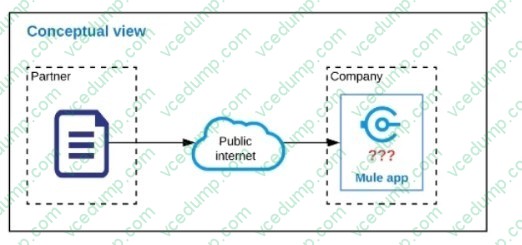
B. VM connector
C. SFTP connector
D. Object Store connector -
Question 130:
Which role is primarily responsible for building API implementation as part of a typical MuleSoft integration project?
A. API Developer
B. API Designer
C. Integration Architect
D. Operations
Related Exams:
-
201-COMMERCIAL-BANKING-FUNCTIONAL
Salesforce enCino 201 Commercial Banking Functional -
ADM-201
Salesforce Certified Platform Administrator (Plat-Admn-201) -
ADM-211
Administration Essentials for Experienced Admin (ADM-211) -
ADM-261
Service Cloud Administration (SU24) -
ADVANCED-ADMINISTRATOR
Salesforce Certified Advanced Administrator -
ADVANCED-CROSS-CHANNEL
Marketing Cloud Advanced Cross Channel Accredited Professional -
ADX-201
Administrative Essentials for New Admins in Lightning Experience -
ADX-271
Salesforce Certified Community Cloud Consultant (ADX-271) -
AGENTFORCE-SPECIALIST
Salesforce Certified Agentforce Specialist (AI-201) -
ALS-CON-201
Salesforce Certified Agentforce Life Sciences Consultant
Tips on How to Prepare for the Exams
Nowadays, the certification exams become more and more important and required by more and more enterprises when applying for a job. But how to prepare for the exam effectively? How to prepare for the exam in a short time with less efforts? How to get a ideal result and how to find the most reliable resources? Here on Vcedump.com, you will find all the answers. Vcedump.com provide not only Salesforce exam questions, answers and explanations but also complete assistance on your exam preparation and certification application. If you are confused on your MULESOFT-INTEGRATION-ARCHITECT-I exam preparations and Salesforce certification application, do not hesitate to visit our Vcedump.com to find your solutions here.