MULESOFT-INTEGRATION-ARCHITECT-I Exam Details
-
Exam Code
:MULESOFT-INTEGRATION-ARCHITECT-I -
Exam Name
:Salesforce Certified MuleSoft Platform Integration Architect (Mule-Arch-202) -
Certification
:Salesforce Certifications -
Vendor
:Salesforce -
Total Questions
:273 Q&As -
Last Updated
:May 29, 2026
Salesforce MULESOFT-INTEGRATION-ARCHITECT-I Online Questions & Answers
-
Question 141:
What Is a recommended practice when designing an integration Mule 4 application that reads a large XML payload as a stream?
A. The payload should be dealt with as a repeatable XML stream, which must only be traversed (iterated-over) once and CANNOT be accessed randomly from DataWeave expressions and scripts
B. The payload should be dealt with as an XML stream, without converting it to a single Java object (POJO)
C. The payload size should NOT exceed the maximum available heap memory of the Mute runtime on which the Mule application executes
D. The payload must be cached using a Cache scope If It Is to be sent to multiple backend systems -
Question 142:
An organization currently uses a multi-node Mule runtime deployment model within their datacenter, so each Mule runtime hosts several Mule applications. The organization is planning to transition to a deployment model based on Docker containers in a Kubernetes cluster. The organization has already created a standard Docker image containing a Mule runtime and all required dependencies (including a JVM), but excluding the Mule application itself.
What is an expected outcome of this transition to container-based Mule application deployments?
A. Required redesign of Mule applications to follow microservice architecture principles
B. Required migration to the Docker and Kubernetes-based Anypoint Platform -Private Cloud Edition
C. Required change to the URL endpoints used by clients to send requests to the Mule applications
D. Guaranteed consistency of execution environments across all deployments of a Mule application -
Question 143:
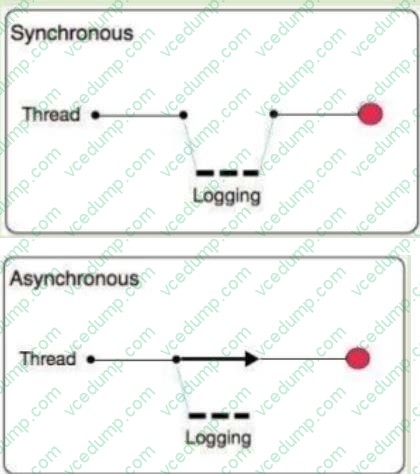
What is a key difference between synchronous and asynchronous logging from Mule applications?
A. Synchronous logging writes log messages in a single logging thread but does not block the Mule event being processed by the next event processor
B. Asynchronous logging can improve Mule event processing throughput while also reducing the processing time for each Mule event
C. Asynchronous logging produces more reliable audit trails with more accurate timestamps
D. Synchronous logging within an ongoing transaction writes log messages in the same thread that processes the current Mule event -
Question 144:
In preparation for a digital transformation initiative, an organization is reviewing related IT integration projects that failed for various for reason.
According to MuleSoft's surveys of global IT leaders, what is a common cause of IT project failure that this organization may likely discover in its assessment?
A. Following an Agile delivery methodology
B. Reliance on an Integration-Platform-as-a-Service (iPaaS)
C. Spending too much time on enablement
D. Lack of alignment around business outcomes -
Question 145:
A travel company wants to publish a well-defined booking service API to be shared with its business partners. These business partners have agreed to ONLY consume SOAP services and they want to get the service contracts in an easily consumable way before they start any development. The travel company will publish the initial design documents to Anypoint Exchange, then share those documents with the business partners.
When using an API-led approach, what is the first design document the travel company should deliver to its business partners?
A. Create a WSDL specification using any XML editor
B. Create a RAML API specification using any text editor
C. Create an OAS API specification in Design Center
D. Create a SOAP API specification in Design Center -
Question 146:
An organization is designing an integration Mule application to process orders by submitting them to a back-end system for offline processing. Each order will be received by the Mule application through an HTTPS POST and must be acknowledged immediately. Once acknowledged, the order will be submitted to a back-end system. Orders that cannot be successfully submitted due to rejections from the back-end system will need to be processed manually (outside the back-end system).
The Mule application will be deployed to a customer-hosted runtime and is able to use an existing ActiveMQ broker if needed. The ActiveMQ broker is located inside the organization's firewall. The back-end system has a track record of unreliability due to both minor network connectivity issues and longer outages.
What idiomatic (used for their intended purposes) combination of Mule application components and ActiveMQ queues are required to ensure automatic submission of orders to the back-end system while supporting but minimizing manual order processing?
A. An Until Successful scope to call the back-end system One or more ActiveMQ long-retry queues One or more ActiveMQ dead-letter queues for manual processing
B. One or more On Error scopes to assist calling the back-end system An Until Successful scope containing VM components for long retries A persistent dead-letter VM queue configured in CloudHub
C. One or more On Error scopes to assist calling the back-end system One or more ActiveMQ long-retry queues A persistent dead-letter object store configured in the CloudHub Object Store service
D. A Batch Job scope to call the back-end system An Until Successful scope containing Object Store components for long retries A dead-letter object store configured in the Mule application -
Question 147:
A Mule application currently writes to two separate SQL Server database instances across the internet using a single XA transaction. It is 58. proposed to split this one transaction into two separate non-XA transactions with no other changes to the Mule application.
What non-functional requirement can be expected to be negatively affected when implementing this change?
A. Throughput
B. Consistency
C. Response time
D. Availability -
Question 148:
In Anypoint Platform, a company wants to configure multiple identity providers(Idps) for various lines of business (LOBs) Multiple business groups and environments have been defined for the these LOBs. What Anypoint Platform feature can use multiple Idps access the company's business groups and environment?
A. User management
B. Roles and permissions
C. Dedicated load balancers
D. Client Management -
Question 149:
According to MuleSoft, which deployment characteristic applies to a microservices application architecture?
A. Services exist as independent deployment artifacts and can be scaled -independently of other services
B. All services of an application can be deployed together as single Java WAR file
C. A deployment to enhance one capability requires a redeployment of all capabilities
D. Core business capabilities are encapsulated in a single, deployable application -
Question 150:
An organization is designing Mule application which connects to a legacy backend. It has been reported that backend services are not highly available and experience downtime quite often. As an integration architect which of the below approach you would propose to achieve high reliability goals?
A. Alerts can be configured in Mule runtime so that backend team can be communicated when services are down
B. Until Successful scope can be implemented while calling backend API's
C. On Error Continue scope to be used to call in case of error again
D. Create a batch job with all requests being sent to backend using that job as per the availability of backend API's
Related Exams:
-
201-COMMERCIAL-BANKING-FUNCTIONAL
Salesforce enCino 201 Commercial Banking Functional -
ADM-201
Salesforce Certified Platform Administrator (Plat-Admn-201) -
ADM-211
Administration Essentials for Experienced Admin (ADM-211) -
ADM-261
Service Cloud Administration (SU24) -
ADVANCED-ADMINISTRATOR
Salesforce Certified Advanced Administrator -
ADVANCED-CROSS-CHANNEL
Marketing Cloud Advanced Cross Channel Accredited Professional -
ADX-201
Administrative Essentials for New Admins in Lightning Experience -
ADX-271
Salesforce Certified Community Cloud Consultant (ADX-271) -
AGENTFORCE-SPECIALIST
Salesforce Certified Agentforce Specialist (AI-201) -
ALS-CON-201
Salesforce Certified Agentforce Life Sciences Consultant
Tips on How to Prepare for the Exams
Nowadays, the certification exams become more and more important and required by more and more enterprises when applying for a job. But how to prepare for the exam effectively? How to prepare for the exam in a short time with less efforts? How to get a ideal result and how to find the most reliable resources? Here on Vcedump.com, you will find all the answers. Vcedump.com provide not only Salesforce exam questions, answers and explanations but also complete assistance on your exam preparation and certification application. If you are confused on your MULESOFT-INTEGRATION-ARCHITECT-I exam preparations and Salesforce certification application, do not hesitate to visit our Vcedump.com to find your solutions here.