MULESOFT-INTEGRATION-ARCHITECT-I Exam Details
-
Exam Code
:MULESOFT-INTEGRATION-ARCHITECT-I -
Exam Name
:Salesforce Certified MuleSoft Platform Integration Architect (Mule-Arch-202) -
Certification
:Salesforce Certifications -
Vendor
:Salesforce -
Total Questions
:273 Q&As -
Last Updated
:May 29, 2026
Salesforce MULESOFT-INTEGRATION-ARCHITECT-I Online Questions & Answers
-
Question 111:
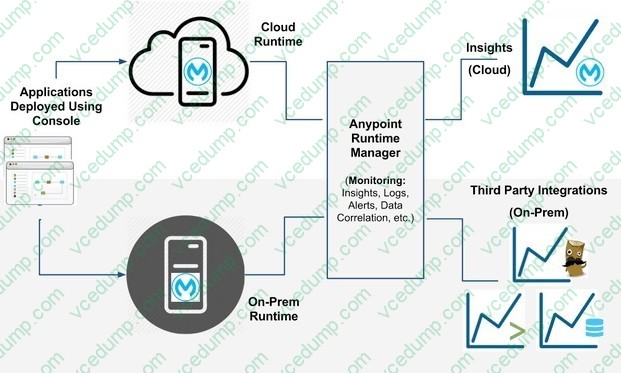
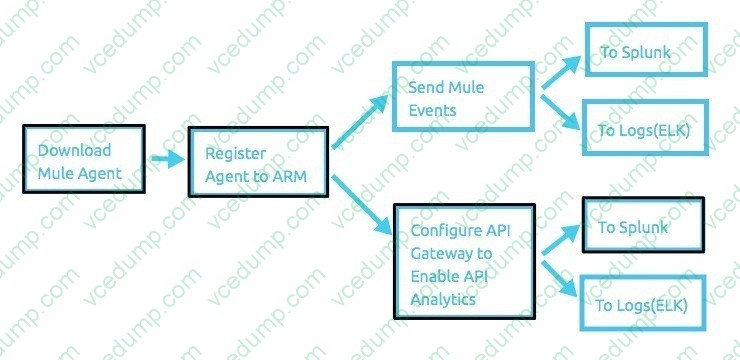
An organization uses Mule runtimes which are managed by Anypoint Platform -Private Cloud Edition. What MuleSoft component is responsible for feeding analytics data to non-MuleSoft analytics platforms?
A. Anypoint Exchange
B. The Mule runtimes
C. Anypoint API Manager
D. Anypoint Runtime Manager -
Question 112:
An airline is architecting an API connectivity project to integrate its flight data into an online aggregation website. The interface must allow for secure communication high-performance and asynchronous message exchange.
What are suitable interface technologies for this integration assuming that Mulesoft fully supports these technologies and that Anypoint connectors exist for these interfaces?
A. AsyncAPI over HTTPS AMQP with RabbitMQ JSON/REST over HTTPS
B. XML over ActiveMQ XML over SFTP XML/REST over HTTPS
C. CSV over FTP YAM L over TLS JSON over HTTPS
D. SOAP over HTTPS HOP over TLS gRPC over HTTPS -
Question 113:
An insurance company has an existing API which is currently used by customers. API is deployed to customer hosted Mule runtime cluster. The load balancer that is used to access any APIs on the mule cluster is only configured to point to applications hosted on the server at port 443.
Mule application team of a company attempted to deploy a second API using port 443 but the application will not start and checking logs shows an error indicating the address is already in use.
Which steps must the organization take to resolve this error and allow customers to access both the API's?
A. Change the base path of the HTTP listener configuration in the second API to a different one from the first API
B. Set HTTP listener configuration in both API's to allow for connections from multiple ports
C. Move the HTTP listener configurations from the API's and package them in a mule domain project using port 443
D. Set the HTTP listener of the second API to use different port than the one used in the first API -
Question 114:
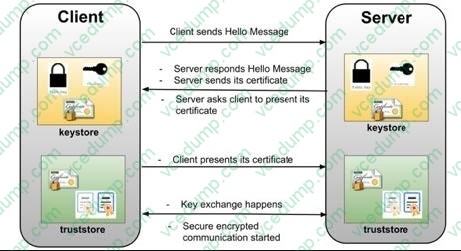
What requires configuration of both a key store and a trust store for an HTTP Listener?
A. Support for TLS mutual (two-way) authentication with HTTP clients
B. Encryption of requests to both subdomains and API resource endpoints fhttPs://aDi.customer.com/ and https://customer.com/api)
C. Encryption of both HTTP request and HTTP response bodies for all HTTP clients
D. Encryption of both HTTP request header and HTTP request body for all HTTP clients -
Question 115:
A global, high-volume shopping Mule application is being built and will be deployed to CloudHub. To improve performance, the Mule application uses a Cache scope that maintains cache state in a CloudHub object store. Web clients will access the Mule application over HTTP from all around the world, with peak volume coinciding with business hours in the web client's geographic location. To achieve optimal performance, what Anypoint Platform region should be chosen for the CloudHub object store?
A. Choose the same region as to where the Mule application is deployed
B. Choose the US-West region, the only supported region for CloudHub object stores
C. Choose the geographically closest available region for each web client
D. Choose a region that is the traffic-weighted geographic center of all web clients -
Question 116:
A mule application designed to fulfil two requirements
1.
Processing files are synchronously from an FTPS server to a back-end database using VM intermediary queues for load balancing VM events
2.
Processing a medium rate of records from a source to a target system using batch job scope
Considering the processing reliability requirements for FTPS files, how should VM queues be configured for processing files as well as for the batch job scope if the application is deployed to Cloudhub workers?
A. Use Cloud hub persistent queues for FTPS files processing There is no need to configure VM queues for the batch jobs scope as it uses by default the worker's disc for VM queueing
B. Use Cloud hub persistent VM queue for FTPS file processing There is no need to configure VM queues for the batch jobs scope as it uses by default the worker's JVM memory for VM queueing
C. Use Cloud hub persistent VM queues for FTPS file processing Disable VM queue for the batch job scope
D. Use VM connector persistent queues for FTPS file processing Disable VM queue for the batch job scope -
Question 117:
An automation engineer needs to write scripts to automate the steps of the API lifecycle, including steps to create, publish, deploy and manage APIs and their implementations in Anypoint Platform.
What Anypoint Platform feature can be used to automate the execution of all these actions in scripts in the easiest way without needing to directly invoke the Anypoint Platform REST APIs?
A. Automated Policies in API Manager
B. Runtime Manager agent
C. The Mule Maven Plugin
D. Anypoint CLI -
Question 118:
What operation can be performed through a JMX agent enabled in a Mule application?
A. View object store entries
B. Replay an unsuccessful message
C. Set a particular tog4J2 log level to TRACE
D. Deploy a Mule application -
Question 119:
A company is designing an integration Mule application to process orders by submitting them to a back-end system for offline processing. Each order will be received by the Mule application through an HTTP5 POST and must be acknowledged immediately.
Once acknowledged the order will be submitted to a back-end system. Orders that cannot be successfully submitted due to the rejections from the back-end system will need to be processed manually (outside the banking system).
The mule application will be deployed to a customer hosted runtime and will be able to use an existing ActiveMQ broker if needed. The ActiveMQ broker is located inside the organization's firewall. The back-end system has a track record of unreliability due to both minor network connectivity issues and longer outages.
Which combination of Mule application components and ActiveMQ queues are required to ensure automatic submission of orders to the back-end system while supporting but minimizing manual order processing?
A. One or more On Error scopes to assist calling the back-end system An Untill successful scope containing VM components for long retries A persistent dead-letter VM queue configure in Cloud hub
B. An Until Successful scope to call the back-end system One or more ActiveMQ long-retry queues One or more ActiveMQ dead-letter queues for manual processing
C. One or more on-Error scopes to assist calling the back-end system one or more ActiveMQ long-retry queues A persistent dead-letter Object store configuration in the CloudHub object store service
D. A batch job scope to call the back in system An Untill successful scope containing Object Store components for long retries. A dead-letter object store configured in the Mule application -
Question 120:
A Mule application is being designed for deployment to a single CloudHub worker. The Mule application will have a flow that connects to a SaaS system to perform some operations each time the flow is invoked.
The SaaS system connector has operations that can be configured to request a short-lived token (fifteen minutes) that can be reused for subsequent connections within the fifteen minute time window. After the token expires, a new token must be requested and stored. What is the most performant and idiomatic (used for its intended purpose) Anypoint Platform component or service to use to support persisting and reusing tokens in the Mule application to help speed up reconnecting the Mule application to the SaaS application?
A. Nonpersistent object store
B. Persistent object store
C. Variable
D. Database
Related Exams:
-
201-COMMERCIAL-BANKING-FUNCTIONAL
Salesforce enCino 201 Commercial Banking Functional -
ADM-201
Salesforce Certified Platform Administrator (Plat-Admn-201) -
ADM-211
Administration Essentials for Experienced Admin (ADM-211) -
ADM-261
Service Cloud Administration (SU24) -
ADVANCED-ADMINISTRATOR
Salesforce Certified Advanced Administrator -
ADVANCED-CROSS-CHANNEL
Marketing Cloud Advanced Cross Channel Accredited Professional -
ADX-201
Administrative Essentials for New Admins in Lightning Experience -
ADX-271
Salesforce Certified Community Cloud Consultant (ADX-271) -
AGENTFORCE-SPECIALIST
Salesforce Certified Agentforce Specialist (AI-201) -
ALS-CON-201
Salesforce Certified Agentforce Life Sciences Consultant
Tips on How to Prepare for the Exams
Nowadays, the certification exams become more and more important and required by more and more enterprises when applying for a job. But how to prepare for the exam effectively? How to prepare for the exam in a short time with less efforts? How to get a ideal result and how to find the most reliable resources? Here on Vcedump.com, you will find all the answers. Vcedump.com provide not only Salesforce exam questions, answers and explanations but also complete assistance on your exam preparation and certification application. If you are confused on your MULESOFT-INTEGRATION-ARCHITECT-I exam preparations and Salesforce certification application, do not hesitate to visit our Vcedump.com to find your solutions here.