MULESOFT-INTEGRATION-ARCHITECT-I Exam Details
-
Exam Code
:MULESOFT-INTEGRATION-ARCHITECT-I -
Exam Name
:Salesforce Certified MuleSoft Platform Integration Architect (Mule-Arch-202) -
Certification
:Salesforce Certifications -
Vendor
:Salesforce -
Total Questions
:273 Q&As -
Last Updated
:May 29, 2026
Salesforce MULESOFT-INTEGRATION-ARCHITECT-I Online Questions & Answers
-
Question 131:
An application deployed to a runtime fabric environment with two cluster replicas is designed to periodically trigger of flow for processing a high-volume set of records from the source system and synchronize with the SaaS system using the Batch job scope
After processing 1000 records in a periodic synchronization of 1 lakh records, the replicas in which batch job instance was started went down due to unexpected failure in the runtime fabric environment
What is the consequence of losing the replicas that run the Batch job instance?
A. The remaining 99000 records will be lost and left and processed
B. The second replicas will take over processing the remaining 99000 records
C. A new replacement replica will be available and will be process all 1,00,000 records from scratch leading to duplicate record processing
D. A new placement replica will be available and will take or processing the remaining 99,000 records -
Question 132:
A Mule application uses APIkit for SOAP to implement a SOAP web service. The Mule application has been deployed to a CloudHub worker in a testing environment.
The integration testing team wants to use a SOAP client to perform Integration testing. To carry out the integration tests, the integration team must obtain the interface definition for the SOAP web service.
What is the most idiomatic (used for its intended purpose) way for the integration testing team to obtain the interface definition for the deployed SOAP web service in order to perform integration testing with the SOAP client?
A. Retrieve the OpenAPI Specification file(s) from API Manager
B. Retrieve the WSDL file(s) from the deployed Mule application
C. Retrieve the RAML file(s) from the deployed Mule application
D. Retrieve the XML file(s) from Runtime Manager -
Question 133:
A DevOps team has adequate observability of individual system behavior and performance, but it struggles to track the entire lifecycle of each request across different microservices.
Which additional observability approach should this team consider adopting?
A. Analytics
B. Metrics
C. Tracing
D. Data mining -
Question 134:
Which type of communication is managed by a service mesh in a microservices architecture?
A. Communication between microservices runtime administrators
B. Communication between microservices developers
C. Communication between microservices
D. Communication between trading partner services -
Question 135:
Refer to the exhibit.
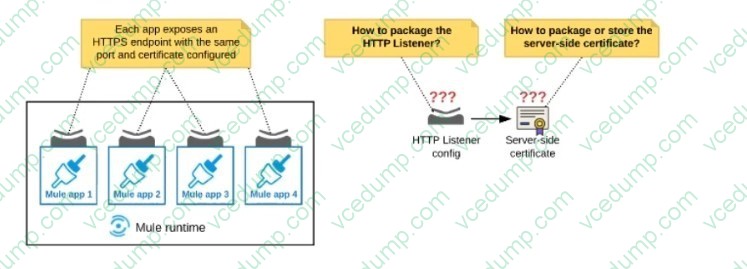
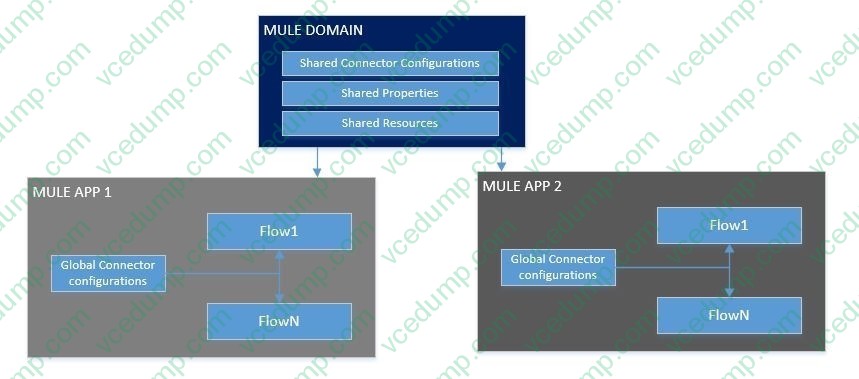
An organization deploys multiple Mule applications to the same customer -hosted Mule runtime. Many of these Mule applications must expose an HTTPS endpoint on the same port using a server-side certificate that rotates often.
What is the most effective way to package the HTTP Listener and package or store the server-side certificate when deploying these Mule applications, so the disruption caused by certificate rotation is minimized?
A. Package the HTTPS Listener configuration in a Mule DOMAIN project, referencing it from all Mule applications that need to expose an HTTPS endpoint Package the server-side certificate in ALL Mule APPLICATIONS that need to expose an HTTPS endpoint
B. Package the HTTPS Listener configuration in a Mule DOMAIN project, referencing it from all Mule applications that need to expose an HTTPS endpoint. Store the server-side certificate in a shared filesystem location in the Mule runtime's classpath, OUTSIDE the Mule DOMAIN or any Mule APPLICATION
C. Package an HTTPS Listener configuration In all Mule APPLICATIONS that need to expose an HTTPS endpoint Package the server-side certificate in a NEW Mule DOMAIN project
D. Package the HTTPS Listener configuration in a Mule DOMAIN project, referencing It from all Mule applications that need to expose an HTTPS endpoint. Package the server-side certificate in the SAME Mule DOMAIN project Go to Set -
Question 136:
A retail company is implementing a MuleSoft API to get inventory details from two vendors by Invoking each vendor's online applications. Due to network issues, the invocations to the vendor applications are timing out intermittently, but the requests are successful after re-invoking each vendor application.
What is the most performant way of implementing the API to invoke each vendor application and to retry invocations that generate timeout errors?
A. Use a For-Each scope to invoke the two vendor applications in series, one after the other. Place the For-Each scope inside an Until-Successful scope to retry requests that raise timeout errors.
B. Use a Choice scope to Invoke each vendor application on a separate route. Place the Choice scope inside an Until-Successful scope to retry requests that raise timeout errors.
C. Use a Scatter-Gather scope to invoke each vendor application on a separate route. Use an Until-Successful scope in each route to retry requests that raise timeout errors.
D. Use a Round-Robin scope to invoke each vendor application on a separate route. Use a Try-Catch scope in each route to retry requests that raise timeout errors. -
Question 137:
Refer to the exhibit.
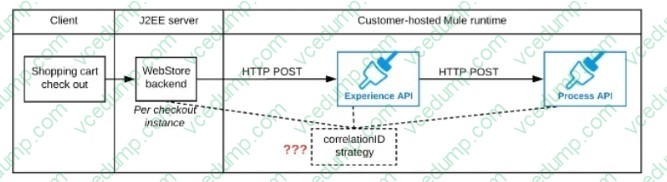
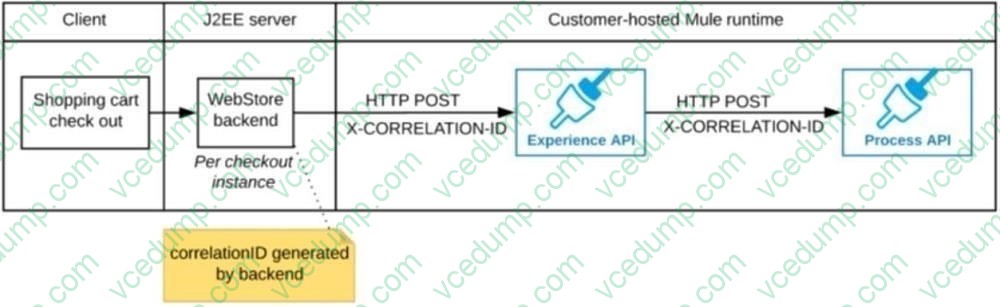
A shopping cart checkout process consists of a web store backend sending a sequence of API invocations to an Experience API, which in turn invokes a Process API. All API invocations are over HTTPS POST. The Java web store backend executes in a Java EE application server, while all API implementations are Mule applications executing in a customer -hosted Mule runtime.
End-to-end correlation of all HTTP requests and responses belonging to each individual checkout Instance is required. This is to be done through a common correlation ID, so that all log entries written by the web store backend, Experience API implementation, and Process API implementation include the same correlation ID for all requests and responses belonging to the same checkout instance.
What is the most efficient way (using the least amount of custom coding or configuration) for the web store backend and the implementations of the Experience API and Process API to participate in end-to-end correlation of the API invocations for each checkout instance?
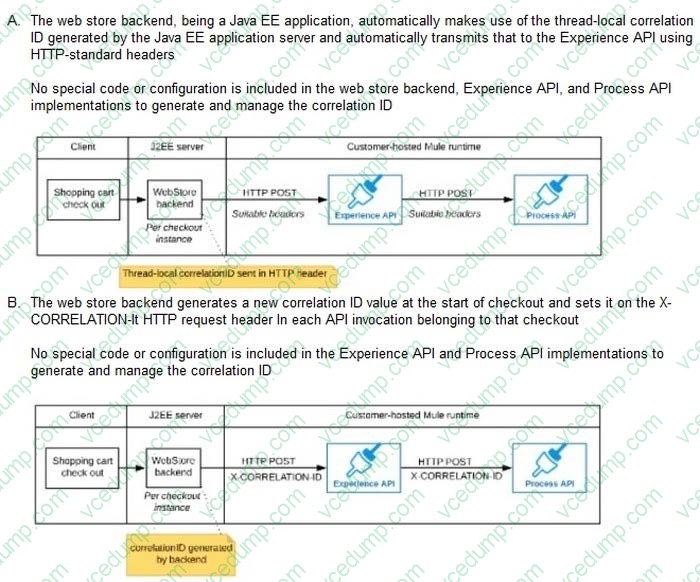
A. Option A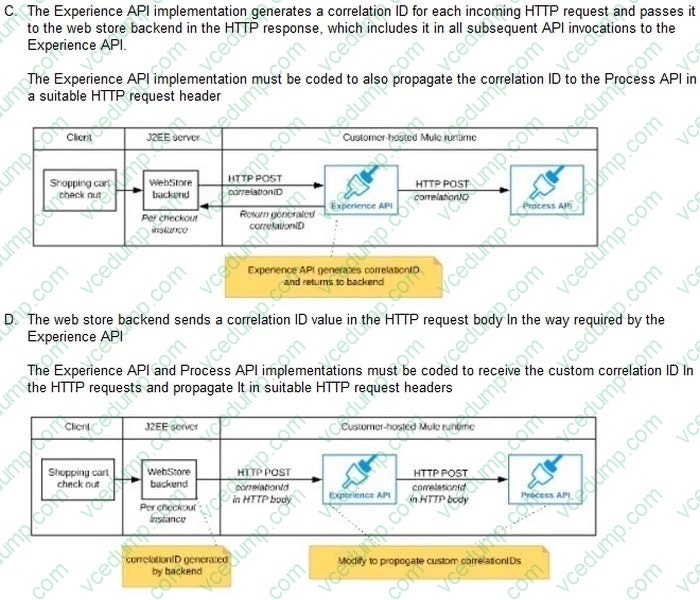
B. Option B
C. Option C
D. Option D -
Question 138:
A company is using Mulesoft to develop API's and deploy them to Cloudhub and on premises targets. Recently it has decided to enable Runtime Fabric deployment option as well and infrastructure is set up for this option.
What can be used to deploy Runtime Fabric?
A. AnypointCLI
B. Anypoint platform REST API's
C. Directly uploading ajar file from the Runtime manager
D. Mule maven plug-in -
Question 139:
As a part of design , Mule application is required call the Google Maps API to perform a distance computation. The application is deployed to cloudhub.
At the minimum what should be configured in the TLS context of the HTTP request configuration to meet these requirements?
A. The configuration is built-in and nothing extra is required for the TLS context
B. Request a private key from Google and create a PKCS12 file with it and add it in keyStore as a part of TLS context
C. Download the Google public certificate from a browser, generate JKS file from it and add it in key store as a part of TLS context
D. Download the Google public certificate from a browser, generate a JKS file from it and add it in Truststore as part of the TLS context -
Question 140:
Which Salesforce API is invoked to deploy, retrieve, create, update, or delete customization information, such as custom object definitions using Mule Salesforce Connectors in a Mule application?
A. sObject Platform Action API
B. User Interface API
C. Metadata API
D. Process Rules API
Related Exams:
-
201-COMMERCIAL-BANKING-FUNCTIONAL
Salesforce enCino 201 Commercial Banking Functional -
ADM-201
Salesforce Certified Platform Administrator (Plat-Admn-201) -
ADM-211
Administration Essentials for Experienced Admin (ADM-211) -
ADM-261
Service Cloud Administration (SU24) -
ADVANCED-ADMINISTRATOR
Salesforce Certified Advanced Administrator -
ADVANCED-CROSS-CHANNEL
Marketing Cloud Advanced Cross Channel Accredited Professional -
ADX-201
Administrative Essentials for New Admins in Lightning Experience -
ADX-271
Salesforce Certified Community Cloud Consultant (ADX-271) -
AGENTFORCE-SPECIALIST
Salesforce Certified Agentforce Specialist (AI-201) -
ALS-CON-201
Salesforce Certified Agentforce Life Sciences Consultant
Tips on How to Prepare for the Exams
Nowadays, the certification exams become more and more important and required by more and more enterprises when applying for a job. But how to prepare for the exam effectively? How to prepare for the exam in a short time with less efforts? How to get a ideal result and how to find the most reliable resources? Here on Vcedump.com, you will find all the answers. Vcedump.com provide not only Salesforce exam questions, answers and explanations but also complete assistance on your exam preparation and certification application. If you are confused on your MULESOFT-INTEGRATION-ARCHITECT-I exam preparations and Salesforce certification application, do not hesitate to visit our Vcedump.com to find your solutions here.