MULESOFT-INTEGRATION-ARCHITECT-I Exam Details
-
Exam Code
:MULESOFT-INTEGRATION-ARCHITECT-I -
Exam Name
:Salesforce Certified MuleSoft Platform Integration Architect (Mule-Arch-202) -
Certification
:Salesforce Certifications -
Vendor
:Salesforce -
Total Questions
:273 Q&As -
Last Updated
:May 29, 2026
Salesforce MULESOFT-INTEGRATION-ARCHITECT-I Online Questions & Answers
-
Question 101:
Refer to the exhibit.
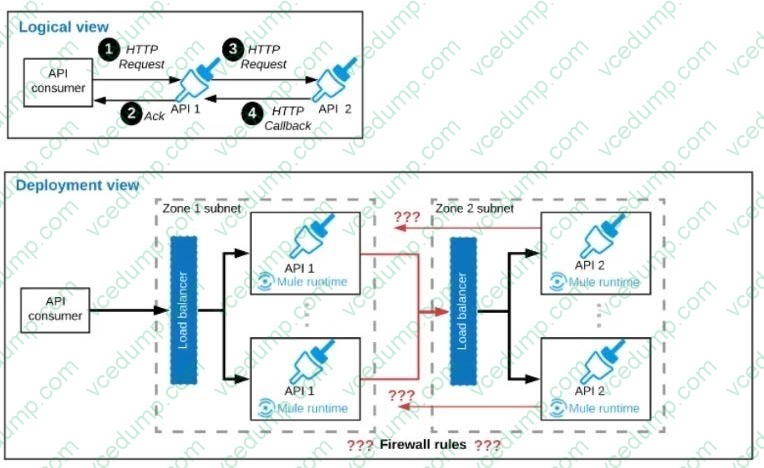
A business process involves two APIs that interact with each other asynchronously over HTTP. Each API is implemented as a Mule application. API 1 receives the initial HTTP request and invokes API 2 (in a fire and forget fashion) while API 2, upon completion of the processing, calls back into API l to notify about completion of the asynchronous process.
Each API Is deployed to multiple redundant Mule runtimes and a separate load balancer, and is deployed to a separate network zone.
In the network architecture, how must the firewall rules be configured to enable the above Interaction between API 1 and API 2?
A. To authorize the certificate to be used both APIs
B. To enable communication from each API's Mule Runtimes and Network zone to the load balancer of the other API
C. To open direct two-way communication between the Mule Runtimes of both API's
D. To allow communication between load balancers used by each API -
Question 102:
An organization has just developed a Mule application that implements a REST API. The mule application will be deployed to a cluster of customer hosted Mule runtimes.
What additional infrastructure component must the customer provide in order to distribute inbound API requests across the Mule runtimes of the cluster?
A. A message broker
B. An HTTP Load Balancer
C. A database
D. An Object Store -
Question 103:
Which productivity advantage does Anypoint Platform have to both implement and manage an AP?
A. Automatic API proxy generation
B. Automatic API specification generation
C. Automatic API semantic versioning
D. Automatic API governance -
Question 104:
A rale limiting policy has been applied to a soap VI.2 API published in Clondhub. The API implementation catches errors in a global error handler on error propagate in the main flow for HTTP: RETRY_EXHAUSTED with HTTP status set to 429 and any with the HTTP status set to 500.
What is the expected H1TP status when the client exceeds the quota of the API calls?
A. HTTP status 429 as defined in the HTTP:RETRY EXHAUSTED error handler in the API
B. HTTP status 500 as defined in the ANY error handler in the API since an API:RETRY_EXHAUSTED will be generated
C. HTTP status 401 unauthorized for policy violation
D. HTTP status 400 from the rate-limiting policy violation since the call does not reach the back-end -
Question 105:
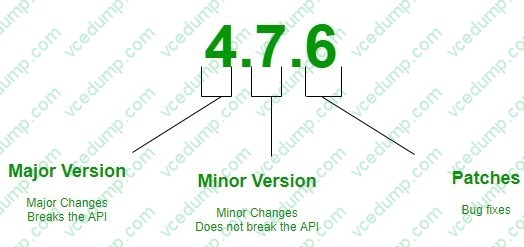
An API has been updated in Anypoint Exchange by its API producer from version 3.1.1 to 3.2.0 following accepted semantic versioning practices and the changes have been communicated via the API's public portal. The API endpoint does NOT change in the new version. How should the developer of an API client respond to this change?
A. The update should be identified as a project risk and full regression testing of the functionality that uses this API should be run.
B. The API producer should be contacted to understand the change to existing functionality.
C. The API producer should be requested to run the old version in parallel with the new one.
D. The API client code ONLY needs to be changed if it needs to take advantage of new features. -
Question 106:
A company wants its users to log in to Anypoint Platform using the company's own internal user credentials. To achieve this, the company needs to integrate an external identity provider (IdP) with the company's Anypoint Platform master organization, but SAML 2.0 CANNOT be used. Besides SAML 2.0, what single-sign-on standard can the company use to integrate the IdP with their Anypoint Platform master organization?
A. SAML 1.0
B. OAuth 2.0
C. Basic Authentication
D. OpenID Connect -
Question 107:
A new Mule application under development must implement extensive data transformation logic. Some of the data transformation functionality is already available as external transformation services that are mature and widely used across the organization; the rest is highly specific to the new Mule application.
The organization follows a rigorous testing approach, where every service and application must be extensively acceptance tested before it is allowed to go into production.
What is the best way to implement the data transformation logic for this new Mule application while minimizing the overall testing effort?
A. Implement and expose all transformation logic as mlaoservices using DataWeave, so it can be reused by any application component that needs it, including the new Mule application
B. Implement transformation logic in the new Mute application using DataWeave, replicating the transformation logic of existing transformation services
C. Extend the existing transformation services with new transformation logic and Invoke them from the new Mule application
D. Implement transformation logic in the new Mute application using DataWeave, invoking existing transformation services when possible -
Question 108:
A MuteSoft developer must implement an API as a Mule application, run the application locally, and execute unit tests against the Running application.
Which Anypoint Platform component can the developer use to full all of these requirements?
A. API Manager
B. API Designer
C. Anypoint CLI
D. Anypoint Studio -
Question 109:
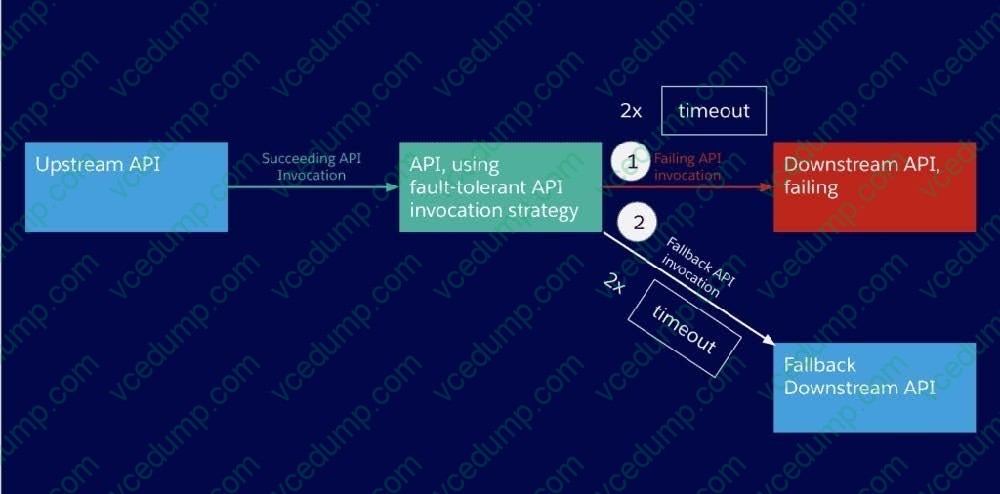
An API implementation is being designed that must invoke an Order API which is known to repeatedly experience downtime. For this reason a fallback API is to be called when the Order API is unavailable. What approach to designing invocation of the fallback API provides the best resilience?
A. Redirect client requests through an HTTP 303 temporary redirect status code to the fallback API whenever the Order API is unavailable
B. Set an option in the HTTP Requester component that invokes the order API to instead invoke a fallback API whenever an HTTP 4XX or 5XX response status code is received from Order API
C. Create a separate entry for the order API in API manager and then invoke this API as a fallback API if the primary Order API is unavailable
D. Search Anypoint Exchange for a suitable existing fallback API and them implement invocations to their fallback API in addition to the Order API -
Question 110:
An organization has implemented a continuous integration (CI) lifecycle that promotes Mule applications through code, build, and test stages. To standardize the organization's CI journey, a new dependency control approach is being designed to store artifacts that include information such as dependencies, versioning, and build promotions. To implement these process improvements, the organization will now require developers to maintain all dependencies related to Mule application code in a shared location.
What is the most idiomatic (used for its intended purpose) type of system the organization should use in a shared location to standardize all dependencies related to Mule application code?
A. A MuleSoft-managed repository at repository.mulesoft.org
B. A binary artifact repository
C. API Community Manager
D. The Anypoint Object Store service at cloudhub.io
Related Exams:
-
201-COMMERCIAL-BANKING-FUNCTIONAL
Salesforce enCino 201 Commercial Banking Functional -
ADM-201
Salesforce Certified Platform Administrator (Plat-Admn-201) -
ADM-211
Administration Essentials for Experienced Admin (ADM-211) -
ADM-261
Service Cloud Administration (SU24) -
ADVANCED-ADMINISTRATOR
Salesforce Certified Advanced Administrator -
ADVANCED-CROSS-CHANNEL
Marketing Cloud Advanced Cross Channel Accredited Professional -
ADX-201
Administrative Essentials for New Admins in Lightning Experience -
ADX-271
Salesforce Certified Community Cloud Consultant (ADX-271) -
AGENTFORCE-SPECIALIST
Salesforce Certified Agentforce Specialist (AI-201) -
ALS-CON-201
Salesforce Certified Agentforce Life Sciences Consultant
Tips on How to Prepare for the Exams
Nowadays, the certification exams become more and more important and required by more and more enterprises when applying for a job. But how to prepare for the exam effectively? How to prepare for the exam in a short time with less efforts? How to get a ideal result and how to find the most reliable resources? Here on Vcedump.com, you will find all the answers. Vcedump.com provide not only Salesforce exam questions, answers and explanations but also complete assistance on your exam preparation and certification application. If you are confused on your MULESOFT-INTEGRATION-ARCHITECT-I exam preparations and Salesforce certification application, do not hesitate to visit our Vcedump.com to find your solutions here.