MCIA-LEVEL1 Exam Details
-
Exam Code
:MCIA-LEVEL1 -
Exam Name
:MuleSoft Certified Integration Architect - Level 1 -
Certification
:Mulesoft Certifications -
Vendor
:Mulesoft -
Total Questions
:290 Q&As -
Last Updated
:Jul 08, 2026
Mulesoft MCIA-LEVEL1 Online Questions & Answers
-
Question 281:
An airline is architecting an API connectivity project to integrate its flight data into an online aggregation website. The interface must allow for secure communication high-performance and asynchronous message exchange.
What are suitable interface technologies for this integration assuming that Mulesoft fully supports these technologies and that Anypoint connectors exist for these interfaces?
A. AsyncAPI over HTTPS AMQP with RabbitMQ JSON/REST over HTTPS
B. XML over ActiveMQ XML over SFTP XML/REST over HTTPS
C. CSV over FTP YAM L over TLS JSON over HTTPS
D. SOAP over HTTPS HOP over TLS gRPC over HTTPS -
Question 282:
Which Anypoint Platform component is responsible for enforcing runtime API policies such as rate limiting and client ID enforcement?
A. Anypoint Studio
B. Runtime Manager
C. API Manager
D. Anypoint Exchange -
Question 283:
An organization plans to migrate all its Mule applications to Runtime Fabric (RTF). Currently, all Mule applications have been deployed to CloudHub using automated CI/CD scripts. What steps should be taken to properly migrate the applications from CloudHub to RTF, while keeping the same automated CI/CD deployment strategy?
A. A runtimeFabric dependency should be added as a mule-plugin to the pom.xml file in all the Mule applications.
B. A runtimeFabric command-line parameter should be added to the CI/CD deployment scripts.
C. A runtimeFabricDeployment profile should be added to Mule configuration properties YAML files in all the Mule applications. CI/CD scripts must be modified to use the new configuration properties.
D. A runtimeFabricDeployment profile should be added to the pom.xml file in all the Mule applications. CI/CD scripts must be modified to use the new RTF profile.
E. The pom.xml and Mule configuration YAML files can remain unchanged in each Mule application. A --runtimeFabric command-line parameter should be added to the CI/CD deployment scripts. -
Question 284:
What aspects of a CI/CD pipeline for Mule applications can be automated using MuleSoft- provided Maven plugins?
A. Compile, package, unit test, validate unit test coverage, deploy
B. Compile, package, unit test, deploy, integration test (Incorrect)
C. Compile, package, unit test, deploy, create associated API instances in API Manager
D. Import from API designer, compile, package, unit test, deploy, publish to Anypoint Exchange -
Question 285:
What condition requires using a CloudHub Dedicated Load Balancer?
A. When cross-region load balancing is required between separate deployments of the same Mule application
B. When custom DNS names are required for API implementations deployed to customer- hosted Mule runtimes
C. When API invocations across multiple CloudHub workers must be load balanced
D. When server-side load-balanced TLS mutual authentication is required between API implementations and API clients -
Question 286:
Refer to the exhibit.
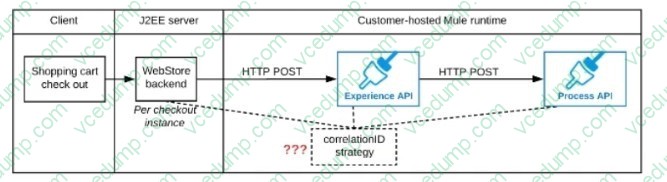
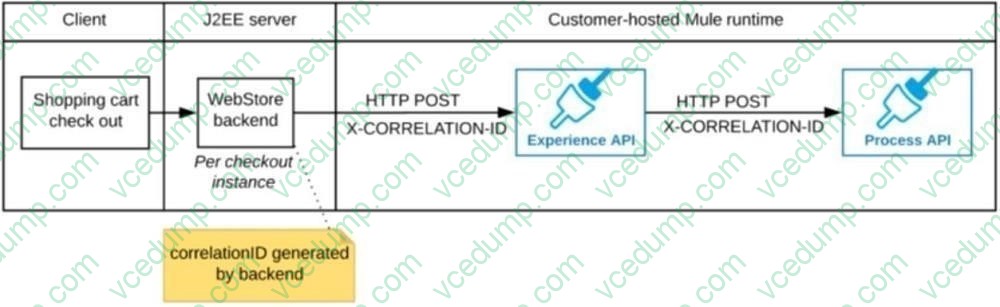
A shopping cart checkout process consists of a web store backend sending a sequence of API invocations to an Experience API, which in turn invokes a Process API. All API invocations are over HTTPS POST. The Java web store backend executes in a Java EE application server, while all API implementations are Mule applications executing in a customer -hosted Mule runtime.
End-to-end correlation of all HTTP requests and responses belonging to each individual checkout Instance is required. This is to be done through a common correlation ID, so that all log entries written by the web store backend, Experience API implementation, and Process API implementation include the same correlation ID for all requests and responses belonging to the same checkout instance.
What is the most efficient way (using the least amount of custom coding or configuration) for the web store backend and the implementations of the Experience API and Process API to participate in end-to-end correlation of the API invocations for each checkout instance?
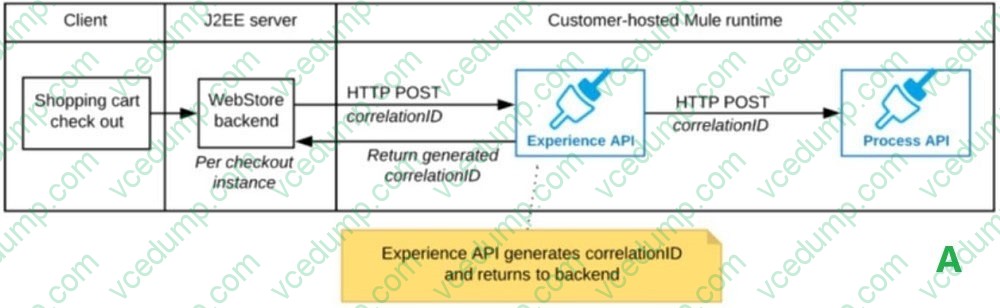
A. The Experience API implementation generates a correlation ID for each incoming HTTP request and passes it to the web store backend in the HTTP response, which includes it in all subsequent API invocations to the Experience API The Experience API implementation must be coded to also propagate the correlation ID to the Process API in a suitable HTTP request header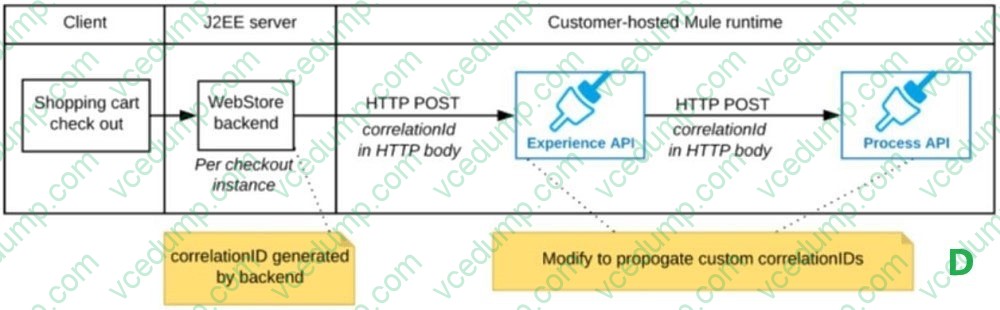
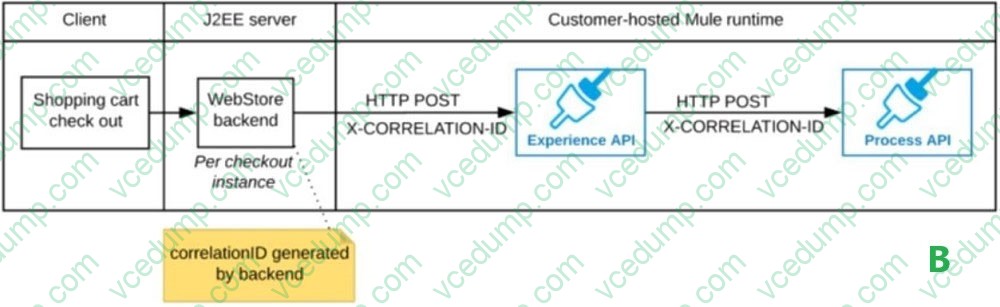
B. The web store backend generates a new correlation ID value at the start of checkout and sets it on the X-CORRELATION-ID HTTP request header in each API invocation belonging to that checkout No special code or configuration is included in the Experience API and Process API implementations to generate and manage the correlation ID
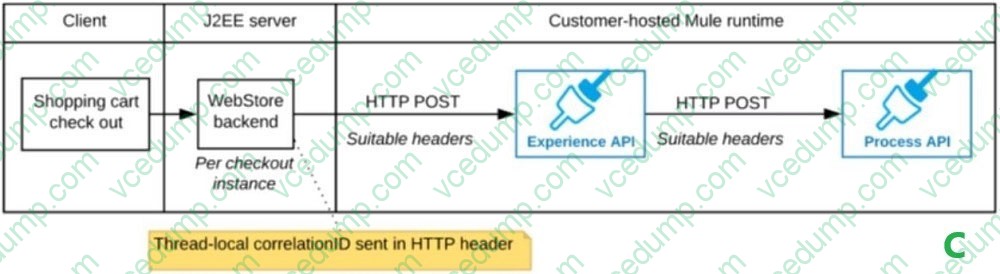
C. The web store backend, being a Java EE application, automatically makes use of the thread-local correlation ID generated by the Java EE application server and automatically transmits that to the Experience API using HTTP-standard headers No special code or configuration is included in the web store backend, Experience API, and Process API implementations to generate and manage the correlation ID
D. The web store backend sends a correlation ID value in the HTTP request body in the way required by the Experience API The Experience API and Process API implementations must be coded to receive the custom correlation ID in the HTTP requests and propagate it in suitable HTTP request headers -
Question 287:
What operation can be performed through a JMX agent enabled in a Mule application?
A. View object store entries
B. Replay an unsuccessful message
C. Set a particular tog4J2 log level to TRACE
D. Deploy a Mule application -
Question 288:
An organization is adopting API-led connectivity and wants to ensure that multiple teams can independently reuse backend capabilities without impacting each other. Which design principle best supports this goal when building System APIs?
A. Embedding business rules directly in the System API
B. Exposing backend systems through stable, contract-first APIs
C. Allowing direct database access to consuming applications
D. Implementing long-running transactions in the System API -
Question 289:
A stock trading company handles millions of trades a day and requires excellent performance and reliability within its stock trading system. The company operates a number of event-driven APIs Implemented as Mule applications that are hosted on various customer-hosted Mule clusters and needs to enable message exchanges between the APIs within their internal network using shared message queues. What is an effective way to meet the cross-cluster messaging requirements of its event-driven APIs?
A. Non-transactional JMS operations with a reliability pattern and manual acknowledgements
B. Persistent VM queues with automatic acknowledgements
C. JMS transactions with automatic acknowledgements
D. extended Architecture (XA) transactions and XA connected components with manual acknowledgements -
Question 290:
Refer to the exhibit.
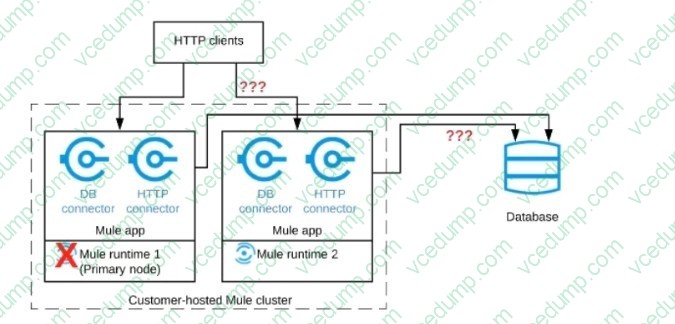
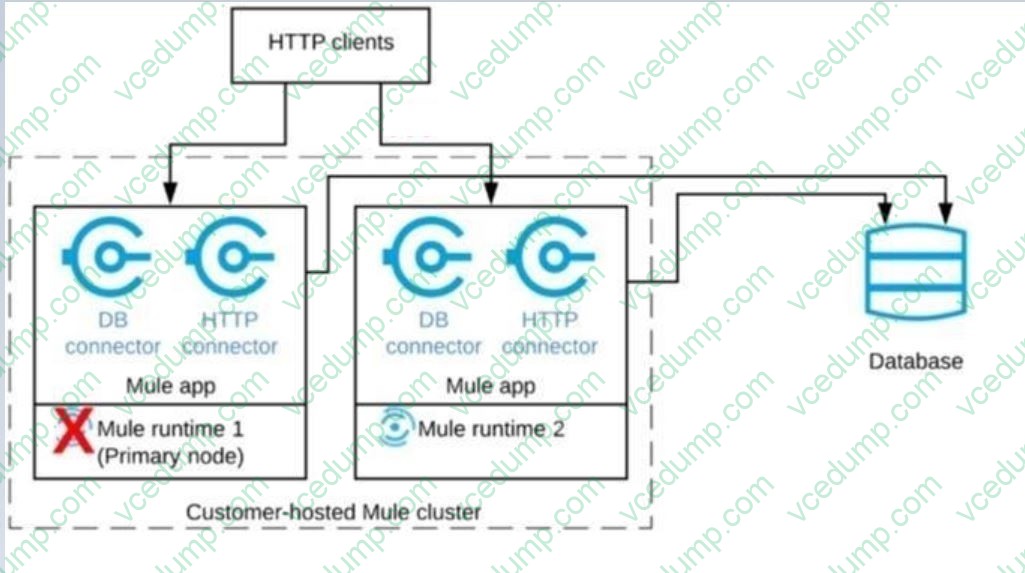
A Mule application is deployed to a cluster of two customer-hosted Mute runtimes. The Mute application has a flow that polls a database and another flow with an HTTP Listener.
HTTP clients send HTTP requests directly to individual cluster nodes.
What happens to database polling and HTTP request handling in the time after the primary (master) node of the cluster has railed, but before that node is restarted?
A. Database polling continues Only HTTP requests sent to the remaining node continue to be accepted
B. Database polling stops All HTTP requests continue to be accepted
C. Database polling continues All HTTP requests continue to be accepted, but requests to the failed node Incur increased latency
D. Database polling stops All HTTP requests are rejected

Related Exams:
-
MCD-ASSOC
MuleSoft Certified Developer - Integration and API Associate (Mule 3) -
MCD-LEVEL1
MuleSoft Certified Developer - Level 1 (Mule 4) -
MCD-LEVEL1-DELTA
MuleSoft Certified Developer - Level 1 (Mule 4) DELTA -
MCD-LEVEL2
MuleSoft Certified Developer - Level 2 (Mule 4) -
MCIA-LEVEL1
MuleSoft Certified Integration Architect - Level 1 -
MCIA-LEVEL1-MAINTENANCE
MuleSoft Certified Integration Architect - Level 1 MAINTENANCE -
MCPA-LEVEL1
MuleSoft Certified Platform Architect - Level 1 -
MCPA-LEVEL1-MAINTENANCE
MuleSoft Certified Platform Architect - Level 1 MAINTENANCE
Tips on How to Prepare for the Exams
Nowadays, the certification exams become more and more important and required by more and more enterprises when applying for a job. But how to prepare for the exam effectively? How to prepare for the exam in a short time with less efforts? How to get a ideal result and how to find the most reliable resources? Here on Vcedump.com, you will find all the answers. Vcedump.com provide not only Mulesoft exam questions, answers and explanations but also complete assistance on your exam preparation and certification application. If you are confused on your MCIA-LEVEL1 exam preparations and Mulesoft certification application, do not hesitate to visit our Vcedump.com to find your solutions here.